
You're doing everything right, and still, the phone rings with news you didn't expect. A child who had started to settle in, a nursery that finally felt ready, a stack of court papers waiting for the next step, then suddenly, the placement is in trouble. That kind of moment can feel crushing, especially when you've already attached your heart to the idea of becoming a family.
In Texas, that painful event has a name. Adoption disruption means an adoptive placement ends after a child has been placed in the home but before the adoption is legally finalized. Texas policy materials note that national disruption estimates are much higher than Texas's average, while Texas's average disruption rate has been reported at 2% to 3.5%, compared with broader national estimates of 10% to 25% (Texas Senate presentation). That doesn't make disruption painless, but it does mean most Texas adoptive placements do reach the finish line.
The hardest part for many families is the emotional whiplash. One day, you're planning a lifetime. The next, you're trying to understand whether the child is safe, who makes the next decision, and what the law says about the future. Families in this position need compassion, clear information, and immediate legal guidance, not blame.

For families still in the paperwork and visitation stage, post-placement visits often feel like one more hurdle. They matter because they help the court and the agency see whether the placement is stable before finalization. You can read more about that process in our guide to post-placement visits required before Texas adoption finalization.
When an Adoption Placement Falls Apart Before Finalization
A couple may spend months getting ready. They complete training, clear background checks, childproof the house, and learn how to work around nap schedules, trauma triggers, or sibling dynamics. Then the child arrives, and the day-to-day reality is harder than anyone expected. The child may need more support than the family can safely provide, or the placement may show that this match is not stable for the long term.
That is the human side of Texas adoption disruption before finalization. The placement has not yet become permanent through a final court order, so the breakdown happens inside the adoption process itself, before the judge signs the decree.
What the law means in plain English
Before finalization, the child is living with the prospective adoptive family, but the court has not entered the final adoption decree. That distinction matters because the case is still open, and the next step may involve the agency, the court, or child welfare authorities deciding whether the placement should continue. In legal terms, disruption is a recognized event within the adoption process. In human terms, it is a painful change that can affect everyone involved without turning the situation into a judgment about whether the adults cared enough.
Practical rule: a disruption is the placement ending before the final order, not a verdict on a family's love or effort.
Texas has a reputation for comparatively lower disruption numbers than the broader national estimates often cited in child welfare discussions. That context matters for hopeful parents, birth parents, and relatives, because it shows that most Texas adoptions still move forward even when the risk of a breakdown is real.
For families still in the paperwork and visitation stage, post-placement visits required before Texas adoption finalization often feel like one more checkpoint. They give the court and the agency a chance to see whether the placement is holding together before finalization.
Disruption vs Dissolution in Texas Adoption Law
These two terms get mixed up often, and the confusion can add unnecessary stress to an already painful process. In Texas, they describe different stages, different court questions, and different legal consequences. A simple way to keep them straight is this, disruption happens before finalization, dissolution happens after finalization (Texas Family Adoption).
Side-by-side comparison
| Factor | Disruption Before Finalization | Dissolution After Finalization |
|---|---|---|
| Legal stage | The child is placed, but the judge has not signed the final decree | The judge has already signed the final adoption decree |
| Child's legal status | The adoption is still pending | The child is already legally adopted |
| Main court issue | Whether the placement should continue or end | Whether the final decree can be challenged or undone |
| Procedural pressure | Immediate placement and safety decisions | A narrower challenge process, with a limited filing window |
| Practical focus | Next placement, support, and child welfare | Court relief, legal grounds, and the child's best interests |
The final decree changes everything because Texas Family Code Chapter 162 draws a firm procedural line. Under § 162.012, a challenge to a final adoption decree generally must be filed within six months of entry, unless an exception like fraud or lack of jurisdiction applies (Texas adoption challenge overview). Before that decree, the case is still open and the court can still act on the placement. After it, the legal path narrows quickly.
For families, “almost finished” and “finalized” are not the same thing. Before finalization, the court is still deciding whether the child's home can become permanent. After finalization, Texas treats the parent-child relationship as complete, so the questions shift from placement stability to whether a completed decree can be attacked and on what grounds.
A consent problem can also change the analysis before finalization. If there is a concern that a birth parent's agreement was not valid, families often need to examine what makes an adoption consent invalid in Texas before the court can move the case to a final order.
That distinction matters in ordinary family life too. A stepparent may already be doing the work of a parent, but the legal relationship is still unfinished until the court signs the decree. A case like that follows the same rule, the relationship may feel real in the home, yet the law still treats the adoption as pending.
A quick way to remember it
- Disruption, the placement stops before the final order.
- Dissolution, the adoption is already finalized, and a legal challenge comes later.
- The finalization date is the dividing line that changes the whole case.
Common Causes of Adoption Disruption in Texas
Age is one of the clearest patterns in the research. A literature review of classic U.S. studies reported disruption rates of 4.7% for children ages 3-5, 10.4% for ages 6-8, 17.1% for ages 9-11, 22.4% for ages 12-14, and 26.1% for ages 15-18 (Adoption Council literature review). The takeaway is simple, older children face a much higher risk of disruption than younger children, especially when the match, services, or expectations aren't strong enough.
What usually makes placements unstable
Research and Texas policy materials point to a cluster of recurring issues, not just one cause. Behavioral or emotional challenges can overwhelm a home that wasn't prepared for them. Gaps in preparation or services can leave parents without practical tools once the child arrives. Unrealistic expectations can make normal adjustment feel like failure. And insufficient disclosure about the child's history can set everyone up for shock when the home environment doesn't match the child's real needs (Texas post-adopt report).
A disruption often grows from a mismatch between what a family was told, what the child needs, and what support actually arrived after placement.
That's why child history matters so much in foster-to-adopt and kinship cases. A relative may love a child and still need more information about trauma, schooling, therapy needs, or sibling dynamics before saying yes. The legal process alone can't solve that. Honest matching and real support have to happen before finalization.
A plain example
A family accepts placement for a school-age child who has already moved several times. They expected a few weeks of adjustment, but the child arrives with sleep issues, strong separation anxiety, and major school refusal. If no one prepared the parents for those patterns, the placement can start to crack very quickly.
Texas families often ask whether consent problems are part of the same issue. They're related, but not identical. If you want to understand how consent can become legally defective, our page on what makes an adoption consent invalid in Texas is a useful companion piece.
The larger point is this. Disruption is rarely random. It usually reflects age, preparation, disclosure, support, and whether the adults had realistic expectations about the child's needs.
Immediate Steps to Take When a Placement Breaks Down
The first hours matter because the child's safety matters. If a placement is falling apart, adults need to stop improvising and start documenting, notifying, and stabilizing. Even when emotions are high, the goal is to keep the child calm and make sure the right people know what is happening.
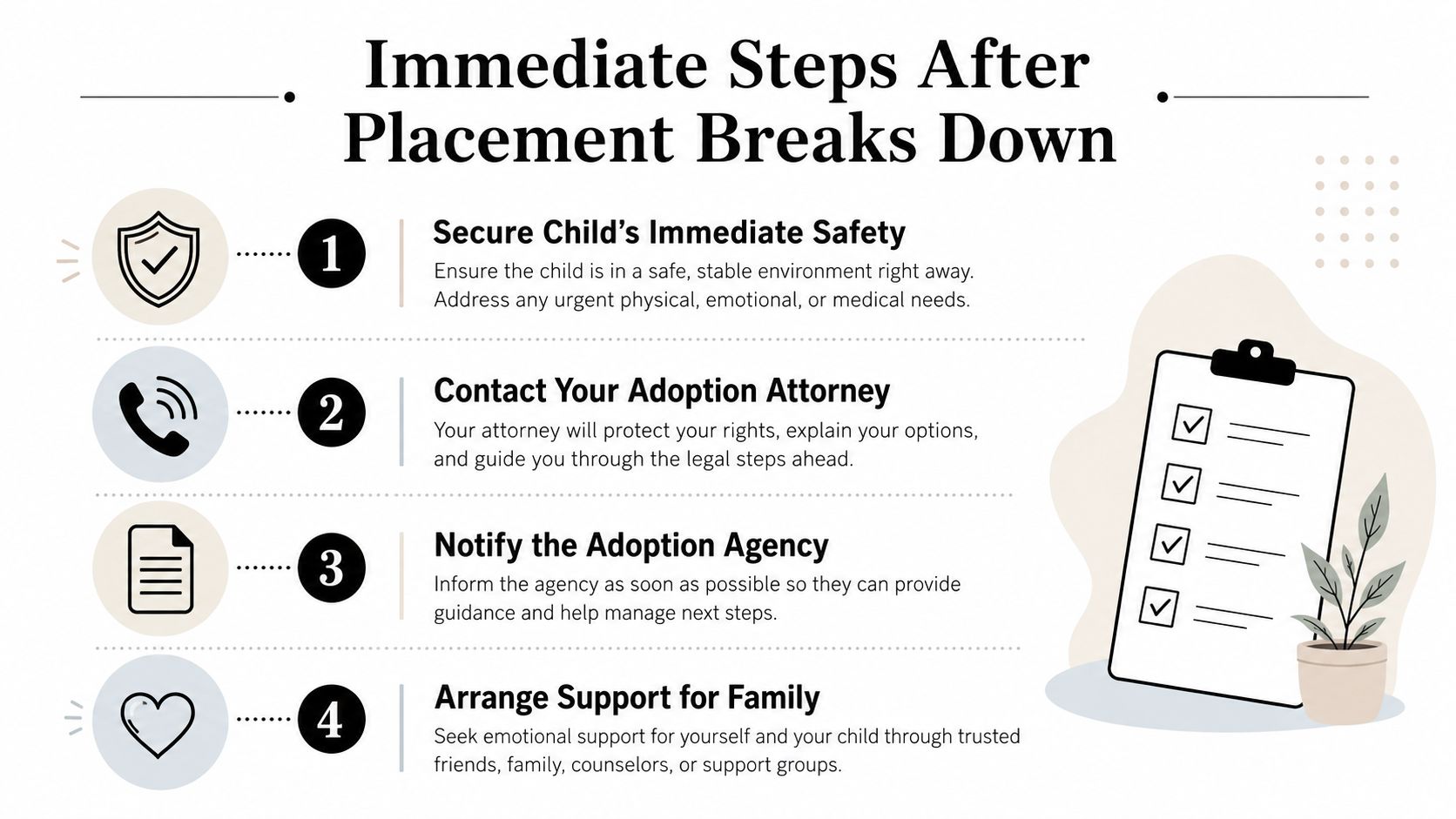
The first 24 to 72 hours
Secure the child's immediate safety.
If there is any risk of harm, separate the child from danger first and call emergency help if needed. Safety comes before paperwork.Contact your adoption attorney.
A lawyer can tell you who has authority, what documents matter, and whether court action is needed right away.Notify the agency or the court.
The right notice depends on the type of adoption, but no one should assume others already know the placement has broken down.Arrange support for everyone involved.
Families often need counseling, a relative to sit with the children, or a calm third party to help manage communication.
Keep a clean record
Write down dates, times, names, and what was said. Save texts and emails. If DFPS is involved, or if the child's next placement needs agency oversight, those records help everyone understand what happened and what the child needs next. In a crisis, memory gets fuzzy fast, and careful notes can protect both the child and the adults.
The legal and emotional strain can be intense. A short conversation with a trained counselor can help parents process grief without putting that weight onto the child. For families who want to understand how professionals talk about attachment-related concerns, this avoidant attachment disorder guide can provide useful background in a gentle way.
Legal and Emotional Consequences for Families and Birth Parents
A disruption can feel different depending on where you sit, but it affects everyone in the home. For the child, the loss may feel like another break in a chain of care. For the prospective adoptive parents, it can bring grief, confusion, and fear about what comes next. For birth parents, it may reopen hard questions about trust, consent, and whether the placement had enough stability to last.
The legal side
Before finalization, the court is still focused on where the child should go next and who has authority to make that decision. In some cases, an agency or child welfare authority steps in. In others, the next home may be with a relative or with a different adoptive family. The child's best interests still guide the process when adults do not agree.
Texas law also treats birth parent consent with care. A birth mother may not sign legal adoption papers before the child's birth, and she must wait at least 48 hours after delivery before signing consent forms (Texas birth mother rights overview). Once consent is signed, Texas does not give an automatic revocation period, so changing course usually requires the correct legal process, not just a later change of heart.
The emotional side
A disruption often leaves parents blaming themselves, even when they did not cause the break. Birth parents may feel they made the wrong choice, or that the system did not support the plan they agreed to. Children may become withdrawn, angry, or frightened when a home disappears before the adoption is complete. Those reactions are human, not strange.
The child's need for safety does not stop, even when the adults are grieving.
A short conversation with a trained counselor can help parents process grief without placing that burden on the child. Families who want a gentle introduction to how professionals talk about attachment-related concerns can read the avoidant attachment disorder guide for background that may make the child's stress responses easier to understand.
How families begin to move forward
Some families decide to try again later. Others need time before they can even think about another placement. Both reactions are normal. Healing starts with clear facts, support from people who understand adoption, and an honest look at what the family can realistically handle next.
If a family later pursues adoption again, the path may involve a stepparent case, a kinship placement, or another foster-related permanency plan. Each route still puts the child's stability first, not the adults' timeline.
How to Reduce the Risk of Disruption Before Finalization
Prevention starts long before placement day. Families who get the most practical support are usually the ones who ask hard questions early and keep asking them until the answers make sense. Trauma-informed preparation, honest matching, and legal diligence do not remove every risk, but they do reduce the chance that everyone is shocked after the child moves in.
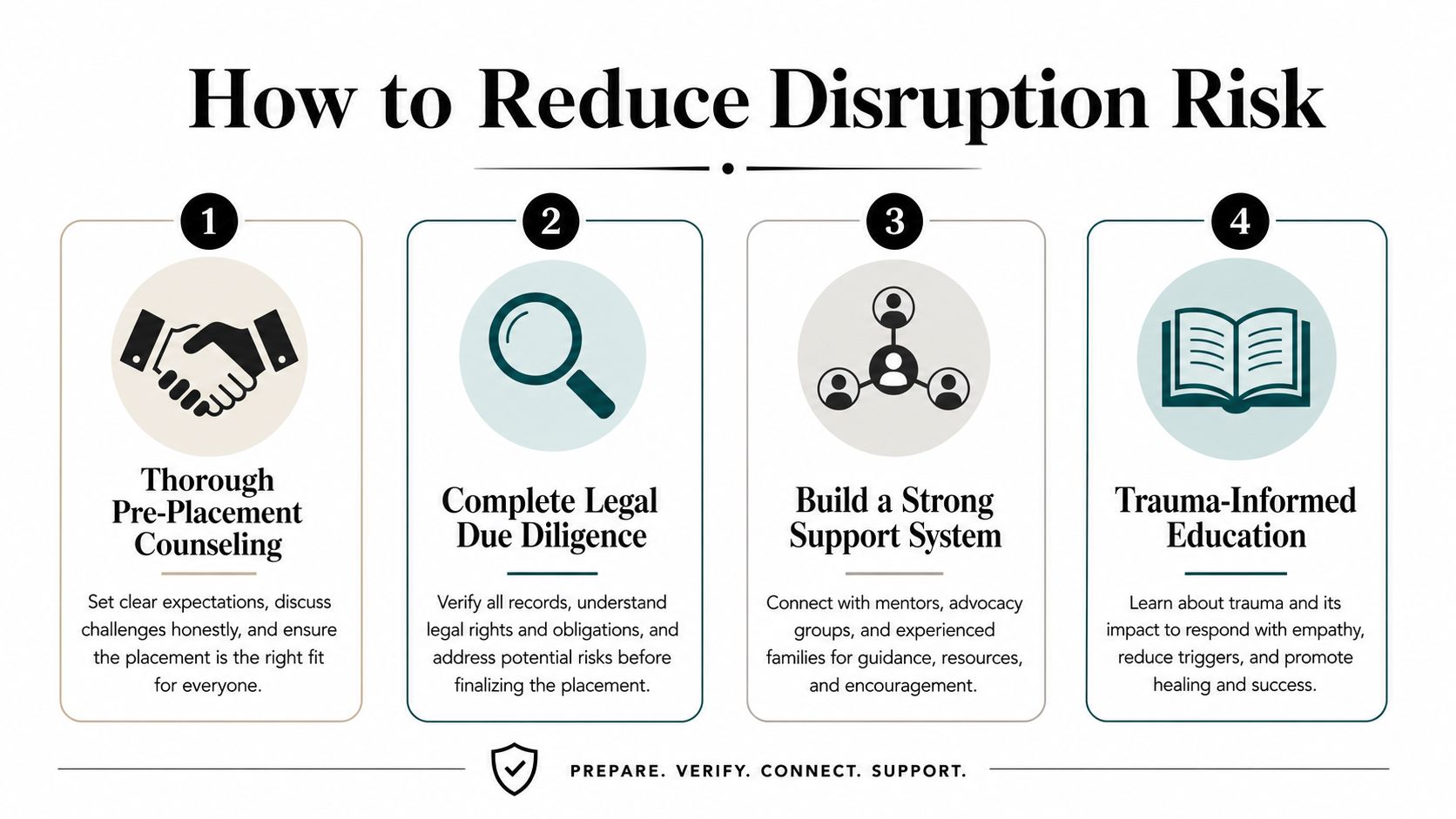
What reduces risk in real life
- Thorough pre-placement counseling. Families need a frank conversation about stressors, school needs, sibling issues, and behavior patterns before placement.
- Complete legal due diligence. An adoption attorney can spot timing issues, consent concerns, and procedural problems before they become crisis points.
- A strong support system. Grandparents, counselors, clergy, friends, and other adoptive parents can help carry the first hard weeks.
- Trauma-informed education. Parents do better when they understand how trauma, loss, and attachment may show up at home.
A child's needs also deserve targeted support, not vague encouragement. Programs that address early intervention and family support can matter a great deal, especially when a child is already struggling to adjust. For a broader look at early help and services, the Soul Shoppe early intervention guide offers a helpful place to start.
A legal and family example
A family in a CPS-related case may hear that a child is “doing fine,” then discover the child has significant anxiety in the evening, trouble at school, and difficulty separating from caregivers. If those details were discussed early, the family could plan for therapy and structure instead of hoping the problem would fade.
A compassionate adoption lawyer matters. The Law Office of Bryan Fagan, PLLC helps Texas families with adoption and guardianship matters, including stepparent, kinship, foster-care, LGBTQIA+, and special-needs cases. In some situations, legal guidance can keep a placement from unraveling because no one had the right information at the right time.
One more practical rule
Do not agree to a placement you cannot support with the resources you already have, plus the resources you can line up quickly.
That advice sounds simple, but it saves families from making promises the child's needs may outgrow. Honest limits protect everyone.
When to Contact a Texas Adoption Attorney
Call a lawyer as soon as a placement starts feeling unstable, before signatures, deadlines, or court dates make the problem harder to manage. A Texas adoption attorney can explain your options, help protect the child's best interests, and guide communication with the agency or court. If you want help choosing counsel, our guide on how to choose the right adoption attorney in Texas is a practical place to start.
If you're facing an adoption disruption, trying to prevent one, or still working through the steps toward finalization, the Law Office of Bryan Fagan, PLLC can help you understand your rights and next moves with care and clarity. Visit Law Office of Bryan Fagan, PLLC to schedule a free consultation and talk through your Texas adoption concerns with a team that understands how much is on the line.
