
Considering adoption is an incredible act of love and careful planning for your child's future. It’s a decision born from courage, not from "giving up." In Texas, the process is designed to support you, allowing you to create a personal adoption plan, choose the right family, and complete the legal steps to give your child a stable, loving home.
Your First Steps in the Texas Adoption Journey
Deciding to explore adoption brings a wave of powerful emotions—strength, hope, uncertainty, and even grief. It's a deeply personal process, and our goal is to provide clear, compassionate information so you feel empowered, not overwhelmed. You are not alone, and a network of support is ready to help you navigate this path with clarity.
This guide will walk you through how to place a child for adoption in Texas, explaining the process in plain English and focusing on your rights and choices. Understanding the road ahead is the best way to find peace of mind.

Understanding Your Options and Rights as a Birth Parent
In Texas, the law protects you and ensures your decision is made with full clarity and without pressure. As a birth parent, you have control over several key parts of the process from the very beginning.
- Choosing the Type of Adoption: You get to decide if you want an open adoption with ongoing contact, a closed adoption for complete privacy, or a semi-open plan that feels right for you.
- Selecting the Adoptive Family: You have the right to look through profiles of hopeful families and choose the one you believe is the perfect match for your child.
- Creating a Hospital Plan: You can outline exactly how you want your hospital stay to go, from who is in the delivery room to how much time you spend with your baby.
These early decisions are the foundation of your adoption plan. To learn more, you can read our detailed guide on how to start the adoption process in Texas.
You are here because you love your child and want to give them the best possible life. This is an act of selfless love, and your needs and feelings are a priority every step of the way.
Finding Compassionate Support
The emotional and legal sides of adoption are completely intertwined. It's crucial to have support from professionals who understand both. An experienced adoption attorney can explain your rights under the Texas Family Code in simple terms, making sure every detail is handled ethically and with your best interests at the forefront.
This is all about creating a loving, secure plan for your child's future. We're committed to providing the information and guidance you need to make that choice with confidence and peace.
Exploring Your Primary Adoption Paths
When you're considering adoption for your child, the first thing to know is that you are in the driver's seat. In Texas, there isn't just one path forward. You get to choose the route that feels right for you, gives you the support you need, and builds the future you imagine for your child.
The three main avenues are working with an adoption agency, pursuing a private or independent adoption, or arranging a kinship adoption with a family member. There's no single "best" choice—only the one that aligns with your heart and your unique situation.
Working with an Adoption Agency
For many birth mothers, going through an adoption agency provides a sense of structure and a built-in support system. Agencies are licensed by the state of Texas and offer a whole suite of services, which can be a huge relief during an emotional journey.
Think of an agency as your all-in-one guide. They handle the logistics so you can focus on your well-being.
- Free and Confidential Counseling: You'll have access to licensed professionals who can help you talk through your feelings and explore every option without any pressure.
- Matching You with Families: Agencies have a pool of hopeful adoptive families who are already pre-screened, have passed background checks, and completed a home study.
- Legal Coordination: They will connect you with a qualified adoption attorney to manage all the legal details and protect your rights.
- Financial Support: Agencies can help you with court-approved, pregnancy-related living expenses like rent, utilities, and medical bills.
For example, a woman feeling overwhelmed and alone might find immense comfort in the 24/7 counseling an agency offers. She can look through detailed, personal profiles of waiting families, knowing each one has been carefully vetted, which brings a profound sense of peace.
Choosing a Private or Independent Adoption
A private adoption, often called an independent adoption, puts you in direct control of the process. In this scenario, you and your attorney take the lead in finding and choosing the adoptive family. Sometimes you already know the family—maybe a friend or coworker—or your lawyer helps you connect with a family through their own network.
This path gives you the most direct say in every decision. You can communicate directly with the hopeful parents, building a relationship from the ground up and on your own terms.
Private domestic adoptions are a well-established and trusted option. Across the U.S., there are roughly 25,000 of these adoptions each year, not counting stepparent adoptions. This route is especially fitting for birth parents who envision a very open adoption, as it encourages a direct, personal connection right from the start. For a deeper look at the numbers, you can check out this report on adoption statistics from the National Council for Adoption.
Imagine a birth mother who learns that a trusted family friend has been trying to grow their family for years. A private adoption allows her to work directly with them and their lawyer to formalize a plan that she already knows is built on love and trust.
The most important thing to remember is that you are in control. Whether you choose an agency or a private attorney, Texas law is designed to protect your rights and ensure your decision is made thoughtfully and freely.
Comparing Adoption Paths for Birth Parents in Texas
Choosing between an agency, private, or kinship adoption depends entirely on your personal needs and what you want the process to look like. To help you see the differences at a glance, we've broken down the key features of each path.
| Feature | Private Adoption | Agency Adoption | Kinship Adoption |
|---|---|---|---|
| Who Finds the Family? | You and your attorney find and select the adoptive family. | The agency provides profiles of pre-screened families for you to choose from. | The adoptive parent is a relative (grandparent, aunt, etc.) you already know. |
| Level of Control | High. You manage the process and communication directly. | Moderate. The agency guides the process, but your choices are central. | High. You and your family work together, usually with an attorney. |
| Support Services | Varies. Your attorney provides legal support; you may seek counseling on your own. | Comprehensive. Includes counseling, financial aid, legal coordination, and 24/7 support. | Legal support from an attorney; emotional support comes from within the family. |
| Best For | Birth parents who want maximum control or have already identified a family. | Birth parents seeking structured support, counseling, and a pool of vetted families. | Birth parents who want their child raised by a trusted relative. |
| Communication | Direct communication between you and the adoptive parents from the start. | Often facilitated by the agency, especially in the beginning. | Direct, as it's within the existing family structure. |
| Cost to Birth Parent | None. All legal and approved living expenses are paid by the adoptive parents. | None. The agency ensures your costs are covered by the adoptive parents. | None. The adopting relative typically covers all legal costs. |
Ultimately, this table is a starting point. Your final decision will come down to what feels most secure, supportive, and right for you and your child.
Considering Kinship Adoption with a Relative
Sometimes, the most loving and stable home for a child is one they are already connected to. A kinship adoption is the legal process that lets a relative—like a grandparent, aunt, or even an older sibling—become a child's legal parent. This path is often chosen to keep family bonds strong, ensuring the child is raised by trusted family members and maintaining a solid sense of identity and belonging.
Kinship adoptions can feel less complicated than other types, especially when everyone in the family agrees on what is best for the child. However, it's still a formal legal process. It requires the termination of parental rights and court approval to make sure the adoption is truly in the child's best interests.
An attorney is absolutely essential to navigate the paperwork and court hearings correctly. This formalizes the plan, giving legal security to both the child and the relative who is stepping up to become their parent.
The Legal Process of Placing a Child for Adoption in Texas
The legal side of adoption can seem intimidating, but every rule and every document is there for a reason: to protect you, your child, and the adoptive family. These steps make sure your decision is yours alone, made with a clear head and a full heart, and that your child’s future is legally secure.
Let’s walk through what happens, so you can walk into this process with confidence.
Understanding these legal steps helps you stay in control. Every paper signed is a deliberate part of the loving plan you’ve created for your baby.
Signing the Affidavit of Relinquishment
The most important legal document you will sign is the Affidavit of Relinquishment of Parental Rights. This is the document where you officially and legally consent to the adoption.
This is a significant step. Under Texas Family Code Chapter 162, you cannot sign this document until at least 48 hours after the birth of your child. This isn't just a random number; it's a critical safeguard for you. It gives you time to recover from delivery, to be free from the influence of pain medication, and to sit with your decision without the immediate pressure of labor and birth.
This waiting period ensures your choice is completely voluntary. No one can legally rush you, and any professional who tries is waving a massive red flag.
What About the Birth Father’s Rights?
Texas law also has clear rules about the birth father's rights. His involvement is a key piece of the puzzle, and how it’s handled depends entirely on your situation.
- If the Father Is Known and Agrees: The process is straightforward. He can also sign an affidavit of relinquishment, showing his support for the adoption plan.
- If the Father Is Unknown or Unsupportive: Things work a bit differently. Your attorney will take specific legal steps to notify him of the adoption. This might involve using a service like the Texas Paternity Registry or publishing a legal notice. If he doesn’t come forward to contest the adoption within a set time, the court can terminate his parental rights.
Your attorney handles these situations with care and sensitivity. The goal is to respect everyone's legal rights while making sure the adoption is legally solid and can’t be challenged down the road.
Termination of Parental Rights: A Necessary Legal Step
The phrase “termination of parental rights” sounds harsh, but it’s a necessary legal step that makes adoption possible. Think of it not as a loss, but as a transfer of legal responsibility.
This court order officially ends the legal parent-child relationship between you (and the birth father) and your child. Once that happens, the adoptive parents can become the child's legal parents, giving them the power to make medical decisions, enroll the child in school, and provide for all their needs.
The termination of your parental rights is not a reflection of your love. It is the legal step that empowers the family you chose to become your child’s permanent, secure family.
Whether you choose an agency, private, or kinship adoption, the legal destination is the same: a safe, finalized adoption for your child.
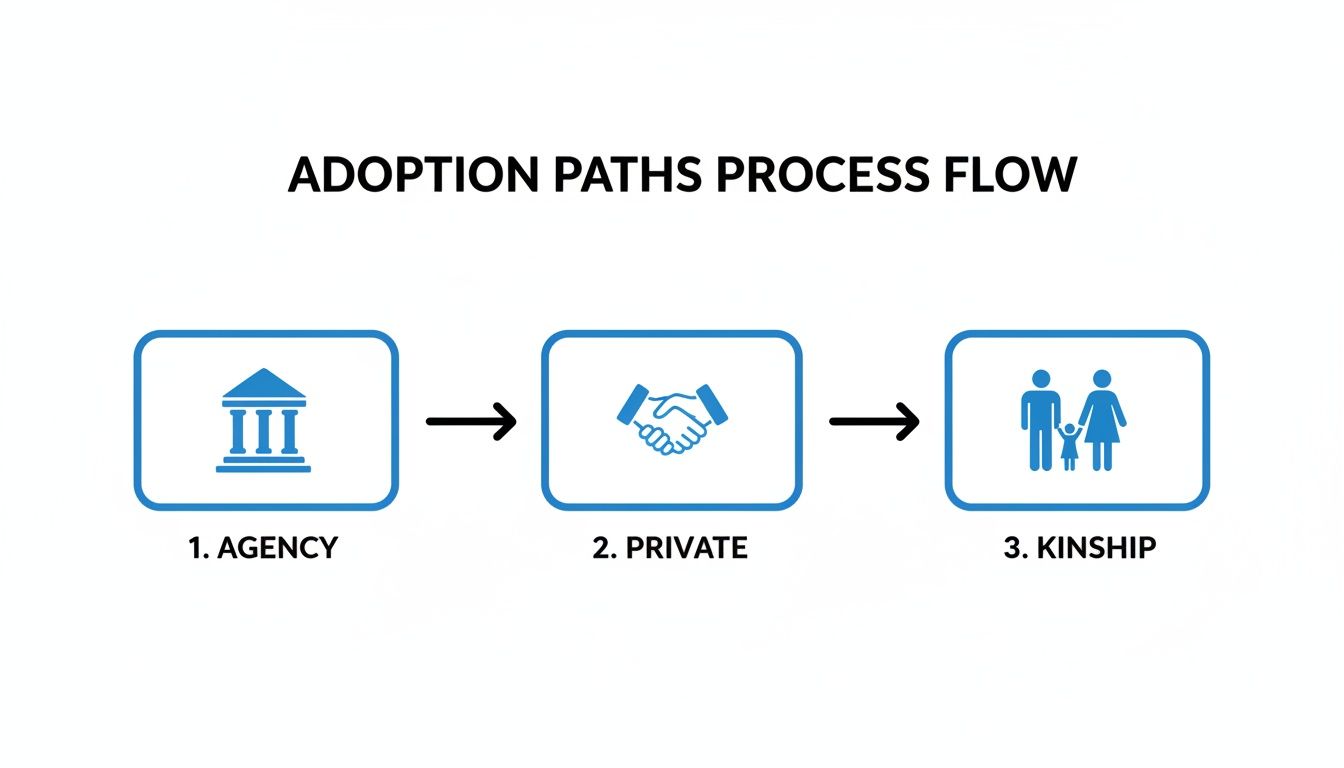
This process might seem complicated, but each path leads to a finalized adoption. You can learn more about the specific legal paperwork, like the affidavit, by reading our guide on the release of parental rights form.
Why You Absolutely Need Your Own Lawyer
This is non-negotiable: you must have your own adoption attorney. The adoptive family will have their lawyer, whose job is to represent their best interests. Your lawyer’s only job is to protect yours.
Having your own attorney ensures that:
- Your rights are protected from start to finish.
- You are never pressured or coerced into a decision.
- All the paperwork is handled correctly and ethically.
- Any financial support for pregnancy-related expenses is managed legally.
And remember, the adoptive family pays for your lawyer. You should never pay a dime for your own legal representation. It's a fundamental protection built into the Texas adoption system.
Having a dedicated attorney isn't just a good idea—it's your right. They are your advocate, your guide, and your safeguard, making sure the plan you've made for your child is built on a solid, ethical, and legally sound foundation.
How to Create Your Personal Adoption Plan
This is where you take the lead. An adoption plan is your personal blueprint, a document outlining your specific wishes for yourself and your baby—before, during, and after the birth.
Think of it less like a rigid contract and more like a loving guide. It ensures everyone involved, from the hospital staff to the adoptive parents and your own support system, understands and respects your choices. This is your chance to think through every detail and make decisions from a place of clarity.

Designing Your Hospital Experience
The birth of your child is a deeply personal moment, and you have every right to decide how it unfolds. Your hospital plan is a critical part of your overall adoption plan. It clearly communicates your preferences to the medical team and the adoptive family, which helps reduce stress and uncertainty on the day of delivery.
As you create your hospital plan, ask yourself these questions:
- Who do I want in the delivery room? You can choose a support person, the adoptive parents, or decide you’d rather have that time to yourself.
- How much time will I spend with the baby? You might want immediate time alone, or you may prefer the adoptive parents to be there from the very beginning. There's no right or wrong answer.
- When will the adoptive parents meet the baby? This could be right after birth or after you’ve had a day or two of private time.
- Who will name the baby? You can choose a name for the original birth certificate, or you might decide on one together with the adoptive family.
For example, we worked with a birth mother who wanted the first 24 hours completely alone with her baby to hold, feed, and say her goodbyes in private. Her hospital plan stated this clearly, and the nurses and adoptive parents lovingly respected her wishes. That’s the power of having a plan.
Deciding on Future Communication
One of the most important decisions in your adoption plan is the level of openness you want after the placement. While "open adoption" isn't a legally binding term in Texas, it refers to an agreement about future contact. The spectrum is wide, and you get to choose what feels right for you.
An open adoption plan is built on trust and mutual respect. It acknowledges that your connection to your child doesn't end at placement; it simply changes form.
So, what could this look like in practice?
- Photos and Letters: You might arrange to get regular updates and photos, often through a secure online portal or sent directly from the adoptive family.
- Phone Calls or Video Chats: Some families schedule calls on birthdays or holidays to stay connected.
- In-Person Visits: You may agree to meet once or twice a year in a comfortable, neutral setting.
The level of openness can also change over time. Many birth parents start with letters and photos and, as trust builds, feel more comfortable with occasional visits. Your adoption attorney or agency can help you formalize these wishes into a Post-Adoption Contact Agreement (PACA), which outlines everyone’s expectations clearly.
Exploring different agencies can also help you find a support system that aligns with your preferences; you can learn more by reading our guide on how to choose an adoption agency.
Understanding Available Financial Support
Texas law acknowledges that birth mothers often need financial help during pregnancy and recovery. The law allows adoptive parents to provide reasonable and court-approved financial assistance for pregnancy-related expenses.
This is not about "paying for" an adoption. It’s about ensuring your well-being during a physically and emotionally demanding time.
This support can cover essential costs such as:
- Rent and utility bills
- Maternity clothing
- Food and transportation
- Medical and hospital bills not covered by insurance
- Counseling services
All financial assistance must be handled legally and transparently through your attorneys and be approved by a judge. This protects you and ensures the entire process is ethical. Knowing this support is available can remove a huge source of stress, allowing you to focus on your health and making the best plan for your child’s future.
Your Emotional Well-Being After Placement
The moment an adoption is finalized in court, a new chapter begins—not just for your child and their new family, but for you. While the legal process might be over, your emotional journey is just getting started. It's so important to give yourself grace during this time and remember that seeking support is an act of strength.
The decision to place a child for adoption comes from a place of profound love, and that love doesn't just disappear. It changes. This is your time to focus on healing and well-being, recognizing that your needs matter long after the papers are signed.

Acknowledging Grief and Complex Emotions
It is completely normal, and expected, to feel a sense of grief after placement. You can feel at peace with your decision and, in the very next moment, feel a wave of deep sadness. These feelings aren't contradictory; they are a real part of the adoption experience.
Allow yourself to feel whatever comes up without judging yourself for it. Some days you might feel confident and reassured. On others, you might feel a sharp pang of loss triggered by something as simple as seeing a family at the park. All of it is valid.
Finding Your Post-Placement Support System
You do not have to walk through this new chapter alone. In fact, building a solid post-placement support system is one of the most powerful things you can do for your long-term emotional health. This network gives you a safe space to process your feelings and connect with people who truly get it.
Consider reaching out to these resources:
- Individual Counseling: A therapist who specializes in adoption or grief can offer one-on-one support that’s specific to your experience. They can help you develop healthy coping strategies to work through the complex emotions.
- Birth Parent Support Groups: There is incredible healing in connecting with other birth parents. These groups provide a unique community where you can share your story and listen to others without any fear of judgment.
- Trusted Friends and Family: Lean on the people who supported you from the start. Their continued love and encouragement can be a huge source of strength on tough days.
Placing a child for adoption is a major life event. Exploring professional help, like a guide to counseling for life transitions, can be a great step toward getting the emotional support you deserve.
The Reality of Open Adoption Contact
If you have an open adoption, staying in contact can be a beautiful and rewarding part of your journey. But it also comes with its own emotional landscape. Seeing your child happy and thriving can bring immense joy and confirm you made the right choice. At the same time, those moments can also stir up feelings of loss.
It helps to remember that your relationship with the adoptive family will likely evolve over time. Open communication and mutual respect are everything.
Your feelings are valid, and your well-being is a priority. Taking care of yourself emotionally is not selfish—it is a necessary part of honoring the loving decision you made for your child.
The landscape of adoption is continually changing, with more families looking toward domestic options. Intercountry adoptions to the U.S. have dropped a staggering 94% from their peak in 2004. This major shift has led more hopeful parents to pursue private infant and relative adoptions within Texas, creating more opportunities for birth parents to create stable, loving, and often open adoption plans. You can read the full Pew Research Center analysis of this global trend to understand these dynamics.
The legal finality of adoption provides security for your child, but your emotional journey is ongoing. We at the Law Office of Bryan Fagan, PLLC, are committed to your well-being, not just during the legal process but for the long term. Honoring your emotions and seeking support are powerful steps toward a healthy and hopeful future.
Answering Your Biggest Adoption Questions
Thinking about adoption brings up a lot of questions—and you deserve clear, honest answers. Getting straight-to-the-point information can bring a sense of calm and confidence to your decision-making process. Let's walk through some of the most common concerns we hear from birth parents in Texas.
Do I Have to Pay to Place My Child for Adoption?
Absolutely not. As a birth parent, you will never have to pay any costs related to the adoption.
All expenses, from your own attorney's legal fees to counseling services and any court-approved living assistance, are covered by the adoptive family. The entire process is designed to support you, not create a financial hardship.
Can I Change My Mind?
Yes, you have the absolute right to change your mind anytime before you sign the final legal documents. This is your decision, and no one can force you to move forward.
In Texas, there's a mandatory waiting period. You cannot sign the Affidavit of Relinquishment of Parental Rights until at least 48 hours after your child is born. This waiting period is a critical safeguard, giving you time to be certain of your choice without pressure.
It's important to know, however, that once this document is signed, it is legally irrevocable. This finality is what provides the stability every adoption needs, ensuring the child can grow up in a secure, permanent home with the family you chose.
What if the Birth Father Disagrees?
This is a very real and understandable concern for many birth mothers. If the birth father is unsupportive of the adoption plan or you don't know where he is, Texas law provides a clear and secure path forward.
Your adoption attorney will handle the legal steps required to formally notify him of the adoption. If he doesn't respond or take action to establish his parental rights within the legally required timeframe, the court can terminate his rights. This ensures the adoption is legally sound and can proceed smoothly.
How to Move Forward with Compassionate Legal Guidance
If you’ve read this far, you’ve already done one of the hardest parts—you started gathering information. This is your journey, and it’s important to know that you have options, you have rights, and you absolutely do not have to figure this out alone. The best next step is to talk to a trusted legal expert who not only understands the Texas Family Code but also gets the real, human emotions involved.
Making a decision this big requires clarity, not pressure. While modern tools like AI legal software can help you understand complex legal terms, nothing can replace a direct, compassionate conversation with an experienced attorney who can listen to your specific situation and give you honest answers.
Your peace of mind is the priority. A confidential conversation can provide the answers you need to move forward with confidence, knowing you have explored every option with care and love.
We invite you to schedule a free, completely confidential consultation with our team. This is a safe, no-pressure space to ask your questions and get a clear picture of how we can support you. Let us help you find the clarity and peace of mind you deserve.
At The Law Office of Bryan Fagan, PLLC, our team is ready to provide the compassionate, expert legal guidance you need. We are here to listen to your story, explain your rights, and help you create a loving plan that feels right for you and your child. Schedule your free consultation today at https://texasfamilyadoption.com.
