
A child has been sleeping in your home, eating at your table, and calling you when something goes wrong. You may be the one signing school forms, taking them to checkups, helping with homework, and calming fears at bedtime. In every practical sense, you're already parenting.
Then a problem comes up. The school asks for proof that you have authority to enroll the child. A doctor's office hesitates before treatment. A travel form needs a legal signature. In those moments, many caregivers learn the hard truth. Love and daily care matter a great deal, but they don't automatically create legal parenthood.
That gap is where many Texas relatives, stepparents, and longtime caregivers live for far too long. They've done the hard part already. They've shown up. What's missing is the court order that gives the child lasting stability and gives the caregiver full authority to protect them.
From Caregiver to Parent Your Adoption Journey Begins
A grandmother takes in her grandson after a family crisis. At first, everyone says it's temporary. Months pass. Then years. She buys school clothes, meets with teachers, and sits through fevers and scraped knees. One day she's told she may need legal paperwork to handle a major medical decision. That's often the moment informal care stops feeling safe.
The same happens with a stepfather who has raised his wife's daughter for years, or an aunt who became the steady home when the child's parents could not. Their bond is real. But the law still separates caregiver from parent until the adoption is complete.

Why families decide to make it official
Many people looking up how to adopt a child you've been raising informally aren't starting from zero. They're trying to bring the law in line with the life they're already living. That's a very different emotional place than a typical adoption search.
National adoption data helps explain why this path is so common. In foster care, adoption often follows an existing caregiving relationship. In 2022, the U.S. Department of Health and Human Services reported that of 53,665 children and youth adopted, 57% were adopted by foster parents and 33% by relatives, and the average age at adoption was 6, with 28% age 9 or older according to the Adoption Council's foster care and adoption statistics summary. For many children, permanency comes after someone has already been doing the day-to-day parenting.
Practical rule: If a child is already relying on you as their parent, formal adoption often protects a relationship that already exists rather than creating a new one.
If you're caring for a younger child, practical home routines matter too. Some caregivers find it helpful to review everyday transition planning, like this practical guide for new mums, because adoption is not only a legal process. It also reshapes family roles, schedules, and caregiving responsibilities.
What legal permanence changes
Once an adoption is finalized, you're no longer depending on informal agreements or family understandings. You have legal standing to act as the child's parent. That brings peace of mind to school decisions, medical care, and long-term planning.
For relatives exploring that next step, this Texas kinship adoption overview is a useful starting point. It addresses the route many grandparents, aunts, uncles, and siblings take when they're ready to move from temporary care to permanent family status.
Confirming Your Eligibility to Adopt in Texas
Before filing anything, you need to answer a simple but important question. Can you legally bring this case in Texas? In family court, that question often turns on your relationship to the child, your current legal position, and whether another court order is already in place.
Texas adoptions are governed largely by Texas Family Code Chapters 162 through 166. In plain English, those chapters cover the court process for adoption, required evaluations, the effect of adoption, and related issues such as access to information and certain procedural rules. The court's focus stays on the best interests of the child.
Your path usually falls into one of three categories
Some caregivers have a cleaner legal path than others.
- Relatives and kinship caregivers often include grandparents, adult siblings, aunts, uncles, or other extended family who stepped in when the child needed a safe home.
- Stepparents usually pursue adoption with their spouse, who remains a legal parent while the other parent's rights must be addressed.
- Non-relative caregivers may face more procedural hurdles because they don't start with a family relationship recognized by blood or marriage.
The category matters because it affects what background facts the judge will expect to see. A grandparent who has been the child's stable home may present a different case than a family friend who took over care during a crisis.
Standing means the legal right to file
People hear the word standing and think it sounds abstract. It isn't. It means whether the law allows you to ask the court for the relief you want.
In practical terms, standing often depends on facts such as your relationship to the child, whether you already have court-ordered rights, and whether the child has been living with you under circumstances the court can verify. If you've only been helping informally, the court may require additional steps before your case is ready for adoption.
That's why interim legal tools can matter.
Informal caregiving can hold a family together for a season, but it doesn't give the same protection as a court order.
Neutral sources note that informal placement is not a stable status and suggest getting a custody order or power of attorney while long-term plans are being sorted out. Those same materials also note that even relative adoptions usually still require home studies, fingerprints, medical checks, and written consent, even when the child is already living with the family, as discussed in this guide on informal child and adult adoptions.
A quick self-check before you move forward
If you're considering adoption, ask yourself:
- Do I have any current legal authority? A prior SAPCR order, conservatorship order, or guardianship-type arrangement can change your options.
- Is the child already living with me full time? Courts pay attention to stability, routine, and who has been meeting the child's needs.
- Do I know where both legal parents are? If not, expect the case to become more involved.
- Is CPS involved now, or was it involved before? A CPS history can affect records, placement history, and how parental rights are handled.
What works and what doesn't
A good adoption case is built on records, not assumptions. School forms, medical records, proof of residence, text messages about placement, and prior court orders can all help tell the child's story clearly.
What doesn't work is relying on a family handshake deal from years ago and hoping the court will treat that as legal parenthood. Texas courts care about the child's actual life, but they still need a proper legal basis to act.
The Legal Roadmap to Formalizing Your Family
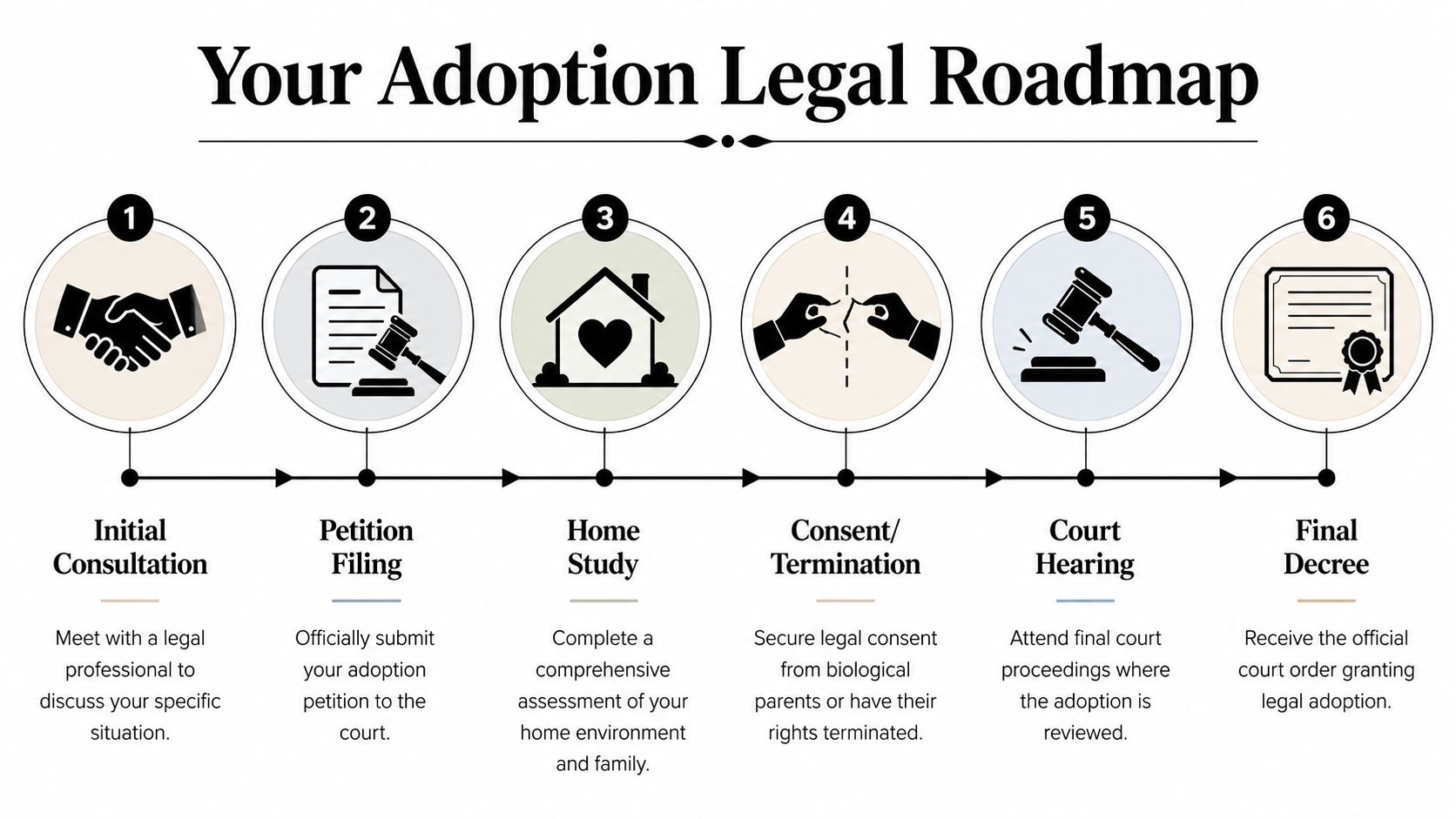
Once eligibility is clear, the work becomes procedural. That's good news. Adoption feels overwhelming when it's vague. It becomes manageable when you break it into concrete steps.
Step one starts with your paperwork and legal posture
For a child you've been raising informally, the efficient path is still a formal legal process. It requires a home study, resolution of the other legal parent's rights through consent or termination, and a court petition. A common mistake is assuming long-term caregiving creates parental status automatically. It does not, as explained in New York's adoption process guidance.
In Texas, that often means filing an Original Petition for Adoption and, depending on the case, combining it with a suit affecting the parent-child relationship or a request to terminate parental rights. Chapters 162 through 166 do not exist in isolation. They often interact with other parts of the Family Code that govern conservatorship, service, and termination.
The sequence most families follow
Identify the case type
A stepparent adoption is usually different from a relative adoption. A CPS case has its own history and paperwork. If your case began informally, part of the legal job is translating real life into the correct legal category.Gather proof of the child's life with you
Judges want to see stability. That may include school records, medical records, insurance information, proof of residence, and evidence showing who has been making day-to-day decisions.File the petition and give notice
Adoption can't move forward in secret. Required parties must receive notice according to the rules. If someone's location is unknown, your attorney may need to document search efforts and ask the court for an alternate method of service.
Before you get too far into the process, some families benefit from hearing a broad overview of how adoption cases are handled in practice:
The home study and child-focused investigation
Texas courts usually require a pre-adoptive social study or similar evaluation before finalization. People often call this a home study. It is not a white-glove inspection of your housekeeping. It is an assessment of whether the placement is safe, stable, and in the child's best interest.
Expect questions about:
- Home safety such as sleeping arrangements, basic cleanliness, and general suitability
- Family background including everyone living in the home
- Finances in a practical sense, meaning whether the household is stable enough to support the child
- Relationship history showing how the child came into your care and how the bond developed
- Background screening for required adults in the home
A judge may also appoint a professional to represent or investigate the child's interests. Families often hear terms like attorney ad litem or amicus attorney. In plain language, these are people the court appoints to help evaluate what outcome serves the child best. Their role depends on the order and the case.
Where delays usually happen
Most delays come from one of three issues.
| Issue | Why it slows the case | What helps |
|---|---|---|
| Missing documents | The court can't finalize on guesses | Gather records early |
| Unresolved parental rights | Adoption can't bypass legal parents | Address consent or termination from the start |
| Weak proof of caregiving history | The judge needs a clear timeline | Organize school, medical, and residence records |
Best practice: Treat your adoption like a fact file, not just a heartfelt story. The court needs both.
Families often need separate advice on ending a legal parent's rights before the adoption can proceed. This Texas termination of parental rights resource helps explain that part of the process.
One practical option for handling the filing, coordination, and court hearings is working with a firm that handles Texas adoption cases, such as the Law Office of Bryan Fagan, PLLC. The value in that kind of representation is not just form preparation. It's managing service issues, required evaluations, and court presentation in a way that fits your specific family history.
Navigating Parental Rights and Consent
Many hopeful adoptive parents experience the most anxiety with the legal complexities. They've raised the child for years, yet the legal case still turns on someone else's rights. That can feel unfair, especially when the other parent has been absent or unreliable. But Texas courts take parental rights seriously, and they should.
Many public explanations oversimplify this issue. In reality, adoption doesn't happen just because a caregiver has been present longer or done a better job. Legal permanence depends on a proper resolution of the legal parents' rights.

Voluntary consent and involuntary termination are not the same
Court guides confirm that both birth parents generally must consent in writing, and extra steps are needed if one parent cannot be identified or does not agree. Legal permanence depends on consent, termination, or another court-ordered pathway rather than how long the child has lived with the caregiver, as noted in California's relative adoption court guidance.
In Texas practice, that usually creates two broad paths:
Voluntary relinquishment
A legal parent signs proper documents giving up parental rights. This can make the case more direct, though the paperwork still must be done correctly and approved by the court.Involuntary termination
If a parent refuses, disappears, or remains intermittently involved without meaningful parenting, the court may need to decide whether legal grounds exist to terminate that parent's rights.
Common hard situations
Some of the most common fact patterns look like this:
The missing parent
Maybe the father was never consistently involved, or the mother left years ago and contact is sporadic or nonexistent. You still can't skip notice. The court will expect a real effort to locate that parent. That may involve addresses, relatives, online searches, prior employers, public records, or other documented efforts.
The parent who objects but hasn't parented
This is often the most painful scenario. A caregiver has done everything for the child, but the legal parent appears once the adoption is filed and refuses consent. The court then looks beyond emotion and asks for evidence. Texas cases may involve proof tied to abandonment, endangerment, failure to support, substance abuse, criminal conduct, or other statutory grounds, depending on the facts.
The parent with partial, inconsistent contact
A birthday message once in a while does not automatically defeat an adoption, but it can complicate the case. Courts look closely at the pattern. Was there real parenting, support, safe involvement, and responsibility? Or was the contact too limited and erratic to provide stability for the child?
The court does not compare who loves the child more. It decides whether the law allows parental rights to continue and whether adoption serves the child's best interests.
What evidence usually matters
If a case may require termination, start preserving evidence early.
- Communication records such as texts, emails, and missed attempts to coordinate parenting
- Support history showing whether the parent contributed financially or materially
- Criminal or CPS records when legally available and relevant
- Witness testimony from teachers, relatives, counselors, or others who can describe the child's actual caregiving reality
- Your timeline with dates, addresses, and major events laid out clearly
For a closer look at who must agree before an adoption can move forward, this Texas adoption consent guide is a helpful companion.
Estimating Your Adoption Costs and Timeline
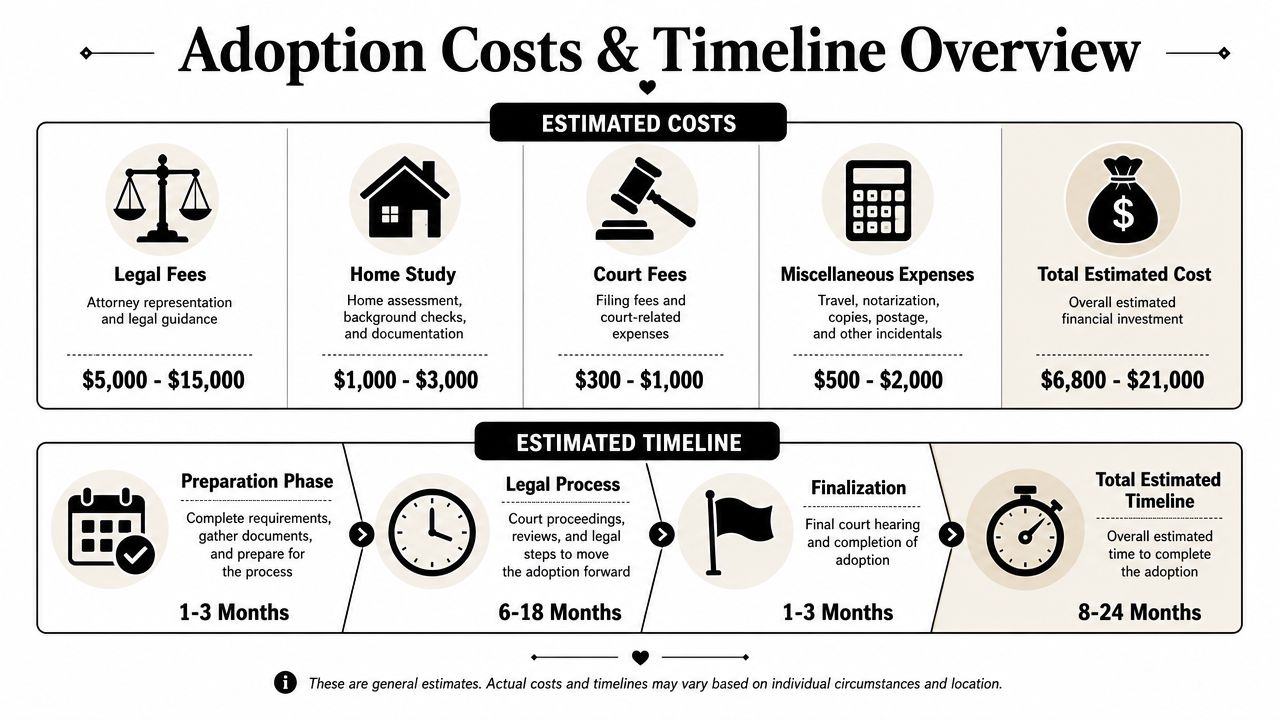
Families almost always ask two practical questions early. How much will this cost, and how long will it take? The honest answer is that both depend on conflict, paperwork, and the parental-rights issue.
That matters because a smooth stepparent or relative adoption with full cooperation looks very different from a contested case involving a missing parent, service issues, or a trial on termination. The legal system can move steadily, but it rarely moves instantly.
What costs usually include
Even without assigning one flat number, most Texas families should plan for several categories of expense:
- Court filing fees for the petition and related filings
- Home study or social study fees for the required evaluation
- Service costs if a parent must be formally served
- Attorney fees based on complexity and whether the case becomes contested
- Child-related professional fees if the court appoints an attorney ad litem or other investigator
Why timelines vary so much
A straightforward case can move at a reasonable pace when documents are ready, consent is signed, and the home study is completed without problems. A contested case can take much longer because the court must resolve notice, evidence, and legal grounds before adoption is even eligible for finalization.
Here is the practical difference:
| Case type | Typical pressure point | Likely pace |
|---|---|---|
| Uncontested relative or stepparent adoption | Waiting on evaluations and hearing dates | More predictable |
| Case with a missing parent | Service and proof of search efforts | Slower |
| Case requiring termination trial | Evidence, hearings, and court scheduling | Least predictable |
How to budget wisely
Start with a written list of expected steps in your own case. If you know a parent is likely to object, budget for a more involved process from the beginning rather than hoping it stays simple. That mindset prevents a lot of stress.
You should also ask early whether old CPS records, prior orders, or out-of-county filings need to be retrieved. Those details don't always look dramatic, but they often affect both timing and cost.
Your Family's Future and How an Attorney Can Guide You
A child who has already made a home with you deserves more than an informal arrangement held together by goodwill. Adoption can provide legal permanence, daily authority, and long-term security. It can also relieve a child's quiet fear that everything could change with one phone call, one family dispute, or one emergency.
That doesn't mean every situation is simple. Some families need a temporary custody order first. Some need help locating a missing parent. Some need a careful court presentation because the facts are emotionally charged and legally messy. The right legal strategy depends on the actual history of the child's life, not just the label attached to the case.
What an attorney actually helps with
A good Texas adoption lawyer does more than file forms.
- Case assessment means identifying whether you need adoption now, temporary orders first, or a combined strategy.
- Parental-rights work includes consent documents, service issues, and termination litigation when necessary.
- Court preparation means organizing records, preparing testimony, and making sure the judge receives a clear, child-centered picture.
- Problem solving becomes critical when CPS history, missing parents, or contested facts threaten to delay finalization.
Why this step matters for the child
When adoption is done correctly, the legal record finally matches the child's lived experience. The adult who has been showing up becomes the legal parent with full authority and full responsibility. That clarity matters at school, at the doctor's office, in estate planning, and in daily life.
It also helps families prepare for the practical side of caregiving. Along the way, some relatives and adoptive parents also review resources such as essential child first aid so they feel ready for both the legal and everyday responsibilities that come with permanent parenting.
A strong adoption case is built around one steady idea. The child already has a family life. The court process secures it.
If you're trying to figure out how to adopt a child you've been raising informally, you don't have to solve every issue before asking for help. You just need a clear starting point and a legal plan that fits your family.
If you're ready to talk through your options, the Law Office of Bryan Fagan, PLLC offers free consultations for Texas families exploring kinship, stepparent, foster care, and other adoption paths. A conversation can help you understand where your case stands now, what legal steps come next, and how to move from informal caregiving to lasting legal security for the child in your home.
