
Generally, no. A full legal adoption in Texas usually requires the birth parents to consent or a court to terminate their parental rights, and nationally kinship adoption is common enough to account for 33% of public child-welfare adoptions in 2022, up from 23% in 2007 for adoptions from foster care, which shows relatives adopt often but still must meet the same legal foundation for adoption as anyone else. What many families need, though, isn't adoption at all. They need legal authority to care for a child while preserving family ties, and that's where options like conservatorship can matter.
A Relative's Love and a Difficult Question
A lot of families arrive at this question privately.
A grandmother starts keeping her grandson “just for a little while” after school. Then she's the one packing lunches, taking him to the doctor, and answering late-night calls from the school nurse. An aunt takes in her niece because things at home aren't stable. An older sibling helps raise a younger brother while everyone hopes the parents will get back on their feet.
That's when the legal questions start. Can I enroll this child in school? Can I approve medical care? Can I protect this child without cutting the parents out forever?

The question behind the question
When someone asks, can you adopt a relative without terminating parental rights, they're often asking something more personal:
- Can I keep this child safe
- Can I make day-to-day decisions
- Can I give this child stability
- Can I do it without causing more pain in the family
In Texas, the word adoption has a very specific legal meaning. It doesn't just mean caring for a child or even raising a child for years. It means the law creates a new parent-child relationship.
That's why this issue feels so hard. Your heart may be saying, “I want to protect this child,” while the legal system is asking, “Are you trying to become the child's legal parent in a permanent way?”
Some relatives don't want to replace a parent. They want enough legal authority to care for the child safely while the family heals.
A practical starting point
If your real goal is long-term authority without ending the parent-child relationship, adoption may not be the best fit. In many Texas family situations, managing conservatorship or a related custody arrangement may solve the actual problem better than adoption does.
If your goal is permanent legal parenthood because the child needs finality and safety, adoption may still be the right path. But it's important to start with the right question, not just the familiar word.
Why Texas Law Views Adoption as a Permanent Transfer
Texas law treats adoption as something much bigger than custody. Under Texas Family Code Chapter 162, adoption creates a legal relationship that's meant to stand on the same footing as a parent-child relationship formed at birth.
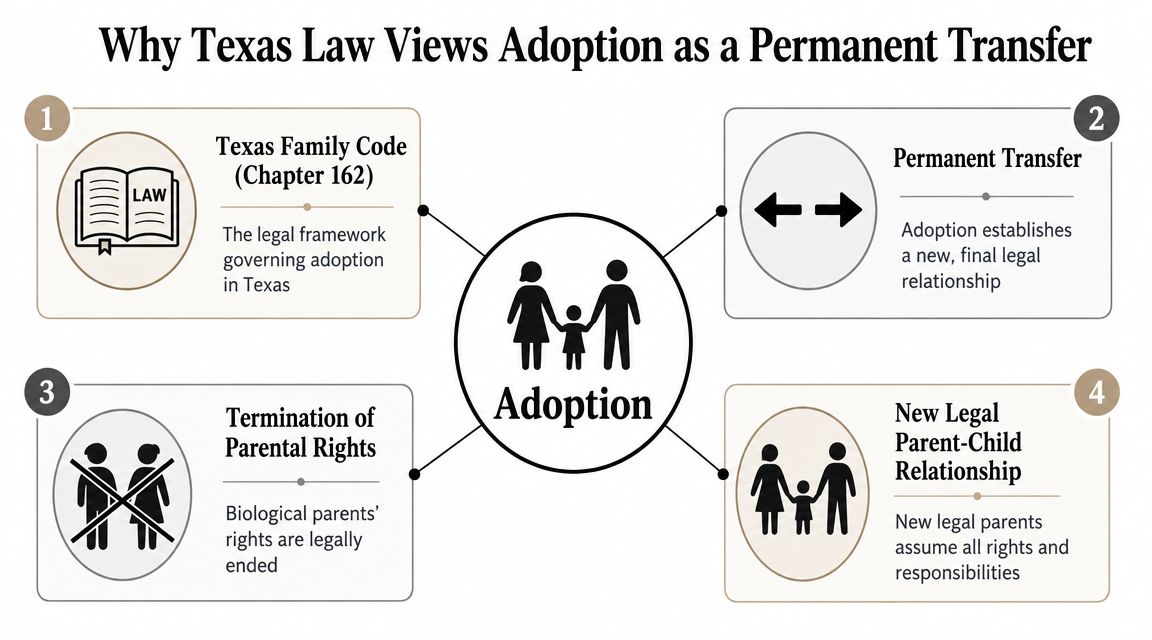
Adoption changes who the legal parents are
This is the part that trips people up.
A relative may already be the child's emotional parent in every way that matters at home. But the court doesn't only look at who has been doing the parenting. The court also looks at who has the legal rights and duties tied to parenthood.
At a foundational level, a relative generally cannot formally adopt a child unless the birth parent or parents either consent to the adoption or a court has legally terminated their parental rights, because adoption creates a new, exclusive parent-child relationship, as explained by Grandfamilies' adoption overview.
It serves as a legal foundation. If the law is going to build a new permanent parent-child structure, it has to be clear who stands in the parent role. Texas doesn't leave that split in place in a full adoption.
Termination is tied to exclusivity
That doesn't mean termination is always about punishment. Sometimes a parent signs a voluntary relinquishment because they know another family member has been acting as the stable parent. In other cases, a court considers involuntary termination because the child's safety requires it.
Either way, the legal result is the same. The adoption can't create a full new parent-child relationship while the old one remains intact in the ordinary relative-adoption setting.
For families sorting through that reality, it often helps to first understand how termination of parental rights works in Texas, because that step is usually what controls whether adoption is even possible.
Practical rule: If you want the court to name you the child's permanent legal parent through adoption, the court must first address the legal rights of every existing parent.
Why this matters emotionally
Many relatives feel guilty even asking about termination. They worry it sounds harsh or disloyal.
But the legal question isn't whether you love the parent. It's whether the child needs a permanent legal parent with full authority. Texas courts focus on the child's best interests, not family labels alone.
That's why it helps to separate two different ideas:
- Caregiving means who's raising the child.
- Adoption means who the law recognizes as the parent forever.
Once you see that difference, the next decision gets clearer.
The Better Path for Your Family Adoption vs Conservatorship
A grandmother has been getting the child to school, taking the child to doctor visits, and handling bedtime for months. The parent is still in the picture, but not in a way that gives the child day-to-day stability. In that situation, many relatives are not really asking, "How do I replace the parent?" They are asking, "How do I protect this child and still leave room for family ties?"
For many Texas families, the answer is conservatorship, not adoption.
That distinction matters. Adoption changes who the legal parent is. Conservatorship gives a caregiver legal authority to raise and protect the child without automatically cutting off the parent-child relationship. If your real goal is to keep the child safe, enrolled in school, insured, and medically cared for, conservatorship may fit the problem more closely.
Illinois Legal Aid explains a similar idea in its adoption and guardianship discussion. Families sometimes need legal authority and stability more than they need a full legal replacement of the parent.
What conservatorship does in Texas
In Texas, managing conservatorship is the set of court-ordered rights and duties that lets an adult act for a child. A relative who is named managing conservator may be given authority over:
- School matters such as enrollment and educational planning
- Medical care including consent for treatment
- Daily supervision like housing, routines, and activities
- Support and services including dealing with agencies and providers
That can solve the problem families feel every day. The school needs a signature. The doctor needs consent. The child needs one adult clearly in charge.
For some families, guardianship may also come up in the conversation, especially if they are comparing family court and probate court options. This overview of guardianship of a minor in Texas explains how that path differs from conservatorship and adoption.
Adoption vs Managing Conservatorship in Texas
| Feature | Adoption | Permanent Managing Conservatorship |
|---|---|---|
| Legal parent status | The adoptive relative becomes the child's legal parent | The relative gets decision-making authority but does not become the child's new legal parent through adoption |
| Birth parents' rights | Usually ended by consent or court order before adoption is finalized | May remain in some form, depending on the court's orders |
| Permanency | Designed to be permanent and final | Can provide long-term stability, but it is not the same as adoption |
| Ability to change later | Much harder to undo because adoption creates a new legal parent-child relationship | Court orders may sometimes be modified if circumstances change |
| Purpose | Creates a new family line in the eyes of the law | Gives the caregiver legal authority to protect and raise the child |
| Best fit for | Situations where finality and full parental replacement are necessary | Situations where the family needs authority without fully severing parental ties |
A simple way to understand the difference is this. Adoption answers, "Who is the parent under the law?" Conservatorship answers, "Who has the right to make decisions for this child right now and over the long term?"
A coffee-table example
Say your sister has struggled with addiction, but she is in treatment and seeing the child safely. You have been the one handling homework, meals, school forms, and doctor appointments. The child needs stability today. The family also hopes your sister may continue rebuilding her relationship with the child.
In that setting, conservatorship often matches the family's real goal better than adoption. It can give you authority without forcing an all-or-nothing choice before the family is ready.
The best legal option is the one that matches the child's needs, not the one that sounds the most permanent.
When adoption is probably not the first move
Conservatorship deserves a close look if:
- The parent still has a meaningful relationship with the child and the family wants to preserve that bond.
- You mainly need legal authority for school, medical care, counseling, and daily decisions.
- Reunification is still possible later if the parent becomes stable and consistent.
- Everyone agrees the child should stay with you but no one agrees that parental rights should end.
A Texas family law attorney can help compare those options under the Texas Family Code and the facts of your family's situation. The Law Office of Bryan Fagan, PLLC handles adoption- and guardianship-related family law matters for Texas families who are sorting through those choices.
Pursuing Adoption When It Is the Right Choice
Sometimes conservatorship isn't enough.
A child may need permanent legal stability because a parent has disappeared, repeated dangerous behavior hasn't changed, or everyone involved agrees that the relative caregiver has become the child's true long-term parent. In those cases, adoption may be the right next step.
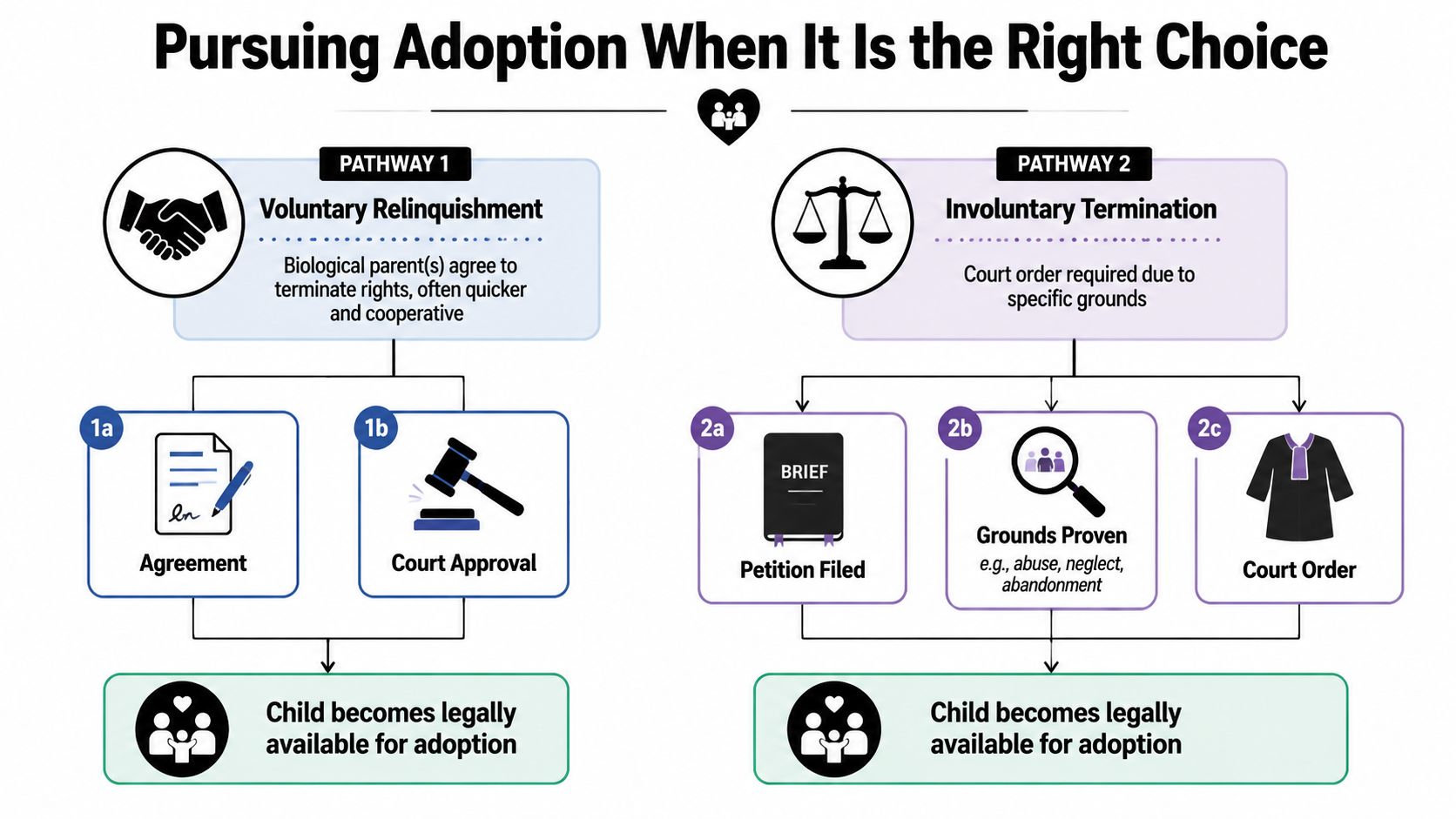
The cooperative path
The simpler route is voluntary relinquishment.
That means the birth parent signs documents giving up parental rights and consenting to the adoption. In Texas, those documents and timing rules matter. Courts expect the paperwork to comply with the Family Code, and judges still examine whether the adoption serves the child's best interests.
When parents are in agreement, the case is usually less emotionally exhausting. There may still be required steps such as a petition, background review, a home study or evaluation when required, and a final hearing under Texas adoption procedures in Chapters 162 through 166.
A helpful starting point for relatives considering that route is this guide to kinship adoption in Texas.
The contested path
If consent isn't given, the issue becomes proving legal grounds for involuntary termination.
Florida-based guidance notes a relative adoption may move forward without parental consent only if the petitioner proves grounds such as abandonment, and that cases with consent can be completed in months while contested cases require proof of statutory facts to the court, as described in this discussion of parental consent in adoptions. Texas uses its own statutes and procedures, but the same core principle applies. Relative status alone doesn't remove the need to prove the legal basis for ending parental rights.
Texas Family Code Chapter 161 governs termination. The court won't terminate rights just because a relative can offer a better home. The petitioner must prove a legal ground and also show that termination is in the child's best interest.
Common grounds can include allegations such as abandonment, endangerment, or failure to support, but the exact legal fit depends on the facts.
What the Texas process usually involves
A relative adoption case often unfolds in stages:
Filing the case
The petitioner asks the court for termination, adoption, or both, depending on the posture of the case.Notice to all legal parents
Every parent whose rights are at issue must be properly notified.Investigation and required checks
Texas courts often require background information and, in many cases, an evaluation or home study process before finalization.Evidence and hearings
If the case is contested, the court hears evidence about the parent's conduct and the child's needs.Finalization
If the court approves the adoption, the judge signs an order creating the new legal parent-child relationship.
For readers who want a visual overview of how those paths differ, this video can help:
Consent can make a case simpler. It does not make the court optional.
What Happens in a Contested Relative Adoption
The hardest cases are often the most common.
An aunt has cared for her nephew for a long time. The child's mother agrees to the adoption because she knows her sister has been the stable parent. The father hasn't visited in years, or maybe he suddenly objects once he learns an adoption is pending.

One yes is not enough
In a contested relative adoption where only one parent consents, the court can't finalize the adoption until the other parent's rights are addressed. The petitioner must prove the non-consenting parent is unfit according to statutory grounds before rights can be terminated, as explained in Justia's overview of adoption by family members.
That's true even when the relative caregiver has done everything right for years.
If a parent can't be found
People often assume a missing parent automatically loses rights. It doesn't work that way.
The court still requires proper notice efforts. Depending on the facts, that may involve formal attempts to locate the parent, documented service efforts, and in some cases substitute service methods allowed by law. Texas courts take notice seriously because termination affects constitutional parental rights.
That's one reason these cases can feel slower than families expect.
What evidence matters
The court usually wants specifics, not general frustration.
Helpful evidence may include:
- Contact history such as long gaps in communication or missed visitation
- Support records showing whether the parent provided financial help
- Safety concerns including records tied to neglect, substance abuse, or dangerous conduct
- Caregiver proof like school records, medical records, and testimony showing who has met the child's needs
If you're already dealing with foster care schedules, parent visits, or court dates, practical organization matters. A simple outside resource that some families find useful is this guide for foster care families, especially when a child's case involves multiple hearings and family contacts.
Courts don't terminate rights because a relative is more available. Courts terminate rights when the evidence meets the legal standard and the child's best interests support that result.
The emotional reality
Contested adoptions are draining because they mix legal proof with family pain.
A parent may love the child and still be unable to parent safely. Another parent may reappear late in the case. Grandparents and aunts often feel pulled between protecting the child and fearing they'll be blamed for “taking sides.”
That tension is normal. It's also why careful legal preparation matters so much in a contested relative adoption.
Taking the Next Step to Protect Your Family
If you've read this far, you probably aren't looking for legal theory. You're looking for a way to protect a child you love.
The clearest answer is this: full adoption and continued parental rights usually don't coexist. If you want the court to make you the child's permanent legal parent in Texas, the parents' rights have to be addressed first. But if your real goal is authority, stability, and protection without that final legal break, conservatorship may be the better fit.
Questions to ask yourself now
Start with these:
- Do I need permanent legal parent status, or do I mainly need decision-making authority?
- Are the birth parents willing to cooperate, partly cooperative, or fully opposed?
- Has CPS been involved, or is this a private family arrangement?
- Would preserving some legal connection with a parent help this child, or would it create instability?
Those answers usually point you toward the right path.
When legal help becomes especially important
Some cases are manageable only with close legal guidance:
- A parent won't consent
- A parent can't be located
- There are questions about abandonment or unfitness
- The child has lived with you for a long time but there's no formal court order
- You're torn between adoption and conservatorship
Texas adoption law under Chapters 162 through 166 and termination law under Chapter 161 are detail-heavy. Small procedural mistakes can delay a case or create real problems at finalization.
A steady next move
You don't have to solve the whole future in one conversation.
Start by gathering the basics: who has cared for the child, whether there are existing court orders, whether each parent agrees, and what kind of stability the child needs most right now. From there, a family law attorney can help you choose a path that protects the child without creating unnecessary conflict.
The right legal plan should match the child's life, not force the child into a label.
If your family is trying to decide between relative adoption, conservatorship, or another legal option in Texas, a conversation with Law Office of Bryan Fagan, PLLC can help you sort through the facts of your situation with compassion and clarity. We offer free consultations for Texas families who want practical guidance on protecting a child they love.
