 Skip to content
You may be reading this late at night, after scrolling agency websites, saving checklists, and wondering whether foster care adoption in Texas could really become part of your family's story. You may feel hopeful, but also nervous about the parts no one explains clearly. How long does it take? What if a child is placed in your home and then leaves? When does foster care become adoption?
Those questions are normal. They matter because foster to adopt in Texas is both meaningful and legally complex. Families often begin with a simple desire to love a child, then quickly run into unfamiliar terms like conservatorship, home study, and termination of parental rights.
Texas law gives families several adoption paths, including foster care adoption, stepparent adoption, kinship and relative adoption, and private adoption. Chapters 162 through 166 of the Texas Family Code shape much of that process, including who may adopt, when consent is required, and how a court finalizes an adoption. In foster care cases, those legal rules sit alongside CPS and DFPS procedures, which can make the journey feel harder than it needs to be.
This guide walks through the process in plain English, with the emotional reality included. If you're a hopeful adoptive parent, a relative caring for a child, or a birth parent trying to understand what permanency may look like, clear information can help you take the next step with steadier footing.
Your Journey to Building a Family Through Foster Care
Some families arrive here after infertility. Some after years of thinking about adoption. Others are relatives already caring for a child and trying to understand whether foster care adoption is the right long-term step. However you got here, the mix of excitement and fear is real.
Foster care adoption asks a lot of parents. It asks for patience, flexibility, and the ability to love a child whose legal future may still be unresolved. It also gives something extraordinary in return. It gives a child the chance to grow up in safety, connection, and permanence.

Texas has a large foster care population. As of fiscal year 2025, Texas ranks as the second-most populous state for foster care placements in the United States with 17,520 children currently in care. Adoption accounted for 26% of all foster care exits according to CAFO foster care statistics. That means foster-to-adopt families play a real role in helping children move from uncertainty into permanency.
Why this path feels different
In a private adoption, the legal goal is usually adoption from the beginning. In foster care, the first goal is often family reunification. That difference changes everything. You may open your home to a child and begin daily life together while the case is still moving through court.
That doesn't mean foster to adopt in Texas is the wrong path. It means the path works best when parents begin with honest expectations.
Practical rule: In foster care, love may start before legal certainty does.
Texas families also need to know that the court doesn't look only at what adults want. The court focuses on the best interests of the child. That standard runs through Texas adoption law. It affects placement decisions, home studies, consent issues, and finalization hearings.
The legal framework in plain English
Texas Family Code Chapters 162 through 166 cover adoption procedure, records, and related protections. At a basic level, an adoption case asks the court to create a legal parent-child relationship. Once a court signs an adoption order, the adoptive parent becomes the child's legal parent with all related rights and responsibilities.
For relatives, stepparents, and foster parents, the emotional path may look different, but the legal question is the same. Can the court lawfully approve this adoption, and is it in the child's best interest?
A family law attorney can help translate that legal question into real-world steps. That may include reviewing CPS status, checking whether parental rights have been terminated, preparing paperwork, and helping a family understand whether they're looking at foster care, matched adoption, kinship adoption, or another route entirely.
Are You Ready Eligibility and First Steps in Texas
The first stage often feels heavy on paperwork, but the purpose is simple. Texas wants to know whether a child will be safe in your home. The rules are not there to make caring people give up. They are there because many children in foster care have already lived through instability, trauma, or neglect.
To adopt from Texas foster care, you must be at least 21, financially stable, and complete a criminal background check. In 2021, 5,925 Texas children in foster care were waiting for an adoptive family, as noted by AdoptUSKids information for Texas.
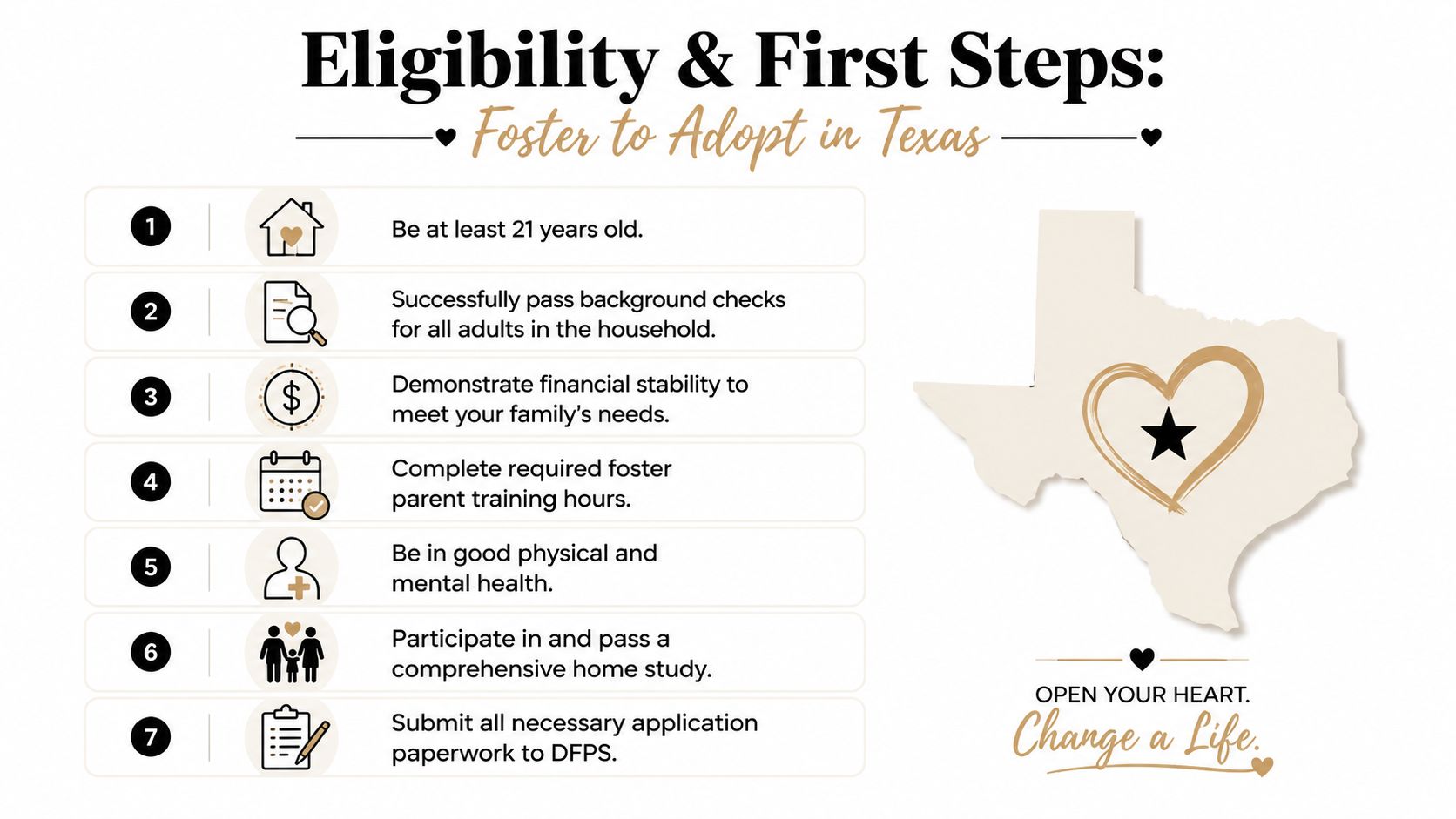
What Texas looks for
These requirements sound formal, but each one serves a child-centered purpose.
- Minimum age: You must be at least 21. Texas wants adoptive and foster parents to have adult stability and legal capacity.
- Financial stability: You don't have to be wealthy. The state wants to see that you can meet your household's needs consistently.
- Background checks: Criminal and abuse or neglect checks help screen for safety concerns in the home.
- References and personal history: Caseworkers look for maturity, honesty, and a support system.
- Training: Pre-service training prepares you for the realities of parenting a child who may have experienced trauma.
- Home study: This evaluates whether your home is safe and whether your family is prepared.
- Application paperwork: This creates the formal record the agency and court will rely on later.
If you want a simple overview of the baseline rules, Who Can Adopt in Texas? Eligibility Requirements gives a factual summary of the basic requirements to become an adoptive parent in Texas.
Your first practical moves
Many families get stuck because they try to learn everything at once. It helps to think in sequence.
- Attend an information meeting. DFPS or a child-placing agency usually starts there. This is where you hear how foster care, foster to adopt, and adoption-only placements differ.
- Choose the right agency relationship. Ask how the agency handles foster-to-adopt cases, communication, training, and post-placement support.
- Gather documents early. Identification, financial records, medical forms, and household information tend to slow families down if collected late.
- Talk through your openness as a family. Age range, sibling groups, medical needs, and behavioral needs all matter.
- Learn the foster parent process. A practical starting point is this guide on how to become a foster parent in Texas.
Families often feel discouraged by the checklist. In reality, the checklist is part of how Texas decides whether a child can safely settle into your home.
A simple example
A married couple may assume they are ready because they have a spare bedroom and a strong marriage. A relative caregiver may assume they're automatically approved because the child already knows them. In both situations, Texas still requires screening, documentation, and review.
That can feel impersonal. But for the child, it creates a record the court can trust later if the case moves toward permanency.
The Home Study and Licensing Process
The home study is where many families' anxiety spikes. People imagine a stranger walking through the house looking for reasons to say no. In practice, it's closer to a structured evaluation of safety, readiness, and family functioning.
For non-relative adoptions in Texas, families may also encounter required documents such as the Health, Social, Educational, and Genetic History Report, often called the HSEGR. Texas requires that report in applicable cases, along with the adoption evaluation, FBI fingerprint background checks, and CPS history checks before finalization can occur.
What happens in a home study
A home study usually includes paperwork, interviews, and a home inspection. The caseworker isn't looking for a perfect home. The caseworker is looking for a safe, stable one.
You may be asked questions like these:
| Topic | What the caseworker may ask |
|---|---|
| Parenting approach | How do you handle stress, conflict, and discipline? |
| Family history | What was your own childhood like, and how might that affect your parenting? |
| Support system | Who helps you when life gets hard? |
| Motivation | Why are you pursuing foster care adoption instead of another path? |
| Child needs | What behaviors or needs would be difficult for your family to manage? |
Those questions can feel personal because they are personal. The state is trying to understand how your household will respond when a child arrives with grief, fear, or uncertainty.
What to do before the visit
A home study is easier when you treat it like preparation, not performance.
- Check basics first: Working smoke detectors, safe medication storage, and a generally secure home matter more than stylish furniture.
- Talk as a household: Spouses, partners, and older children should discuss why your family is pursuing this path and what changes may come.
- Be candid: If you have a past hardship, explain it openly. Caseworkers look for insight and stability, not perfection.
- Organize records: Keep your forms, IDs, and requested documents together so the process doesn't stall.
If you'd like a closer look at what evaluators usually review, this page on Texas adoption home study requirements can help you understand the process.
The strongest home studies are not the ones with flawless answers. They're the ones where adults show self-awareness, consistency, and a realistic picture of family life.
Licensing is preparation, not a hurdle
Licensing often includes training on abuse, neglect, attachment, behavior, and the child welfare system. That training matters because children in foster care may carry loss into your home, even when placement is a positive step.
A short example helps. A parent may think a child who refuses hugs is being distant. Training helps that parent see another possibility. The child may be testing whether adults respect boundaries. That shift in understanding changes how trust gets built.
Texas adoption procedures under the Family Code create the legal route to adoption, but licensing builds the parenting foundation. One without the other usually isn't enough.
From Placement to Permanency The Critical Waiting Period
A child is placed in your home. You buy pajamas, learn bedtime routines, and start showing up for school pickups and medical appointments. Friends may say, "So when is the adoption?" That question can be painful because the honest answer is often, "We don't know yet."
This is the phase many families misunderstand most.

What placement actually means
When a child enters your home through foster care, the child usually remains in the legal custody of the state. You may be the day-to-day caregiver, but you are not yet the child's legal parent. Court hearings, permanency planning, visitation, and agency decisions may still shape what happens next.
In many CPS cases, reunification with the birth family remains the primary goal for at least part of the case. That's why foster parents often hear the phrase "legal risk." It means the placement may or may not end in adoption.
A realistic example looks like this. A family welcomes a young child and quickly bonds. At the same time, the child's parents may still be working services ordered by the court. The foster parents' role is to provide safety and care, even while the long-term legal outcome is undecided.
The six-month reality
A common misconception is that foster-to-adopt is a fast track to adoption. Texas law, however, mandates a minimum six-month period of fostering the child before the adoption can be finalized, as discussed in this Texas foster-to-adopt discussion.
That waiting period matters emotionally as much as legally. You are asked to attach, nurture, and commit while living with uncertainty. Families often feel guilty for hoping adoption happens and guilty again for fearing loss. Both feelings can exist at the same time.
How families get through this stretch
Some homes do better in this season because they stop treating it like a countdown and start treating it like a relationship.
- Focus on the child in front of you: Daily consistency matters more than guessing the final outcome.
- Ask direct legal questions: Find out the current permanency goal and whether parental rights issues are still pending.
- Use support wisely: Counseling, support groups, trusted friends, and experienced professionals can help you manage the emotional strain.
- Keep records: Appointments, services, school updates, and case communications can become important later.
Families who need a legal overview of CPS-related adoption issues often review Foster Care and CPS Adoption in Texas to understand how placement and permanency fit together.
During the waiting period, your job is not to predict the court's final decision. Your job is to give the child stability today.
Navigating the Legal Path to Adoption
At some point, the case turns from possibility to legal analysis. That shift usually centers on one issue more than any other. Termination of parental rights, often called TPR.
If you're hearing this term for the first time, think of it as the court's decision that the legal parent-child relationship with a birth parent has ended. In Texas foster care adoption, this is the gate the case must pass through before adoption can move forward.
Why TPR matters so much
Under Texas Family Code §162.001, a child may only be adopted if the parent-child relationship with each living parent has been legally terminated. This termination is the required legal precursor that makes a foster child legally free for adoption, according to Texas Family Code Section 162.001.
Termination can happen voluntarily, such as through a signed relinquishment, or involuntarily by court order. In a stepparent case, the rules can differ because one parent's rights may remain intact if that parent is the petitioner's spouse. But in a foster care case involving state custody, TPR is often the defining legal event.
Where families often get confused
Many foster parents assume placement means adoption is mostly decided. It isn't. A child may be thriving in your home while the legal case is still unresolved. If TPR has not happened, the adoption case is not ready for finalization.
That is why one of the most important questions in foster to adopt Texas cases is simple: What is the TPR status?
A family may wait months, believing the case is moving steadily, only to learn a parental rights issue is still being litigated. That doesn't mean anything has gone wrong in your home. It means the legal foundation for adoption is still under construction.
What the legal team does
Several lawyers may be involved in a CPS case. The state may have counsel. The child may have an attorney ad litem or guardian ad litem. Foster parents sometimes assume those attorneys represent the foster family's interests too. Usually, they do not.
That is one reason some families choose to speak with private counsel as the case approaches permanency. A private adoption attorney can review status, explain deadlines, prepare adoption filings, and help the family understand what still must happen before a judge can finalize the case. For families sorting through this issue, termination of parental rights in Texas is often the central legal question.
If you don't know whether parental rights have been terminated, you don't yet know whether the case is truly on the path to adoption.
Texas Family Code Chapters 162 through 166 also include rules on consent, records, and procedural requirements. For older children, consent may become part of the picture as well. In some cases, especially with relatives or stepparents, additional statutory details affect who may file and when. That is why foster care adoption often feels simpler emotionally than it does on paper.
Finalization and Life as a Forever Family
The final hearing is often one of the happiest court appearances a family will ever have. By the time you reach this point, the legal uncertainty has narrowed and the court is being asked to recognize what your family has already been living. This child is home.

What finalization looks like
At the hearing, the judge reviews the paperwork, confirms the legal requirements have been met, and signs the adoption order. In many courtrooms, judges take photos and speak warmly to the family. It is still a legal proceeding, but it often feels more like a milestone than a dispute.
After finalization, parents usually move into a new set of practical tasks:
- Update vital records: Families often request a new birth certificate reflecting the adoptive parent or parents.
- Handle identity documents: Some families also apply for a new Social Security record for the child.
- Keep important papers safe: Court orders, amended records, and agency documents should be stored carefully.
- Plan for support: Adoption may end a court case, but it doesn't end the child's need for connection, healing, and stability.
For families parenting children with medical needs or developmental questions, it can help to understand early childhood testing and health follow-up. A plain-language resource on newborn screening explained can be useful when you're organizing medical records and learning how to advocate for a child's health history.
Life after the courtroom
Adoption creates permanence, but it doesn't erase grief, trauma, or questions about identity. A child may feel joy and loss at the same time. Parents may feel relief and then discover that daily parenting still requires patience, therapeutic support, and room for hard conversations.
That is especially true in foster care, kinship, and CPS-related adoptions. Some children need help processing visits, prior placements, or memories tied to their birth family. Some relatives need help balancing family unity with legal boundaries. Some stepparents and LGBTQ+ parents need guidance on records, school forms, and practical next steps after the order is signed.
This short video adds context on the emotional side of the adoption journey.
The goal isn't a perfect family story. It's a secure one. Foster care adoption, kinship adoption, stepparent adoption, and other Texas adoption paths all work best when adults stay focused on the child's best interests and ask for help when legal or emotional questions arise.
If you're close to finalization, still waiting on a placement, or trying to understand whether foster to adopt in Texas is the right fit for your household, clear legal guidance can make the next step feel much more manageable.
If you want guidance suited to your family's needs, Law Office of Bryan Fagan, PLLC offers free consultations for Texas families exploring adoption and guardianship. Whether you're considering foster care adoption, sorting out TPR questions, preparing for a home study, or finalizing an adoption in court, a conversation with an attorney can help you move forward with clarity and care.

