
You can sometimes adopt while going through a divorce in Texas, but the case usually becomes more difficult because the court will look closely at whether the child will have a stable home. Divorce does not automatically bar adoption, and adoption timelines are often measured in months, which means a separation before finalization can change the legal path in a major way.
You may be reading this after a hard conversation at the kitchen table, after filing papers, or after realizing that the adoption plans you made as a couple no longer match your reality. Maybe you already completed a home study. Maybe you've met with an agency. Maybe a child is already in your home and you're afraid everything could fall apart at once.
That fear is understandable.
When families ask, can you adopt while going through a divorce in Texas, they usually want a simple yes or no. Texas law rarely works that way. The better answer is this: your adoption dream may still be alive, but the court is going to ask harder questions now. The focus shifts from your intentions as a couple to whether one adult, or a changed household, can still give the child permanence, safety, and consistency.
For many people, the legal stress overlaps with practical stress. Housing may change. Income may change. Insurance may change too. If you're sorting through coverage issues while separating, it can help to review health insurance qualifying events 2026 so you understand how life changes may affect your options while your family situation is shifting.
A divorce in the middle of an adoption doesn't always end the process. But it does require honesty, speed, and a careful legal strategy centered on the child.
Your Adoption Journey and an Unexpected Detour
Take a common situation. A married couple starts a Texas adoption together. They attend classes, gather financial records, answer personal questions for the home study, and begin picturing the child's room. Then the marriage starts breaking down before the judge signs the final adoption order.
That kind of timing matters a lot.
One practitioner-focused source explains that in private domestic-agency adoptions, legal custody may remain with the agency until finalization, and that process can “easily take several months” during the adoption timeline. In plain language, that means many adoptions stay legally unfinished longer than hopeful parents expect. If a separation happens during that window, the court may pause, modify, or deny the adoption depending on consent, the child's welfare, and state law, even though divorce itself isn't an automatic disqualifier.
What this feels like for parents
Few individuals prepare for two major family-law events at the same time. You may feel pulled in opposite directions. Part of you is grieving a marriage. Another part is still firmly committed to becoming a parent.
Practical rule: The closer your case is to finalization, the more important your exact legal posture becomes. Small details can change whether the court sees a path forward.
Readers often get confused here. They assume that because Texas allows single-parent adoptions, a joint adoption can continue with one spouse removed. Sometimes that may be possible. Sometimes it won't be. Much depends on the kind of adoption, the status of the case, the expectations of the agency or birth parents, and whether the court believes the revised plan still serves the child's best interests.
The question behind the question
Usually, the actual question isn't just “Can I still adopt?”
It's “Will the court still believe I can give this child a dependable home?”
That's the issue you need to prepare for. Not with panic, but with documentation, candid communication, and legal advice specific to where your case stands today.
Why a Divorce Complicates Your Texas Adoption
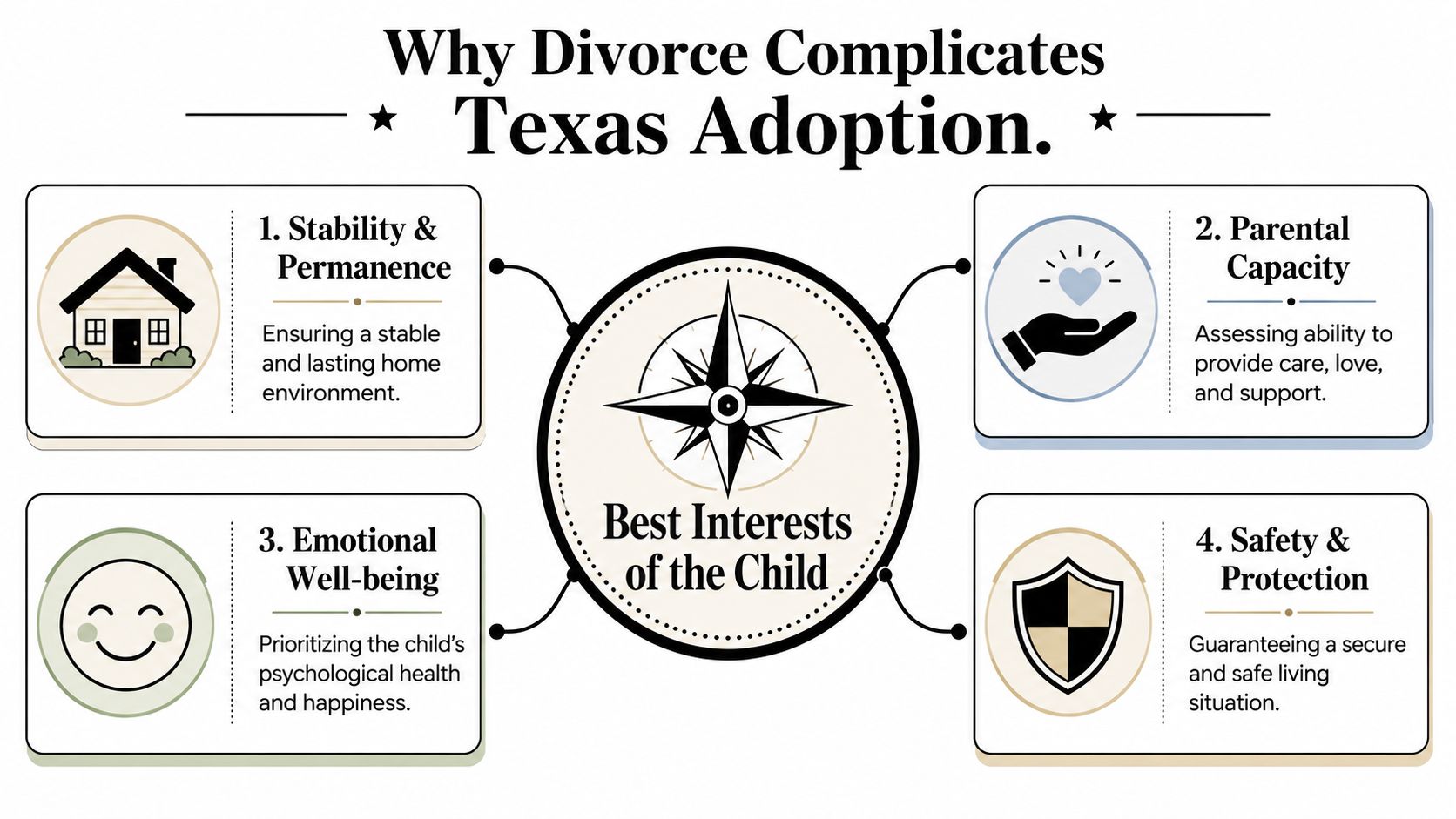
Texas family courts keep returning to one central idea in adoption cases: the best interests of the child. Under the Texas Family Code adoption framework, including Chapters 162 through 166, the court is not just approving paperwork. The judge is deciding whether a legal parent-child relationship should be created because that outcome protects the child's long-term welfare.
A pending divorce makes that decision harder because it introduces uncertainty into a process that is supposed to create permanence.
What the court is really looking at
When judges, agencies, and evaluators review an adoption during a divorce, they usually look past the label of “married” or “separating” and focus on practical stability.
They may look closely at:
- Living arrangements. Where will the child sleep, attend school, and spend daily life if the adults no longer live together?
- Financial ability. Can the person seeking to continue the adoption support the child after separation?
- Parenting capacity. Is the remaining applicant emotionally and practically ready to parent during a stressful transition?
- Consistency. Will this child face another major disruption if the adoption proceeds in a rapidly changing home?
A pending divorce can turn what began as a routine joint adoption into a higher-scrutiny single-applicant case or require the parties to restart under a different adoption category because courts and agencies may re-evaluate household stability, finances, and parental fitness when divorce changes the adoption path.
Why “best interests” matters so much in Texas
Texas adoption law is built around permanency. Chapter 162 addresses adoption procedures, while related chapters and family-law rules guide issues like evaluations, reports, and the court's authority to approve or reject a petition. In everyday terms, the judge wants confidence that the legal order entered today will still make sense for the child after the adults' conflict settles.
A divorce doesn't just change your relationship status. It changes the evidence the court relies on to decide whether adoption is the right permanent step for this child.
That is why even a sincere, loving prospective parent may face extra questions. The court isn't punishing divorce. The court is testing whether the child's future remains secure despite it.
How Divorce Affects Different Adoption Scenarios
Not every Texas adoption responds to divorce in the same way. A stepparent adoption raises one set of problems. A private agency match raises another. A foster or kinship matter may involve different decision-makers, different reports, and a different practical reality if the child already knows the home.
A side-by-side look
| Adoption Type | Primary Challenge During Divorce | Can it Proceed? | Key Consideration |
|---|---|---|---|
| Stepparent adoption | The marriage to the child's parent is the foundation for the adoption | Sometimes, but often becomes difficult if the relationship is ending before finalization | Whether the stepparent will still have legal standing if the adoption is not yet final |
| Private domestic adoption | Agency, birth parent, and court may have approved a two-parent household | Sometimes, but the case may need to be reworked as a single-parent adoption | Whether the original placement decision depended on a married-couple plan |
| Kinship or relative adoption | The child may already have family ties and a current placement in the home | Sometimes, especially if one caregiver can show independent stability | Whether the remaining caregiver can meet the child's needs alone |
| Foster care adoption | The state and agency may treat the divorce as a major change in circumstances | Sometimes, but disclosure and re-evaluation are likely | Whether permanency with one caregiver still serves the child's well-being |
Stepparent adoption
This is often the most emotionally confusing scenario. A stepparent may already function like a parent every day. But until the adoption is final, legal rights can remain incomplete.
In Texas, once a stepparent adoption is finalized, the child is treated the same as a biological child in divorce proceedings. If the divorce happens before finalization, the stepparent may have no legal standing to seek conservatorship or visitation under this Texas-focused discussion of adoptive child custody in divorce.
That's why timing is so important in stepparent cases. If you're dealing with this specific situation, it may help to review uncontested stepparent adoption in Texas to understand how finalization creates legal parent status.
Private agency adoption
Private adoptions can become complicated fast because more than one person may have relied on the original family structure. The agency may have approved a married household. A birth parent may have selected a couple, not one person. The court may need updated reports before allowing the matter to continue.
If the divorce involves mistrust or allegations like cheating, practical family-law issues can spill into the adoption too. In that setting, some readers find it useful to understand what to know about infidelity and divorce because those disputes often affect communication, disclosure, and decision-making.
Kinship and foster care adoption
These cases can be more flexible in practice because the child may already be placed with family or with a foster parent. The court may focus less on the loss of a two-parent household and more on whether one caregiver can continue providing a stable, safe, familiar home.
A grandmother adopting a grandchild, for example, may still move forward after separation from a spouse if she can show steady housing, income, and daily caregiving history. A foster parent in a pending divorce may face close review, but not every case ends automatically.
The closer the child's current life is tied to one dependable caregiver, the more the court may focus on preserving that stability rather than starting over.
Procedural Steps When Divorce Happens Mid-Adoption
The most important thing you can do is act quickly and tell the truth. A divorce in the middle of an adoption is not the kind of change you can quietly “wait out.” Agencies, social workers, and courts expect disclosure because your household circumstances have materially changed.

Step one is disclosure
Start by notifying the people involved in the case:
- Your adoption attorney. You need to know whether the current petition is still viable.
- Your agency or social worker. They may require updated evaluations or reports.
- The court, through proper filings. If the original petition listed two spouses, the paperwork may need to be amended.
Texas adoption procedure under Chapters 162 through 166 often involves petitions, required consents, evaluations, and a final hearing. If your family structure changes, those filings may also need to change. In many cases, the legal issue becomes whether a joint petition should be converted into a single-parent adoption request.
Update the evidence, not just the forms
Paperwork alone won't fix the problem. The court may need a revised picture of your home.
That can include:
- A new home study or update showing where the child will live now
- Fresh financial records reflecting your current income and expenses
- An updated care plan for school, childcare, transportation, and medical needs
- Corrected personal information about who is still seeking to adopt
If you're trying to understand how family court expects preparation and evidence to come together, this overview may help.
Think through the practical parenting questions
A judge may ask questions that feel very ordinary, but they carry legal weight. Who will pick the child up from daycare? Where will the child stay during work hours? How will you manage transitions if the child has already formed bonds with both adults?
Those details matter because adoption is about creating a durable parent-child relationship, not just finishing a legal process. In Texas, some families choose to get advice from a firm that handles both adoption and family-law litigation, such as Law Office of Bryan Fagan, PLLC, because mid-adoption divorce issues often touch both areas at once.
Consent and the Rights of All Parties
Consent is one of the most sensitive parts of any adoption. Texas law in Chapters 161 and 162 separates two ideas that people often blur together: ending one person's parental rights and creating a new parent-child relationship through adoption. Your divorce may affect the second issue even when the first issue is already underway.
When the original consent was built around a couple
If a birth parent chose you and your spouse together, a later divorce can raise a serious question: does the original placement still reflect what that birth parent agreed to? The answer may depend on the language of the consent, the stage of the case, and whether the court believes the revised one-parent plan still protects the child.
That doesn't mean consent always disappears. It means the court may need to revisit whether the legal and factual basis for adoption has changed too much.
When one spouse stops agreeing
Sometimes one spouse decides not to continue. Sometimes that spouse actively objects to the other moving forward alone. In a joint adoption, that conflict can matter because the original petition and shared intent may no longer exist.
The finalization of an adoption creates a legal parent-child relationship equivalent to a biological one. If divorce occurs before the final decree, the adoption itself can fail. If it happens after, the parent-child bond is generally preserved and custody and support are handled under ordinary family law as explained in this discussion of divorce and adoption finalization.
Consent problems become harder when the adults' story changes after the case was filed but before the judge signs the final order.
Termination of the other parent's rights
Readers also ask whether their divorce changes the need to terminate another biological parent's rights. Usually, that is still a separate legal question. If a biological parent's rights must be ended before the adoption can proceed, that issue still has to be handled correctly under Texas law.
For a fuller look at that process, including how parental rights cases connect to adoption, see termination of parental rights in Texas.
A practical example helps. If a child's biological father is absent and the adoptive petition was filed by a married couple, the couple's later divorce doesn't automatically erase the need for a valid termination process. It may, however, change who is asking to adopt once that termination is complete.
Weighing the Risks and Creating a Strategy
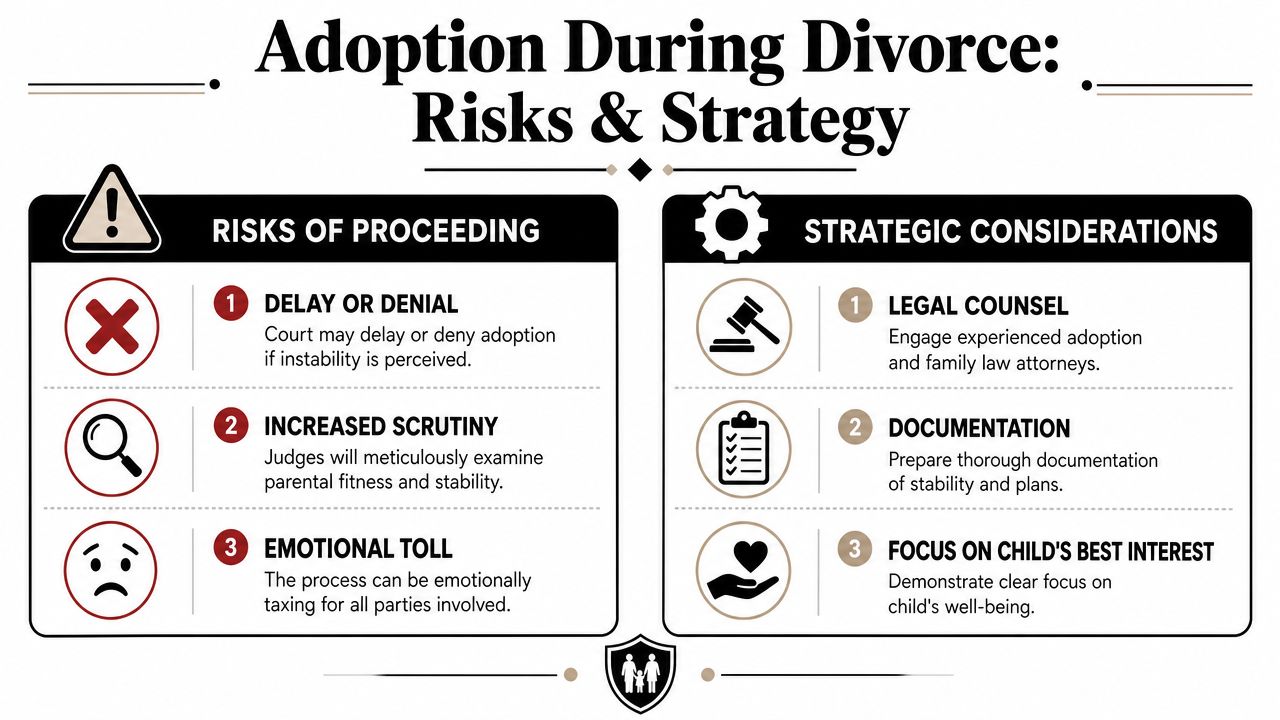
There are moments when pushing forward makes sense. There are other moments when pressing ahead mainly increases the chance of delay, denial, or more disruption for the child. The hard part is knowing which moment you're in.
A divorce during the adoption process is often treated as a significant change in circumstances requiring disclosure. In foster or relative placements, the child may still remain in the home if the remaining caregiver can independently show stability and meet the child's needs under this discussion of divorce during adoption proceedings.
When continuing may make sense
Some cases have a realistic path forward. For example:
- One parent has been the clear primary caregiver and can document daily responsibility.
- The child is already closely bonded to one household member whose continued care would reduce disruption.
- The legal filings can be amended cleanly to match the new reality.
- The adults can cooperate enough to avoid creating more instability around the child.
In some divorces, a negotiated agreement can help reduce conflict while the adoption path is sorted out. In Texas family practice, that may include a Rule 11 agreement if the parties can put clear terms in writing through counsel.
When pausing is the wiser choice
Pausing an adoption is not giving up. In many families, it is the most child-centered decision available.
Pause may be the better strategy when:
- Housing is still changing
- Income is uncertain
- The other spouse may contest the process
- The original placement depended strongly on a two-parent home
- You need time to rebuild your case as a single applicant
Sometimes the strongest move is to stabilize first and adopt second.
That may feel disappointing. It may even feel unfair. But adoption courts are not grading your hope or your love. They are deciding whether this specific legal step, at this specific moment, protects the child from further upheaval.
Frequently Asked Questions
What divorce documents might the court or agency ask for?
That depends on the case, but be prepared to share pleadings that show a divorce has been filed, any temporary orders, updated financial information, and current living arrangements. If your home study or agency file still describes a married household, those materials may need to be corrected.
If we reconcile, can we switch back to a joint adoption?
Possibly, but it usually isn't automatic. The court or agency may want updated records showing the household is stable again. If the case has already been changed to a single-applicant path, your attorney will need to determine whether the petition should be amended again.
Does it matter who filed for divorce?
Usually, the court's main concern is not who filed first. The larger issue is whether the child will have a stable, permanent home and whether the facts in the adoption file are still accurate.
Can a child stay in the home while the adults divorce?
In some foster or relative-placement situations, yes. The deciding question is often whether the remaining caregiver can independently meet the child's needs and maintain stability.
If my stepparent adoption is almost finished, am I protected?
“Almost finished” and “finalized” are not the same thing. Until the final decree is signed, legal parent status may still be incomplete. That distinction matters in divorce.
Should I tell the agency right away, even if nothing is final in the divorce?
Yes. A pending divorce can affect consent, evaluations, placement expectations, and the court's review of the case. Early disclosure usually puts you in a stronger position than waiting and hoping the issue won't matter.
If your family is asking whether adoption can still move forward during a divorce, careful legal advice can make a real difference. The Law Office of Bryan Fagan, PLLC helps Texas families understand adoption procedure, parental rights, and next-step planning with compassion and clarity. If you'd like guidance specific to your situation, you can schedule a free consultation and talk through your options in plain English.
