
Same-sex couples absolutely can and do adopt in Texas. In Texas, 23% of same-sex couples are raising children, and 18% of same-sex couples with children have an adopted child, compared with less than 3% of different-sex married couples with children.
If you're reading this, you may be sitting at the kitchen table with your partner, talking about baby names, agency options, or whether the law will treat your family fairly. That mix of hope and worry is real. Many couples don't just want a yes-or-no answer. They want to know what the road looks like, where it gets bumpy, and how to protect their child and both parents from the start.
Texas adoption law can feel intimidating at first. But when you break it down into plain steps, it becomes much more manageable. The heart of the process is still the same as it is for any family. The court wants to know that the adoption is in the best interests of the child and that the legal paperwork has been handled correctly.
Yes You Can Build Your Family Through Adoption in Texas
A lot of couples start here with one quiet question. Can same-sex couples adopt in Texas? The answer is yes, and not just in theory. Families across Texas are already doing it.

One couple may be planning a private infant adoption. Another may already be raising a child and wants the non-biological parent legally recognized. Another may be looking into foster care because they have room in their home and heart for a child who needs permanence. The legal path may differ, but the purpose is the same. You want your family to be secure.
The data shows this isn't a rare issue. The Williams Institute report on same-sex couples in Texas found that more than one in five same-sex couples in Texas (23%) were raising children under age 18, and more than 18% of same-sex couples with children had an adopted child, compared with less than 3% of different-sex married couples with children. That tells us something important. Adoption isn't a side issue for LGBTQ+ families in Texas. It's a common and meaningful way people become parents.
Why this question feels bigger than paperwork
When hopeful parents ask about adoption, they're often asking several questions at once:
- Can we both be legal parents
- Will an agency work with us
- Will a judge approve our case
- What happens if one of us is the biological parent already
Those are good questions. They deserve plain answers.
Adoption isn't just about bringing a child home. It's about creating a legal bond that protects your child in school, health care, inheritance, and everyday life.
If you're early in the process, it may help to start with a broad overview of gay and adoption issues in Texas and then narrow down the path that fits your family. Some couples need a joint adoption. Some need a stepparent adoption. Some unmarried partners need a more careful second-parent strategy.
What matters most at the start
Texas doesn't ask whether your family looks traditional. The legal questions usually center on fitness, procedure, consent, and the child's best interests. That means preparation matters. Clear paperwork matters. Choosing the right adoption route matters.
For many couples, the hardest part is not whether adoption is allowed. It's figuring out which legal lane applies to them.
The Legal Foundation of Same-Sex Adoption Rights
The turning point came on June 26, 2015. After the U.S. Supreme Court decided Obergefell v. Hodges, same-sex couples had the constitutional right to marry nationwide, and that changed adoption practice in a very practical way.
For married couples in Texas, that ruling helped align adoption rights with marriage rights. A married same-sex couple could move through the process with the same general legal access as other married couples. Texas legal guidance also notes that for adoptions ordered on or after June 26, 2015, the state can issue amended supplemental birth certificates listing same-sex adoptive parents. The Texas adoption guidance discussing the post-Obergefell change explains that this was a concrete sign of legal recognition, not just a symbolic one.
What this means in everyday life
That legal recognition matters in ordinary moments, not just in court. Think about the forms parents sign at school, the authority needed during a medical emergency, or the ability to travel with a child without legal uncertainty. An adoption order gives a family stronger footing than assumptions or informal understandings.
For readers who want a larger view of the statutes, this guide to Texas adoption and the Family Code is a helpful place to see how Texas Family Code Chapters 162 through 166 shape adoption procedure, termination issues, and related court steps in plain language.
Why formal parentage still matters
Marriage helps. It doesn't erase every legal question.
Texas family law practice has long taught one lesson clearly. If one parent is biological and the other is not, or if a child came into the family through a prior relationship, assisted reproduction, or an earlier adoption, it's wise to secure a formal adoption order whenever possible. That order is often the cleanest legal protection for the non-biological parent.
Practical rule: If you want both parents fully protected, don't rely on assumptions about parentage when a court order is available.
Another point often causes confusion. Texas does not prohibit same-sex couples from adopting, but the route can change depending on whether the couple is married and whether one parent's rights already exist. In many cases, sexual orientation isn't the primary concern. It's whether the law allows the second parent to be added without cutting off another legal parent's rights.
That is why consent forms, prior orders, surrender documents, and parentage records matter so much. Texas courts don't just ask, "Do these adults love this child?" They also ask, "Have the legal prerequisites been satisfied under the Family Code?"
Choosing Your Adoption Pathway as a Couple
Not every same-sex couple in Texas uses the same adoption route. The right path depends on your relationship status, whether one of you is already the child's legal parent, and whether you're adopting a child together for the first time.
The three most common pathways
Stepparent adoption usually fits when one spouse is already the child's legal parent and the other spouse wants full legal parental rights too. This often comes up after one parent has a child from a prior relationship or where one parent has an existing legal connection to the child. In Texas, this route usually requires the other legal parent's consent or written surrender of rights, unless the court has already terminated those rights.
Joint adoption is usually the clearest route for married couples adopting a child together. In that situation, both spouses typically petition together. The process is substantively similar to what other married couples follow, although local practice can still affect timing and paperwork expectations.
Second-parent adoption or a sequential strategy often becomes the focus for unmarried partners. Many couples are often surprised by this.
The Texas Law Help explanation of same-sex parentage notes that unmarried same-sex couples can adopt in Texas, but they are often required to proceed as two single people jointly adopting the same child, with one partner adopting first and the other following after a minimum six-month delay. That is very different from a married couple filing as a unit from the beginning.
Texas adoption pathways for same-sex couples
| Adoption Type | Who It's For | Key Consideration |
|---|---|---|
| Stepparent adoption | Married couples where one spouse is already the child's legal parent | Consent or surrender of the other legal parent's rights may be required |
| Joint adoption | Married couples adopting a child together | Both spouses usually petition together, but county practice can affect details |
| Second-parent or sequential adoption | Unmarried partners seeking legal rights for both adults | One parent may need to adopt first, and the second may have to wait before completing their own adoption |
Where couples often get stuck
The legal confusion usually sounds like this: "We're committed. We live together. We're raising this child together. Why can't we just file jointly if we're unmarried?"
The answer is that Texas practice doesn't always treat an unmarried couple as a single legal unit for adoption purposes. That doesn't mean you can't both become legal parents. It means the sequence may be different, and timing becomes part of the legal strategy.
If you're unmarried, don't assume your process will mirror a married couple's case. The structure may be different even when the goal is the same.
This can also connect with family planning choices made before adoption is even on the table. Some couples first explore assisted reproduction, and a practical overview like Bornbir's IUI vs IVF comparison can help families think through the different roads to parenthood before they settle on an adoption or parentage plan.
How to choose the safest route
Ask these questions early:
- Are we married under current law
- Is one of us already a legal parent
- Does another legal parent still have rights that must be addressed
- Are we working with an agency, private placement, foster care case, or family adoption
- Will the court require a home study, background checks, or additional filings in our county
If you're comparing professionals, it also helps to look for LGBT-friendly adoption agencies in Texas that understand the difference between a standard joint adoption and a more technical parentage-protection case.
Your Step-by-Step Guide to the Texas Adoption Process
You have finished a long intake call, gathered your records, and started wondering what happens next. That is a normal moment in any adoption case. Texas adoption usually follows a clear sequence, but the path can feel different depending on whether you are a married couple pursuing a joint adoption or an unmarried couple planning for one partner to adopt first and the other to secure legal parentage in a separate step.
Chapters 162 through 166 of the Texas Family Code set the legal framework. At the courthouse level, judges usually want to see three things. A legally complete file, a safe and stable home, and a plan that protects the child's best interests for the long term.
This visual overview helps many families see the process more clearly.
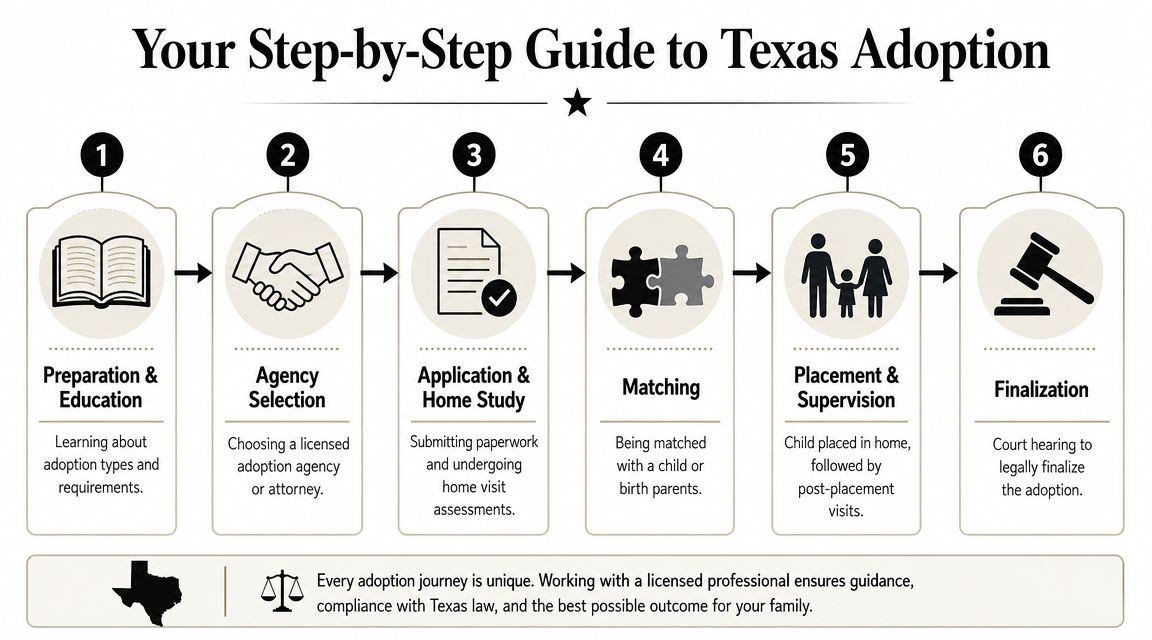
Step one through step three
Identify the legal path before you file anything
This first step shapes everything that follows. A private infant adoption, foster care adoption, stepparent adoption, kinship adoption, and a second-parent style case can all lead to the same result, but they do not use the same paperwork or timeline.For married same-sex spouses, the cleanest route is often a joint adoption if the case structure allows it. For unmarried partners, Texas may not treat you as one legal adopting unit at the start. In practice, that can mean one partner adopts first, then the other files a second-parent or related parentage action later. The family goal is the same. The legal sequence is different.
Choose the professionals who will guide the case
Some families work with a licensed agency. Others work directly with an attorney, especially in stepparent, relative, or already-placed child cases. Your team should understand how to handle consent, termination of any existing parental rights, and the extra planning that may be needed if only one partner can be listed as the initial adoptive parent.This choice matters in a practical way. An agency may have its own placement policies and comfort level with LGBTQ+ families, while a direct legal filing in the right type of case may involve fewer gatekeepers.
Complete the application, background checks, and home study
This stage makes many hopeful parents nervous. The home study works more like a safety check and preparation meeting than a test designed to catch you failing. A social worker reviews your home, your background, your finances, your relationships, and your readiness to parent.If you are married and adopting jointly, the home study usually evaluates both spouses together. If you are unmarried and one partner is expected to adopt first, ask early how the evaluator and agency will describe the household. That detail can affect how the case is presented and whether a later second-parent step will be needed.
Step four through step six
A lot of readers like to hear the process explained out loud as well as read on the page. This short video can help reinforce the basics before you meet with a lawyer or agency.
- Matching and placement
In an agency or private adoption, this is the phase where a child is matched with the adoptive home or a planned placement moves ahead. In a stepparent or second-parent case, there may be no traditional match because the child is already living with the family.
This is also where couples often see the practical difference between legal eligibility and agency discretion. A married couple may be considered for joint placement more easily in some settings. An unmarried couple may face questions about whether one partner will be the primary legal applicant, even if both adults are already parenting together day to day.
Post-placement supervision
After placement, Texas often requires follow-up visits or reports before finalization. These check-ins help the court confirm that the child is settling in well and that the placement remains safe and appropriate.For some same-sex couples, this period is emotionally complicated. You may already feel like a family, but only one parent may have full legal status until the case is finalized, or until a second filing is completed. That gap is one reason careful planning at the beginning matters so much.
Finalization in court
Finalization is the hearing where the judge reviews the file and signs the adoption order if the legal requirements have been met. Once that order is entered, the parent-child relationship becomes permanent and enforceable.For married spouses in a joint adoption, both names may appear in the same final order. For unmarried partners, final legal protection may take more than one court step. Couples are often surprised by that, so it helps to treat finalization as the end of a sequence, not always the end of a single hearing.
What families should keep in mind
- Paperwork drives the timeline: Missing consents, incomplete background materials, or unresolved issues involving another legal parent can slow the case.
- Parentage questions should be addressed early: This is especially true if one partner is already a legal parent or if an unmarried couple expects to complete the process in stages.
- The court focuses on stability: Judges want a clear record showing who the legal parents are and why the adoption serves the child well.
- The emotional experience varies by case type: A foster care adoption may involve transition and grief. A stepparent or second-parent case may bring relief after a long period of legal uncertainty.
The process can feel formal because the court is building a legal safety net around your family. Once you understand each step, the path usually feels far more manageable.
Navigating Potential Hurdles and Finding Supportive Agencies
Most same-sex couples move through the Texas adoption process under the same basic legal rules as other families. But honesty matters here. Some couples still run into practical barriers, especially at the agency level.
The Family Equality Texas LGBTQ family law guide notes that agency implementation can vary and that some child welfare providers may make placement decisions based on religious beliefs under a Texas law passed in 2017. The same guidance stresses why a formal adoption remains so important. Relying on marriage alone or presumed parentage can leave a family vulnerable if a dispute arises later.
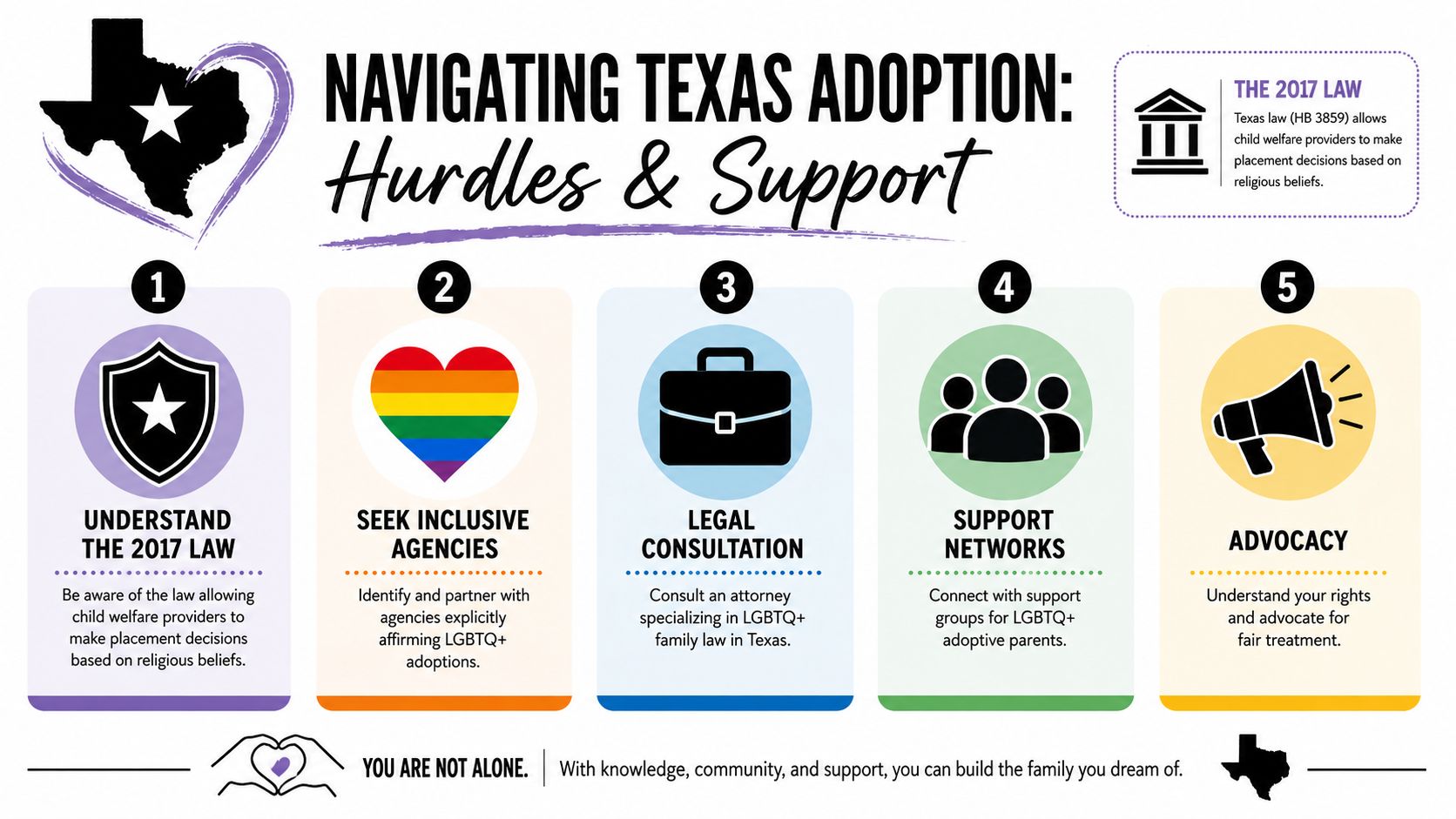
How to screen an agency before you invest time
Not every agency will be the right fit. You can save yourself heartache by asking direct questions early.
- Ask about LGBTQ+ placements: Request the agency's current policy and practical experience working with same-sex couples.
- Ask who will handle your file: A welcoming website doesn't always tell you how an individual worker or partner organization approaches these cases.
- Ask about referral networks: If the agency can't serve your family, ask whether they refer to affirming agencies, attorneys, or home study providers.
- Ask how they handle unmarried couples: This is one of the clearest ways to learn whether the agency understands the legal distinctions discussed above.
Signs that support is real
A supportive professional usually does more than say "all families are welcome." They can explain the paperwork, talk through parentage issues without hesitation, and help you think ahead about finalization, amended records, and long-term legal protection.
A good fit often sounds calm and concrete. "Here is the likely route for your case. Here is what consent issue we need to solve. Here is when we should file."
Some barriers are emotional. Others are procedural. The best support addresses both.
Keep your focus on legal security
If an agency gives you mixed signals, don't assume your adoption dream is over. It may mean that you need a different provider, a different county strategy, or a lawyer who can steer the case more precisely.
The most important goal is to leave the process with a court order that clearly protects your child and both parents. That order can matter years later in ways families don't always expect, from medical decisions to inheritance rights to travel and school records.
Adopting from Texas Foster Care
For some same-sex couples, foster care adoption is the path that feels most natural. They aren't just looking for a newborn placement. They want to offer stability to a child who needs a permanent family now.

This route often involves children who are older, part of a sibling group, or carrying the emotional weight of earlier disruptions. That doesn't make the experience less joyful. It just means the parenting journey may begin with trust-building, consistency, and patience.
What makes foster care adoption different
In foster care cases, the state's focus is first on child safety and permanency. If reunification is no longer possible and parental rights have been addressed by the court, adoption may become the long-term plan.
Families moving into this space often complete training, provide detailed household information, and work closely with caseworkers. The paperwork can feel heavy, but the purpose is to prepare the home and support the child, not to test whether a family is "perfect."
Children coming from foster care may need time to settle. They may react strongly to change, boundaries, or affection because of earlier losses. That is why many adoptive parents find it helpful to learn about connection and trust before placement. A simple outside resource like That's Okay's attachment theory guide can help parents think about why a child may cling, withdraw, or struggle during transitions.
A hopeful example
A couple may begin as foster parents, expecting to provide temporary care. Over time, they become the adults who show up for school meetings, doctor's appointments, bedtime routines, and hard days. The child starts calling for them when scared. The legal file still matters, but by then the family bond is already growing in everyday moments.
That is one reason foster care adoption can be profoundly meaningful. It joins legal permanence with emotional healing.
What to keep in view
- Trauma-informed parenting helps: Behavior often has a history behind it.
- Permanency matters for the child: Clear legal status can reduce uncertainty.
- Support systems matter for parents too: Community, counseling, and practical help make a difference.
If foster care is on your heart, don't let fear of complexity stop you from learning more. The process asks a lot, but it can also open the door to lasting family connection.
Begin Your Journey to Parenthood Today
A couple can reach the point of saying, "We are ready," and still feel unsure about the first legal step. That is normal. In Texas, the answer is yes, same-sex couples can adopt. The primary work is choosing the path that gives your child, and both parents, the strongest legal protection.
That choice often depends on one practical fact. Are you married, or unmarried?
For married couples, joint adoption is usually the clearest route. It places both spouses in the case from the start and ends with one adoption order recognizing both parents. For unmarried partners, the process can be more complicated. One partner may adopt first, and the other may need a later stepparent or second-parent style adoption strategy, depending on the facts of the case and what the court will allow. It works a bit like building a house with one blueprint versus adding a room later. Both can lead to a secure home, but the planning is different.
Agency choice matters too. Some agencies are welcoming and experienced with LGBTQ+ families. Others may use their own placement preferences in ways that make the process harder, even when the law allows the adoption. That does not mean your goal is out of reach. It means careful screening on the front end can save time, stress, and heartbreak later.
A good next step is simple. Sit down with someone who can explain which path fits your family, what paperwork will matter most, and how to protect both parents whenever Texas law allows it. Clarity turns a huge question into a series of manageable ones.
If you're ready to talk through your options, Law Office of Bryan Fagan, PLLC offers free consultations for Texas families exploring adoption, stepparent adoption, kinship adoption, foster care adoption, and LGBTQIA+ parentage questions. A confidential conversation can help you understand your next step and build your family with greater peace of mind.
