 Skip to content
Some families arrive at this question after years of already living like family. A stepfather helped with homework, sat through band concerts, and answered late-night calls from college. A grandmother raised a grandson into adulthood and wants the law to reflect what everyone already knows. A mentor, aunt, or longtime caregiver became the steady parent figure life didn't originally provide.
If that sounds like your story, you're not trying to create a bond out of thin air. You're trying to honor a bond that already exists.
Adult adoption in Texas often brings relief because it gives legal shape to something the heart settled long ago. It can offer clarity, permanence, and peace. For many families, that matters just as much as the paperwork. It says, in a way the court can recognize, “This is my parent,” or “This is my child.”
More Than a Legal Process A Lifelong Bond
Maria was raised by her stepdad from elementary school through adulthood. He taught her to drive, showed up when she got married, and helped her through hard seasons after her mother passed away. By the time she was an adult, they didn't need a label to feel like family. But they still wanted the law to recognize what their daily life had already proven.
That's the heart of Adult Adoption Texas cases. This process usually isn't about replacing love with legal forms. It's about matching the record to reality.

Some families come to this point after a stepparent relationship. Others come through kinship care, foster care, or years of informal parenting by a grandparent, aunt, uncle, or family friend. The stories differ, but the feeling is often the same. You want the law to catch up with the life you've already built together.
A helpful starting point is learning what adult adoption means in Texas. Once people see that this option exists, many feel less intimidated. They realize the law has room for families that were built through commitment, not just biology.
Why families choose this path
Adult adoption can carry emotional meaning, but it also gives legal certainty. That combination matters. Families often want:
- Recognition: The parent-child relationship becomes formally recognized by the court.
- Stability: Important future questions become clearer when the relationship is legally defined.
- Belonging: Many adults want their family identity reflected in official records, not just private memories.
Adult adoption often feels less like a beginning and more like a long-overdue acknowledgment.
For hopeful parents and adult children alike, the process can feel surprisingly tender. A brief court hearing may mark decades of care, sacrifice, and loyalty. That moment can be deeply moving because it validates a relationship that was already real long before anyone filed a petition.
Who Is Eligible for Adult Adoption in Texas
Texas law makes adult adoption much simpler than child adoption. The key idea is voluntary adult consent. Under Texas Family Code guidance summarized here, any adult who is at least 18 years old can be adopted in Texas if they provide their own written, voluntary consent. That same source explains that adult adoption does not require a home study or a CPS investigation because the court focuses on consent rather than the best-interest standard used in child cases.
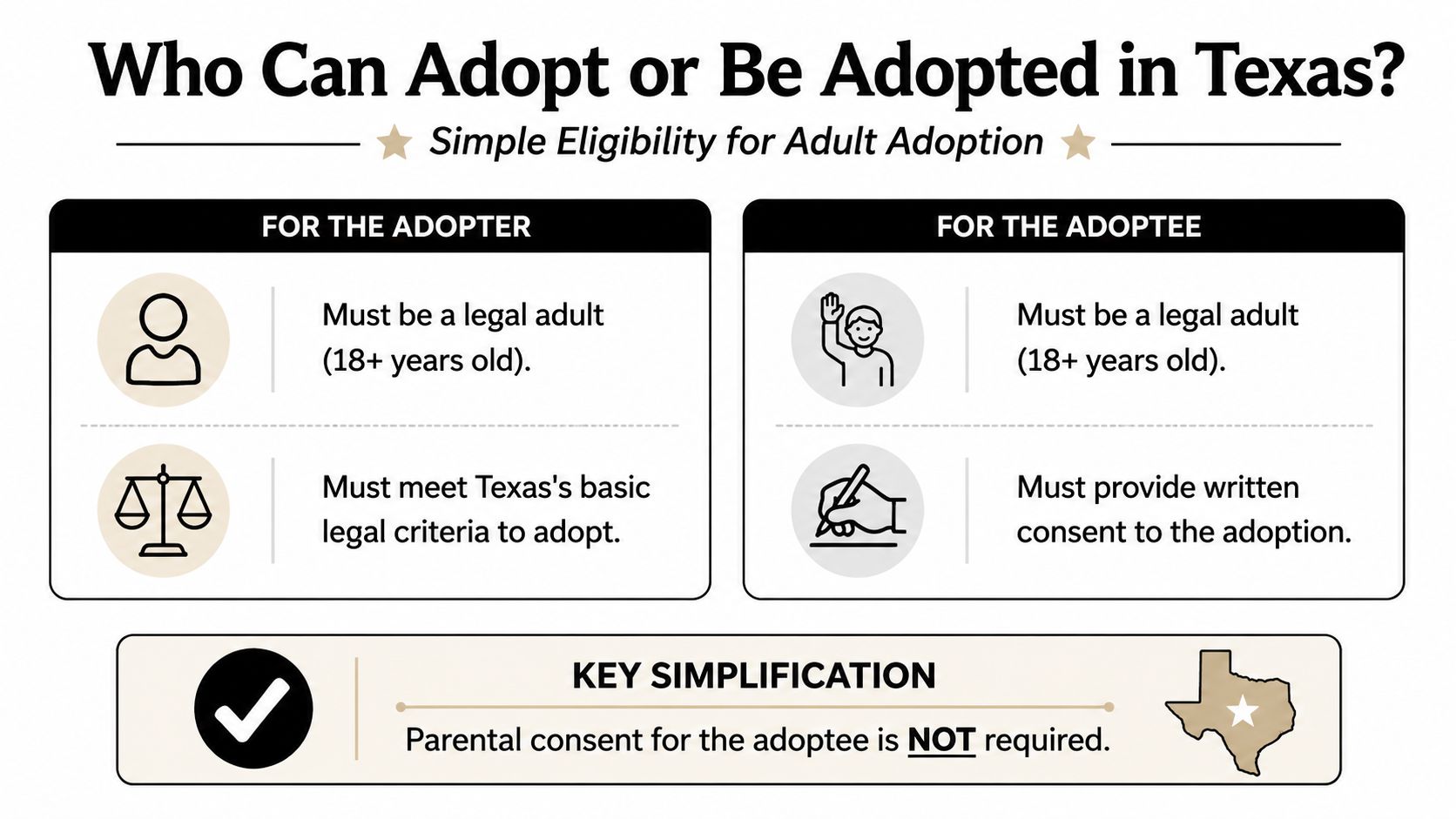
That difference answers one of the biggest points of confusion. Families often assume every adoption case works like a child adoption case. It doesn't. Texas Family Code Chapters 162 through 166 contain several adoption rules, but adult adoption follows its own path inside Chapter 162.
For the adopter
The person asking the court to adopt must be an adult residing in Texas. If that person is married, both spouses must jointly file the petition. That requirement surprises some couples, especially when only one spouse has the close bond with the adult adoptee.
Here's the practical reason. The court wants the legal family structure to be clear and consistent on the front end, rather than uncertain after the decree is signed.
For the adult being adopted
The adult adoptee must be at least 18 and must give written consent. This is not optional. The consent must be voluntary.
That written consent is the foundation of the case. In a minor adoption, the court's lens centers on the child's needs and legal protections. In an adult adoption, the court starts from the adult's autonomy. The law assumes adults can make this choice for themselves, so the court's main concern becomes whether the decision is informed and genuine.
What Texas doesn't require here
Many readers will find this information a relief. In a typical adult adoption case, Texas does not require:
- A home study: No one comes to inspect your home as part of this process.
- A CPS investigation: This isn't handled like a child welfare case.
- Biological parent consent: The adult adoptee's own consent controls.
- A background check tied to adult adoption procedure: The law does not set this up like a minor adoption screening process.
If you're exploring Adult Adoption in Texas, the simplest factual description is this: one adult legally adopts another, and the process is far simpler than a child adoption.
Practical rule: If the adult adoptee is willing, informed, and able to give written consent, you've already met the core legal question that drives most adult adoption cases.
Navigating the Adult Adoption Process Step by Step
The process feels less overwhelming when you break it into small, manageable actions. In uncontested cases, the path can often be completed in 30 to 60 days depending on local court scheduling, as explained in this Texas adult adoption process overview. That same source describes the basic path: file an Original Petition, obtain written consent, schedule the hearing, secure the signed Decree of Adoption, and update vital records.
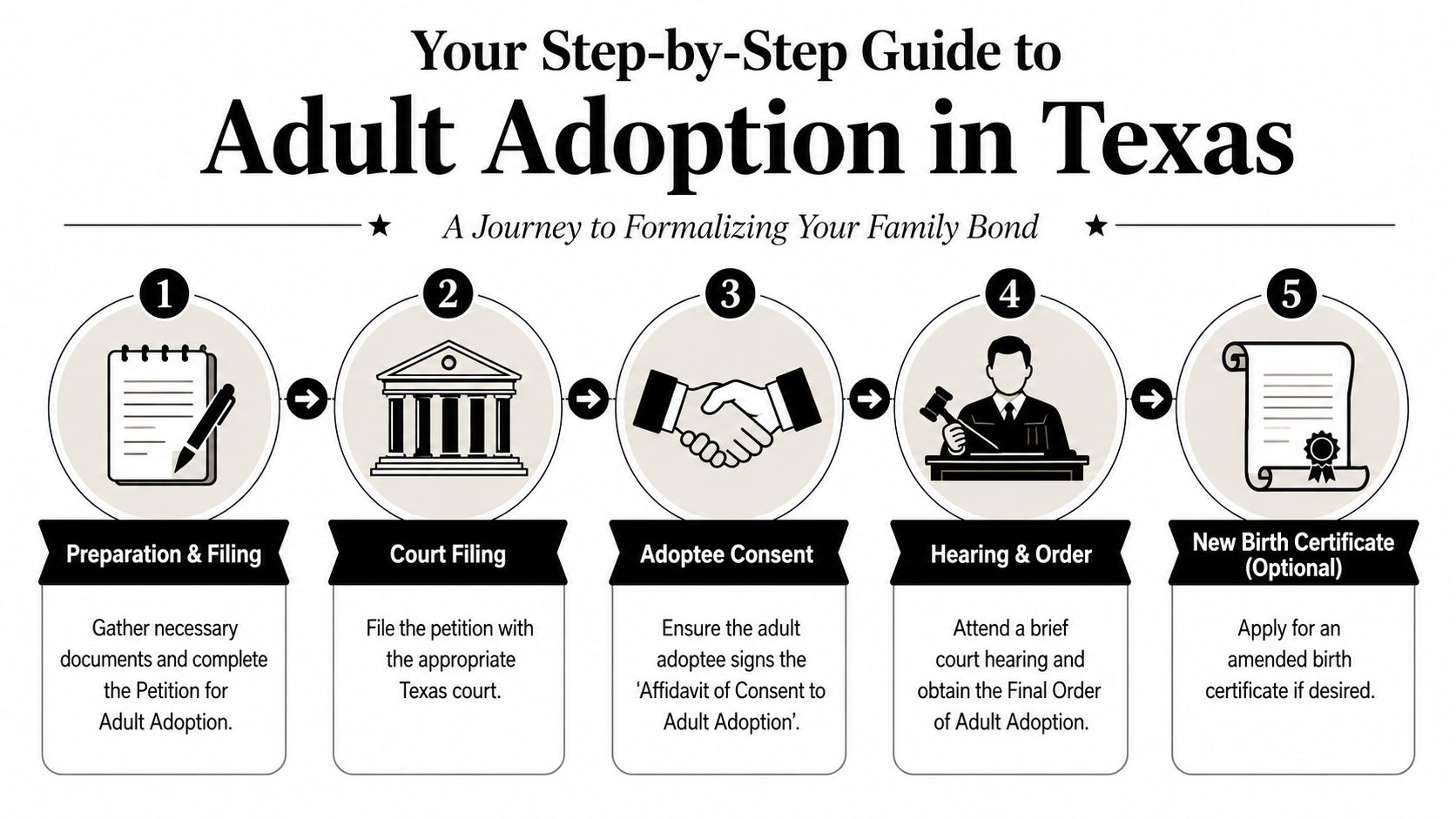
For many families, the most helpful resource at this stage is a plain-language guide on how to adopt an adult in Texas. It helps put the sequence in order before emotions and paperwork start mixing together.
Step one begins with the petition
The case starts when the petitioner files an Original Petition for Adoption of an Adult in the district court or a statutory county court with family law jurisdiction in the county where the petitioner lives. Filing in the right county matters because courts need proper jurisdiction before they can sign a valid order.
Some families hesitate here because they worry the petition has to tell a dramatic life story. Usually, it doesn't need drama. It needs accuracy. The petition tells the court who is involved and what legal change you're asking the judge to approve.
Written consent is the center of the case
The adult adoptee must sign written voluntary consent. This document matters because the court wants direct proof that the adoptee understands the request and agrees to it.
If your family speaks more than one language, make sure the adoptee fully understands every document before signing. In some situations, families use language solutions for Texas businesses when they need clear translation support for formal paperwork and communication. The goal is simple. Consent should be informed, not rushed.
The court date is usually straightforward
After the paperwork is filed, the hearing gets scheduled. Many courts handle uncontested adult adoptions in a brief setting. The judge typically wants to confirm that the legal requirements are met and that the consent is voluntary.
Both the petitioner and the adult to be adopted are generally required to attend personally, although a court may waive attendance for good cause through a written order. That detail matters if someone has serious health issues, travel barriers, or other unusual circumstances.
Here's the video version if you prefer seeing the process explained visually.
The judge signs the decree
If everything is in order, the judge signs the Decree of Adoption. This is the document that changes the legal relationship.
The decree isn't just ceremonial. It's the court order that creates the new legal parent-child status. That's why details matter. Names, consent forms, and filing steps need to be correct before the hearing.
Final records still matter after court
After the decree is signed, the paperwork usually continues with vital records. The process described in the same Bryan Fagan source includes filing the signed decree and submitting the VS-160 Certificate of Adoption with the VS-140 Birth Record Application to the Texas Vital Statistics Unit for an amended birth certificate.
Families sometimes assume the hearing ends everything. Emotionally, it may. Administratively, there's still a final clean-up stage.
- File the signed decree: This puts the court's final order into the official case record.
- Handle birth record paperwork: This is how families seek an amended birth certificate.
- Keep certified copies: You may need them later for estate planning, identity documents, or other legal records.
Bring organized copies of every filed document to the hearing. Even in simple cases, that small habit reduces stress.
The Legal Effects of an Adult Adoption Decree
When the judge signs the decree, the relationship changes in a meaningful legal way. Under this Texas adult adoption summary, an adult adoption creates a legal parent-child relationship for all purposes, including full inheritance rights identical to a biological child, while also severing inheritance rights from the biological parents. That same source explains that biological parent consent is not required and that adult adoption has no effect on federal immigration status.
Inheritance rights become clear
For many families, this is the most important legal effect. If a stepparent raised an adult child for years, adult adoption can place that child in the same inheritance position as a biological child.
That can be especially important in blended families. Without clear legal planning, families sometimes worry about future disputes, confusion, or painful misunderstandings after a death. Adult adoption may reduce that uncertainty by clearly defining the legal relationship.
Key point: Adult adoption is not only symbolic. It can directly affect estate rights and family decision-making later.
If inheritance planning is part of your reason for adopting, it also helps to review broader estate tools. Some families start by comparing a guide on online will generators for individuals with more formal legal planning options so they can understand what adoption changes and what a separate will should still address.
The family relationship becomes legally permanent
Once the decree is signed, the adoptee becomes the legal son or daughter of the adoptive parent or parents. That can bring emotional peace, but it also creates a clearer legal identity.
A simple example helps. If an adult daughter has always introduced her stepfather as “my dad,” the decree makes that description legally accurate, not just socially understood. For many people, that alignment feels powerful.
Name change questions need careful handling
Many families also want to know whether the adult adoptee can change their name as part of the adoption. That issue can come up naturally, especially when someone wants their legal identity to match the family name they've used informally for years.
The practical takeaway is that name-related questions should be handled carefully in the paperwork and court order. Families shouldn't assume every desired name update happens automatically in every situation. A careful review of the petition, decree language, and vital records steps can prevent later frustration.
Immigration is a separate issue
This point deserves a plain answer because it causes a lot of confusion. Adult adoption does not change federal immigration rights.
If a family is hoping an adoption will help with immigration status, they need separate legal advice in that area. Adult adoption may create a valid family relationship under Texas law, but it does not create federal immigration benefits.
Adult Adoption vs Adult Guardianship in Texas
Families often use these terms as if they mean the same thing. They don't. Adult adoption is about creating a permanent legal family relationship. Adult guardianship is generally about decision-making authority when an adult can't manage personal or financial matters independently.
A fuller comparison of guardianship and adoption in Texas can help if your family is deciding which path fits your situation.
The core difference
If two adults want to formalize a parent-child bond, adoption may fit. If an adult needs protection because they cannot safely handle their own affairs, guardianship may fit better.
That difference matters because the purpose of the case shapes everything else. One path recognizes family identity. The other addresses capacity and care.
Adult Adoption vs Adult Guardianship
| Feature | Adult Adoption | Adult Guardianship |
|---|---|---|
| Purpose | Creates a legal parent-child relationship | Gives someone authority to help manage another adult's affairs |
| Focus | Family bond and permanence | Protection and decision-making |
| Consent | Centers on the adult adoptee's voluntary agreement | Often involves questions about the adult's ability to make decisions |
| Duration | Permanent once granted | Typically continues as long as the legal need exists |
| Emotional meaning | Often formalizes an existing family identity | Often addresses safety, care, and practical support |
| Typical question | “We already feel like parent and child. Can the law reflect that?” | “My loved one is vulnerable. Who can legally help?” |
A quick example
A stepmother who raised her husband's son into adulthood may seek adult adoption because the relationship already feels permanent and mutual. By contrast, a family caring for an elderly relative with serious cognitive decline may need guardianship because someone must legally act on that adult's behalf.
Those are two different legal needs, even if both come from love.
Common Questions and How We Can Help
Some questions don't show up until families are almost ready to file. Others carry old pain, especially if your family history includes CPS involvement, estrangement, or years of informal caregiving.
One of the hardest questions is whether adult adoption can reconnect a parent and child after an earlier CPS termination. TexasLawHelp notes that this is a distinct legal question from a standard adult adoption because it can intersect with prior court orders involving a minor, and there is no specific data on court rulings in that area in the source discussed here through this TexasLawHelp adult adoption toolkit. In plain terms, that means families should be careful about assuming a standard adult adoption automatically resolves old juvenile court issues.
Questions families ask most often
- Do we need a home study? In a standard adult adoption, no. That's one reason many families find this process less burdensome than child adoption.
- Do biological parents have to agree? The earlier legal rules discussed above place the focus on the adult adoptee's written voluntary consent.
- Can this help with immigration? No. Adult adoption under Texas law doesn't change federal immigration rights.
- Will we have to go to court? Usually yes, although attendance may be waived for good cause if the court signs a written order.
- How long does it take? Many uncontested cases move on the timeline discussed earlier, though scheduling and paperwork still matter.
When the emotional side is harder than the legal side
Sometimes the forms are the easy part. The hard part is naming the relationship out loud. An adult adoptee may worry about hurting a biological parent's feelings. A stepparent may feel awkward asking for a legal title after years of consistent presence. A grandparent may fear that wanting legal recognition sounds selfish when it really comes from devotion.
Those feelings are normal.
The law can formalize a relationship, but the decision usually grows out of years of trust, grief, loyalty, and love.
For families comparing options, the broader adoption environment in Texas can feel confusing because child adoption, stepparent adoption, kinship care, CPS matters, open adoption choices, and guardianship all follow different rules. Chapters 162 through 166 of the Texas Family Code govern adoption-related procedures, but the practical path depends on the kind of family relationship you're trying to protect.
Getting support before filing can prevent delays
Even an uncomplicated case benefits from careful preparation. Clear consent language, correct filing location, accurate decree terms, and complete vital records steps can make the difference between a smooth hearing and a frustrating delay.
One factual option families sometimes consider is the Law Office of Bryan Fagan, PLLC, a Texas family law firm that handles adoption and guardianship matters across the state, including adult adoption questions.
If your family is standing at that threshold now, take heart. You don't have to sort through every legal detail alone, and you don't have to apologize for wanting the law to recognize the family you've already built.
If you're considering adult adoption in Texas and want clear guidance specific to your family's story, schedule a free consultation with Law Office of Bryan Fagan, PLLC. A thoughtful legal review can help you understand your options, prepare the right documents, and move toward formalizing a bond that already feels like family.

