
You may be sitting at your kitchen table with a notebook open, a list of baby names in the margin, and one hard question in the center of the page. How much does it cost to adopt a child in Texas?
That question can feel heavy because adoption is both emotional and practical. You're thinking about love, permanence, and family. At the same time, you're wondering how to budget for court filings, home studies, agency fees, and legal help without losing sight of the child you hope to welcome home.
The good news is that there isn't just one answer. In Texas, adoption costs depend largely on which kind of adoption you're pursuing. A private infant adoption has a very different financial path than a stepparent adoption, a kinship case, or an adoption through foster care. Texas law also shapes the process at each stage, especially in Texas Family Code Chapters 162 through 166, which cover adoption procedures, required consents, termination issues, confidentiality rules, and related family law protections.
Families often feel calmer once they can see the numbers in context. A written budget can help, and some parents also find it useful to review practical savings ideas such as FloosYo's saving strategy while they prepare for adoption-related expenses.
Your Dream of Adoption and The Question of Cost
Adoption usually starts long before any paperwork is filed. It starts when a family imagines a child in the home, a seat at the table, and a future built together. Then the financial questions arrive, and they can make a hopeful plan feel uncertain.

Texas adoption law is designed to protect children and create stable legal parent-child relationships. Under the Texas Family Code, that means courts look closely at consent, termination of parental rights when required, home studies, and whether the adoption serves the best interests of the child. Those legal safeguards matter, but they also affect cost.
Why families get confused about price
Many people search for one number. They want a single price tag. Adoption doesn't work that way.
A family adopting through a private agency may pay for matching services, a home study, legal work, and other adoption-related expenses. A stepparent may only need a much narrower court process. A foster family may face very little out-of-pocket cost because the state covers major parts of the process.
Practical rule: The type of adoption usually drives the cost more than anything else.
The other source of confusion is timing. Some expenses come early, like preparation and paperwork. Others come later, such as finalization costs in court. That's why a realistic budget should track both the total cost and when the expense will likely arise.
The legal path matters as much as the budget
Texas Family Code Chapter 162 focuses on the adoption itself, including the court order that makes the child legally yours. Related chapters address consent, confidentiality, and procedures that may affect birth parents, relatives, and caregivers. In plain terms, the law is trying to make sure the adoption is valid, secure, and built to last.
That's also why legal guidance matters. Families often don't need more pressure. They need a clear map.
The Spectrum of Texas Adoption Costs at a Glance
The biggest cost question in Texas isn't “Is adoption expensive?” It's “What kind of adoption are you pursuing?”
Some paths are highly structured and cost-intensive because they involve an agency, matching, and extensive legal coordination. Others are more direct because the child already knows the family, as in many stepparent and relative adoptions. If you're exploring Stepparent Adoption in Texas, that's one of the most common Texas adoption paths and it works very differently from a private infant placement.
Typical Adoption Costs in Texas by Type (2026 Estimates)
| Adoption Type | Typical Cost Range |
|---|---|
| Foster care adoption through DFPS | $0 to $5,000 total in most cases according to McCarty Larson |
| Private domestic adoption | $25,000 to $50,000 according to Angel Adoption |
| Private domestic agency adoption for a healthy infant | $40,000 to $45,000 according to Ramos Family Law |
| Stepparent or second-parent adoption | $2,000 to $3,000 according to Tapestry Adoption |
| Relative or kinship adoption | Often follows a cost structure similar to stepparent adoptions, though the exact cost depends on the legal issues involved |
Why the ranges are so different
Private infant adoption often costs more because several parts of the process are bundled together. Families may be paying for agency involvement, legal representation, a home study, and court compliance. Some expenses are legally required, not optional.
Foster care adoption is different because the state plays a larger role. Texas families adopting through DFPS generally don't pay agency or home study fees, which changes the cost picture dramatically.
Stepparent and relative adoptions usually cost less because there's no matching process. The child is already in a family relationship or established caregiving relationship, so the legal work centers more on obtaining the proper court orders and addressing any needed consent or termination issues.
A simple way to think about budgeting
Use these three questions first:
- What path fits your family? Your relationship to the child often determines the process.
- What legal steps are required? Consent and termination issues can affect complexity.
- When do fees come due? A lower total cost can still feel stressful if expenses arrive all at once.
A good adoption budget isn't just about the final number. It's about understanding what each payment is for and when your family will need it.
Deconstructing Private and Agency Adoption Fees
Private adoption is often the path families picture first. They may be hoping to adopt a newborn, work with an agency, and build an open or semi-open relationship with a birth parent. It can be a meaningful process, but it's usually the most expensive one in Texas.
For a healthy infant, private domestic agency adoption in Texas typically ranges from $40,000 to $45,000, and the agency fee alone often accounts for $20,000 to $50,000 of the total cost, making it the largest share of the expense, according to Ramos Family Law.
Families are often surprised by that spread. The reason is that “agency fee” doesn't mean a single simple task. It often reflects the work involved in screening, education, matching, support, coordination, and case management.
What private adoption fees usually include
Another Texas cost benchmark places private domestic adoption between $25,000 and $50,000, with major cost categories including program fees of about $23,700, legal expenses of $2,000 to $5,000 or more, and home studies of $1,500 to $3,000, according to Angel Adoption.
That broad range usually reflects several moving parts:
- Agency or program fees: These often cover matching and case coordination.
- Legal fees: These may include work related to parental rights, adoption filings, and final court orders.
- Home study fees: Texas requires screening and evaluation before approval in many adoption cases.
- Birth mother support and related expenses: These can be part of a private adoption, depending on the case and what the law permits.
If you want a more focused discussion of this pathway, this guide on private adoption cost in Texas explains the process in greater detail.
Why Texas law affects cost
Texas Family Code Chapters 162 through 166 are part of why private adoption carries more legal cost. Before a court finalizes an adoption, the legal groundwork must be secure. That can include verified consent, proper notice, termination of parental rights when necessary, and court review of whether the adoption serves the child's best interests.
A home study is another point families ask about. In simple terms, it's a formal review of the home and family circumstances. It isn't there to scare people away. It's there to help the court confirm that the placement is safe and appropriate.
A realistic private adoption example
A couple might start with an agency and learn that most of their cost isn't one surprise bill. It's a series of separate obligations. They may pay for intake and program participation, then the home study, then legal work around placement and finalization.
Private adoption fees can feel large because you're paying for a complete legal and practical framework, not just a single filing.
This is also where families benefit from asking specific questions early. What is included in the agency fee? What is billed separately? Which costs are refundable, and which aren't? Those questions can save stress later.
Adopting from Foster Care The Most Affordable Path
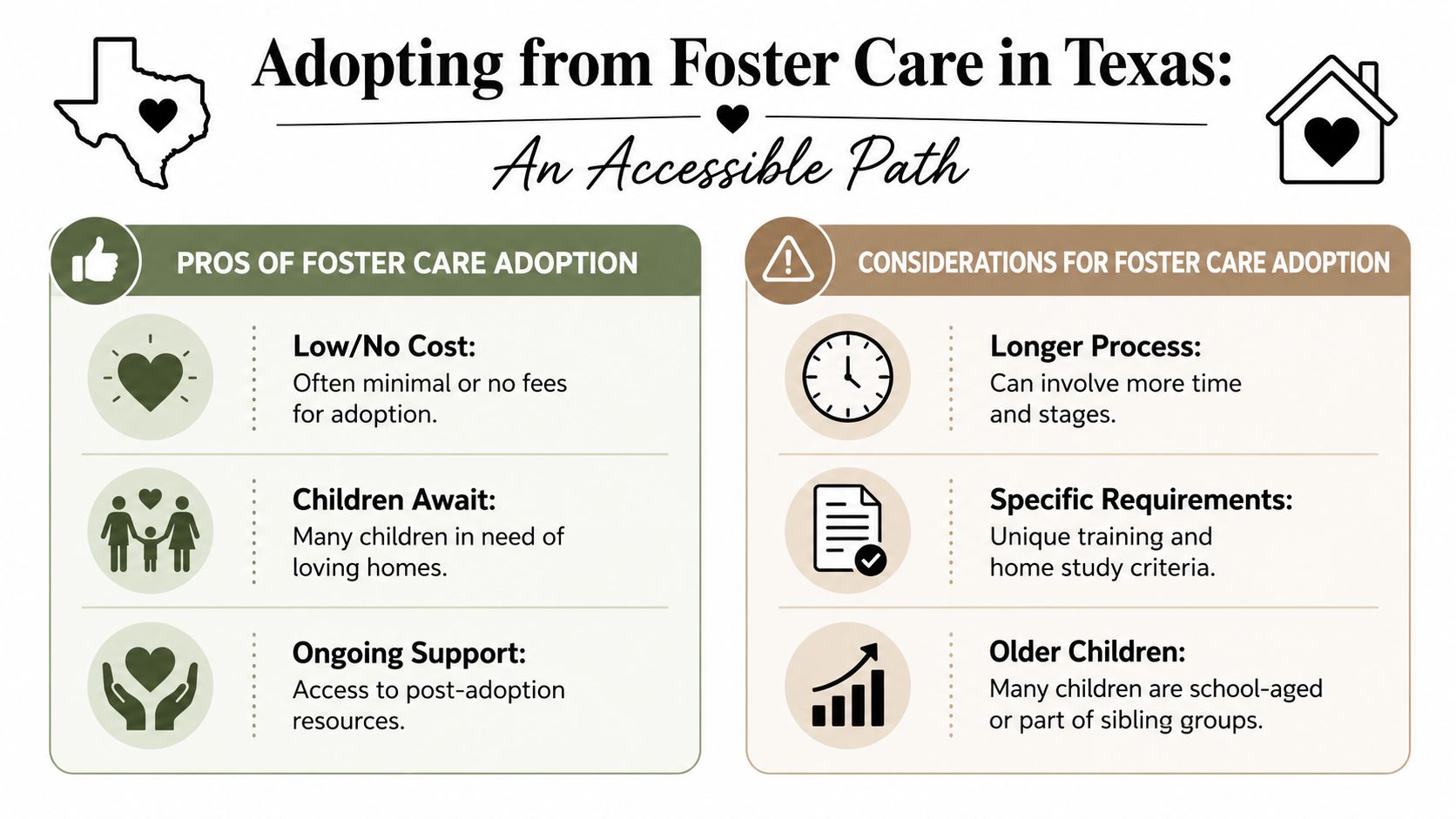
For many Texas families, foster care adoption is the most financially accessible road to permanency. It also fills a critical need. Children in state care need stable, loving homes, and the legal system tries to support families willing to step forward.
Why foster care adoption costs so much less
In Texas, adopting through the foster care system is effectively free in most cases because the state covers critical expenses. Attorney fees for finalization can range from $1,200 to $1,500, and families may receive up to $1,200 in reimbursement for non-recurring adoption expenses if the child is eligible for adoption assistance, according to McCarty Larson.
A related DFPS explanation says the state does not charge fees to adopt children, and reimbursement of up to $1,200 per child may be available for eligible non-recurring expenses such as attorney fees, court costs, and amicus fees through adoption assistance, as described by Texas DFPS requirements.
That's why many families see their net cost fall very close to zero. The biggest difference is that DFPS, not a private agency, carries much of the process.
What the process usually looks like
Foster care adoption still involves important legal and procedural steps:
- Training and approval: Families complete the required preparation process.
- Home study and evaluation: The state reviews the home and household.
- Placement and supervision: The child lives with the family while the placement is evaluated.
- Finalization in court: A judge signs the order creating the legal parent-child relationship.
You can read more about this specific cost path in this overview of adoption from foster care cost.
What families should keep in mind
Foster care adoption is affordable, but it isn't always simple emotionally. Some children are older, part of sibling groups, or have experienced trauma and instability. Families need to prepare not just financially, but relationally.
Some of the most affordable adoptions require the deepest emotional readiness.
Texas courts still focus on the same central issue here as in any adoption. The placement must support the child's best interests. The lower cost doesn't mean the process is less important. It means the state is helping remove financial barriers to permanency.
Costs for Stepparent and Relative Adoptions
Stepparent and relative adoptions often begin with an existing bond. A child already calls the petitioner “Mom,” “Dad,” “Grandma,” or “Uncle.” The adoption isn't creating a brand-new relationship so much as protecting one that already exists in daily life.
That's a big reason these cases are usually less expensive than private infant adoptions. There's no agency matching fee, and there typically aren't the same placement-related expenses.
Stepparent adoption costs in Texas
In Texas, stepparent or second-parent adoption is the most straightforward and affordable private adoption path, with average total costs between $2,000 and $3,000, primarily for legal representation and court filing fees rather than agency charges, according to Tapestry Adoption.
The legal work often centers on a few key issues:
- Consent or termination: The other parent may need to consent, or the court may need to address termination of that parent's rights.
- Court filings: The petition and supporting documents must be prepared and filed correctly.
- Final hearing: The judge reviews the case and, if appropriate, signs the adoption order.
For many families, the most difficult part isn't the filing fee. It's understanding whether the other parent's rights must be terminated and what proof the court will require.
Relative and kinship cases often follow a similar pattern
A grandparent, aunt, uncle, adult sibling, or other relative may already be caring for the child. In those cases, the court still needs to confirm that the legal requirements are met, but the cost structure usually looks more like a family-based court proceeding than an agency adoption.
Texas Family Code Chapter 162 still matters here because the court must enter a valid adoption order. Related provisions can also matter when there has been a prior custody case, CPS involvement, or questions about parental rights.
If you're exploring this path, How Long Does a Texas Adoption Take? can help you understand the broader process alongside cost.
A family example
A stepfather who has raised a child for years may want legal authority that matches the emotional reality at home. He may not need an agency, but he still needs a valid court process. The same is true for a grandmother who has been the child's steady caregiver and wants lasting legal security.
These cases are often less about finding a child and more about legally honoring the family that already exists.
How to Reduce Costs with Financial Aid and Tax Credits
Adoption expenses can still feel intimidating even when you know the likely range. The better question is often not “Can we pay everything at once?” but “What support can we line up before and after finalization?”

The federal adoption tax credit
For adoptions finalized in 2025, the federal adoption tax credit is up to $17,280 per child, and the same source notes a 2026 projected adoption tax credit of $17,670 per child, according to Adoption Choices of Texas. Because tax rules can change and depend on income and timing, families should treat that 2026 figure as a projection and confirm current guidance when filing.
The same source explains that qualified adoption expenses can include items such as adoption fees, court costs, attorney fees, travel expenses related to adoption, and home study fees. The credit generally does not apply to stepparent adoptions.
That doesn't mean every family receives the same benefit in the same year. Tax liability, income limits, and the timing of finalization all matter. A tax professional can help you understand how this fits your specific case.
Other ways families reduce out-of-pocket strain
Families often combine several strategies instead of relying on one:
- Employer adoption assistance: Some employers help with qualifying adoption expenses.
- Grants from nonprofits: These can reduce the amount you need to save or borrow.
- Structured savings plans: A separate adoption fund can make irregular expenses easier to manage.
- Adoption loans: Some families use financing to spread costs over time rather than paying a large sum at once.
For children who qualify, subsidies can also change the long-term budget picture. This explanation of what adoption subsidy means can help families understand that support.
A short overview like this can also make the financing conversation easier to absorb before you sit down with your accountant or lawyer.
Build a plan before you commit to spending
One practical approach is to divide your budget into three buckets:
- Up-front costs such as applications, home studies, or retainers.
- Process costs that arise during the case.
- Finalization and post-adoption costs such as court work, records, and transition needs.
This is also where legal guidance can save money indirectly. A Texas adoption attorney can help identify what applies to your path and what doesn't. The Law Office of Bryan Fagan, PLLC assists families with adoption and guardianship matters across Texas, including the legal steps from preparation through court finalization.
The strongest financial plan is usually the one that matches the legal path from the beginning.
Putting It All Together Real-Life Cost Scenarios
Numbers make more sense when you place them inside a family's daily life. These examples show how different Texas adoption paths can feel on the ground.
Scenario one with a private infant adoption
Jordan and Elise want to pursue a private domestic adoption. They begin by contacting agencies and learning that this path usually involves the highest up-front expense. They budget for the major categories commonly associated with private adoption, including agency involvement, a home study, and legal work.
Their planning reflects the known Texas ranges for private domestic adoption. They understand that private adoption can fall within the broad $25,000 to $50,000 range noted by Angel Adoption, and that private domestic agency adoption for a healthy infant often falls in the $40,000 to $45,000 range discussed earlier in the article.
What helps them most is not pretending the expense is small. It's breaking the process into stages. They build savings first, ask detailed fee questions, and speak with a tax professional about whether the federal adoption tax credit may help offset part of their qualified expenses after finalization.
Scenario two with a kinship adoption
Maria and her husband have been caring for Maria's grandson for quite some time. School enrollment, medical decisions, and long-term security all point them toward adoption. Their case doesn't involve an agency or a matching process because the child is already in their home.
Their financial concern is narrower. They're focused on legal filings, whether parental rights issues need to be resolved, and what the final court process will require. That kind of case often resembles the cost structure discussed for stepparent and family-based adoptions rather than a private agency placement.
What these examples show
The emotional goal may be the same in both homes. Create safety. Create permanence. Protect a child's future.
The budgeting method, though, is very different.
- Private adoption families often need to prepare for larger, multi-stage costs.
- Kinship and stepparent families usually face a simpler court-centered expense.
- Foster families may see the lightest direct financial burden, depending on eligibility and reimbursement.
For families trying to compare options, How Long Does a Texas Adoption Take? can add useful context because cost and timing often influence each other in real life.
Begin Your Texas Adoption Journey with Confidence
Adoption in Texas doesn't come with one universal price. It comes with a legal path, a family story, and a set of costs that depend on the type of adoption involved. Once you understand that, the process usually feels far more manageable.
Texas Family Code Chapters 162 through 166 exist to protect children, birth parents, and adoptive families. When the legal steps are handled carefully, the result is more than a court order. It's lasting family security. If you're ready to talk through your options, a clear conversation can help you move forward with confidence.
If you're considering adoption, kinship care, or guardianship in Texas, the attorneys at Law Office of Bryan Fagan, PLLC can help you understand the legal process, likely costs, and next steps for your family. Schedule a free consultation to discuss your situation in a supportive, practical setting.
