 Skip to content
A school calls because your granddaughter hasn’t been picked up. You drive over, bring her home, and tell yourself it’s just for tonight. Then tonight becomes a week. A week becomes school drop-offs, doctor visits, bedtime routines, and the quiet worry that without legal authority, you can’t fully protect her.
That’s where many grandparents begin when they’re thinking about adopting a grandchild in texas. They’re already doing the work of parenting, but the law hasn’t caught up yet.
Adoption can turn an uncertain caregiving arrangement into a permanent legal relationship. It can give you the authority to make decisions about school, medical care, and day-to-day life. It can also give a child something just as important: stability. In Texas, that stability often comes from family. Relatives, including grandparents, adopt more than half of the children and teens from foster care, and the state recorded 4,586 adoptions in fiscal year 2021 according to the Texas adoption statistics and requirements summary.
For some families, the path is cooperative. A parent signs paperwork because they know the child needs consistency. For others, the path runs through CPS, court hearings, and difficult evidence about neglect, absence, or unsafe conditions. Both paths are emotional. Both require care.
Texas law gives grandparents a route forward, but the steps can feel heavy if you’re trying to learn them while also comforting a child who’s scared, confused, or grieving change. If you’re in that place, it helps to understand your starting point and your legal options. Families often begin by reviewing the legal rights of grandparents in Texas before deciding whether adoption, conservatorship, or another remedy fits their situation.
Introduction
A grandmother in Texas may start with a spare toothbrush in the guest bathroom and end up packing school lunches every morning. A grandfather may think he’s helping “for a little while” and then realize he’s the person signing reading logs, calming nightmares, and answering hard questions about why Mom or Dad isn’t there.
That shift from informal care to full-time parenting happens fast. The legal system usually moves slower.
When grandparents step in, they often face two problems at once. The first is practical. Can you enroll the child in school, approve counseling, or handle medical treatment? The second is emotional. How do you give a child a sense of safety without making family conflict even worse?
Adoption is one option that can answer both concerns. It creates a full parent-child legal relationship. That means the court is not just recognizing that you help care for your grandchild. The court is recognizing you as the child’s legal parent.
Why this process feels confusing
Many grandparents hear several legal words at once. Custody, conservatorship, kinship care, guardianship, and adoption can sound similar when you’re in crisis. They are not the same.
A simple way to think about it is this:
- Conservatorship may give decision-making power without fully replacing the parent-child legal relationship.
- Kinship care usually describes a child living with relatives, often with CPS involvement.
- Adoption creates a permanent legal bond.
A grandparent can be the child’s daily caregiver for years and still need a court order to gain full legal authority.
Why family placement matters in Texas
Texas places real value on keeping children connected to family when that can be done safely. That is one reason grandparent and relative adoptions matter so much. They don’t just provide shelter. They preserve family identity, routines, relationships, and history.
That matters for a child who’s already lost a sense of control.
What grandparents usually need most
Most grandparents don’t need more legal jargon. They need answers to plain questions:
- Can I adopt if the parents won’t agree?
- What does CPS have to prove?
- What if my grandchild is old enough to have opinions about where they live?
- Will my age count against me?
- What paperwork should I gather before I file anything?
Those are the questions that shape the rest of the process.
Overview of eligibility and adoption types
A grandmother may already be doing the work of a parent. She gets the child to school, sits through doctor visits, pays for groceries, and keeps the bedtime routine steady. In court, though, the question is narrower. Can Texas legally turn that caregiving role into a permanent parent-child relationship?
That answer depends on two things. First, whether the grandparent is a suitable adoptive parent. Second, whether the legal path is open for adoption at all.
Those are separate questions, and families often get them mixed together.
Who can qualify to adopt a grandchild
Texas courts do not use one single checklist that says, "grandparent approved" or "grandparent denied." The judge looks at the whole picture, much like a mechanic checking an entire vehicle instead of one tire. A safe home matters, but so do health, consistency, support, and the child’s long-term stability.
A grandparent usually needs to show:
- A stable home environment: The court will want clear evidence that the child has a reliable place to live and a workable daily routine.
- Enough income or resources to meet the child’s needs: Wealth is not the test. The question is whether food, housing, medical care, school needs, and supervision can be covered.
- Parenting ability and support: Judges often look at who helps you, how you handle school and medical decisions, and whether you can meet the child’s emotional needs over time.
- A legally available child for adoption: Adoption cannot be finalized while a parent’s rights are still intact unless the required legal steps to end those rights are completed.
- The child’s consent in cases where Texas law requires it: An older child may have a formal voice in the case, not just an informal opinion at home.
One point deserves extra attention. Being the child’s main caregiver for months or even years does not automatically convert into adoption eligibility. It helps your case, but the court still requires the legal foundation to be in place.
The main adoption types grandparents usually see
Grandparent adoptions in Texas often fall into a few recurring patterns. The family history may differ, but the legal roads tend to look like these:
| Adoption type | Common situation | What usually needs the most attention |
|---|---|---|
| Private relative adoption | The child is already living with a grandparent through a family arrangement or earlier court order | Getting proper consent or completing a termination case |
| CPS-related relative adoption | CPS removed the child and placed the child with family | Following the CPS case rules, termination findings, and placement approvals |
| Related household or blended-family adoption situations | The home structure is more complicated, and multiple adults may have legal roles tied to the child | Identifying every party, every required notice, and every parental right that must be addressed |
The label matters less than many families expect. Adoption works like building a house on a legal foundation. If the foundation is missing, the name of the project does not fix it.
Private relative adoption
This path often begins informally. A parent may leave the child with grandparents for what was supposed to be a short period, then the arrangement stretches into months or years. Everyone in the family may already treat the grandparent as the parent in practice.
Private relative adoption can look simpler because CPS is not leading the case. In reality, it often turns on one hard issue: parental rights. If a parent agrees to sign, the process may be more direct. If a parent disappears, refuses consent, or has a history that raises safety concerns, the case can become much more contested.
That is why families should separate two ideas in their minds. Daily care is one issue. Legal authority is another.
CPS-related adoption
CPS cases follow a different track, and they often raise questions standard adoption guides skip. A grandparent may assume that once CPS places the child with family, adoption is just paperwork. It usually is not.
In a CPS case, the court may already be considering whether the parents’ rights should be terminated. That process has its own deadlines, evidence rules, service plans, and findings the judge must make. If termination does happen through CPS, the grandparent’s adoption case may become more straightforward because one major barrier has already been addressed. If termination has not happened yet, the adoption cannot go around that step.
This is the part many grandparents overlook. A CPS placement is not the same as automatic permission to adopt. It is better to view CPS placement as the state saying, "This may be the safest family home right now," while adoption asks a separate question, "Should this become the child’s permanent legal family?"
Special considerations for grandparents over 60
Age by itself does not disqualify a grandparent in Texas. Courts do not apply a rule that says a person over 60 cannot adopt. Still, age often leads to more detailed questions, and it helps to be ready for them.
A judge may look closely at:
- Current health and likely long-term caregiving ability
- Backup caregivers if you become sick or injured
- Retirement income, savings, or other reliable financial support
- Your plan for the child if your circumstances change
- Whether your home setup matches the child’s physical, school, and emotional needs
This does not mean older grandparents face a closed door. It means the court may want a longer-range plan. A good way to understand it is to compare it to naming a guardian in estate planning. The judge is not only asking whether you can care for the child today. The judge is also asking what protections are in place for five years from now.
For grandparents over 60, preparation often matters as much as age. Medical records showing stability, a clear support network, and practical backup plans can answer concerns before they grow into objections.
Some families also need to weigh whether adoption is the right legal tool or whether another long-term arrangement better fits the facts. That question becomes especially important when a grandparent wants stability for the child but also needs to consider health changes, retirement realities, or unresolved CPS termination issues.
Document checklist and required forms
A grandparent may have cared for a child for years and still hit a delay at the courthouse because one order is missing or one form was signed the wrong way. That can feel unfair. It is also common.
Paperwork is the court’s way of checking that the legal story matches the family story. If the file has gaps, the judge may have no clear path to finish the adoption, even when everyone in the family knows the child belongs with you.
For grandparents, the document stack often does more than prove identity. It also connects several legal pieces that may have built up over time, such as prior custody orders, CPS involvement, temporary placements, or a pending termination case. That last point gets overlooked in many adoption guides. If CPS has already filed a case, or if parental rights were terminated through a separate proceeding, your adoption paperwork has to line up with that record precisely. If you are over 60, it also helps to include clear records that answer practical questions early, such as health stability, income, and long-term caregiving plans.
Core documents families usually gather
The exact forms vary by county and by the path your case has taken, but many grandparents are asked to pull from the same basic categories:
- Adoption petition: This asks the court to approve the adoption and identifies the child, the petitioners, and the relief requested.
- The child’s identifying records: Birth certificate, Social Security information if available, and any records that confirm the child’s legal identity.
- Existing court orders: Conservatorship orders, temporary orders, divorce decrees, guardianship papers, or other rulings that affect who currently has legal rights.
- Parental rights paperwork: Signed affidavits of voluntary relinquishment, service records, orders related to termination, or documents from a CPS case if one exists.
- Household records: Marriage certificate, divorce paperwork, death certificate of a parent if applicable, and documents showing who lives in the home.
- Identity and screening materials: Driver’s licenses or other identification, plus materials needed for fingerprinting and background checks.
- Financial and care records: Proof of income, insurance information, school records, medical records for the child, and sometimes documents that show how care has been handled day to day.
A filing packet works like a chain. If one link is missing, the clerk may accept the case but the court can still stall later.
Where families often get stuck
Grandparents often assume their caregiving history will fill in the blanks. Judges usually still need the blanks filled with documents.
The problems below cause many of the delays:
- Name or date mismatches: If a birth certificate says one thing and an older order says another, the court may want an explanation or corrected record.
- Missing prior orders: A past CPS order or conservatorship order can affect who must be notified and what findings the judge must make.
- Improper signatures or notarization: Some forms must be signed in a very specific way. A kitchen-table signature may not satisfy the court.
- Termination records that do not match the adoption file: If parental rights are being terminated in the same case, or were terminated earlier, the dates, cause numbers, and parties need to line up.
- Incomplete information about an absent parent: Even when a parent has been out of contact for a long time, the court usually needs proof of notice efforts or a lawful basis to proceed without consent.
That last issue deserves extra attention. In many grandparent adoptions, the hardest paperwork problem is not the adoption form itself. It is proving that the other legal path, especially termination through CPS or a private suit, was handled correctly. Courts are careful here because adoption permanently changes parental rights.
A simple way to organize the file
Use separate folders, whether paper or digital, and label them by legal purpose rather than by date. That makes it easier to answer a clerk, attorney, or judge quickly.
| Folder | What to place inside |
|---|---|
| Child records | Birth certificate, school records, medical information |
| Court papers | Existing orders, petitions, notices, hearing dates |
| Parent-related documents | Relinquishment forms, service records, communication logs |
| Home study materials | References, household information, financial records |
If you are over 60, consider one additional folder for long-range planning. Put in recent medical summaries you are comfortable sharing, proof of steady income, and written backup care arrangements if something happens to you. The court is often asking a future-focused question: can this placement remain stable for the child over time?
Bring copies to every meeting.
Originals matter, but so do clean duplicates. Clerks, social workers, attorneys, and CASA or CPS personnel may each need to review the same record at different stages.
Child consent deserves special care
If your grandchild is old enough that consent is legally required, treat that step as both a legal act and an emotional moment. A child may agree with the adoption and still feel torn.
That reaction makes sense. Children often hear the word adoption as a statement about loyalty, even when the adults mean safety and permanence.
A calmer explanation usually helps more than a rushed signature. You might say, “This paperwork helps me take care of you in every way the law recognizes. It does not erase your feelings about your parent.”
That approach keeps the child from feeling like a form is asking them to pick a side.
Home study and background checks
A lot of grandparents hear “home study” and picture a white-glove inspection. In practice, it works more like a family safety review. The court wants a clearer picture of the home, the caregiving routine, and whether this placement can give the child lasting stability.
That concern can feel especially personal if you are a grandparent who has already been raising the child for months or years. You may be thinking, “If the child is doing well here, why do we have to prove it?” The answer is that adoption changes legal rights permanently. Before a judge signs that order, the court usually wants an independent assessment.

For grandparents over 60, the review often includes an added question beneath the surface. Can this home stay stable over time, and is there a backup plan if the caregiver’s health changes? That does not mean age blocks adoption. It means the court may look more closely at long-range planning, daily support, and who could step in during an emergency.
What the home study usually examines
A home study often includes interviews, a home visit, reference checks, and background screening. The social worker may ask about your relationship with the child, your household routine, your discipline approach, and how you manage school, medical care, and emotional support.
The goal is not a perfect house. The goal is a home that is safe, functional, and steady.
Reviewers often focus on a few core areas:
- Household safety: sleeping space, working utilities, storage of medications or weapons, and basic hazard prevention
- Daily stability: school attendance, routines, transportation, supervision, and who handles appointments
- Financial reliability: whether the household can consistently meet the child’s needs
- Caregiver health: your present ability to parent and any realistic future planning
- Support system: relatives, friends, church members, neighbors, or paid helpers who can provide backup if needed
Many families feel less anxious after looking over an adoption home study checklist for Texas families before the first visit.
Questions a social worker may ask
Some questions are practical. Others go to the heart of how your family works.
You may be asked why adoption is needed instead of the current arrangement, how the child talks about their parents, what losses or trauma the child has experienced, and how you respond when the child is angry, shut down, or fearful. A worker may also ask about contact with safe relatives and whether you can support those relationships without creating confusion or risk.
These questions can feel loaded, especially in cases that touched CPS. Try to hear what the worker is really testing. Usually, it is whether you understand the child’s emotional world, not whether you can give a polished answer.
Background checks and CPS history
Background checks are a standard part of the process. They often include criminal history and any relevant CPS history tied to the adults in the home.
If something appears, context matters. An old issue with a clear explanation is different from a recent allegation involving child safety. The court and the evaluator will usually care about what happened, how long ago it was, and whether the concern still affects the child’s wellbeing now.
CPS history deserves extra attention because relatives are often surprised by how much it can shape the case. If CPS previously investigated the parents, removed the child, or sought termination, those records may influence how the court views safety, permanency, and the urgency of adoption. If CPS also had contact with your household, be ready to explain the outcome clearly and provide any paperwork showing the matter was resolved.
Early honesty helps. If there is a past arrest, dismissed charge, founded CPS finding, or complicated family incident, disclose it and explain it directly. A social worker is usually more concerned by a surprise than by an older problem that has already been addressed.
Preparing the child for the visit
Children can misread a home study. Some hear “someone is coming to the house” and worry they are about to be moved again.
A simple explanation usually works best: “Someone is coming to learn about our family and make sure this home is safe for you.” That tells the truth without putting pressure on the child.
Avoid coaching. Reassurance is better. The child does not need perfect answers. The adults need to show that this home understands the child’s needs and can care for them with patience, structure, and consistency.
Managing consent and termination paths
This is often the hardest part of adopting a grandchild in texas. Before adoption can happen, the legal rights of the child’s biological parents must be addressed. Courts do not skip this step, even when grandparents have been doing the parenting for a long time.
Families usually face one of two routes. The parent signs away rights voluntarily, or the court is asked to terminate rights involuntarily.

Cases involving CPS and involuntary termination are especially difficult for relatives to manage. One relative adoption overview states that Texas sees over 20,000 children in kinship care annually, with 40%+ involving grandparents, and notes that only 15% finalize without legal aid because of the complexity of these cases, as discussed in this article on relative adoption in Texas.
Voluntary termination
This path is usually simpler emotionally and legally, though “simple” is still relative. A parent signs formal relinquishment documents, and the court reviews whether the legal requirements are met.
Voluntary termination can work when a parent recognizes that the child needs a stable home now and that the grandparent has already become the daily parent.
Even then, grandparents should proceed carefully. A parent may be cooperative one week and hesitant the next. Timing, formal execution, and proper filing matter.
Involuntary termination
This path comes up when a parent won’t consent, cannot be located, or remains unable to provide safe care. In these cases, the court must find legal grounds and decide that termination is in the child’s best interest.
Grandparents often feel torn here. They may know termination is necessary, but they also fear being seen as “taking” a child from their own son or daughter. That emotional conflict is real.
The legal question is different. The court asks whether the parent-child legal relationship should continue.
A side-by-side comparison
| Issue | Voluntary path | Involuntary path |
|---|---|---|
| Parent participation | Parent signs formal paperwork | Parent may object, disappear, or contest |
| Proof needed | Properly executed relinquishment and adoption evidence | Evidence of legal grounds plus best-interest proof |
| Emotional tone | Often cooperative but still painful | Often tense and fact-heavy |
| Risk of delay | Lower if paperwork is complete | Higher because hearings and evidence disputes may follow |
Evidence grandparents may need in contested cases
If you are asking the court to terminate rights involuntarily, facts matter more than feelings. Loving the child is not enough by itself. The court needs evidence tied to legal grounds.
That may include:
- CPS records: Prior investigations, service plans, or removal findings
- Witness statements: Teachers, counselors, relatives, neighbors, or others with direct knowledge
- Missed support or contact history: Records showing long absences or failure to provide care
- Medical or school records: If they help show neglect, instability, or harm
- Your caregiving history: Proof that you have been the steady parent figure
For families facing this issue, it helps to review the legal framework around termination of parental rights in Texas.
The judge is not choosing the more sympathetic adult. The judge is deciding what legal structure best protects the child.
Child consent when the child is older
If your grandchild is old enough that consent is required, this part deserves patience. Some children are relieved. Others freeze. Some say yes and cry afterward.
A child may feel deep love for you and still grieve the meaning of adoption. That doesn’t make the case weak. It makes the child human.
Try to keep adult conflict out of the conversation. The child should not feel responsible for punishing or rescuing a parent.
Court hearings timeline and costs
You file the case, gather the records, and then the question starts pressing on you every morning. How many court dates are ahead, and how much will this cost before the adoption is done?
The shortest answer is that Texas grandparent adoptions do not move on one fixed track. A case with signed consents, complete paperwork, and no dispute may move in months. A case tied to contested termination, CPS history, or trouble locating a parent often takes much longer. Court timing works a lot like airport security. If every document is ready and no alarm goes off, you keep moving. If one issue appears, the whole line slows down.
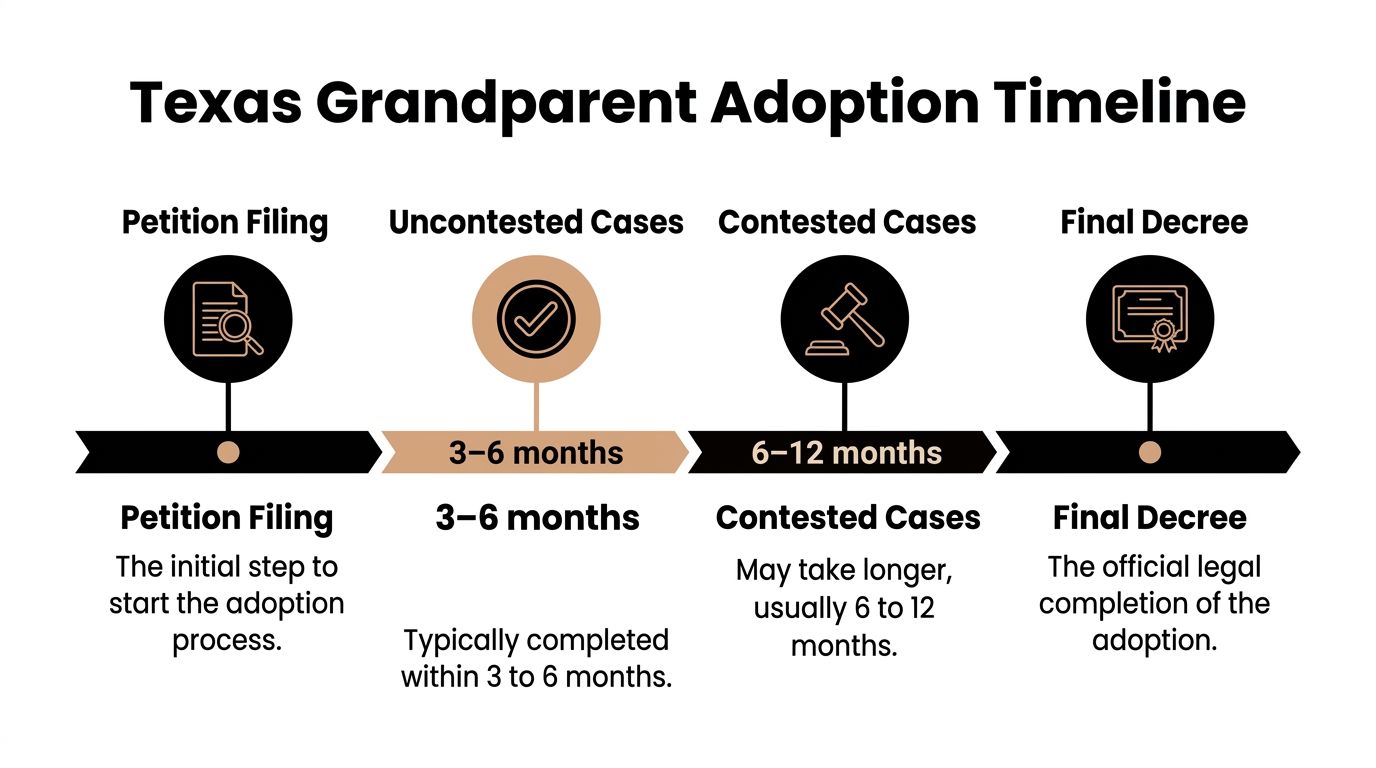
A practical estimate is this: uncontested cases often finish faster than contested ones. Many families see a shorter path when parental rights have already been resolved and every required person has been properly served. Cases usually stretch out when termination must still be decided, especially if CPS records, missing parents, or objections are involved.
What the hearing sequence often looks like
The court process usually unfolds in stages, even if some hearings are combined.
Initial filing
The petition starts the case. The court file becomes the official story of why adoption is being requested.Service and notice
Parents and any other required parties must receive legal notice. If someone cannot be found, the court may require extra steps before the case can safely proceed.Home study and investigation
The evaluator reviews your home, background information, and day-to-day caregiving setup. For grandparents over 60, this stage may bring closer questions about health, stamina, and long-term planning.Termination hearing, if needed
This is often the longest and most demanding part of the case. If CPS has been involved, the court may examine prior removals, service plans, safety findings, and whether reunification efforts failed. Standard adoption articles often gloss over this point, but in real grandparent cases, termination procedure can be the part that controls the calendar.Final adoption hearing
Once the court has a clean legal path, the judge reviews the record and decides whether adoption is in the child’s best interest.
Some courts combine parts of this process. Others set separate dates. The more legal loose ends still hanging, the more likely you are to see multiple hearings instead of one final appearance.
Why contested cases take longer
A contested case is not a slower version of an uncontested one. It is a different kind of case.
If a parent objects, the court may need more evidence, more notice work, and more time for testimony. If CPS records exist, those records may need to be obtained, reviewed, and explained. If a parent appears late after being hard to locate, earlier scheduling can change. One procedural problem can delay everything else because the judge has to make sure the foundation is legally sound before signing an adoption order.
Here is the practical difference:
| Case type | What usually affects timing |
|---|---|
| Uncontested | Signed consents, completed paperwork, timely home study, no dispute about termination |
| Contested | Objections, service problems, CPS history, disputed facts, separate termination proceedings |
Costs and budgeting
Costs also vary with the shape of the case. It helps to think in layers rather than hunting for one magic number.
A simple case may involve filing fees, background checks, document copying, notarization, and the home study. A more difficult case can add attorney fees, repeated hearings, extra service attempts, record retrieval, and time away from work. If the case turns on involuntary termination, expenses often rise because preparation becomes more evidence-heavy.
Many families should plan for:
- Court filing fees
- Home study fees
- Background check costs
- Attorney fees, if you hire one
- Service of process expenses
- Certified copies, notarization, and record retrieval
- Travel, parking, child care, or missed work for hearings
Ask the clerk or your lawyer what fees are paid up front and what costs tend to appear later. That question helps families avoid the common mistake of budgeting only for filing day.
Ways to reduce avoidable expense
You cannot remove every cost, but you can prevent some repeat spending.
- Gather records early: Birth certificates, prior orders, CPS paperwork, school records, and medical records are often harder to collect than families expect.
- Answer requests quickly: Delays can lead to rescheduled interviews, amended pleadings, or another court setting.
- Keep one organized file: A binder or digital folder saves time and attorney review costs.
- Ask about fee waivers: Some families qualify, depending on income and case details.
- Confirm service details carefully: A wrong address or incomplete name can create expensive do-over work.
Special issues for grandparents over 60
Age alone does not block adoption in Texas. Still, older grandparents often face a different set of questions from the court and from the home study evaluator.
That is not a judgment about love or commitment. It is the court asking a future-focused question: who will care for this child not only today, but through school years, medical needs, and the ordinary surprises of family life? A healthy 62-year-old grandparent may be an excellent adoptive parent. The court just may want clearer planning on paper than it would from a younger petitioner.
A Texas family law overview on this topic discusses how grandparent adoption cases can raise added questions about health and long-term caregiving for older adopters, according to this overview of grandparent adoption in Texas.
What older grandparents may need to show
Judges and evaluators may focus on practical stability, including:
- Health management: Whether any medical conditions are controlled and compatible with daily parenting
- Backup caregiving plans: Who can help if you are hospitalized or temporarily unable to provide care
- Financial planning: How the child’s needs will be covered over time
- Household setup: Whether the home fits the child’s age, routine, and developmental needs
This is one reason older grandparents should prepare documents before the hearing, not after questions arise. A doctor’s letter, insurance information, or a written backup care plan can answer concerns before they become obstacles.
When conservatorship may be worth comparing
Some grandparents reach this stage and realize they are asking two different questions at once. Can I care for this child now, and should I pursue adoption specifically?
Adoption creates a full legal parent-child relationship. Permanent managing conservatorship can provide decision-making authority without changing the legal relationship in the same way. For some older caregivers, especially those concerned about health changes later, that comparison deserves careful thought before the final hearing.
| If your main goal is… | You may want to explore… |
|---|---|
| Full permanent parental status | Adoption |
| Authority to care for the child under a different legal structure | Conservatorship |
What to expect at the final hearing
Final hearings are often shorter and quieter than families expect. The judge may review the paperwork, confirm the legal requirements have been met, ask a few questions, and sign the order.
If the case involved contested termination or CPS history, the emotional weight may still be heavy even if the hearing itself is brief. Bring your documents, arrive early, and prepare the child in simple, age-appropriate terms if the child will attend. A calm final hearing usually reflects work that was done long before that day.
When to seek legal help and next steps
A grandmother may reach this point with the child already sleeping in her spare room, enrolled in the local school, and calling her house home. On paper, that can look close to adoption. In court, it may still be several legal steps away.
That gap matters most when the case is not clean and simple. If a parent cannot be found, if CPS has ever been involved, or if there are older court orders in the background, legal questions can stack up quickly. For grandparents over 60, judges may also look more closely at future caregiving plans, support systems, and medical stability. That does not mean adoption is out of reach. It means preparation carries more weight.
Red flags that usually call for legal guidance
Some situations are like driving on an open Texas highway. Others are more like merging through construction with missed signs and detours. These are the cases where legal help often makes the process safer and clearer:
- A parent objects: Even a weak objection can change what must be proved and how the hearing is handled.
- CPS is involved or was involved before: Termination through a CPS case can follow a different path than a private relative adoption, and the old record may still affect what the court needs to review.
- You cannot locate a parent: Notice rules are strict. If service is handled the wrong way, the case can be delayed or challenged later.
- There are earlier custody, SAPCR, or conservatorship orders: Adoption does not erase those papers automatically. The new case has to line up with what another court has already signed.
- The child has trauma, divided loyalties, or is old enough to express a strong view: Legal timing and presentation matter more in these cases.
- You are over 60 and expect questions about health or long-term care: A written plan for backup caregivers, finances, and medical support can help answer concerns before they slow the case.
Why getting advice early often helps
Early legal advice is often less about conflict and more about order. Adoption cases can resemble building a house. If the foundation is off by a few inches, the problem may not show up until much later, when fixing it is harder and more expensive.
A lawyer can help you choose the right path at the start, especially if the case may involve private termination, a prior CPS termination order, or a child who has been in and out of state systems. That includes practical work such as:
- preparing the petition and supporting paperwork correctly
- identifying whose rights must be addressed before adoption can be granted
- sorting out whether CPS records, prior removals, or old orders need to be pulled into the case
- helping older grandparents present a stable long-term care plan
- preparing for county-specific court expectations and contested hearings
Law Office of Bryan Fagan, PLLC handles Texas adoption and guardianship matters, including relative, stepparent, and CPS-related cases.
A steady next step
Start by making a simple case file of your own. Gather the child’s birth certificate if available, school and medical information, names and last known addresses for each parent, copies of any CPS paperwork, and any prior court orders involving custody or conservatorship. If you are an older grandparent, add documents that show how daily care will be managed over time, such as insurance information, a support network, or a backup caregiver plan.
Then ask one clear question. Are you dealing with a straightforward relative adoption, or are you also dealing with termination problems that need careful handling first?
That distinction is easy to miss. It is also where families lose time.
The goal is to give your grandchild legal stability that matches the life you are already providing at home. If any part of the record feels incomplete, contested, or tied to CPS history, getting legal advice before filing can prevent avoidable setbacks and help you build a case the court can follow with confidence.

