 Skip to content
The bond between a grandparent and a grandchild is one of life’s purest joys, built on a foundation of unconditional love and memories that last a lifetime. When that connection is suddenly at risk, the fear and uncertainty can be absolutely heartbreaking.
The hard truth is that in Texas, grandparents do not have automatic legal rights to see or raise their grandchildren. However, the law does provide specific pathways for you to step in when it’s truly in the child’s best interest.
Understanding Your Role as a Texas Grandparent
When family dynamics fracture—whether through divorce, death, or a parent’s inability to provide a safe home—grandparents often find themselves in an emotionally charged and confusing spot. You might be worried sick about losing contact or feel a powerful urge to provide the stability your grandchild desperately needs.
It’s critical to know that while Texas law fiercely protects the rights of parents, it also acknowledges the vital, stabilizing role a grandparent can play. Your path forward starts with understanding the different legal tools available. Each one has a distinct goal and its own set of steep legal hurdles. But no matter which path you take, the court’s guiding star is always the same: what is in the best interest of the child?
The Three Main Legal Paths for Grandparents
In Texas, your options generally boil down to three main legal actions. Think of them as levels of involvement, from simply maintaining a relationship to becoming the primary, legal caregiver.
- Possession or Access (Visitation): This is the most common route for grandparents. It involves asking the court for a legally enforceable schedule to see your grandchild, ensuring your relationship continues even if the parents object.
- Conservatorship (Custody): This is a much bigger legal step. Here, you’re asking the court to grant you the rights and responsibilities of a parent, usually because the child’s current home life with their parents is dangerous or unhealthy. You can learn more about what this responsibility entails by exploring the role of a sole managing conservator.
- Adoption: This is the most permanent and profound solution. A kinship adoption legally ends the biological parents' rights and makes you the child's legal parent in every way. It offers the ultimate security and stability for a child who needs it most.
To give you a better sense of how these options fit together, here is a helpful visual guide.
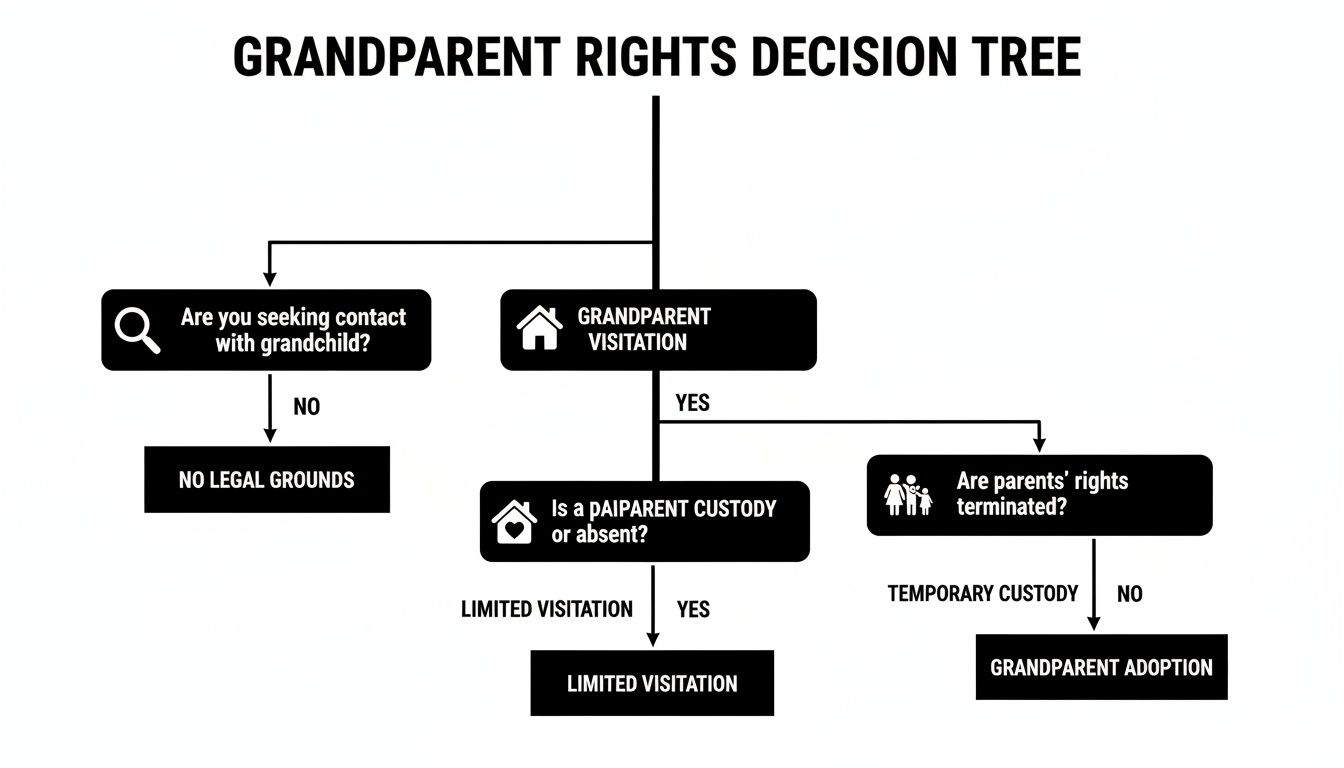
As this flowchart shows, each path—visitation, custody, and adoption—involves a deeper level of legal responsibility and, in turn, requires a much higher standard of proof to win in court.
Before we dive deeper, here’s a quick overview of these legal avenues.
Grandparent Rights in Texas at a Glance
This table breaks down the primary legal options for grandparents in Texas, what each one accomplishes, and the typical situations where they apply.
| Legal Avenue | What It Achieves | When It Typically Applies |
|---|---|---|
| Possession or Access | Grants legally enforceable visitation time with a grandchild. | A parent is denying access, and you can prove that the denial is harming the child's well-being. |
| Conservatorship (Custody) | Grants you the legal rights and duties of a parent, making you a primary caregiver. | The child's current living situation with their parent(s) is physically or emotionally dangerous. |
| Adoption | Permanently makes you the child's legal parent, terminating the biological parents' rights. | The biological parents' rights have been terminated (or will be), and adoption is in the child's best interest. |
Understanding these distinctions is the first step in figuring out which path, if any, is the right one for your family’s situation.
Proving Your Case to the Court
Securing legal rights as a grandparent isn't about what you want; it's about what the child needs. You have to prove to a judge that your involvement is essential for the child's well-being, and the Texas Family Code sets a very high bar.
The core principle guiding every Texas family court is that a fit parent is presumed to act in their child's best interest. To overcome this, a grandparent must present clear and compelling evidence that denying their involvement would significantly harm the child's physical or emotional health.
This means your case has to be built on solid facts, not just your feelings or fears. Our goal is to replace your uncertainty with clarity. By understanding these foundational concepts, you can start to see a way forward, armed with the knowledge to protect that bond you cherish so deeply.
How to Win Grandparent Visitation in Texas
For a grandparent, the thought of being cut off from your grandchild is a nightmare. When a parent suddenly denies access, it can feel like a door has been slammed on one of the most important relationships in your life. While Texas law provides a path to reopen that door, it takes a lot more than just being a loving, capable grandparent.
To get a court to order visitation—what the law calls possession or access—you first have to prove you have standing. That’s the legal right to even file a lawsuit in the first place. For grandparents, this usually means showing a judge that your grandchild’s physical health or emotional well-being would be significantly impaired if they couldn’t see you. Make no mistake, this is a very high bar to clear.
The court always starts from the position that a fit parent knows what’s best for their own child. Your job is to bring clear, compelling evidence to challenge that assumption. This isn't about putting the parent on trial; it's about focusing squarely on what the child needs.

Meeting the "Significant Impairment" Standard
So, what does "significant impairment" actually look like in the real world? It means proving that your absence would cause genuine, measurable harm to the child—not just that they would miss you or be sad.
Imagine a situation where your son or daughter tragically passes away. You've always been a huge part of your grandchild’s life, maybe even helping with daily care. Then, the surviving parent suddenly cuts off all contact. In a case like that, you might have a strong argument. Your sudden removal from the child's life could be emotionally devastating, ripping away a source of stability when they need it most.
Other scenarios that might meet this tough standard include situations where:
- The parent struggles with substance abuse or has a history of neglect, and you have consistently been the stable, safe presence in the child's life.
- The parent is in jail, and you've been the one providing care and emotional support to the grandchild.
- You lived with the grandchild for a long time and were essentially a primary caregiver.
In every one of these examples, the focus is the same: you played a crucial, established role in the child’s life, and your absence would cause real, tangible harm.
The Legal Journey, Step by Step
Once you've shown you have the right to sue (standing), the official process of getting visitation rights begins. Every family's situation is different, but the legal path generally follows a few key steps.
- File an Original Petition: Your attorney will kick things off by filing a lawsuit called an "Original Petition in Suit Affecting the Parent-Child Relationship." This document is your formal request to the court, asking it to grant you possession of or access to your grandchild.
- Serve the Parents: The child’s parents have to be officially notified that you’ve filed a lawsuit. This formal notification is known as "service of process."
- Mediation: Before you ever see the inside of a courtroom for a final trial, Texas courts will almost always require everyone to try mediation. This is a confidential meeting where you, the parents, and your lawyers sit down with a neutral third-party mediator to try and hammer out a visitation schedule you can all agree on.
- Temporary Orders Hearing: If the situation is urgent and waiting isn't an option, your attorney can ask for a temporary orders hearing. The goal here is to get a short-term visitation schedule in place to protect the child’s well-being while the full case moves forward.
- Final Trial: If you can't reach an agreement in mediation, your case will go to a final trial. A judge will listen to evidence and testimony from both sides and then make a final ruling based on one thing: what is in the best interest of the child.
The legal ground for grandparent rights is constantly shifting, shaped by major court decisions over decades. A pivotal U.S. Supreme Court case, Troxel v. Granville, completely changed the game for grandparent visitation nationwide. The ruling strengthened a parent's fundamental right to raise their child as they see fit, making it much harder for grandparents to win visitation. It created a complex and sometimes contradictory legal environment. You can explore the complexities of these legal precedents to get a better sense of the challenges involved.
This process can be an emotional rollercoaster, but it’s a structured path toward protecting that precious bond with your grandchild. The key is to keep your focus on the child's needs and build a clear, fact-based case that proves why your presence is absolutely vital for their happiness and stability.
When Grandparents Must Step In and Seek Custody
Sometimes, love means taking on the profound responsibility of becoming a primary caregiver. While visitation rights are about maintaining a cherished bond, there are heartbreaking situations where a child’s safety and well-being require a grandparent to seek conservatorship—the legal term for custody here in Texas.
This isn’t just a bigger step than asking for visitation; it’s a monumental one. You are asking a court to grant you the legal authority to make critical, life-altering decisions for your grandchild. It's a path reserved for the most serious circumstances.
The Texas Family Code sets an incredibly high bar. You must prove to the court that the child's current living situation with a parent poses a "serious, immediate question concerning the child’s physical health or welfare." This isn't about disagreeing over parenting styles or minor worries; this is about situations where a child is in genuine, immediate danger.

What Qualifies as a Dangerous Environment
Proving a child is in immediate danger requires more than just your word. It demands clear, compelling evidence. The court needs to see the cold, hard facts demonstrating that the parent is unable or unwilling to provide a safe and stable home. These are often the most painful family crises, the kind that force a grandparent to act.
Real-world examples that might meet this high legal standard include:
- Substance Abuse: A parent’s addiction to drugs or alcohol is directly endangering the child.
- Abandonment or Neglect: The parent has left the child without adequate care, supervision, or support for their basic needs.
- Family Violence: The child has been a victim of, or witness to, physical or emotional abuse in the home.
- Parental Incarceration: The parent is imprisoned and simply cannot care for the child.
- Severe Mental Health Issues: An untreated mental illness is preventing the parent from providing a safe environment.
In every one of these scenarios, the laser focus is on the direct harm—or risk of harm—to the child. Your job is to show the court not only that these problems exist but precisely how they create a dangerous environment for your grandchild.
This difficult reality reflects a growing trend. The scope of grandparent caregiving in the United States is substantial, with 2.1 million grandparents responsible for their grandchildren as of 2023. These are often long-term arrangements, with nearly 60% of these caregivers having cared for their grandchildren for five or more years. You can discover more insights about these kinship care trends and see how many other families are navigating similar challenges.
Building a Strong Case for Custody
If you believe you must seek custody, your entire case will rest on a foundation of solid proof. Your word alone, no matter how heartfelt and true, is simply not enough in the eyes of the law. You need to gather documentation that paints an undeniable picture of the situation for the judge.
This is the time to be meticulous and organized. You'll want to collect things like:
- Police Reports or CPS Records: Official documents are powerful. They detail instances of abuse, neglect, or domestic violence.
- Medical Records: This could include evidence of injuries or neglect that the child has suffered.
- Witness Testimony: Statements from teachers, neighbors, or other family members who have witnessed the dangerous environment firsthand can be crucial.
- Photos and Videos: Visual proof of unsafe living conditions or a parent's incapacitation can speak volumes.
This process is emotionally draining, and the legal standards are incredibly complex. It's crucial to understand the legal tools available. For instance, you might want to learn more about the difference between guardianship and custody to fully grasp all your options.
Taking this step is a profound act of love and protection. Having compassionate legal guidance in your corner can make all the difference in ensuring your grandchild's future is safe and secure.
Creating a Forever Family Through Kinship Adoption
For many grandparents who have already become full-time parents, legal custody—or what Texas calls conservatorship—can feel like a temporary fix. It gives you the authority to make day-to-day decisions, but it doesn't offer the deep, lasting security that both you and your grandchild truly deserve.
Kinship adoption is the path to that permanence. It's a profound act of love that legally transforms your role from caregiver to parent, creating a forever family in the eyes of the law.
Adoption is a world away from custody. While custody grants you the right to care for your grandchild, the legal ties to the biological parents usually remain intact. Adoption, on the other hand, is final. It's a legal process that permanently terminates the biological parents' rights and establishes a brand-new, legally recognized parent-child relationship between you and your grandchild.
This means you become their parent in every sense of the word. It's a foundation of stability that can never be challenged in court again—the ultimate promise of a secure future.
The Journey to a Forever Family
The adoption process in Texas can seem intimidating, but it’s really just a series of clear, manageable stages. Every step is designed with one goal in mind: protecting the child’s best interests for the long haul. With the right guidance, this journey is absolutely something you can navigate.
- Termination of Parental Rights: This is the biggest legal hurdle. Before any adoption can move forward, a court has to legally end the rights of the biological parents. This can happen voluntarily if a parent agrees to sign away their rights, or involuntarily if a court finds the parent has abandoned, neglected, or endangered the child.
- The Adoption Home Study: Yes, even for grandparents, Texas law requires a home study. Try not to think of it as an intimidating inspection. It's more of a collaborative process to make sure your home is a safe and supportive place for the child. A social worker will visit, conduct some interviews, and review documents to prepare a report for the court.
- Finalization Hearing: This is the beautiful, final step. Once all the legal boxes are checked, you'll go to a court hearing where a judge reviews your case and signs the final adoption decree. It's often a joyous and emotional celebration—the moment your grandchild legally and forever becomes your child.
Understanding the Emotional and Legal Hurdles
The decision to adopt your grandchild is fueled by love, but it can also bring up a lot of complicated emotions, like grief over the family situation that made this necessary. It’s completely okay to acknowledge those feelings. On the legal side, the process demands meticulous attention to detail and a solid understanding of the Texas Family Code.
For grandparents thinking about this path, our complete guide to kinship adoption in Texas offers invaluable insight into the specific requirements and steps you'll face.
Adoption is so much more than a legal document; it's a statement of unconditional commitment. It tells a child, "You are home. You are safe. You are ours, always." This legal finality brings emotional peace of mind to everyone involved, closing a chapter of uncertainty and opening a new one filled with stability and love.
Navigating the termination of a biological parent's rights—especially when that parent is your own child—is emotionally draining. It takes a delicate balance of compassion and legal resolve. Having an experienced attorney to guide you through these sensitive conversations and court proceedings is crucial to protecting both your grandchild’s future and your own peace of mind.
Navigating Parental Objections and Court Proceedings
It's one of the hardest things a grandparent can face: the child you raised is now the one standing between you and your grandchild. The emotional toll is immense, and it’s a situation that calls for a delicate mix of determination and empathy.
Let’s be direct: Texas courts operate under a powerful legal principle known as the parental presumption. This means judges start with the assumption that a fit parent always knows what’s best for their child. To get a court to intervene, you have to overcome that presumption, and the bar is set very high.
It's not enough to simply say you're a loving grandparent who misses their grandchild. While your love is what fuels this fight, a judge needs to see cold, hard facts. Your case has to be built on a solid foundation of evidence showing that denying you access is actively harming your grandchild's well-being.

Building Your Case with Facts and Evidence
To have any chance of success, you must become a meticulous record-keeper. The goal is to create a detailed timeline that paints a clear picture of your consistent, positive role in the child's life—and, if necessary, any concerning behavior from the parent.
Start documenting everything. This isn’t about creating drama; it’s about being prepared. Your evidence file should include things like:
- Photographs and Videos: Visual proof of the strong, established bond you share with your grandchild.
- School and Medical Records: Paperwork showing you attended doctor’s appointments, school events, or parent-teacher conferences.
- Emails and Text Messages: Any communication with the parent that sheds light on your relationship with the child or the reasons for the conflict.
- Witness Testimony: Statements from teachers, neighbors, or other family members who have seen your relationship firsthand can be incredibly persuasive.
This painful loss of contact is a surprisingly common issue. In the United Kingdom, for example, an estimated 15% of grandparents have been cut off from their grandchildren. That's about 2 million people affected by what some have called a hidden family crisis. You can read more about this hidden family crisis to see just how widespread this heartbreaking situation is.
The Role of Court-Appointed Professionals
In especially contentious cases, a judge might bring in outside professionals to help them decide what’s truly best for the child. One of the most important figures is the amicus attorney. This is a lawyer appointed by the court to represent the child’s best interests—not what the child wants, but what the child needs.
The amicus attorney will interview everyone involved—you, the parents, and the child—before making a recommendation to the judge. How you present your story to this attorney is a critical moment in your case.
Mediation offers a less confrontational path to resolution. Before you ever get to a final trial, Texas courts will almost always require you and the parents to attend mediation. It's a confidential meeting where a neutral third party helps you try to find a solution you can both live with, giving you a chance to find common ground without a judge making the final call.
Going to court against your own family is emotionally draining. But by staying focused on the facts and presenting your case with clarity and respect, you give yourself the best possible chance to advocate for your grandchild’s future.
How an Experienced Attorney Can Protect Your Family's Future
This journey to protect the bond you share with your grandchild can feel overwhelming, but you don't have to walk this path alone. We've covered the powerful legal options available to you in Texas—from seeking visitation to pursuing custody or even adoption. Each route, as you've seen, comes with its own significant legal hurdles and emotional challenges.
Navigating the Texas Family Code requires more than just love and determination; it demands a strategic legal approach focused on clear, compelling evidence. The court’s guiding star is always the best interest of the child, and that principle has to be at the heart of every document filed and every argument made on your behalf.
Turning Knowledge into Action
Now is the time to turn what you've learned into action. Trying to face these challenges without experienced legal counsel can put your entire case at risk. A good family law attorney acts as your advocate, your guide, and your strategist, making sure your story is told effectively and your rights are vigorously defended.
When working with a modern law firm, you'll see they use secure tools for everything, including things like Attorney E-Signature Best Practices. This kind of attention to detail and compliance is exactly what you need when building a strong, organized case.
A compassionate family law attorney does more than just represent you in court. They provide the clarity and reassurance you need to make empowered decisions for your family's future, translating complex legal standards into a clear path forward.
If you are facing the potential loss of your relationship with your grandchild, don't wait for the situation to get worse. The stakes are simply too high to leave anything to chance.
We invite you to schedule a free, confidential consultation with the compassionate family law attorneys at The Law Office of Bryan Fagan, PLLC. Let's talk about your unique situation and find a clear path forward, together.
Frequently Asked Questions About Grandparent Rights
The Texas legal system can feel like its own language, especially when your heart is on the line. To bring some clarity to this emotional process, here are plain-English answers to the questions we hear most often from grandparents fighting to stay in their grandchildren's lives.
Can I Get Visitation Rights If My Child Objects?
Yes, it’s possible, but it is an uphill battle. Texas courts start with a strong parental presumption, which is a legal way of saying they assume a fit parent knows what’s best for their child.
To get a judge to order visitation against a parent's wishes, you have to prove that denying you access would significantly impair the child's physical health or emotional well-being. This is a very high bar to clear. It isn't enough to say you love them; you have to show that your absence would cause actual harm.
Typically, this means showing things like:
- You’ve been a primary caregiver in the past, and the child relies on you.
- You share a deep, established bond that is crucial to the child's stability.
- The parent's reasons for cutting you off are not in the child's best interest.
Building a winning case here is about strategic, compelling evidence, not just good intentions.
What Is the Difference Between Custody and Adoption?
While both put you in charge of your grandchild’s care, there's a huge legal difference between having custody (what Texas calls being a "managing conservator") and formally adopting them.
Think of it this way: Custody gives you the legal right to make decisions for your grandchild, but the biological parents' rights usually remain intact. They might still have visitation or other rights. Adoption, however, is permanent. It completely and forever terminates the biological parents' rights and makes you the child's legal parent in every sense of the word.
Adoption provides the ultimate "forever family" security. It ensures your role in your grandchild's life can never be legally challenged again.
How Much Does It Cost to File for Grandparent Rights?
The cost can vary significantly depending on how complicated your situation becomes and, frankly, whether the parents contest your case. Every case involves court filing fees and costs to have legal papers officially served. Then you have attorney fees.
If everyone can reach an agreement, the costs stay on the lower end. But if your lawsuit is contested, things get much more expensive. The process can quickly expand to include discovery (gathering evidence), depositions, mandatory mediation, and even a full-blown trial.
The best way to get a realistic picture is to talk it through. During a free consultation, our attorneys can review your specific situation and give you a much clearer idea of the financial investment needed to protect that precious relationship.
This journey is deeply personal, and you don’t have to walk it alone. The dedicated attorneys at The Law Office of Bryan Fagan, PLLC are here to offer the compassionate guidance and experienced legal representation you deserve. Schedule your free, confidential consultation today, and let us help you find a clear path forward for your family. Visit us at https://texasfamilyadoption.com to get started.

