
Deciding to grow your family through infant adoption in Texas is one of the most personal and profound choices you can make. It's a journey fueled by incredible hope and love, but it almost always comes with a long list of questions. Think of this as the very first step toward writing a beautiful new chapter for your family.
Starting Your Texas Infant Adoption Journey With Hope
Making the decision to adopt is a huge moment, one that usually mixes pure excitement with a healthy dose of "what do we do now?" uncertainty. Here at The Law Office of Bryan Fagan, PLLC, we understand. We've walked alongside countless Texas families navigating this exact path, and our goal is to give you a clear, compassionate roadmap for the journey ahead, helping you move forward with confidence.

Understanding the Key Players and Principles
Your adoption journey won't be a solo mission. You'll have a dedicated support team, and it's helpful to know who does what from the very beginning.
- Adoption Agencies: These are often the matchmakers. They connect hopeful adoptive families with birth parents, provide essential counseling services, and handle the required home study.
- Adoption Attorneys: This is where we come in. An experienced adoption attorney is essential for handling the legal framework of your adoption. We manage the termination of parental rights and finalize the adoption in court, ensuring every step complies with Texas law to protect your growing family.
At the core of every infant adoption in Texas is one guiding principle, straight from the Texas Family Code: the best interests of the child. This isn't just a legal phrase; it's a promise. It ensures that every decision—from the initial home study to the final court order—is focused on one thing: creating a secure, stable, and loving permanent home for the child. This framework protects everyone involved—the child, the birth parents, and you.
A Journey of Hope and Preparation
Texas is a state deeply committed to building families through adoption. Thousands of children find their forever homes here every year. According to the Texas Department of Family and Protective Services (DFPS), 4,586 children were adopted in the 2021 fiscal year alone. For families across Houston, Dallas, Austin, and San Antonio pursuing infant adoptions, these numbers show how important it is to have experienced legal guidance to make your journey a success. You can learn more about Texas adoption statistics and what they might mean for you.
Adopting an infant is so much more than a legal process; it's the beginning of a lifelong story. Each step you take is a deliberate act of love, laying the foundation for a strong, united family.
As you start down this path, please remember that you are not alone. With a compassionate legal team in your corner, you can move forward with the assurance that your family's future is in caring and capable hands. The road ahead is all about creating a secure and loving future, and we are here to guide you every step of the way. When you're ready to learn more, schedule a free consultation with our team to talk about your dreams of building a family.
Qualifying to Adopt an Infant in Texas
If you’re considering infant adoption in Texas, you're probably asking the same quiet question every hopeful parent asks: "Are we eligible?" It's a completely normal worry, but the answer is often more encouraging than people expect.
Texas law doesn't look for a perfect checklist of personal traits. Instead, it focuses on something much more fundamental: your ability to give a child a stable, secure, and loving home. The Texas Family Code (specifically Chapter 162) lays out the baseline requirements—you must be at least 21 years old and financially able to care for a child. The law welcomes all kinds of families, so your marital status, background, or age (beyond the minimum) won't automatically prevent you from adopting. The state’s primary focus is always what's in the best interests of the child.
The Home Study: A Collaborative First Step
The heart of the qualification process is the adoption home study. The name alone can sound intimidating, like an inspection you have to pass. But in reality, it’s a much more collaborative and educational process. The goal isn't to judge you; it's to prepare you for parenthood and confirm your home is a safe and nurturing place for a baby.
A licensed social worker will guide you through this process, which usually includes a few key parts:
- Interviews: You'll sit down and talk, both together as a couple (if you're adopting with a partner) and individually. Expect to chat about your life story, your relationship, how you view parenting, and what led you to adoption. Honesty and openness are key.
- Home Visits: Yes, the social worker will visit your home, but they aren't looking for perfection. They're simply checking for basic safety features—things like working smoke detectors, ensuring potential hazards are stored securely, and that you have enough space for a little one.
- Background Checks: This is a mandatory step to protect the child. Every adult living in your home will need to complete criminal background and child abuse registry checks.
The home study is your chance to show you're ready to welcome a child into your life. Think of it less as an evaluation and more as preparation—a process designed to build a strong foundation for your growing family.
Gathering Your Paperwork and Demonstrating Readiness
While the home study is deeply personal, there's also a practical, administrative side to it: gathering your documents. Getting organized from the start can make this part of the journey feel much smoother and less overwhelming.
You'll typically be asked to provide:
- Financial Information: This usually means sharing documents like pay stubs or tax returns to show you can financially support a child.
- Personal References: You’ll need letters from friends, family members, or colleagues who can speak to your character and vouch for your readiness to be a parent.
- Health Statements: A simple letter from your doctor confirming you are physically and mentally healthy enough to care for a child is standard.
This part of the process is about showing, both on paper and in person, that you're prepared for the incredible responsibility and joy that comes with raising a child. Instead of seeing these steps as hurdles, try to view each one as a deliberate act of love and preparation for the infant who will soon join your family. For a deeper dive into this crucial step, you can learn more about what a home study for adoption involves in our detailed guide.
Building a family through adoption is a journey of the heart, one that's supported by careful, deliberate legal steps. If you have questions about your own eligibility or feel ready to begin this beautiful process, our team is here to offer clarity and support. We invite you to schedule a free consultation with The Law Office of Bryan Fagan, PLLC, to discuss your dreams of building a family with the compassion and legal expertise you deserve.
Navigating the Legal Path of Private Adoption
Once you've completed your home study, the adoption journey pivots from preparation to the deeply personal, legally intricate steps of matching with an expectant mother and formalizing your family. This is the stage in a Texas private infant adoption where dreams start to feel real, guided by a legal roadmap designed to protect every single person involved—especially the child and their birth parents.
The process unfolds chronologically, built on a bedrock of compassion and mutual respect. It often begins with "the match"—the incredible moment an expectant mother chooses you to parent her child. From that point on, the focus is twofold: ensuring she has all the support she needs while you prepare for the legal milestones ahead. Every step is governed by the Texas Family Code, which acts as a crucial safeguard to keep everything ethical, transparent, and centered on the child’s best interests.
Rights and Compassion for Birth Parents
At the very heart of every adoption is a birth mother's courageous and selfless decision. Texas law doesn't just acknowledge the immense weight of this choice; it builds in protections to honor her rights and emotional well-being. A compassionate adoption isn't just a nice idea—it's a legal requirement.
One of the most critical legal protections is the 48-hour waiting period. Under Texas Family Code Section 162.012, a birth mother cannot legally sign any documents to relinquish her parental rights until at least 48 hours after the child is born.
This waiting period is a non-negotiable safeguard. It ensures that this life-altering decision is not made under the immediate physical and emotional duress of labor and delivery. It gives the birth mother time to breathe, reflect, and be absolutely certain.
This rule highlights a core principle of Texas adoption law: a birth parent's consent must be fully informed and completely voluntary. During this time, she has the right to counseling and support, free from any pressure. For hopeful adoptive parents, understanding and respecting this waiting period is fundamental. It honors the birth mother’s journey and solidifies the ethical foundation of your adoption. Our team makes it a priority to ensure birth parents are treated with the dignity and care they deserve throughout this sensitive time.
For a deeper dive into how these relationships and legal frameworks function, you can explore the nuances of what is private adoption and how it stands apart from other paths.
The flowchart below gives you a bird's-eye view of the qualification process, which is the gateway to this legal journey.
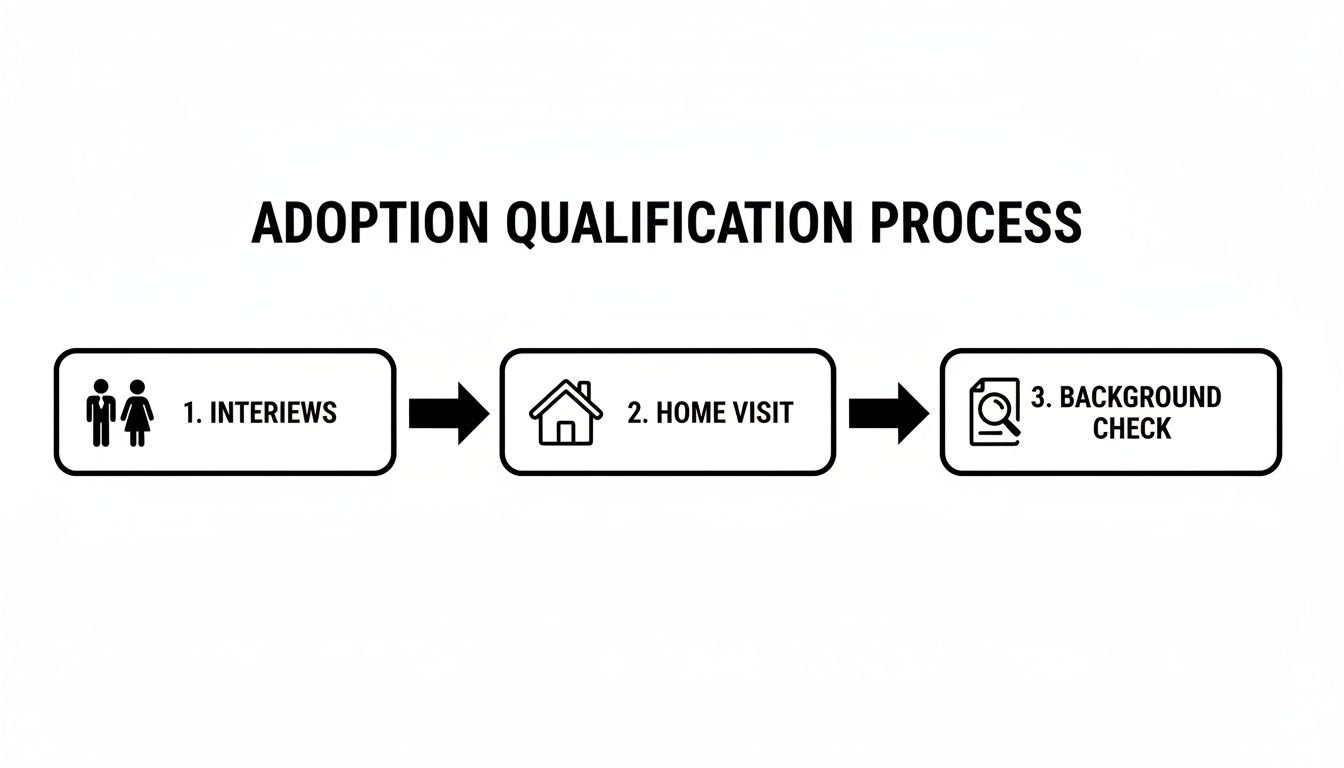
As you can see, the path to adoption is a structured series of conversations and checks, all designed to prepare you for these next critical steps.
The table below breaks down the key legal and practical stages you'll encounter during a private infant adoption here in Texas.
Key Stages in a Texas Private Infant Adoption
This table outlines the typical chronological steps and legal milestones in a private infant adoption process in Texas, from the initial decision to the final court hearing.
| Adoption Stage | Key Actions And Legal Requirements | Typical Timeframe |
|---|---|---|
| Matching | An expectant mother chooses you. You'll work through your agency or attorney to formalize the match and agree on communication and support terms. | Varies (Weeks to Months) |
| Birth & 48-Hour Wait | The baby is born. The birth mother has a legally mandated 48-hour period to wait before she can sign any relinquishment documents. | 48 hours post-birth |
| Relinquishment | The birth mother (and father, if involved) signs a legally binding Affidavit of Relinquishment, terminating their parental rights. | Immediately after the 48-hour wait |
| Placement & Petition | You take your baby home. Your attorney files the initial adoption petition with the court, initiating the legal process. | Within days of relinquishment |
| Post-Placement Supervision | A social worker conducts periodic home visits over six months to support your family's adjustment and prepare a report for the court. | 6 Months |
| Finalization Hearing | After successful post-placement supervision, you attend a final court hearing where a judge signs the final Decree of Adoption. | 1-2 months after supervision ends |
Each of these stages is a significant step forward, bringing you closer to making your family legally and officially whole.
From Relinquishment to Post-Placement Supervision
Once the 48-hour period is over and the birth mother signs the affidavit of relinquishment, her parental rights are terminated. If the birth father is involved, his rights must also be legally addressed, either through his own relinquishment or through other court actions. This is a monumental legal moment that officially clears the path for the adoption to proceed.
After you bring your new baby home, the next chapter begins: post-placement supervision. Don't let the name intimidate you; this isn't a test you can fail. It's a supportive process designed to ensure your new family is adjusting well. For the next six months, a social worker will visit your home periodically.
These visits are meant to:
- Offer Support and Resources: The social worker is there to answer questions, point you to parenting resources, and help you navigate the beautiful chaos of the early days with a new baby.
- Observe the Family Bond: They want to see that the baby is happy and healthy and that you are all bonding as a family in a positive way.
- Prepare a Final Report: The social worker compiles reports from these visits to submit to the court. This serves as powerful evidence that the placement is successful and is absolutely in the child's best interest.
Think of this six-month period as a bridge between bringing your child home and legally becoming their parent forever. It gives everyone time to settle into their new rhythm with a solid support system in place.
Filing the Final Petition and Approaching the Finish Line
With the post-placement visits successfully completed, the final legal step is finally in sight. Your adoption attorney will file the formal Petition to Adopt with the court. This document is the culmination of your entire journey, bundling together everything from your home study approval and the birth parents' relinquishment documents to the positive post-placement reports.
This filing is the official signal to the court that you have met every last legal requirement and are ready to finalize the adoption. It’s the culmination of months, or even years, of hope, patience, and love. The court will then set a date for your finalization hearing—the joyous day when a judge will officially declare you a forever family.
Each of these legal steps, while complex, is a deliberate and meaningful part of building a strong, secure family. If you have questions about where you are in this process, we invite you to schedule a free, compassionate consultation with The Law Office of Bryan Fagan, PLLC. We are here to provide the legal clarity and emotional support you need to confidently move forward.
Choosing Between Open and Closed Adoption
One of the most personal decisions you'll make on your adoption journey is what kind of relationship you’ll have with your child’s birth family. This isn't just a legal checkbox; it’s a choice that will shape your family’s story and your child’s sense of self for years to come. In Texas, the options generally fall into three categories: open, semi-open, and closed adoption.
Thinking through these choices isn't about memorizing definitions. It's about picturing your future family. It's about considering what will give your child the strongest sense of identity and security as they grow up. The honest truth? There is no single "right" answer—only the one that feels right for you, your child, and honors the hopes of the birth parents.
What Open Adoption Looks Like in Practice
An open adoption is a relationship with direct, ongoing contact between your family and the birth parents. Every family builds this relationship differently, but it often includes things like:
- Direct Communication: Freely exchanging texts, phone calls, emails, or even video calls.
- In-Person Visits: Getting together once or twice a year, perhaps for a birthday celebration or a casual park meetup.
- Shared Milestones: Sending photos and updates back and forth as your child grows.
For example, a family in an open adoption might meet the birth mother for lunch every year around the child’s birthday. This kind of relationship allows the child to know their birth family, to ask questions as they get older, and to understand their own story from a place of love and complete transparency.
Understanding Semi-Open and Closed Adoptions
Of course, not every family or birth parent feels ready for the level of connection in a fully open adoption. That’s perfectly okay. Semi-open and closed adoptions offer different degrees of privacy and communication.
A semi-open adoption is a middle ground where communication flows through a neutral third party, like your adoption agency or attorney. You might swap letters and photos once a year, but you won't share identifying details like last names or addresses. This creates a bridge for connection while keeping everyone’s privacy intact.
A closed adoption, which used to be the norm, means no contact at all. Once the adoption is finalized, all records are sealed, and no identifying information is shared between the birth and adoptive families. While much less common today, some birth parents still choose this path for their own emotional healing and closure.
"The goal of any adoption arrangement is to create a foundation of love and security for the child. The 'right' level of openness is the one that allows everyone—the child, the adoptive parents, and the birth parents—to feel respected and at peace with the arrangement."
Post-Adoption Contact Agreements in Texas
To ensure everyone is on the same page and to set clear, healthy expectations from the start, many families in Texas create a Post-Adoption Contact Agreement (PACA). It’s important to know that these agreements are not legally enforceable by a court in the same way a custody order is. However, they are incredibly powerful tools for building trust.
A PACA is a written agreement, signed by both the adoptive and birth parents, that lays out the plan for future contact. It can specify things like:
- The frequency of letters and photos.
- The number of visits per year.
- How you'll handle communication.
Think of this document as a good-faith promise and a clear reference point for everyone involved. It helps prevent misunderstandings down the road and builds a relationship founded on trust and mutual respect. For a deeper dive into how these options compare, we invite you to explore the differences between open vs. closed adoption in our complete guide.
This decision is one of the most personal you will ever make. If you're trying to figure out which path feels right for your family, schedule a free consultation with The Law Office of Bryan Fagan, PLLC. We can offer the compassionate, experienced guidance you need to create an adoption plan that honors everyone involved.
Understanding the Costs and Timeline for Adoption
Let's talk about two of the biggest questions on every hopeful parent's mind: how much will this cost, and how long will it take? For many families just starting their infant adoption journey, these topics can feel like massive, intimidating hurdles. Our goal here is to pull back the curtain and give you a transparent, no-surprises breakdown.
Knowing what to expect—both with your calendar and your finances—is empowering. It lets you move forward with a sense of peace, so you can focus on what really matters: preparing your heart and home to welcome a child.
A Realistic Look at the Adoption Timeline
One of the first things we're always asked is, "How long will it take to adopt a baby in Texas?" While every journey is unique, a realistic timeframe for a domestic infant adoption is typically one to two years. That clock starts the moment you begin your application and home study and stops when the judge’s gavel falls, finalizing your family in court.
So, what happens during that time? Several key factors influence the timeline:
- Home Study Completion: This is the foundational first step. It can take anywhere from three to six months, depending on how quickly you can gather your documents and the agency's schedule.
- The Matching Process: This is the most unpredictable part of the entire journey. It’s all about the right connection. Some families are chosen by an expectant mother within a few months, while for others, it takes longer.
- Legal Procedures: Once a baby is placed in your arms, Texas law requires a six-month post-placement supervision period. This is to ensure everyone is thriving before the adoption becomes legally final.
Patience is more than a virtue in adoption; it's a necessity. But this waiting period isn't passive. Think of it as an active time of preparation, education, and getting everything ready for your new arrival.
Breaking Down the Costs of a Texas Infant Adoption
Financial transparency is essential for a smooth adoption. While the final number can vary, most private infant adoptions in Texas fall somewhere in the range of $25,000 to over $45,000. Seeing that figure can be a shock, but understanding where the money goes helps make it feel much more manageable.
Let’s look at the main categories of expenses you can expect:
- Agency and Attorney Fees: This is the professional engine that drives the process. These fees cover everything from finding and matching you with a birth mother, providing her with crucial counseling and support, and handling all the complex legal work of terminating parental rights and finalizing your adoption.
- Home Study Costs: A licensed social worker is required to conduct your home study. This fee covers their time for the interviews, home visits, background checks, and writing the final, detailed report for the court.
- Birth Mother Support: Texas law allows adoptive parents to provide reasonable financial help to the birth mother for her pregnancy-related living expenses. This can include things like housing, groceries, and medical costs not covered by insurance. Every single payment must be court-approved to ensure everything is handled ethically and legally.
Financial planning for adoption is not just about having the funds; it’s about creating a stable foundation for your new family. Every dollar is an investment in a secure and loving future for your child.
Financial Resources to Help You Build Your Family
That price tag can feel daunting, but you are not in this alone. There are numerous resources designed to help, and many families we work with use a mix of these options to make their adoption dream a reality.
Here are some of the most impactful resources you should know about:
- The Federal Adoption Tax Credit: This is a game-changer for many families. For 2024, the maximum credit is a significant $16,810 per child. It's a non-refundable credit, which means it can reduce your federal income tax liability. If you don't use it all in one year, you can carry the remainder forward for up to five years.
- Employer-Provided Benefits: More and more companies are recognizing adoption as a way to build a family. Check with your HR department to see if your employer offers adoption assistance, which might include financial reimbursement or paid leave.
- Adoption Grants and Loans: There are many non-profit organizations that offer adoption grants—money that you don’t have to pay back. Additionally, some banks and credit unions offer low-interest loans specifically for adoption expenses.
Planning for the costs and timeline of an infant adoption in Texas is a proactive step that builds confidence. When you have a clear financial map and a realistic grasp of the timeline, you can navigate this beautiful, life-changing journey with less stress and more joy.
When you're ready to talk about your specific situation and start creating a plan, our team at The Law Office of Bryan Fagan, PLLC, is here for you. Schedule a free, compassionate consultation to get the clear guidance you deserve.
Finalizing Your Adoption and Beginning Your New Life
After months—sometimes even years—of paperwork, waiting, and preparing your heart and home, the finalization hearing is the beautiful finish line of your adoption journey. This day in court is so much more than a legal formality. It’s a celebration and a milestone—the moment a judge officially declares that your child is, and always will be, a legal member of your family. It’s when your dream becomes reality.
This hearing is usually a happy and relaxed event. You, your child, and your attorney will stand before a judge who reviews the final report from the social worker and confirms that every requirement under the Texas Family Code has been met. With the stroke of a pen on the final Decree of Adoption, it’s official. Your family is legally whole.
Life After the Final Decree
Once the excitement of finalization day settles, a few practical next steps help you transition into your new life. Your story as a family is just beginning, and these tasks are the foundational pieces that solidify your child’s place within it.
Your attorney will help you apply for a new birth certificate for your child, one that lists you as the parents. This is a critical document you'll need for everything from school registration to getting a passport down the road. You’ll also want to get a Social Security number for your child if one hasn't been issued yet.
The finalization hearing isn't the end of your adoption story; it is the first day of the rest of your life together as a legally recognized family. It’s the official start of a lifelong journey of parenthood, love, and growth.
This is also the time to settle into the rhythm of your Post-Adoption Contact Agreement, if you have one. Navigating this relationship with respect, love, and consistency honors the promises you made and enriches your child’s understanding of their own unique story. As you settle in, friends and family will surely want to celebrate with you, and there are wonderful guides for thoughtful gifts for new parents that can help them support you.
Embracing Your Forever Family
The journey of an infant adoption in Texas is a path paved with patience, hope, and an incredible amount of love. From the first home study visit to the final, joyful moments in the courtroom, every single step is designed to build a strong, secure, and lasting family. You've laid a beautiful foundation, and now you get to enjoy the incredible adventure of being parents.
The team at The Law Office of Bryan Fagan, PLLC, has been honored to guide countless families to this beautiful moment. If you're just starting your journey or have questions about these final steps, we invite you to schedule a free, compassionate consultation. Let us help you confidently take that next step toward building your forever family.
Frequently Asked Questions About Texas Infant Adoption
It's completely normal to have a long list of questions when you're considering adoption. It’s a huge, life-changing decision. We’ve answered a few of the most common questions we hear from families in plain English.
What Happens If a Birth Father Is Unknown or Cannot Be Located?
This is a scenario that comes up more often than you might think, and Texas law has a specific process for handling it. The first step involves making a genuine, documented effort to find the father.
If that search is unsuccessful, the next step often involves publishing a legal notice. This isn't just a formality; it's a critical legal step to ensure everyone's rights are respected. This is where having an experienced adoption attorney is essential. We know how to navigate the Texas Paternity Registry and other legal requirements to protect your adoption from any future challenges.
Can a Birth Mother Change Her Mind After Signing Relinquishment Papers?
This is a significant concern for many hopeful adoptive parents. In Texas, a birth mother’s decision to sign an affidavit relinquishing her parental rights is considered irrevocable, meaning it cannot be undone except in very rare cases of fraud or duress.
To protect everyone involved, the law states she cannot sign this document until at least 48 hours after the baby is born. This waiting period ensures the decision is made with a clear mind, free from the immediate pressures of childbirth. This legal finality provides the stability and peace of mind that both the child and the adoptive family need to move forward and bond.
Do We Need an Adoption Agency and an Adoption Attorney?
Many families find that using both is the best path forward. Think of it this way: an agency is fantastic at the "people" part of the process—things like matching you with a birth mother, providing counseling and support for her, and organizing the home study. They are experts in the social and emotional aspects of adoption.
An adoption attorney, on the other hand, is legally required for the court side of things. We handle the critical legal steps, from the termination of parental rights to standing before a judge to finalize your adoption. Sometimes one professional is all you need, but often, an agency and an attorney work together as a powerful team to support you. We can help you figure out what makes the most sense for your family.
Building a family through adoption is a journey of the heart, but it’s one that must be supported by careful, experienced legal guidance. At The Law Office of Bryan Fagan, PLLC, we are here to provide the compassionate and knowledgeable support you need, every single step of the way.
If you’re ready to learn more about infant adoption in Texas, let's talk. Schedule a free, no-obligation consultation with our team today. We’re ready to help you confidently build the forever family you’ve been dreaming of.
