 Skip to content
If you’ve found yourself asking, "what is the process of adopting a child in Texas," you’ve come to the right place. We know this journey is about more than just paperwork; it’s a structured legal path designed to make sure every child finds a safe, loving, and permanent home. It's a profound process, guided by Texas law and deep emotional milestones, that culminates in the beautiful moment your family legally becomes one.
Your Adoption Journey: A Compassionate Overview
Deciding to adopt is one of the biggest moments of your life. It's a path filled with hope, patience, and incredible love, but it can also feel overwhelming. Here at The Law Office of Bryan Fagan, PLLC, we believe that understanding the road ahead is the first step toward a confident and successful adoption. Our goal is to give you a clear roadmap, turning legal complexities into manageable steps so you can focus on what matters most—preparing your heart and home for a child.
This guide is designed to walk alongside you through every phase of the Texas adoption process. We'll break down what can seem like a daunting journey into a series of clear, understandable stages, always keeping the child's best interests at the very center of everything we do.
A Journey of Heart and Law
Adoption is where legal procedure meets a deep, personal connection. The Texas Family Code, specifically Chapters 162–166, lays out the legal framework that protects everyone involved—the child, the birth parents, and you, the adoptive parents. But beyond the statutes and courtrooms, this is a deeply human experience.
Think about a couple who has longed for a child for years. Their journey starts with a hopeful conversation, which leads them to learn about the process, choose an adoption professional, and get their home ready. Every single step, from the first application to the final court hearing, is a milestone on their path to parenthood. This is the reality for thousands of Texas families, and it can be yours, too.
"Adoption is not about finding a child for your family. It's about finding a family for a child." – Unknown
This single idea guides every legal action and decision in the process. It's all about creating stability, offering unconditional love, and building a foundation for a child's bright future.
What to Expect in This Guide
Throughout this guide, we’ll explore the essential phases of adoption, making sure you feel prepared and empowered every step of the way. You will learn about:
- The Foundational Steps: From the initial preparation to the critical home study.
- Connecting with a Child: How the matching and placement process works.
- The Legal Necessities: Including the termination of parental rights and finalizing the adoption in court.
We're here to provide clarity and compassionate legal guidance. We understand the emotional weight of this decision and are committed to helping you build your family with confidence. For personalized advice, we invite you to schedule a free consultation with our team.
The Five Core Phases of the Texas Adoption Process
Thinking about the Texas adoption process can feel like staring at a giant, complicated map with no clear starting point. But it's much easier to navigate when you see it as a series of connected, manageable phases. Each step builds on the last, moving you closer to building your family. This journey is a thoughtful legal procedure designed to make sure every detail is handled with care, always keeping the child's best interests at heart.
This visual flow shows the core milestones of your adoption journey, from the initial decision to the finalization in court.
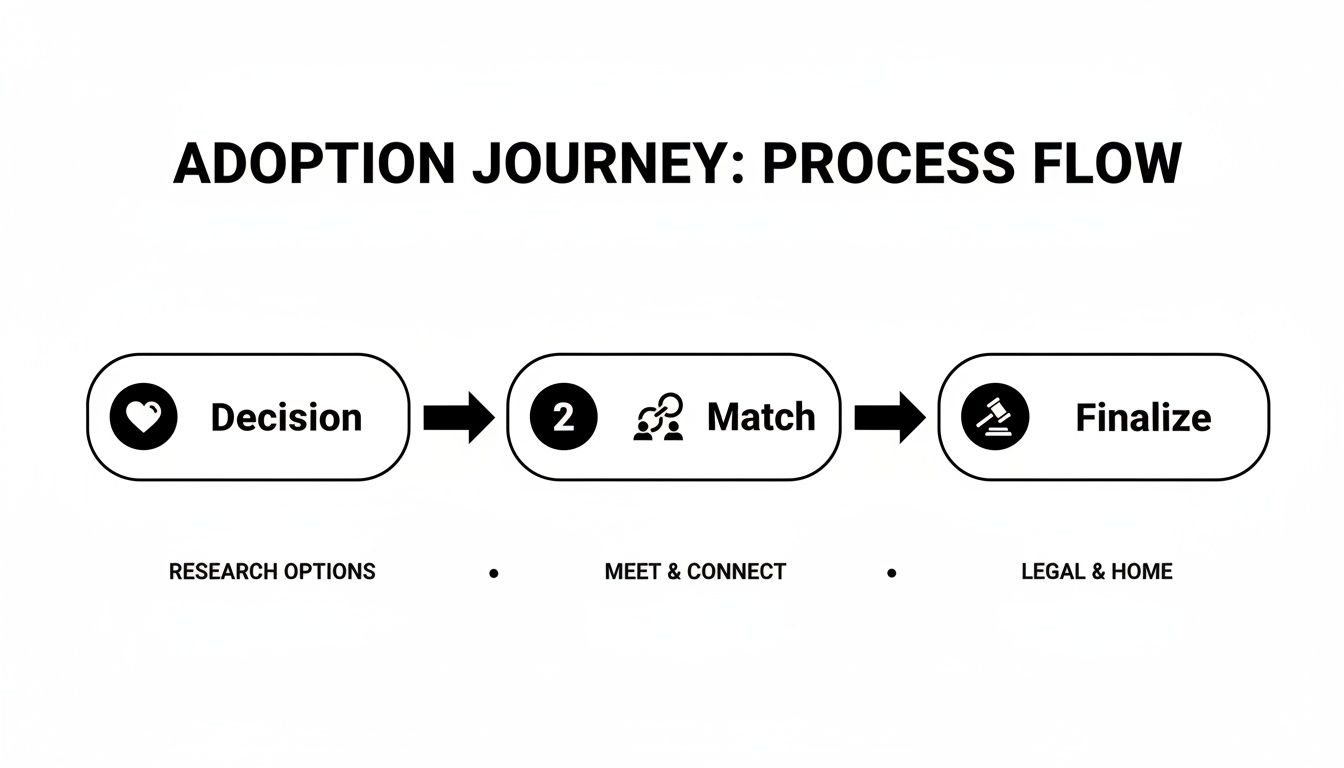
This diagram simplifies a complex legal and emotional path into three key moments: making the heartfelt decision, matching with a child, and legally becoming a family. Below, we’ll unpack this even further into five distinct phases to give you a complete picture of the road ahead.
Phase 1: Preparation and Application
This is where your journey truly begins. In this initial phase, you’ll make some of the biggest decisions, like choosing the type of adoption that fits your family's hopes—whether that's a private adoption, a stepparent adoption, or adopting through the foster care system.
This is also the time to find an experienced adoption attorney. Having a compassionate legal guide from the very beginning means you have a trusted partner to answer questions, handle the initial paperwork, and map out a clear strategy for your unique situation. Your attorney will help you understand all the requirements and prepare for the next steps, giving you a strong, confident start.
Phase 2: The Home Study
The home study is probably the most talked-about part of the adoption process, and it’s completely natural to feel a little nervous about it. But try to see it not as an inspection, but as a collaborative and educational process. Mandated by the Texas Family Code, the home study is designed to ensure that any home a child is placed in is safe, stable, and nurturing.
A licensed social worker will meet with you to chat about your background, lifestyle, and how you see yourself as a parent. The process usually involves:
- Interviews: Conversations with you and anyone else living in your home.
- Home Safety Check: A review of your home to make sure it meets basic safety standards for a child.
- Document Review: Gathering important paperwork like birth certificates, marriage licenses, and financial statements.
- Background Checks: State and federal criminal history checks are required for all adults in the home.
The goal is to get to know you and prepare you for welcoming a child into your life. It’s a foundational step that confirms your readiness to become a parent.
Phase 3: Matching and Placement
This is the phase where hearts and hopes finally connect. The matching process looks very different depending on the type of adoption. In a private infant adoption, you might create a profile book for expectant mothers to look through. In a foster care adoption, a caseworker will work to find a child whose needs you are uniquely equipped to meet.
Once a match is made, the moment you've been waiting for arrives: placement. This is the day the child comes to live with you. It's a time of incredible joy and a big adjustment for everyone. This initial period is when you start to bond and function as a family, creating the routines and rhythms of your new life together.
Phase 4: Consent and Legal Clearance
Before any adoption can be finalized, the parental rights of the child’s biological parents must be legally terminated. This is a critical and sensitive step handled with the utmost care by the court system and your attorney. It's often referred to as the Termination of Parental Rights (TPR).
A birth parent can sign a voluntary affidavit to give up their rights, but in Texas, a birth mother cannot do so until at least 48 hours after the child's birth. This waiting period ensures her decision is made freely and without pressure. In other cases, a court may involuntarily terminate parental rights if it’s proven to be in the child's best interest. Your attorney will manage every legal detail of the TPR process to ensure it’s done correctly and ethically.
Phase 5: Finalization and Beyond
After the child has lived in your home for a legally required period—typically at least six months—the final phase begins. This includes post-placement supervision, where a social worker will visit your home a few times to see how everyone is adjusting and to offer support.
The journey concludes with the finalization hearing. You, your child, and your attorney will go before a judge, who will review the case file and sign the final decree of adoption. This is the moment your child legally and forever becomes a part of your family. It's a day for celebration, marking the official start of your new life together.
To provide a clear overview, we've summarized these stages below.
Key Stages in the Texas Adoption Journey
This table breaks down the entire process into its core components, helping you see how each phase contributes to the final goal of building your family.
| Adoption Phase | Primary Goal | Key Activities |
|---|---|---|
| 1. Preparation & Application | To lay the groundwork for a successful adoption. | Choosing an adoption type, selecting an attorney, gathering initial documents, and understanding legal requirements. |
| 2. Home Study | To ensure a safe, stable, and nurturing home environment for a child. | Interviews with a social worker, a home safety inspection, document review (financials, IDs), and completing state and federal background checks. |
| 3. Matching & Placement | To connect prospective parents with a child. | Creating a parent profile, working with agencies or DFPS to find a match, and welcoming the child into the home for the initial placement period. |
| 4. Consent & Legal Clearance | To legally free the child for adoption by terminating biological parental rights. | Securing voluntary consent from birth parents (after the legal waiting period) or pursuing involuntary termination through the court system. This is a critical legal step. |
| 5. Finalization & Beyond | To legally complete the adoption and celebrate the new family unit. | Completing the post-placement supervision period, attending the finalization hearing in court, and receiving the final decree of adoption. |
Each of these steps is a significant milestone on your path to parenthood.
Navigating these five phases requires patience, hope, and expert guidance. If you're ready to take the first step or have questions about where you are in the process, we invite you to schedule a free consultation with our team. We're here to help you build your family, one step at a time.
Navigating the Different Paths to Adoption in Texas
The journey to building a family through adoption isn't a single, straight road. Think of it more like a landscape with several distinct paths, each leading to the same beautiful destination. In Texas, the answer to what is the process of adopting a child really depends on which path you take. Each option comes with its own unique emotional terrain, legal steps, and timeline.
Figuring out which of these paths aligns with your family’s heart and circumstances is the very first step. Maybe you're hoping to connect with an expectant mother, legally formalize the bond with a stepchild, keep a child within the family, or open your home to a child from the foster care system. No matter your situation, there is a way forward. Our goal is to explain these options with clarity and compassion, helping you choose with confidence.

Private Infant Adoption
When people think of adoption, this is often the picture that comes to mind. Private infant adoption is all about creating a direct connection between an expectant parent and hopeful adoptive parents, usually with an adoption agency or attorney helping to facilitate. It’s a deeply personal journey, one that’s built on a foundation of trust and open communication.
In this process, you'll create a profile that tells your story—who you are, what your life is like, and the loving home you hope to provide. Expectant parents review these profiles to find a family they feel is the right fit for their child. Once you're matched, the relationship can grow through letters, calls, or even in-person meetings, depending on what everyone is comfortable with. To learn more about the specifics, check out what is private adoption in our comprehensive guide.
Stepparent Adoption
When a new spouse steps into a parental role, a stepparent adoption is a powerful way to make that bond legally solid. This is one of the most common types of adoption in Texas, and it offers a more streamlined process to make the family whole in the eyes of the law. It gives the stepparent full legal rights and responsibilities for the child—the same as a biological parent.
For a stepparent adoption to move forward, the other biological parent must either agree to the adoption by terminating their parental rights or have their rights terminated by a court. This is a crucial legal step that provides stability for the child. The process is often quicker than other adoptions because the child is already living in the home, which can simplify the home study requirement.
The core purpose of a stepparent adoption is to provide a child with the legal security and permanency of having two loving, committed parents. It formalizes a bond that already exists in the heart of the family.
Kinship or Relative Adoption
Family is the first and most important safety net for a child. Kinship adoption, sometimes called a relative adoption, recognizes this by allowing a family member—like a grandparent, aunt, uncle, or older sibling—to adopt a child. This path is all about preserving family connections and cultural heritage, giving a child stability in a familiar and loving environment.
These adoptions often happen when a biological parent cannot care for their child due to illness, incarceration, or other difficult situations. The process is typically more straightforward than non-relative adoptions, as both the courts and the Texas Department of Family and Protective Services (DFPS) recognize the value of keeping children with their families.
- Emotional Benefit: The child gets to stay with trusted relatives, which minimizes the trauma of being placed with strangers.
- Legal Simplicity: Texas law often streamlines the home study and other legal requirements for relatives.
- Preserving Bonds: It ensures that important family relationships and traditions can continue without interruption.
Foster Care Adoption
Adopting a child from the foster care system is an incredible act of love that offers a permanent, stable home to a child who has known too much uncertainty. These children, from infants to teenagers, are in the state's care because their biological parents are unable to provide a safe home. While the primary goal of foster care is always reunification with the biological family, that's not always possible. When it isn't, adoption becomes the path to giving a child a forever family.
The process usually starts with becoming a licensed foster parent. Many families begin by fostering a child with the hope of eventually adopting them, a route known as "foster-to-adopt." The state provides extensive training, support, and often financial assistance to help families meet the needs of these children, many of whom have experienced trauma. It's a journey that demands patience and a big heart, but the reward of giving a child a family is immeasurable.
Understanding the Legal and Emotional Landscape
Every adoption is a journey of both the heart and the law. To truly understand what is the process of adopting a child, you have to see where the legal framework and the deep emotions of the journey meet. This is where legal precision and human compassion are most closely intertwined, all working toward one goal: creating a permanent, loving family while respecting the rights of everyone involved.
At the very center of every legal action is one guiding principle that shapes every court decision in Texas: the best interest of the child. This standard, firmly rooted in the Texas Family Code, means that every choice is weighed against what will provide the child with the safest, most stable, and nurturing future possible.
The Critical Step: Termination of Parental Rights
For a child to be legally free for adoption, the rights of their biological parents must be permanently and legally ended. This is a profound and necessary legal step known as the Termination of Parental Rights, or TPR. It’s handled with immense care and legal diligence because of how significant it is.
There are two ways this can happen:
- Voluntary Relinquishment: This is when a birth parent makes the thoughtful and incredibly difficult decision to sign legal documents, called an affidavit of relinquishment, to voluntarily give up their parental rights. In Texas, a birth mother cannot sign this document until at least 48 hours after giving birth, ensuring the decision is made with a clear mind and without pressure.
- Involuntary Termination: In heartbreaking situations where a child's safety is at risk due to abuse, neglect, or abandonment, a court may step in. After a thorough legal process where the parent has the right to be heard, a judge can involuntarily terminate their parental rights if it is proven to be in the child's best interest.
This is arguably the most sensitive part of any adoption. Having an experienced attorney is essential to ensure this process is handled ethically, legally, and with compassion for all parties.
Open vs. Closed Adoptions: A Modern Choice
Another key aspect to consider is the nature of the relationship between the adoptive family and the birth parents after the adoption is finalized. This is often described as the level of "openness" in an adoption.
An open adoption involves some form of ongoing communication after the placement. This could mean sharing letters, photos, and emails, or even arranging occasional visits. The goal is to allow the child to know their full story and maintain a healthy connection with their biological roots, which many experts believe is incredibly beneficial for their sense of identity.
A closed adoption, on the other hand, involves no contact. All records are sealed, and no identifying information is shared between the families. While this was once the standard, closed adoptions are less common today but are still the right choice for some families depending on their unique circumstances.
The modern legal process for adopting a child has become more structured over the past few decades. Recent data shows that in 2021, over 66% of non-stepparent adoptions in the U.S. came from the public foster care system, with another 31.7% occurring through private domestic channels. Learn more about these adoption statistics and trends.
A Story of Open Adoption
Consider the story of a couple, Mark and Sarah, who adopted a baby boy through a private agency. They connected with the birth mother, a young woman named Emily, who wanted her son to grow up knowing he was deeply loved by her.
Together, they created an open adoption agreement. Mark and Sarah send Emily photos and updates twice a year, and they have a private social media group where they can share milestones. This open line of communication has allowed their son to grow up understanding his own story with honesty and love, and it has given Emily peace, knowing her child is thriving.
Navigating these legal and emotional waters requires a steady hand. The decisions you make here will shape your family’s future for years to come. For compassionate guidance on these sensitive matters, we invite you to schedule a free consultation to discuss your path forward.
How to Prepare for Your Home Study with Confidence
The home study is usually the part of the adoption process that makes people the most nervous. It's completely normal to feel a bit on edge about a stranger coming to inspect your home and ask personal questions. But let's reframe this step. Think of it not as a test you can pass or fail, but as a conversation—a collaborative effort to ensure a child will land in a safe, stable, and loving home.
The social worker is there to get to know you, offer resources, and help prepare you for the beautiful journey of parenthood. They’re on your team, working toward the exact same goal you are: building a strong family.

What Your Home Study Will Cover
In Texas, the home study is a thorough but straightforward review of your life and home environment, designed to paint a complete picture of the family a child will be joining. For a deeper dive, you can learn more about the home study process in our dedicated article.
Generally, you can expect the home study to have a few key parts:
- Personal Interviews: These are just conversations. You'll talk about your background, your childhood, your relationship, how you plan to parent, and your reasons for choosing adoption.
- Background Checks: This is a standard part of the process. State and federal criminal background and child abuse registry checks are mandatory for every adult living in the home.
- Financial Review: You'll be asked to share documents showing your income and savings. This isn't about being rich; it's about demonstrating that you can financially support a child.
- Home Safety Inspection: The social worker will do a walkthrough to make sure your home meets basic safety standards, like having working smoke detectors and safely stored cleaning supplies.
This process is absolutely vital for kids waiting in the foster care system. The strict timelines and permanency goals of child welfare law mean these children need security, and a positive home study is the first step. AFCARS data for FY 2024 showed 70,418 children in the U.S. foster system were waiting for adoption, each one needing the promise of a safe home.
A Story of Finding Confidence
Let me tell you about a couple we worked with, David and Maria. They were incredibly anxious about their home study. They worried their small apartment wasn't "perfect" enough and that past struggles would be held against them.
But during their first interview, they decided to just be open and honest. They shared their journey, their dreams for a child, and even their fears. Their social worker listened with empathy, reassuring them that the goal wasn't perfection—it was preparedness. She offered practical tips for childproofing and praised their financial planning. By the end, David and Maria told us the process had actually boosted their confidence, confirming they were more than ready to be amazing parents.
A Practical Checklist for Your Paperwork
Getting organized is one of the best ways to reduce stress. To manage the paperwork that comes with a home study, it helps to follow some effective document management best practices. Here’s a list of common documents you’ll probably need to gather:
- Personal Identification: Birth certificates, driver's licenses, and Social Security cards for all adults in the home.
- Relationship Status: Your marriage certificate, if you're married.
- Financial Information: Recent pay stubs, tax returns, and bank statements.
- Health Statements: Letters from your doctors confirming you are physically and mentally healthy enough to parent.
- Personal References: Contact information for several non-family members who can speak to your character.
Remember, the home study is a crucial part of what is the process of adopting a child, but it's a supportive one. It’s an opportunity to reflect on your strengths and prepare your home and heart for the incredible journey ahead.
If you have questions or feel overwhelmed about preparing for your home study, our compassionate team is here to help. We invite you to schedule a free consultation to talk through your unique situation and move forward with peace of mind.
Partnering with an Attorney for Your Adoption Journey
Navigating the adoption process on your own can feel like trying to solve a puzzle in the dark. It’s overwhelming, but having a compassionate legal partner by your side makes all the difference. This is where The Law Office of Bryan Fagan, PLLC comes in. We handle the legal complexities so you can focus on what truly matters: preparing your heart and home for a child.
Think of us as your guides and advocates. We ensure every document is filed correctly and on time—a detail that is critical for a smooth adoption. Our team provides steady, clear guidance on all the requirements in the Texas Family Code, so you never have to guess what comes next.
Your Advocate in Court and Beyond
From representing you confidently in hearings for the termination of parental rights to celebrating with you on finalization day, we are with you every step of the way. You don’t have to walk this path alone. Having experienced adoption attorneys near you provides a level of peace of mind that’s simply invaluable. Our experience allows us to anticipate challenges and protect your family's future before problems even arise.
An adoption attorney does more than file paperwork; they provide the legal shield that allows you to focus on the emotional journey of becoming a parent, knowing every detail is handled with precision and care.
We understand the emotional weight of this journey and are committed to helping you build your family with confidence.
Take the Next Step with Confidence
The journey to adoption is a significant one, and you deserve a guide who understands both the legal maze and the emotional side of the process. We invite you to schedule a free, no-obligation consultation to talk about your unique situation. Let us answer your questions and show you how we can help you build your family with the peace of mind you deserve.
Answering Your Questions About the Adoption Process
It’s completely normal to have questions as you start thinking about adoption—in fact, it’s a critical part of the process. To help bring some clarity, we've put together answers to some of the most common questions we hear from families just starting their journey. Our goal is to give you straightforward information that helps you feel confident and prepared for the road ahead.
How Long Does the Process of Adopting a Child Take in Texas?
The timeline for a Texas adoption really depends on which path you take. Each type of adoption has its own legal roadmap and unique steps that shape how long it takes from start to finish.
- Stepparent or Relative Adoptions: These are usually the quickest. Since the child is often already living with the family, these adoptions can sometimes be finalized in just a few months.
- Private Infant Adoptions: This timeline is much harder to predict. It all comes down to the matching process, which can take anywhere from several months to a couple of years.
- Foster Care Adoptions: Adopting from foster care is a multi-step process. You can generally expect it to take between one and two years, which includes time for foster placement, the termination of parental rights, and legally required post-placement supervision.
An experienced adoption attorney can look at your specific circumstances and give you a much more accurate estimate.
What Are the Biggest Challenges to Prepare For?
Adoption is an incredible journey, but it's smart to go in with your eyes open to the potential challenges. The biggest hurdles are often emotional ones, like managing the anxiety that comes with waiting or learning to navigate the relationships in an open adoption.
On the legal side of things, one of the most common pitfalls is filing paperwork that’s incorrect or incomplete. This can lead to frustrating delays. Working with a skilled attorney helps you get ahead of these issues, ensuring every legal detail is handled correctly from the very beginning and making the entire process smoother.
Every adoption story is different, but the need for patience, a strong support system, and expert guidance is universal. Preparing for both the emotional and legal hurdles is the key to a more successful and less stressful experience.
Can Single Individuals or LGBTQ Couples Adopt in Texas?
Yes, absolutely. Texas law is very clear on this: any single adult or legally married couple who can provide a safe, loving, and stable home is eligible to adopt. The home study is designed to confirm your ability to parent, without any regard for your marital status or sexual orientation.
Our firm is proud to help all kinds of families grow through adoption. We believe that love is what makes a family, and we work to ensure every client is treated with the dignity and respect they deserve.
What Happens If a Birth Parent Changes Their Mind?
This is one of the most common and understandable fears for hopeful adoptive parents. The good news is that the Texas Family Code includes specific protections to create legal finality for everyone involved—the birth parents, the adoptive family, and most importantly, the child.
A birth mother cannot legally sign the documents to relinquish her parental rights until at least 48 hours after the child is born. This mandatory waiting period is there to ensure her decision is made with full consideration and without pressure. Once this document, called an affidavit of relinquishment, is properly signed and executed, it is generally considered irrevocable. Our firm pays meticulous attention to this critical step to protect the permanence and integrity of your adoption.
The journey to build your family is one of the most important you will ever take. At The Law Office of Bryan Fagan, PLLC, we are honored to walk alongside you, providing the compassionate legal guidance needed to navigate every step with confidence. If you have more questions or are ready to begin, schedule your free consultation with us today at https://texasfamilyadoption.com.

