 Skip to content
When you first see the numbers attached to adoption, it’s natural to feel a little sticker shock. One of the first questions we hear from hopeful parents is, "Why does it cost so much to adopt?" It's a valid question, and the answer is more complex than you might think.
The simple answer is that you’re not paying a "price" for a child. You’re investing in a comprehensive, months-long process designed to protect everyone involved—especially the child at the center of it all. It’s better to think of these costs not as a price tag, but as an investment in building a safe, legal, and loving foundation for your family.
The True Story Behind Adoption Costs
The costs can feel overwhelming, but they aren't arbitrary. They represent a collection of essential professional services—legal, social work, medical, and administrative—that ensure the adoption is handled ethically, legally, and with the best interests of the child at heart.
In the United States, a private domestic infant adoption can easily cost upwards of $30,000. Most analyses show a common range between $20,000 and $45,000. While adopting from foster care is often nearly free because it’s subsidized by the state, private adoptions don’t receive that same level of systemic support. You can explore more about these adoption cost comparisons to get a clearer picture of the financial landscape.
A Look at Different Adoption Paths
The path you choose to grow your family is the single biggest factor determining your total cost. The chart below gives a general overview of what Texas families can typically expect.
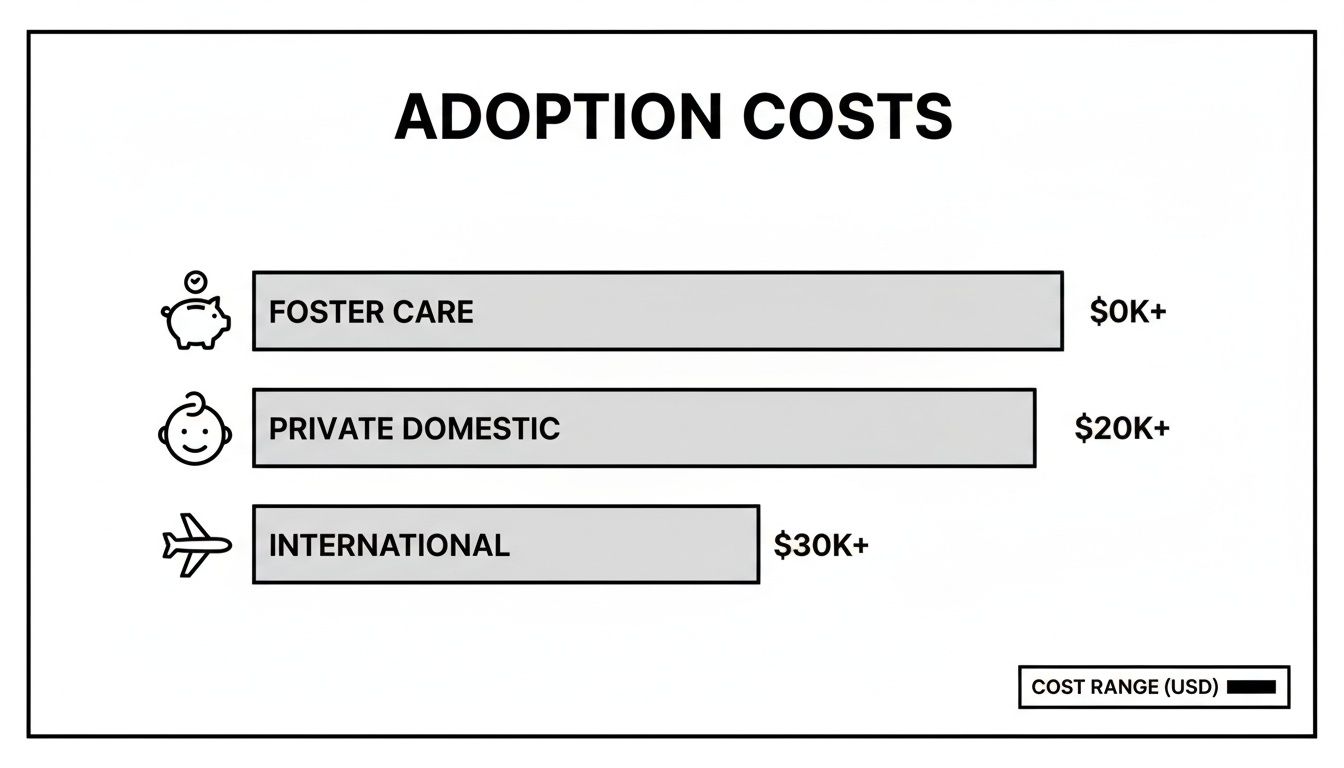
As you can see, there’s a huge financial gap between adopting from foster care and pursuing a private or international adoption. This really drives home how much your chosen path will shape your budget and financial planning.
To give you a clearer snapshot, here’s a quick breakdown of the typical cost ranges Texas families encounter for the most common adoption routes.
Typical Adoption Cost Ranges for Texas Families
| Adoption Type | Estimated Cost Range | Key Cost Drivers |
|---|---|---|
| Foster Care Adoption | $0 – $2,500 | Most fees are reimbursed by the state. Costs are minimal (e.g., travel, home updates). |
| Private Domestic Adoption | $20,000 – $45,000 | Agency fees, legal costs, birth mother expenses, home study, and counseling services. |
| International Adoption | $30,000 – $60,000+ | Agency fees, foreign country program fees, immigration processing, travel, and legal costs. |
| Stepparent Adoption | $1,500 – $5,000 | Primarily legal fees for terminating parental rights and finalizing the adoption. |
These figures are estimates, but they illustrate how different the financial journeys can be. The services included in these costs are what make a secure, legal adoption possible.
Why Each Service Matters
It’s helpful to think of the total adoption cost like building a custom home. You wouldn’t just pay for the lumber; you’d also pay for the architect, the construction crew, and the inspectors who ensure the final structure is safe and sound for a lifetime.
Adoption costs work the same way, covering:
- Legal Guidance: An experienced adoption attorney is your guide through the maze of the Texas Family Code. They handle all court filings, ensure parental rights are properly terminated, and finalize the adoption, making every detail legally airtight.
- Social Work and Counseling: Licensed social workers conduct the state-required home study. Just as importantly, they provide crucial, unbiased counseling to birth parents and offer support to you throughout the emotional journey.
- Agency Operations: These fees keep the lights on for the agency, covering their work to find and screen potential matches, manage communications, and provide ongoing case management.
- Medical and Living Expenses: In Texas, adoptive parents may legally cover reasonable and necessary medical and living expenses for the birth mother, as permitted by the court. This support ensures she and the child are cared for during her pregnancy.
Decoding Private Domestic Adoption Expenses
When you first see the total cost of a private domestic adoption, the number can feel like a roadblock. We understand. But breaking down why it costs what it does is the first real step toward making a plan that works for your family. The final cost isn't one giant payment; it's a series of careful, professional services that all come together to build a safe, legal, and loving home for a child.
Let’s walk through the financial journey of a typical private domestic adoption. We'll turn that big number into a series of understandable steps, using a Texas couple as our example to see how these costs add up over time.

Agency Program and Matching Fees
For most families, the journey kicks off with an adoption agency. This is where you’ll often find the largest single expense: the agency’s program fee, which typically lands somewhere between $15,000 and $30,000. Think of this fee as the engine that drives the entire adoption process.
So, what exactly are you paying for?
- Screening and Matching: Agencies pour a ton of time and resources into finding and vetting both birth mothers and hopeful adoptive parents. This involves outreach, advertising, and a professional staff dedicated to making an ethical match that prioritizes the child's well-being.
- Counseling and Support: A critical piece of this fee funds unbiased counseling for the birth mother. This ensures her decision is made freely and with full emotional support—a cornerstone of any ethical adoption.
- Education and Training: Agencies prepare you for the road ahead. They provide mandatory training for adoptive parents, getting you ready for the unique joys and challenges that come with raising an adopted child.
- Case Management: You're not going it alone. A dedicated caseworker will be your guide through every single step, from the mountain of paperwork to the post-placement visits.
This isn't just an administrative fee. It’s the operational cost for the team of people working to bring your family together safely and ethically.
The Home Study: A Foundation of Trust
Before you can be considered for a match, Texas law requires a home study. This is a thorough review of you, your home, and your readiness to parent. The cost for a home study usually falls between $1,500 and $4,000.
A licensed social worker handles this process, which involves interviews, a home inspection, background checks, and a look at your finances. While it can feel a bit invasive, its purpose is straightforward: to guarantee that a child will be placed in a safe, stable, and loving environment. It’s a foundational step required by the Texas Family Code, designed purely to protect the child's best interests.
For example, imagine a Texas couple, Sarah and Mark. They pay a $2,500 fee for their home study. This covers the social worker's time for multiple visits, detailed background checks for both of them, and the creation of a comprehensive report that is then filed with the court, as required by Chapter 162 of the Texas Family Code.
Legal Counsel for a Secure Future
The Texas Family Code is a complex legal landscape. This is where having an experienced adoption attorney becomes non-negotiable. Legal fees can range from $5,000 to $15,000 or more, depending on the complexity of your case.
Your attorney acts as your family's legal guardian throughout the entire process. Their job includes:
- Filing the adoption petition with the court.
- Ensuring the legal termination of the birth parents' rights is handled perfectly according to state law.
- Representing you at the finalization hearing, the day your family legally comes together.
These legal steps aren't just formalities. They create the permanent, legally recognized bond between you and your child, providing security for a lifetime. We can help you understand more about the specifics of legal fees for adoption in Texas.
Supporting the Birth Mother with Compassion
In Texas, the law allows adoptive families to provide financial assistance for a birth mother's reasonable and necessary living expenses during her pregnancy and for a short time after. This is absolutely not "paying for a baby." It is an act of compassion to ensure she and the child are healthy and safe during a vulnerable time.
These expenses must be approved by the court and can include things like:
- Medical bills not covered by insurance.
- Rent and utilities.
- Maternity clothing and food.
This support can range from a few thousand dollars to $10,000 or more, depending entirely on her individual situation. Every dollar must be carefully documented and handled through your attorney or agency to stay in full compliance with Texas law. This ensures the process remains ethical and focused on care, not coercion.
Each of these pieces comes together not as numbers on a spreadsheet, but as vital services that protect the well-being of everyone involved and create a secure, bright future for your child.
Comparing International and Foster Care Adoption Costs
While private domestic adoption is a common path for many Texas families, it’s certainly not the only one. To find the best fit for your family, it helps to understand the financial reality of every route—including international adoption and adopting from foster care.
These two paths sit at the highest and lowest ends of the cost spectrum. Knowing why will give you the clarity you need to make an informed, confident decision.

The High Cost of International Adoption
Adopting a child from another country is a beautiful way to grow your family, but it almost always comes with the highest price tag, often running from $30,000 to $60,000 or even more. This isn't just one big fee; it’s a complex web of services and legal requirements that stretch across two different nations.
The process is inherently more complicated. You’re not just navigating the Texas Family Code—you’re also dealing with the legal system of another sovereign country and U.S. immigration laws.
Here are the key factors that drive up the cost of international adoption:
- Foreign Country Program Fees: These are paid to agencies or government bodies in the child's home country to manage the adoption on their end.
- Immigration and Visa Processing: Bringing your child home requires extensive paperwork with U.S. Citizenship and Immigration Services (USCIS), and visa applications come with their own set of fees.
- Mandatory Travel and Lodging: Nearly every international adoption requires at least one trip to the child's home country. These trips can last for weeks, adding significant costs for flights, hotels, and daily expenses.
- Translation and Dossier Fees: Your official documents must be translated and authenticated for the foreign government. This process, known as creating a "dossier," can be both expensive and time-consuming.
The world of international adoption has changed dramatically over the years. Adoptions to the U.S. plummeted 94%, from a peak of 22,988 in 2004 to just 1,275 by 2023. As other countries have tightened their rules, the process has become more demanding, often requiring longer stays abroad and pushing total costs even higher. You can read more about these international adoption trends to get a better sense of the global picture.
The Accessible Path of Foster Care Adoption
On the other side of the financial coin is adopting from the Texas foster care system. This is, by far, the most affordable way to build your family. Costs are often minimal—typically between $0 and $2,500.
Why so low? The reason is simple: the state’s number one goal is to find loving, permanent homes for children in its care. The state actively supports families willing to open their hearts to these kids. Instead of parents shouldering the financial burden, the state steps in to provide significant help.
The focus in foster care adoption is not on the family’s ability to pay for the process, but on their ability to provide a safe, nurturing, and permanent home. The state’s financial support reflects its commitment to the child’s best interest above all else.
Many of the costs you'd pay out-of-pocket in a private adoption are covered or reimbursed by the state of Texas. This often includes:
- Home Study Fees: Frequently provided at no cost by the Texas Department of Family and Protective Services (DFPS) or a contracted agency.
- Legal Fees: Many families qualify for reimbursement of the legal and court costs needed to finalize the adoption.
- Ongoing Support: Adoptive parents may be eligible for a monthly subsidy to help with the child’s needs, as well as Medicaid coverage for the child until they turn 18.
This financial structure is designed to remove barriers, ensuring that a child’s chance at a forever home isn't limited by a family's bank account. If you're leaning toward this path, you can get a more detailed breakdown in our guide to understanding the costs of Texas foster care adoption. This route truly puts the child first, creating opportunities for families where finances are not the main obstacle.
The Critical Role of an Adoption Attorney
Many hopeful parents look at the growing list of adoption expenses and ask a fair question: "Do we really need to hire an attorney?"
The answer is an emphatic yes. In the intricate world of Texas adoption, an experienced attorney does far more than just help with paperwork. They are your family’s legal shield, making sure every single step is handled with the precision and care it deserves.
This isn't just about filling out forms correctly. Think of it as an investment in the legal bedrock of your family’s future. A good attorney protects your rights, ensures every action complies with the Texas Family Code, and expertly guides you through the court system to make your adoption permanent and unshakeable.
Protecting Your Family Through the Legal Process
At its heart, an adoption is a legal proceeding. Your attorney's most important job is to make sure the foundation of your family is legally sound. They manage the critical tasks you simply can’t handle on your own, safeguarding your child’s future and giving you priceless peace of mind.
Here are just a few of the crucial responsibilities your adoption attorney handles:
- Terminating Birth Parent Rights: This is one of the most sensitive and legally vital steps in any adoption. Your attorney ensures this process is completed according to the strict guidelines in Chapter 161 of the Texas Family Code, protecting your adoption from any future legal challenges.
- Filing the Adoption Petition: They draft and file the formal "Petition for Adoption" with the correct court. This is the official start of the legal journey that will ultimately make you a parent.
- Court Representation: Your attorney is by your side for all court appearances, especially the finalization hearing. This is the moment a judge signs the final decree of adoption, and you absolutely want an expert there with you.
- Ensuring Ethical Compliance: If any financial support is provided to the birth mother, your attorney oversees it to ensure every transaction is transparent, documented, and approved by the court. This avoids any hint of impropriety that could jeopardize the adoption.
Understanding the Cost of Legal Security
A significant portion of adoption costs comes from legal fees, which is why understanding retainer agreements and other payment structures can be so helpful. An attorney’s fees cover their time, expertise, and the immense responsibility of legally building your family. They handle every detail with a level of precision that prevents costly errors or emotional heartbreak down the road.
At The Law Office of Bryan Fagan, PLLC, we see our role as more than just legal representation. We are your advocates, your guides, and your partners in building a secure and loving family. We ensure that every 'i' is dotted and every 't' is crossed so you can focus on what matters most—preparing to welcome your child home.
Ultimately, hiring a knowledgeable attorney isn't an optional expense; it's a foundational part of the answer to "why does it cost so much to adopt?" This investment ensures your adoption is handled ethically, legally, and with the expert care your new family deserves. The peace of mind that comes from knowing your child's place in your family is legally secure is truly invaluable. If you're looking for guidance, our guide to finding adoption attorneys near you can provide a helpful starting point.
Making Your Adoption Journey Affordable
After breaking down all the costs involved, the final number can feel like a mountain. But it’s a mountain with well-traveled paths to the top. The first step is knowing the costs, and the next is understanding the incredible financial resources available to Texas families just like yours. This isn't about facing a huge bill alone; it's about building a financial plan with tools designed to help you succeed.
The truth is, while the costs are significant, you aren't expected to cover them without support. From federal tax credits to workplace benefits and private grants, there are established ways to make your adoption journey affordable.

The Federal Adoption Tax Credit: A Powerful Tool
One of the most impactful resources you have is the Federal Adoption Tax Credit. This isn't a small deduction; it's a significant, dollar-for-dollar credit designed to directly offset the high cost of adoption. For the 2024 tax year, families can claim up to $16,810 in qualified adoption expenses per child.
This credit is a real game-changer for many families. It can cover a huge portion of your expenses, including:
- Reasonable and necessary adoption fees
- Court costs and attorney fees
- Travel expenses, including meals and lodging
- Other costs directly related to a legal adoption
It's important to know this is a nonrefundable credit. That means it can reduce your federal income tax liability to zero, but you won’t get a cash refund for any amount beyond what you owe. The good news? You can carry forward any unused credit for up to five years, giving you plenty of time to get the full benefit. You can also get a deeper look into the role of an attorney and the associated legal fees for adoption in our detailed guide.
Adoption Grants and Employer Benefits
Beyond the tax credit, many organizations offer adoption grants—outright gifts of money that you never have to repay. These grants come from national and local foundations, and they often have specific criteria based on things like the type of adoption, your income level, or even your profession.
Finding and applying for grants takes time and effort, but the payoff can be huge. A great place to start is with organizations like HelpUsAdopt.org or the National Adoption Foundation.
More and more employers are also stepping up to support families built through adoption. Many now offer adoption assistance as part of their standard benefits packages. This can include:
- Direct financial reimbursement for qualified adoption expenses, often ranging from $5,000 to $25,000.
- Paid leave for adoption, similar to maternity or paternity leave.
Check with your company's HR department to see what they offer. You might be surprised by the support available right at your workplace.
The goal of these programs is to remove financial barriers, ensuring that a loving home is within reach for every family ready to open their hearts. These resources reflect a shared belief that every child deserves a permanent, supportive family.
Navigating the various financial aid options can be confusing. To help clarify, we’ve put together a table comparing some of the most common resources for adoptive families.
Funding Your Adoption: A Comparison of Financial Resources
| Financial Resource | Description | Typical Amount/Benefit | Key Consideration |
|---|---|---|---|
| Federal Adoption Tax Credit | A nonrefundable tax credit that directly reduces your federal income tax liability for qualified adoption expenses. | Up to $16,810 per child (for 2024). | Nonrefundable, but unused credit can be carried forward for up to 5 years. Must have tax liability to benefit. |
| Adoption Grants | A gift of money from a foundation or organization that does not need to be repaid. | Varies widely, from a few thousand to $15,000+. | The application process can be competitive and time-consuming. Each grant has specific eligibility rules. |
| Employer Benefits | Financial reimbursement and/or paid leave offered by an employer to support employees who are adopting. | Reimbursement often ranges from $5,000 to $25,000; paid leave varies by company. | Not all employers offer this benefit. Check with your HR department for availability and policies. |
| Adoption Loans | A personal loan from a bank, credit union, or specialty lender specifically for adoption expenses. | Varies based on creditworthiness; can cover the full cost of adoption. | Must be repaid with interest. Look for lenders who offer low-interest rates specifically for adoption. |
| Crowdfunding/Fundraising | Raising money directly from your personal network of family, friends, and community members. | Varies greatly depending on the size and engagement of your network. | Requires you to be comfortable sharing your personal story publicly. Platforms take a small percentage of funds raised. |
This table is a starting point. The best strategy often involves layering several of these options together to build a comprehensive financial plan that works for your family.
Additional Funding Options
If grants and employer benefits don't cover everything, there are other practical options to bridge the gap. Some families turn to low-interest adoption loans from financial institutions that specialize in helping families grow. These loans can provide the upfront cash needed for agency and legal fees, with a repayment plan spread out over several years.
Crowdfunding has also become an effective way for communities to rally around hopeful parents. Your network of family and friends often wants to help, and platforms like GoFundMe give them a direct way to contribute to your journey.
By combining these different resources—the tax credit, grants, employer assistance, and loans—you can create a solid financial strategy. The path to affording adoption isn't about finding one magic solution; it's about piecing together these opportunities to turn a daunting number into a manageable plan.
Ready to Plan Your Next Steps?
The road to adoption is a journey of the heart, but it’s also one that comes with very real financial questions. Getting a straight answer to "why does adoption cost so much?" is the first real step toward making a plan that works for your family. These aren't just random fees; they're investments in the legal security, ethical oversight, and emotional health of everyone involved—most importantly, the child.
From agency program fees and home studies to the essential guidance of an adoption attorney, every dollar has a purpose: to build a safe, permanent, and loving home. The process is complex for a reason. It has safeguards built in to protect birth parents, adoptive families, and children. Your family's story is unique, and you don't have to navigate this alone.
Building Your Family with Support
While the need for loving homes is huge, the number of domestic adoptions in the U.S. is actually pretty small—just 25,949 children were adopted in 2021. This means the fixed costs for agencies, courts, and professionals (think staffing, training, and legal compliance) are spread across fewer families, which is one reason private adoption costs can feel so high. You can find more details on these global orphan statistics at cafo.org.
Every bit of research you've done has brought you one step closer to your goal. Remember, you have options. Financial resources like the adoption tax credit, grants, and even employer benefits are there to help you bridge the gap.
At The Law Office of Bryan Fagan, PLLC, our job is to guide Texas families through this journey with legal skill and real compassion. We’re here to answer your questions, calm your nerves, and give you the clear, professional advice you need to move forward with confidence.
Your dream of building a family is worth pursuing. If you’re ready to take the next step or just want to talk through your specific situation, we invite you to schedule a free, no-pressure consultation with our team. Let’s talk about your future.
Frequently Asked Questions About Texas Adoption Costs
Navigating the financial side of adoption can bring up a lot of specific questions. We've gathered some of the most common ones we hear from Texas families to give you clear, straightforward answers. Our goal is to provide the practical knowledge you need to move forward with confidence.
Are Adoption Agency Fees Negotiable in Texas?
That's a great question, but the answer is typically no. Agencies set their fees to cover essential operational costs—things like social worker salaries, counseling for birth parents, and all the case management that keeps the process running. Because these costs are largely fixed, the main program fees generally aren't negotiable.
However, it never hurts to ask if an agency offers a sliding scale fee structure based on a family's income. While the core fee is often set in stone, you might find more flexibility in other areas, like choosing your own legal counsel to manage that part of the budget. Always ask for a detailed fee schedule upfront so you know exactly where your money is going.
What Happens If an Adoption Falls Through?
The fear of a disrupted adoption is completely real and valid. Financially, what happens next depends entirely on the agreements you sign with your agency and attorney. Most costs for services that have already been provided—like your home study, background checks, or initial legal work—are non-refundable.
To protect yourself, it's vital to have a clear, written agreement that outlines what happens to your funds if a disruption occurs. Some agencies have policies that allow a portion of your fees to roll over to a new adoption match, which can soften the financial blow. An experienced attorney can review these documents to ensure you fully understand the financial risks involved before you sign anything.
Can We Pay for Any of a Birth Mother's Expenses?
Yes, but Texas law is very specific about what is allowed. Under the Texas Family Code, you can cover "reasonable and necessary expenses." This typically includes costs for her medical care, independent legal counsel, and essential living expenses like rent and food during the pregnancy and for a limited time after birth.
Crucially, these payments are never made directly to her. They must be handled through your attorney or agency, carefully documented, and are subject to court approval. This ensures the support is ethical and cannot be seen as an illegal payment for placing her child for adoption.
Is It Cheaper to Adopt an Older Child?
Generally, yes. Adopting an older child is significantly less expensive than a private infant adoption. The most affordable path is adopting an older child from the foster care system, which often involves little to no cost. In fact, families may even receive a monthly subsidy and health care assistance for the child.
Even in a private adoption, choosing to adopt an older child can be less costly, primarily because there are no birth mother expenses involved. You will still have legal and agency fees, but the overall cost is typically much lower.
The journey to adoption is full of questions, and you don’t have to find the answers alone. The team at The Law Office of Bryan Fagan, PLLC is here to provide the compassionate legal guidance your family deserves. If you’re ready to explore your options, schedule a free consultation with us today.

