
You’ve pictured this moment for months, maybe even years. You’ve prepared your home and your heart for a child, only to have that dream suddenly challenged. That’s the reality of a contested adoption in Texas—an unexpected legal battle that can feel uncertain and overwhelming. Here at The Law Office of Bryan Fagan, PLLC, we want to walk you through this difficult process with clarity and compassion, so you feel empowered, not lost.
What Is a Contested Adoption in Texas?
At its core, a contested adoption means someone with a legal claim to the child is objecting to the adoption plan. It’s no longer a cooperative, joyful process. Instead, it becomes an adversarial case that must be settled by a judge in a Texas courtroom, always with the child's well-being as the top priority.
This is, without a doubt, one of the most emotionally draining experiences a hopeful parent can face. Your journey to build a family hits a roadblock, and the future suddenly depends on a legal fight. We understand the mix of fear, frustration, and love you’re feeling, and we’re here to help you navigate it.

Common Contested Adoption Scenarios
While every family’s story is unique, contested adoptions often arise from a few common situations. Knowing what they are can help you understand what might be ahead. The most frequent scenario we see is in private infant adoptions, where a birth mother has a solid adoption plan, but the biological father emerges to block it.
Other situations that can turn an adoption into a legal contest include:
- A birth parent who already gave consent tries to take it back, often arguing they were misinformed or felt pressured.
- Grandparents or other relatives step in and file a legal objection, believing they should have custody of the child instead. This is especially common in kinship and relative adoptions.
- In a stepparent adoption, the other biological parent (the one not married to the stepparent) refuses to sign away their parental rights.
The central question a Texas court will ask in every single one of these cases is: what is in the best interest of the child? A judge is legally required to put the child’s physical and emotional well-being above everything else.
Navigating this process demands a sharp eye for detail and a solid grasp of the Texas Family Code. While tools like the ones mentioned in this TheLawGPT separation agreement guide can help organize legal information, there is simply no substitute for compassionate, experienced legal counsel when a child’s future is on the line.
Common Reasons an Adoption Is Contested
You’ve poured your heart into an adoption plan, only to have it hit a legal roadblock. It’s a gut-wrenching moment that turns a journey of hope into a stressful legal battle. Understanding why these disputes happen is the first step to navigating them with your head held high.
At its core, a contested adoption boils down to a conflict over parental rights. The Texas Family Code puts immense weight on the biological bond between a parent and child, and a court won’t sever that tie lightly. These aren't just legal arguments on paper; they’re deeply personal, emotional fights over family.
Objections from a Biological Parent
One of the most common triggers for a contested adoption is when a biological parent refuses to give consent. This often happens when an alleged biological father, who was previously out of the picture, suddenly appears to assert his parental rights after finding out about the adoption.
Another classic scenario is the stepparent adoption. When a stepparent wants to adopt their spouse's child, the other biological parent’s consent is required. If that parent says no, the adoption is officially contested. From there, a judge must decide if terminating that parent’s rights is truly in the best interest of the child.
Challenges to a Signed Consent
What happens when a birth parent signs the legal paperwork to give up their rights, then has a change of heart? It’s a tough situation, but it can absolutely lead to a contested case.
In Texas, a properly signed Affidavit of Relinquishment is generally irrevocable. However, a contest can arise if the birth parent argues they signed it under extreme circumstances.
While Texas law makes it very hard to undo a consent once it's signed, it’s not impossible. A birth parent can challenge their signature by proving they were a victim of fraud, duress, or a major procedural mistake. The burden of proof is high and falls entirely on the person trying to revoke their consent.
Under Texas Family Code §§ 161.103 and 161.1035, a birth parent must provide clear evidence of things like deception or coercion. To prove duress, they need to show they were under such intense pressure—like threats of harm or extreme emotional manipulation—that they couldn't possibly have made the decision freely.
Intervention by Relatives
Sometimes, the challenge doesn’t come from a parent but from another family member. Grandparents, aunts, or uncles might object to an adoption, especially in cases involving Child Protective Services (CPS) or kinship placements. They can do this by filing a lawsuit called an intervention, asking the court to give them custody instead of the prospective adoptive parents.
These interventions add a whole new layer of complexity. The judge has to weigh the relatives' claim against the stability and loving home offered by the adoptive family. As with everything in adoption law, the final decision comes down to one thing: the best interest of the child. If you're facing this kind of challenge, it's critical to understand how consent can be challenged in a Texas court so you can prepare for the legal road ahead.
To give you a clearer picture, here are some of the most frequent reasons an adoption might be contested.
Common Triggers for a Contested Adoption
This table breaks down the most frequent scenarios that lead to adoption contests in Texas, highlighting who typically initiates the challenge.
| Reason for Contest | Who Typically Contests | Common Scenario |
|---|---|---|
| Lack of Consent | Uninvolved Biological Parent | An alleged father learns of the adoption late in the process and decides to assert his parental rights. |
| Revocation of Consent | Birth Mother or Father | A birth parent who signed a relinquishment affidavit later claims they were coerced or misled. |
| Stepparent Adoption Objection | Non-Custodial Biological Parent | A parent objects to their ex-spouse's new partner adopting their child, forcing a court battle. |
| Kinship Intervention | Grandparents or Other Relatives | In a CPS case, relatives file a lawsuit to gain custody instead of the proposed adoptive parents. |
| Paternity Disputes | Putative (Alleged) Father | A man claims he is the biological father and was not properly notified of the adoption proceedings. |
Understanding these potential triggers is the first step in preparing for a contested adoption. While they add emotional and legal hurdles, none of these scenarios are automatic deal-breakers. With the right legal strategy, it's entirely possible to protect the adoption plan and finalize your family.
Navigating the Legal Process Step by Step
The thought of a court battle is enough to make anyone’s stomach turn. But when you’re fighting for a child, understanding the road ahead can give you a sense of direction and control during a deeply stressful time.
A contested adoption follows a structured legal path. Think of it less like a chaotic fight and more like a formal, step-by-step journey designed for one purpose: to give a judge all the information needed to decide what is truly in the child's best interest.
Filing the Petition and Serving Notice
The first move is filing a Petition to Terminate Parental Rights and for Adoption with the court. This isn't just paperwork; it’s the official start of the lawsuit. This document tells the court you want to adopt the child and lays out the legal reasons why the other parent's rights should be ended.
Once it’s filed, the person contesting the adoption must be formally notified. This is called service of process, and it’s a non-negotiable step. They are legally "served" with the lawsuit, ensuring they know what’s happening and have a fair chance to respond. It’s a fundamental part of protecting everyone’s rights.
Gathering Evidence During Discovery
After the initial filings, the case moves into what lawyers call the discovery phase. This is where both sides dig for the facts. It’s an investigative period where your attorney will work to collect all the documents, records, and testimony needed to build the strongest possible case for your adoption.
This process involves several key tools:
- Depositions: Formal, out-of-court interviews where your attorney questions witnesses under oath.
- Requests for Production: Formal requests for documents like text messages, emails, or financial records that are relevant to the case.
- Interrogatories: Written questions sent to the other party that must be answered in writing and under oath.
This phase is where the groundwork is laid. It’s all about uncovering the truth and gathering the proof needed to show the judge that the adoption is the right choice for the child.
As the following infographic shows, the reasons for the contest often dictate what kind of evidence becomes most crucial to your case.
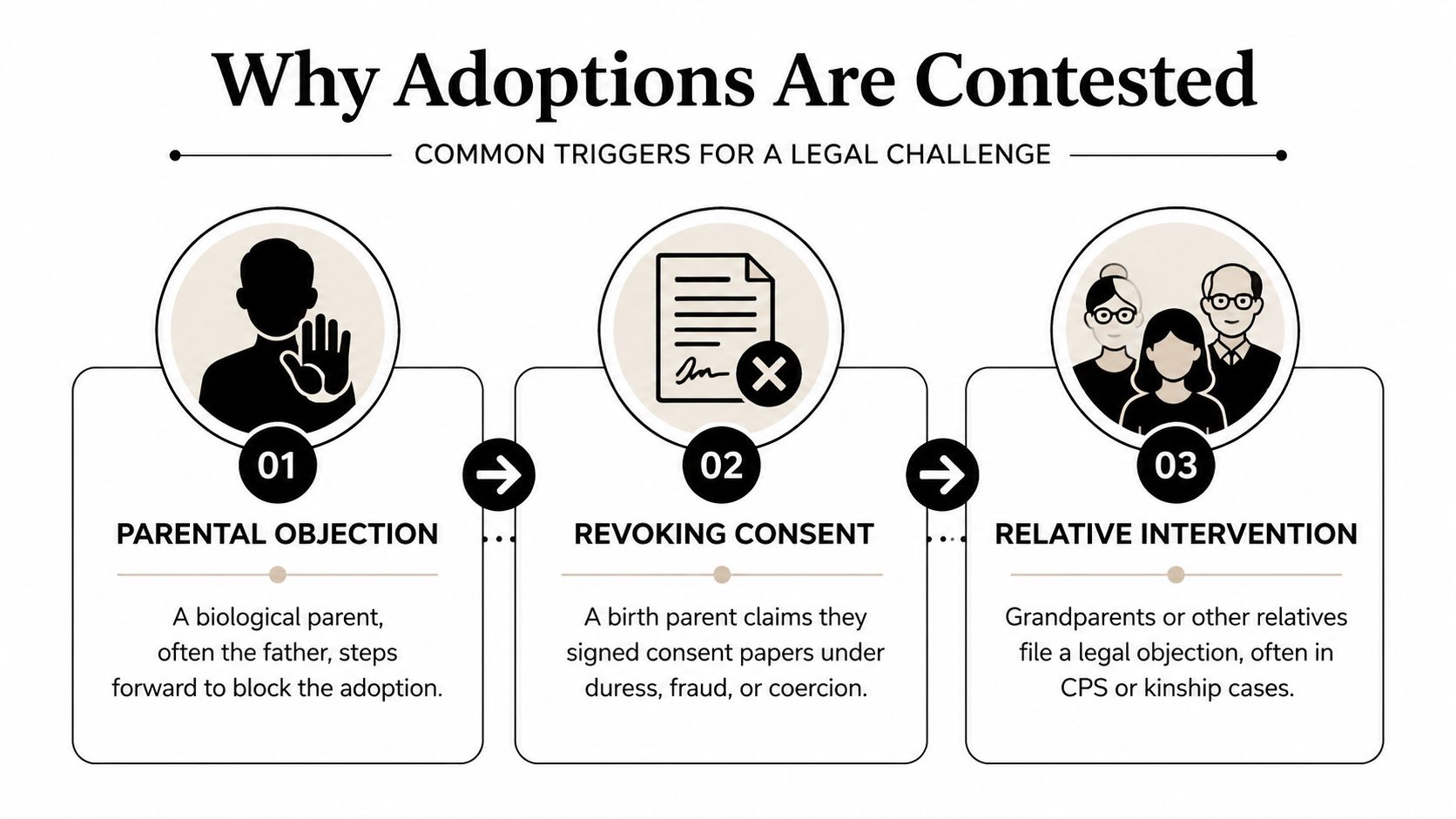
Whether it’s a birth parent having second thoughts or another relative stepping in, this is why the discovery process is so vital—it’s how you challenge or confirm each person’s legal standing and claims.
Hearings, Mediation, and Trial
Before you ever get to a final trial, you’ll likely have several pre-trial hearings. These are held to sort out temporary issues, such as where the child will live while the case is ongoing.
Most Texas courts will also order the parties to attend mediation. This is a confidential meeting where a neutral third-party mediator helps both sides try to find common ground and reach a settlement. It’s an opportunity to resolve the conflict without the cost and stress of a full trial, but if no agreement is reached, the case moves forward.
If mediation fails, the final step is the trial. Here, both sides present their evidence, call witnesses, and make their arguments to a judge (and sometimes a jury). The judge listens to everything and then makes a final, legally binding decision. The entire process is complex, which is why having a clear understanding of the Texas adoption process step by step can provide a helpful framework. At The Law Office of Bryan Fagan, PLLC, we guide you through each stage with compassion and clarity.
The Critical Battle over Parental Rights
When an adoption is contested, the entire process boils down to one central, high-stakes issue: the fight over parental rights. Before an adoption can even be considered, a Texas court must take the monumental step of terminating the biological parent’s legal connection to their child. This is one of the most serious actions a court can take, and judges do not make these decisions lightly.
The law sets an incredibly high bar. It’s simply not enough to show that you would be a wonderful parent or could offer the child a better life. To involuntarily end a parent’s rights, you must meet a strict, two-part test laid out in the Texas Family Code.
The First Hurdle: Proving Statutory Grounds
First, you have to prove the parent committed a specific act that the law recognizes as a reason for termination. You can’t just argue they're a “bad parent” in a general sense. You must prove one of the grounds explicitly listed in Texas Family Code Chapter 161.
These grounds are not vague; they are clearly defined actions and behaviors, such as:
- Endangerment: Knowingly placing the child in conditions or surroundings that endanger their physical or emotional well-being.
- Abandonment: Leaving the child without providing adequate support or maintaining contact, essentially demonstrating a lack of concern for the child's welfare.
- Failure to Support: Failing to support the child as required by a court order for a full year.
- Criminal Conduct: Being convicted or imprisoned for certain crimes that prove the parent is a danger to the child.
Proving one of these grounds is the non-negotiable first step. If you can’t, the case stops there, no matter how loving and stable your home may be.
The Second Hurdle: The Best Interest of the Child
Even if you clear the first hurdle, the fight isn't over. The second, equally crucial part of the test is proving to the judge that terminating the parent's rights is truly in the "best interest of the child."
This is where things become a bit more subjective, but it’s guided by a well-established set of criteria called the Holley Factors. These factors originated from a landmark Texas Supreme Court case and give judges a roadmap for making this life-altering decision.
The Holley Factors provide a framework for the court to analyze what is truly best for a child's future. The court considers the child's needs, the stability of the proposed home, and the actions and inactions of the parent.
A judge will weigh evidence related to things like:
- The emotional and physical needs of the child, both now and in the future.
- The stability of the home you are offering.
- Any actions or failures to act by the parent that might indicate an improper parent-child relationship.
- The emotional and physical danger the child might face, now and in the future.
This two-part test creates an extremely high legal standard to meet. If you're facing this challenge, understanding the nuances of ending parental rights is absolutely critical. Our firm has guided many families through this exact process, and you can learn more about the specifics in our detailed guide on the termination of parental rights. Navigating this battle is where compassionate, skilled legal guidance becomes your most powerful asset.
How an Experienced Adoption Attorney Defends Your Future
When an adoption gets contested, it can feel like the future you’ve been building is about to crumble. The emotional stakes are incredibly high, and the legal battle ahead can seem overwhelming. This is a fight you shouldn’t have to face alone. A contested adoption isn't just about paperwork; it's about protecting the child you love and securing the family you’ve worked so hard to create.
This is exactly where an experienced adoption attorney steps in. They do more than just react to legal challenges—they anticipate them. Think of them as your strategic guide, taking the legal burden off your shoulders so you can focus on being the stable, loving parent a child needs most during this uncertain time.
Your Advocate in and out of the Courtroom
An attorney’s main job is to build the strongest case possible for your adoption. They know what a Texas judge needs to see and hear, and they translate that into a clear, strategic plan.
Here’s a look at what your legal counsel will handle:
- Managing Deadlines and Filings: They make sure every petition, motion, and response is filed perfectly and on time. Simple procedural mistakes can jeopardize an entire case, and they prevent that from happening.
- Gathering Crucial Evidence: Through the formal discovery process, your attorney will dig for the proof needed to win your case. This could mean uncovering text messages, collecting financial records, or taking sworn testimony in depositions to build the grounds for termination.
- Crafting a Compelling Legal Argument: All that evidence is then woven into a powerful story. Your lawyer will present a narrative that shows the judge exactly why terminating parental rights is necessary and why finalizing your adoption is in the child’s best interest.
- Exploring Negotiation and Mediation: Whenever possible, a sharp attorney will look for chances to resolve the conflict through a settlement. This can often save you from a long, emotionally draining trial.

A Partner in Protecting Your Family
Ultimately, your attorney is the architect and defender of your family’s legal foundation. They understand the small but critical details of the Texas Family Code and can turn confusing legal requirements into a straightforward, actionable plan.
An experienced adoption lawyer doesn’t just argue in court—they provide clarity, reassurance, and unwavering support. Their guidance is what turns a stressful legal battle into a successful adoption day.
Hiring a lawyer isn’t just another adoption expense; it’s an investment in your family’s security and peace of mind. They stand with you, fighting to give the child you love the permanent, stable future they deserve. The right attorney gives you the best shot at finalizing your adoption and finally closing this challenging chapter for good.
Frequently Asked Questions About Contested Adoptions
When you’re trying to build your family through adoption, facing a contest can feel like your whole world is spinning. The anxiety and flood of questions are completely normal. We want to give you clear, straight-shot answers to cut through the noise and help you feel more prepared for what’s ahead.
How Long Does a Contested Adoption Take in Texas?
Patience is tough when a child’s future is on the line. While a simple, uncontested adoption in Texas might wrap up in a few months, a contested adoption can easily stretch out to a year or even longer.
The timeline really depends on a few moving parts:
- The legal issues at play. Are we dealing with complex paternity questions or just a straightforward objection?
- The court’s calendar. Some county courts are more backed up than others, affecting how quickly you can get hearings scheduled.
- How willing everyone is to negotiate. Sometimes, a solution can be found in mediation, which speeds things up considerably.
- The discovery process. Gathering all the necessary evidence—from text messages to financial records—takes time.
Your attorney’s job is to push the case forward as efficiently as possible, always keeping the focus on what truly matters: giving that child a stable, permanent home.
What Happens If We Lose the Contested Adoption Case?
This is the question that keeps hopeful adoptive parents up at night, and it’s one we have to face head-on. If the court decides not to terminate the contesting parent’s rights, the adoption simply cannot move forward. It’s a devastating outcome.
What happens next is entirely up to the judge. The court’s order might mean the child is placed with the biological parent, especially if they are now deemed fit to parent. A good adoption attorney will talk you through all possible scenarios from the very beginning, including the option of an appeal if there are solid legal grounds to challenge the judge’s decision. This kind of tough but necessary preparation is a critical part of a solid legal plan.
Can a Birth Mother Contest an Adoption After Signing Consent?
In Texas, when a birth parent decides to place their child for adoption, they sign a powerful legal document called an Affidavit of Relinquishment of Parental Rights. When this document is signed correctly under the strict rules of the Texas Family Code, it is almost always irrevocable. This is by design—it creates the legal finality needed for a child to move on to a permanent family.
That said, a birth mother can try to fight the adoption by filing a lawsuit to undo her consent. To have any chance of success, she would have to prove she signed the affidavit under extreme circumstances, like duress, coercion, or fraud.
The bar to prove this is extremely high, and the burden of proof is entirely on her. This is exactly why it’s so important to have an attorney who handles every single procedural detail with meticulous care from day one. A legally solid adoption is incredibly difficult to challenge down the road.
What if My Spouse's Ex Objects to Our Stepparent Adoption?
This is one of the most common reasons for a contested adoption in Texas. You’re ready to adopt your stepchild, but your spouse’s ex—the other biological parent—is refusing to agree. In this situation, the adoption can’t be finalized unless a court first terminates that parent’s rights.
To move forward, you have to prove two things to the judge:
- You have a legal reason for termination. This could be showing that the parent abandoned the child by failing to pay court-ordered child support for a year or having almost no contact.
- The adoption is in the child’s best interest. You’ll need to use what are known as the Holley Factors to demonstrate the stability, love, and permanence you can provide.
These cases are incredibly personal and always come back to what is truly best for the child’s future.
Going through a contested adoption is a journey you should never have to take by yourself. It’s an emotional rollercoaster that demands a guide who is both a sharp-witted litigator and a compassionate advocate for your family. If your adoption is being challenged, we’re here to give you the expert legal counsel and unwavering support you need.
At The Law Office of Bryan Fagan, PLLC, we’ve stood beside countless Texas families, helping them protect the children they love and secure their futures. We invite you to schedule a free, confidential consultation to talk about your specific situation. Let us help you take the next step toward building your forever family with confidence. Contact us through our website at https://texasfamilyadoption.com today.
