
Some families read adoption checklists during the day and lie awake at night with a different set of questions. What if the match falls through? What if paperwork was done wrong? What if a problem shows up after placement, or even after finalization?
Those worries are normal. Adoption is full of hope, but hope doesn't erase uncertainty.
In Texas, the biggest risks in an adoption case usually aren't random surprises. They tend to come from a few predictable areas: who is handling the placement, whether the legal path is solid, whether consent and parental rights were handled correctly, whether the home study and screening process uncovers a barrier, and whether the family is prepared for the child's long-term needs after court.
That may sound intimidating. In practice, it can be clarifying. Once you know where risk lives, you can plan for it.
Your Journey to Adoption Understanding the Inherent Risks
A couple comes in for a consultation after months of research. They have a nursery plan, a list of baby names, and a folder full of printed forms. What they don't have is peace of mind. One spouse asks about the home study. The other asks whether a birth parent can challenge the case later. Both are really asking the same thing. "How do we protect this child and our family from avoidable heartbreak?"
That question sits at the center of many Texas adoption cases.
Adoption law tries to balance several very important interests at once: the best interests of the child, the legal rights of biological parents, and the need for a safe, stable permanent home. Chapters 162 through 166 of the Texas Family Code shape much of that process. In plain English, that means Texas courts don't treat adoption like a simple form signing. A judge must be satisfied that the legal requirements were followed and that the adoption serves the child well.
Why risk doesn't mean failure
Risk is part of adoption because adoption changes legal parent-child relationships forever. In many cases, one legal relationship must end before another can begin. That creates emotional and procedural pressure for everyone involved.
Still, risk doesn't mean you're on shaky ground from the start. It means you need a careful process.
Adoption cases are strongest when families treat preparation as part of parenting, not just paperwork.
A hopeful parent in a private infant adoption may need to think carefully about consent and expenses. A stepparent may need to understand whether the other parent's rights have been terminated or whether consent is required. A relative caregiver may already be raising the child but still need to make sure the court path is legally complete before filing to adopt.
A calmer way to look at the process
When people ask, "What are the biggest risks in a Texas adoption case?" they're often really asking three smaller questions:
- Is the placement legally sound? Was the child placed through a proper, defensible process?
- Are all required rights and consents addressed? Missing one issue can delay or derail finalization.
- Are we ready for life after court? Finalization is a milestone, not the end of the child's adjustment.
If you understand those three areas early, you're far less likely to be blindsided later.
Foundational Risks Before a Match is Made
Many families assume significant risk begins after they match with a child or an expectant parent. In Texas, some of the most serious problems start earlier. The foundation matters.
If the wrong person or organization is arranging the placement, the case may carry legal weakness from day one. Recent reporting described a Texas "shadow foster and adoption system" in which private organizations may operate with limited oversight, creating a risk of protracted custody disputes and unclear legal status for families who thought they were following a proper path, as discussed in this reporting on Texas placement oversight concerns.
Choosing the right professional
Before you move forward, ask basic but important questions.
- Licensing matters: If an agency or organization is involved, make sure it's properly licensed and operating within Texas law.
- Role clarity matters too: Know who is doing what. Is someone providing counseling, matching services, legal services, or case management?
- Documentation should be organized: If a professional is vague about records, fees, or the legal path, that's a warning sign.
A strong adoption team often includes an attorney and, depending on the case, a licensed agency or social worker. Each serves a different purpose. Families can get into trouble when they assume a facilitator, informal broker, or loosely structured organization can do the same work with the same legal protections.
The home study is not a formality
Texas adoption law also puts real weight on screening. For most domestic adoptions, families must go through a home study and approval process. Child welfare guidance for Texas says prospective adoptive parents must be at least 21, financially able, and healthy enough to parent, and approval may be denied for serious criminal histories, including offenses such as murder, trafficking of persons, severe sexual abuse of a minor, family violence, indecency with a child, or stalking. The same guidance states that applicants won't be approved if they must register as sex offenders, and sustained findings in the child-abuse registry can also lead to denial, according to Texas home study requirements for prospective adoptive parents.
That doesn't mean every family with a complicated history is disqualified. It does mean you shouldn't assume a concern will stay hidden or "probably won't matter."
What families can do early
A practical early-stage checklist looks like this:
- Thoroughly review your own history: Criminal background, prior CPS involvement, and household stability questions usually come up.
- Gather records before you're rushed: Medical, financial, and personal-reference documents are easier to manage when you're not in a match deadline.
- Ask hard questions early: If there's a concern in your background, talk with counsel before spending money and emotion on a path that may not work.
Practical rule: The safest adoption starts with a licensed path, a realistic screening review, and clear expectations about what Texas will require before placement.
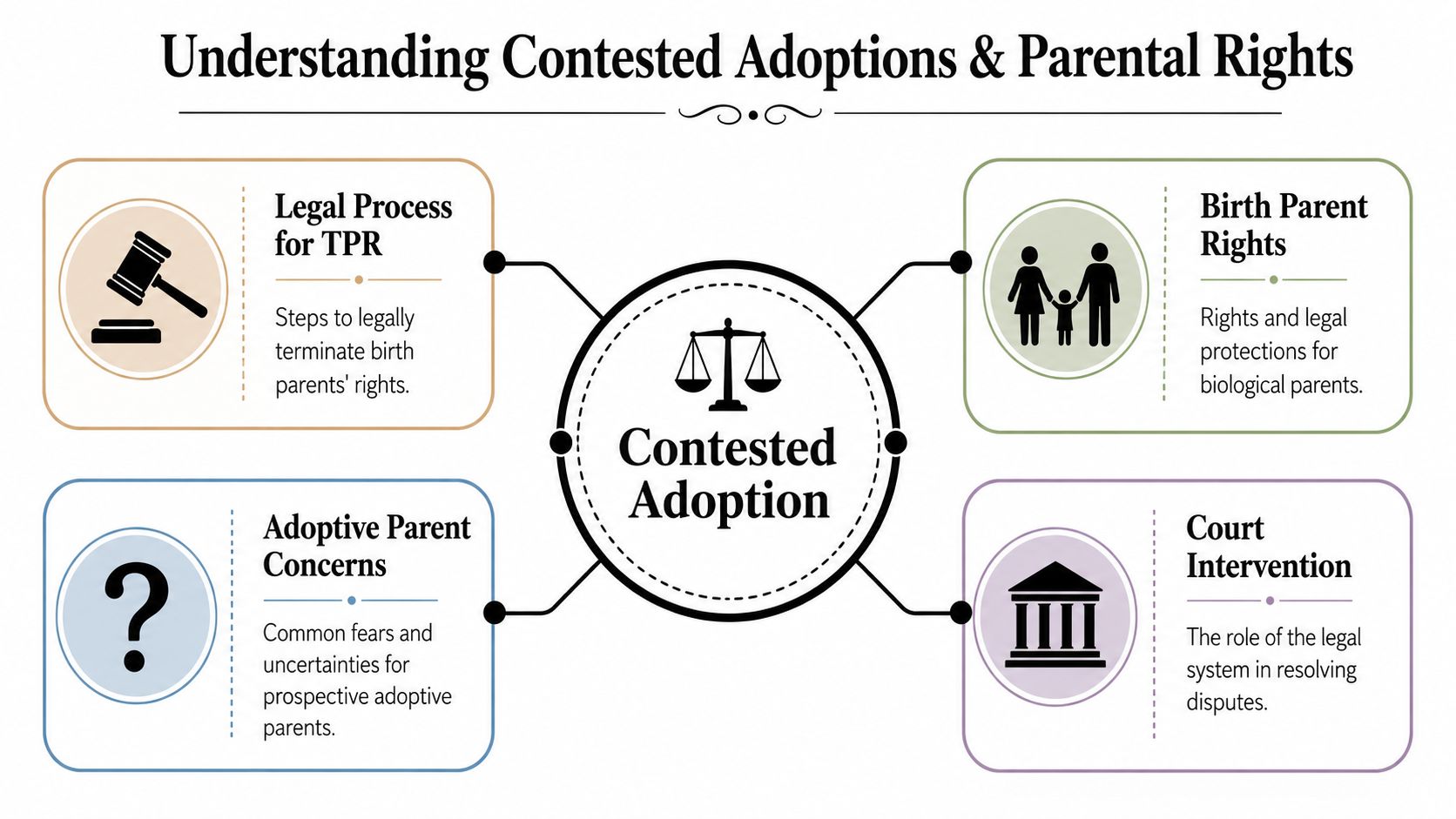
The Heart of the Matter Contested Adoptions and Parental Rights
Most adoptive parents fear one thing more than any other. They fear loving a child, moving toward finalization, and then learning the adoption may be challenged because parental rights weren't handled correctly.
That fear isn't irrational. It points to the legal center of the case.
Under Texas law, adoption usually requires a valid legal basis for the biological parents' rights to be terminated or addressed. Texas Law Help explains that adoption may proceed under specific statutory pathways, such as when both parents' rights are terminated, when a remaining parent consents under limited conditions, or when a court waives consent in the child's best interest, as outlined in Texas guidance on adopting a child. In practical terms, this is why Chapters 162 through 166 of the Texas Family Code matter so much. The court isn't merely approving a new family unit. It is confirming that the old legal structure was lawfully resolved first.
Consent must be valid, not pressured
In private and stepparent or kinship cases, families often focus on whether a parent signed. The better question is whether the consent was legally valid.
Texas places strict controls on what adoptive parents may pay. Guidance warns that illegal payments, or even unintentional financial gifts to a birth parent, can be treated as coercion. If consent looks influenced by unlawful inducement, the validity of that consent can be attacked, and the adoption itself may later be challenged. This is one reason experienced counsel tracks expenses, gifts, reimbursements, and timing with great care.
A simple example shows why. Suppose hopeful parents pay an expectant mother's rent directly without clear legal guidance and proper documentation. They intended kindness, not pressure. But if the case later becomes contested, that payment may be framed as part of an improper effort to influence consent.
Voluntary relinquishment and involuntary termination are different
Not every case follows the same road.
A voluntary relinquishment generally means a parent signs legally required documents surrendering parental rights. An involuntary termination means the court ends those rights without the parent's agreement based on legal grounds and evidence. Families often blur those together, but the risks differ. Voluntary cases depend heavily on clean consent. Involuntary cases depend heavily on proof, procedure, and due process.
Birth-father issues are another common source of confusion. If a father hasn't voluntarily surrendered rights, or if his rights haven't otherwise been resolved, he may contest the case. Texas guidance also notes there is no revocation period after lawful consent is signed, so many later disputes focus less on "changing one's mind" and more on whether the consent was valid in the first place.
Why careful litigation planning matters
In foster care and legal-risk cases, these issues can be even more pronounced. Families considering a case with any dispute over rights often benefit from understanding how courts analyze challenges. For a closer look at that process, see how contested adoption cases are fought in Texas.
A secure adoption usually depends less on hopeful assumptions and more on whether every consent, notice, and termination step can withstand scrutiny later.
Navigating Red Tape Procedural and Financial Hurdles
Some adoption cases don't collapse because of a dramatic courtroom fight. They strain families through delay, paperwork gaps, moving deadlines, and cost uncertainty. These pressures can make a stable case feel unstable.

Legal-risk placements require careful review
In Texas legal-risk adoptions, the Department of Family and Protective Services requires a formal review before a case can be labeled legal risk. DFPS requires decision-makers to determine that termination of parental rights is more than 75% likely, and prospective parents are given 10 calendar days to review records before placement, according to the DFPS legal-risk adoption guidance.
Those aren't small details. They are risk-control points.
If you are reviewing a legal-risk placement, use that record-review window seriously. Medical history, developmental concerns, prior trauma, and placement history can affect stability after placement. Families don't need a perfect file. They do need a full one.
Delays and costs often travel together
Even when everyone is acting in good faith, adoption can involve waiting on court dates, post-placement supervision, background clearances, interstate approvals in out-of-state cases, and corrected filings if a document was incomplete.
Here is where people often get caught off guard:
| Risk area | Why it matters |
|---|---|
| Document timing | A missing signature or outdated form can delay filing or finalization. |
| Record gaps | Incomplete child history can affect placement decisions and future care planning. |
| Interstate steps | If another state is involved, extra approval layers can slow travel and placement plans. |
| Financial surprises | Fees, travel, supervision, and legal corrections can add stress if families haven't planned ahead. |
That doesn't mean families should fear every delay. It means they should build margin into the process.
After placement, a fraud issue, missing disclosure, or false representation can raise serious legal concerns. Families who want a deeper explanation of that scenario can read what happens if fraud is discovered in an adoption case.
A short overview can also help frame the process:
A steadier way to prepare
Try to prepare in layers instead of betting everything on one timeline. Keep your paperwork current. Read child records carefully. Ask who is responsible for each filing. Budget for complications, not just the ideal sequence.
Families who do this well aren't pessimistic. They're organized.
After Finalization Understanding Post-Adoption Risks
Many people treat finalization day as the finish line. Legally, it's a major milestone. Emotionally and developmentally, it's often the beginning of a new chapter.
This is especially important in adoptions involving foster care, trauma history, multiple placements, or older children. Peer-reviewed research explains that pre-placement adversity can increase the risk of long-term psychological difficulties, including attachment difficulties, negative life circumstances, and adoption-related identity concerns that can affect self-esteem, relationships, and well-being, as discussed in this review of post-adoption psychological outcomes.
The child may still be grieving
A finalized adoption can be joyful and hard at the same time. A child may feel safer and still grieve losses connected to birth family, foster placements, siblings, culture, or routine. Parents sometimes misread that grief as rejection.
It usually isn't.
A child who withdraws, tests limits, lies about small things, or struggles with transitions may be showing stress, fear, or confusion. That doesn't mean the adoption is failing. It means the child may need support that goes beyond love alone.
Some of the hardest post-adoption moments happen in families that are deeply committed and doing many things right.
Identity and contact questions can grow over time
An infant adopted today may have very different questions as a school-age child, teenager, or adult. Who am I? Why was I adopted? Who knows my story? If the adoption involved openness, future contact expectations can also become complicated if adults never discussed them clearly.
Texas families often focus intensely on the court process and less on how they will answer these lifelong questions. That's understandable, but it can leave parents underprepared.
Consider these practical supports:
- Trauma-informed counseling: Helpful for children and parents, especially after difficult transitions.
- Age-appropriate adoption language: Children do better when their story is told truthfully and gently over time.
- Structured communication plans: In open adoptions, clarity around contact can reduce confusion later.
- Parent education: Learning about attachment, loss, and regulation can change how parents interpret behavior.
Families who worry about challenges after finalization sometimes ask whether a case can still be attacked later. That concern is worth understanding carefully, and this discussion of challenges after finalization can help frame the issue.
Finalization creates legal security, not emotional simplicity
That distinction matters. Court gives a child legal permanence. Healing, trust, identity, and belonging develop over time.
The healthiest adoptive families make room for both truths.
Your Proactive Plan How to Mitigate Risk in Your Adoption
A child may already feel real to you long before a judge signs anything. You may have chosen a bedroom, started reading about adoption, and told close family members the good news. That is exactly why a risk plan matters. It is not about being suspicious. It is about building a safe structure around a child's future before emotions and deadlines start making decisions for you.
In Texas adoption cases, families often focus on the match or the hearing date. A stronger approach starts earlier. Risk management begins with the foundation. Who is advising you, what documents support the case, how money is handled, and whether your support system can carry the weight of life after placement. Each of those choices protects more than the case. Each one protects the child from instability.
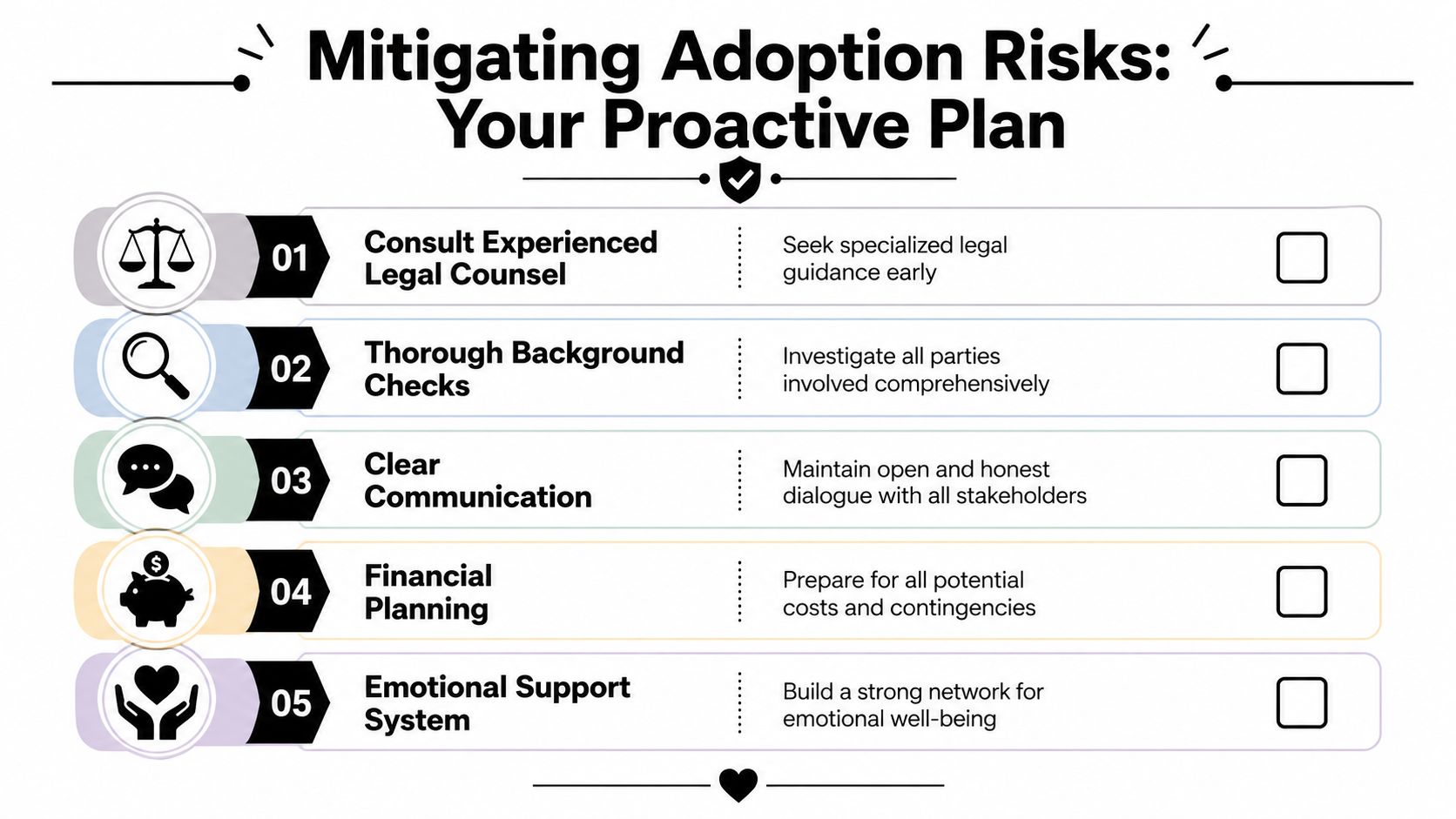
Five practical steps that reduce risk
Vet the professionals before you trust the process
Adoption works best when each person has a clear, lawful role. Ask who is licensed, who gives legal advice, who handles placement decisions, and who communicates with expectant parents or the state. If the answers are vague, stop and get clarity before you proceed.Treat document review as part of protecting the child
Consents, affidavits, medical records, case files, and prior court orders are not paperwork to rush through. They are the blueprint for the case. A careful review can reveal missing signatures, timing problems, unanswered questions about parental rights, or information that will matter for the child's care after placement.Keep every payment lawful and well documented
Money can create avoidable trouble in a private adoption if no one is tracking it carefully. Expenses should be reviewed by counsel, supported by records, and handled in a way that fits Texas law. Good documentation protects everyone involved and helps prevent later claims that the process was improper.Prepare for life in your home, not just for the final hearing
Court approval is one milestone. Daily parenting is the larger commitment. Line up pediatric care, counseling options if needed, school support, time off work, respite help, and honest conversations with relatives about respectful adoption language and boundaries.Ask early what could weaken the case later
This question often brings the right concerns into the open while there is still time to address them. An attorney may spot unresolved notice issues, a consent problem, a filing gap, or a mismatch between the current placement plan and the legal steps still required.
A short decision guide
| If you're facing | Ask this question |
|---|---|
| Private infant adoption | Who arranged the match, and has every expense been reviewed and recorded correctly? |
| Stepparent adoption | What must happen with the other parent's rights before the adoption can be finalized? |
| Relative adoption | Does the family's current legal arrangement support the adoption goal, or does it need to be corrected first? |
| Foster care adoption | Has the path to permanency been examined closely enough to avoid surprises near finalization? |
A family may work with a private attorney, a licensed agency, or both. One option some Texas families consider is Law Office of Bryan Fagan, PLLC, which assists with adoption filings, compliance review, termination-related issues, and finalization in Texas cases.
Key takeaway: Careful risk planning is one of the earliest acts of love in an adoption. It gives a child a stronger legal foundation and gives parents clearer footing for the years ahead.
Let Us Guide You Through Your Texas Adoption Journey
A family can feel steady one week and overwhelmed the next. They have chosen adoption out of love, completed a stack of paperwork, and started picturing life with their child. Then a new question appears. Was the match arranged the right way? Is one missing document going to delay court? Have we prepared for what this child may need after finalization?
Those questions do not mean the adoption is failing. They mean the family is doing what careful parents do. In Texas, risk management in adoption is part of building a safe foundation for a child, much like checking the framing of a house before you hang pictures on the wall. The goal is not to create fear. The goal is to make the legal structure strong enough to support the family for years to come.
The strongest adoption cases usually have that solid foundation in place. The professionals involved are properly qualified. The paperwork matches the facts of the placement. Consent and parental-rights issues are addressed fully, not hurried through. The family is also preparing for daily life after court, including attachment, school questions, medical history gaps, and respectful relationships with birth relatives when those relationships continue.
Texas law treats adoption as more than a single hearing. It is a legal process designed to protect the child's best interests by testing whether the placement is secure, lawful, and ready to last. That is why wise preparation reaches beyond forms and deadlines. It asks whether the child will have stability, clarity, and support once the case is over.
Families considering private infant adoption, stepparent adoption, kinship adoption, LGBTQIA+ adoption, foster care adoption, or another permanency path often need someone to explain what comes next in plain language. A good legal guide can spot small issues before they become expensive or painful ones, and can help parents make decisions that protect both the case and the child.
You do not have to sort through that alone.
If you are thinking about adoption and want guidance specific to your situation, schedule a free consultation with Law Office of Bryan Fagan, PLLC. The firm assists with Texas adoption filings, compliance review, termination-related issues, and finalization, and can help you identify risk early, understand your options, and move ahead with greater clarity and care.
