
In Texas, adoption can take as little as 3 to 6 months in some straightforward stepparent cases, while private domestic infant adoption often takes 12 to 24 months and can stretch to 3 years or more when matching or parental-rights issues slow things down. The reason the answer varies so much is that each adoption path has different legal triggers, and those triggers, not just the court date, usually decide how long the process really takes.
If you're asking this question, you're probably doing more than checking a timeline. You're trying to plan a life. You may be wondering when a child will finally feel secure in your home, when paperwork will stop hanging over your family, or when you can exhale after months of waiting.
That uncertainty is hard. Adoption is joyful, but it can also feel like a long stretch of waiting, gathering documents, answering questions, and hoping the next legal step happens soon.
How long does the legal adoption process really take in Texas? The honest answer is that it depends on the type of adoption and on one central issue in many cases: whether parental rights are already resolved, voluntarily relinquished, or headed into a dispute. Once you understand that, the timeline starts to make a lot more sense.
Your Adoption Journey Starts with a Question
A hopeful parent often asks the timeline question in a quiet moment. Maybe it's after a home visit is scheduled. Maybe it's after a spouse says, "When will this finally be official?" Maybe it's after a child has already started calling you Mom or Dad, and your heart is ready long before the paperwork is.
That question matters because adoption isn't just a legal file. It's school forms, medical decisions, bedtime routines, family photos, and the need for certainty.
Why the same question gets different answers
A stepparent adoption can move on a very different track than a private infant adoption. A relative caring for a grandchild may already have an established relationship with the child, but still face delays if another parent's rights haven't been legally addressed. A foster family may feel emotionally ready to finalize, yet still have to wait for the legal process around permanency to catch up.
Here is the part that confuses many families: the adoption petition itself is not always the slowest part. Often, the bigger issue is everything that must happen before finalization.
Practical rule: The court can't finalize an adoption until the legal foundation is complete. In many cases, that means consent, notice, background review, and termination of parental rights all have to line up first.
A simple example
Consider two families.
One is a stepparent who has raised a child in the home for years, and the other biological parent agrees to sign the needed paperwork. That case may move fairly quickly.
Another family is pursuing a private domestic infant adoption. They may complete their preparation promptly, but then wait for a match, wait for rights to be fully addressed, and wait again for finalization. Their process can be much longer, even if everyone involved is acting in good faith.
Texas law puts the best interests of the child at the center of every adoption. That focus protects children, but it also means courts move carefully. For hopeful parents, that can feel slow. For children, it is meant to create stability that lasts.
The Core Adoption Timeline in Texas
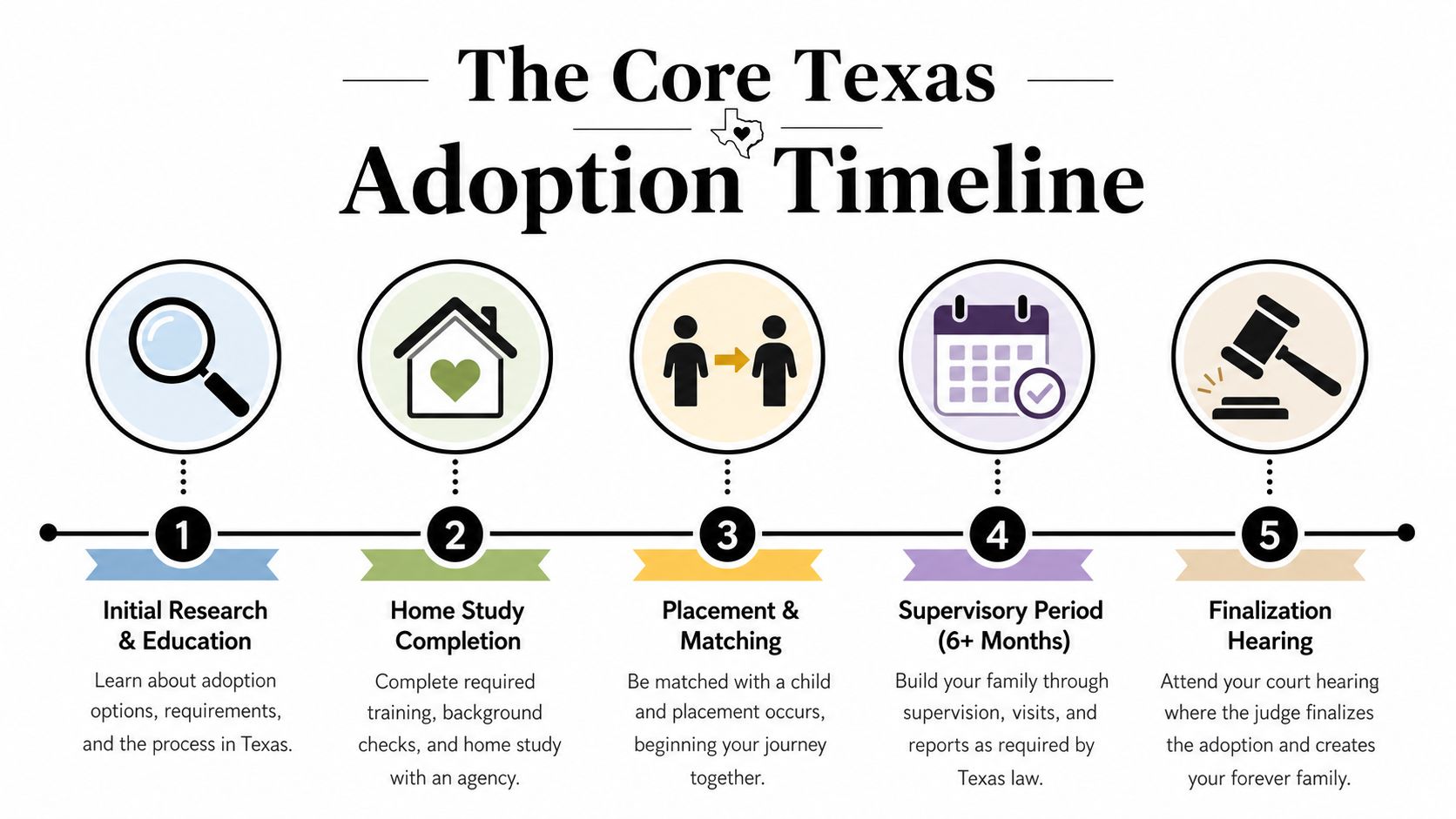
Most Texas adoptions follow the same broad shape, even though the details vary. It's similar to building a house. You can't put the roof on before the walls are up, and you can't build the walls without a foundation.
Stage one through stage three
The process usually begins with education and preparation. Families learn which adoption path fits their situation, gather records, and prepare for any required screening.
Next comes the home study or other court-required review, depending on the kind of adoption, during which a professional evaluates the home, household, and readiness of the adoptive parent or parents. If you'd like a fuller overview of those moving parts, this step-by-step Texas adoption process guide can help you see how the pieces fit together.
After that comes placement or the legal setup for placement. In some cases, the child is already in the home. In others, families are waiting to be matched or approved for a specific child.
Stage four is where many families get surprised
Texas law sets a clear post-placement milestone. A child can be adopted only after living with the petitioner for six months, although a court can waive that requirement if waiver is in the child's best interest, according to Texas Law Help's explanation of adopting a child in Texas.
That matters because some families assume placement means finalization is right around the corner. Usually, it doesn't. Even when the placement itself happens quickly, the law still builds in a waiting period before the court makes the adoption final.
For children in state foster-care cases, the same source explains that once children have lived in their new home for six months, the adoptive family and CPS can make the adoption permanent. So even in a positive case where everyone is ready, there is still a legal timeline built into the process.
The six-month period is not just a delay for delay's sake. It gives the court time to see whether the placement is stable and whether finalization serves the child well.
The final hearing
The last stage is the court hearing. This is the moment many families picture from the start. The judge reviews the legal requirements, confirms the adoption is in the child's best interest, and signs the order if everything is in place.
Here is the five-stage version in plain English:
- Learn the process: Choose the adoption path and understand the legal requirements.
- Complete screening: Finish the home study or any required evaluation.
- Reach placement: Match with the child or formalize the child's placement in your home.
- Wait through supervision: Complete the post-placement period required by law or court order.
- Finalize in court: Attend the hearing and receive the adoption decree.
That sequence sounds simple on paper. The primary difference in timing comes from what has to happen before each stage can move forward.
How Timelines Differ by Adoption Type
A parent in Houston may tell you, "Our friend finished an adoption in a few months. Why is ours taking so much longer?" The answer is often simple, even if it feels frustrating. They may be in a completely different legal lane.
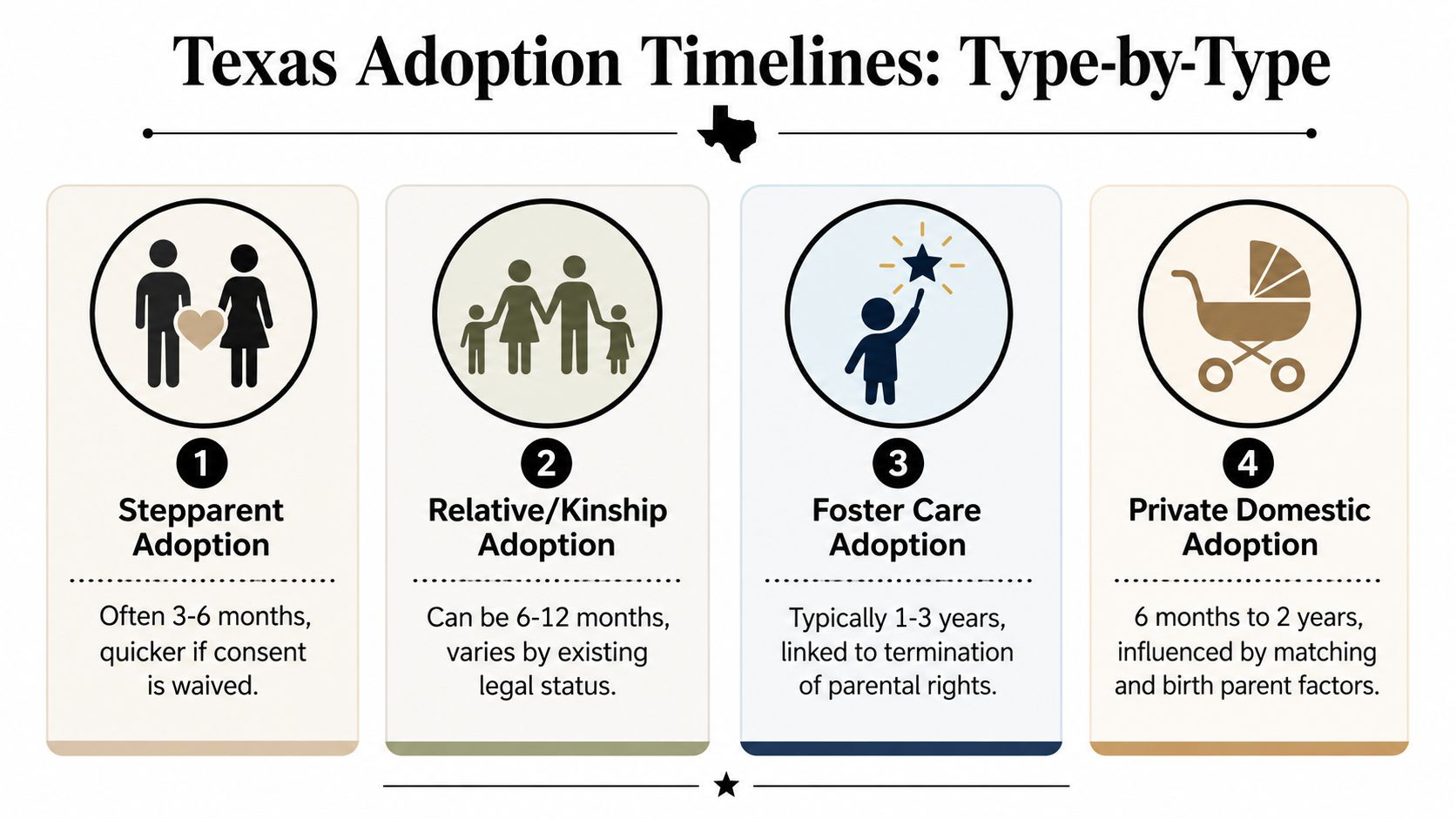
Texas has several adoption paths, and each one has its own timing pressure points. A broader overview appears in this guide to the types of adoption in Texas. The better question is not just "How long does adoption take?" It is "What legal step has to happen before my case can move?"
Stepparent adoption
Stepparent adoption is often the fastest type, but only when the legal pieces line up early.
According to this Texas stepparent adoption timeline discussion, the child generally must live with the stepparent for at least six months before filing unless the court waives that requirement. The same source explains that an uncontested case with proper consent may finish in about three to six months, while a case involving disputed consent or termination of parental rights can take a year or longer.
That difference matters. In a stepparent case, the biggest timing trigger is usually the status of the other parent's rights.
| Adoption situation | Likely pace |
|---|---|
| Other parent consents and paperwork is complete | Often faster |
| Other parent cannot be located or contests termination | Often much slower |
A useful way to understand this is to picture two doors. One door opens when consent is signed correctly. The other requires litigation, notice, proof, and a court ruling before the adoption can continue.
Relative and kinship adoption
Relative and kinship adoption often feels like it should move quickly because the child may already be living with a grandparent, aunt, uncle, sibling, or other family member.
Emotionally, the family may already feel settled. Legally, the court still has to answer a set of threshold questions. Are all necessary parents identified? Has everyone who must receive notice been served? Are parental rights already terminated, or does that case still need to be filed and decided?
That is why two kinship cases can look alike at the kitchen table and move very differently in court. One may be close to finalization because the legal groundwork is already done. Another may still be waiting on the very first trigger needed for adoption to proceed.
A child can be securely placed with family and still not be legally free for adoption.
Foster care adoption
Foster care adoption follows a different clock because the case often begins inside an existing CPS matter. That means the timeline is tied to the history of services, reviews, permanency planning, and court orders that came before the adoptive family entered the picture.
The part families should watch most closely is whether the child is legally free for adoption. If parental rights have already been terminated and the placement is stable, the case can move toward the remaining post-placement and finalization steps. If that issue is still pending, the adoption may pause while the court finishes the permanency process.
Here is the video mentioned above:
Private domestic infant adoption
Private domestic infant adoption usually has the widest timing range because more than one clock may be running at once.
A family may complete its preparation quickly but then wait for a match. A match may happen quickly, but the case still cannot finalize until the parental-rights process is completed correctly. If there is uncertainty about consent, notice, revocation issues, or termination, the timeline can stretch even when everyone hopes for a prompt result.
This is the pattern to keep in mind across all four paths. Adoption type matters, but the legal trigger matters more. In many Texas cases, the primary source of delay is not the final hearing. It is the unresolved step that must happen first, especially termination of parental rights or proof that the child is legally free to be adopted.
Key Factors That Speed Up or Slow Down Your Adoption
A lot of families reach this stage feeling confused. Two Texas adoptions can start around the same time and end on very different schedules. The reason is usually a specific legal checkpoint, not luck.
A useful way to look at timing is to picture the case as a series of green lights. If one light stays red, the rest of the case waits behind it. In many Texas adoptions, the light that matters most is whether every legal step before finalization has been completed.
Termination of parental rights
Termination of parental rights, or TPR, is often the issue that changes the timeline the most. If parental rights have been voluntarily relinquished, notice was handled correctly, and the court record is clear, the case may keep moving through the remaining requirements with fewer interruptions.
If TPR is contested, uncertain, or tied up by notice problems, the case can slow down sharply. A judge cannot finalize an adoption while a basic legal question is still unresolved. That is why two families pursuing the same type of adoption can see very different timelines.
The same timing pattern appears in outside reporting on Texas adoption wait times. One source explains that home study and certification may take several months, that private adoption wait times can stretch far beyond the preparation stage, and that parental-rights issues can add major delay. See this discussion of Texas adoption wait times.
The key point is simple. Adoption type matters, but legal status matters more.
Paperwork and process readiness
Some delays come from big legal disputes. Others come from ordinary paperwork that arrives late or incomplete.
That may sound minor, but adoption works like a relay race. One person cannot start the next step until the previous handoff is complete. If a background check needs clarification, a home study document is missing, or a prior court order has not been gathered yet, the file may sit until the missing piece arrives.
Families can often reduce delay in these areas:
- Missing records: Birth certificates, marriage or divorce records, prior custody orders, and identity documents should be collected early.
- Slow form returns: Agencies, evaluators, and attorneys usually cannot move to the next step until signed materials come back.
- Scheduling gaps: Interviews, home visits, and court settings may need to be rescheduled if calendars are not coordinated promptly.
- Unclear case details: Inconsistencies in names, dates, addresses, or family history can trigger follow-up questions that take time to resolve.
The child's adjustment and the court's best-interest review
Time is not only about forms and hearings. Courts also look at whether the placement is stable and in the child's best interest.
That matters most in cases where family relationships are emotionally layered, such as stepparent and relative adoptions. A child may be happy in the home and still need time to understand what adoption means. A caregiver may feel ready to finalize and still need help answering the court's questions about school, medical care, family ties, or long-term stability.
Those facts do not mean anything is wrong. They mean the court is doing its job carefully.
A shorter timeline usually happens when the legal status is clear, the paperwork is complete, and the adults involved respond quickly. A longer timeline usually points to a specific trigger that still needs attention. Once you identify that trigger, the process often feels less mysterious and more manageable.
Your Adoption Journey Checklist
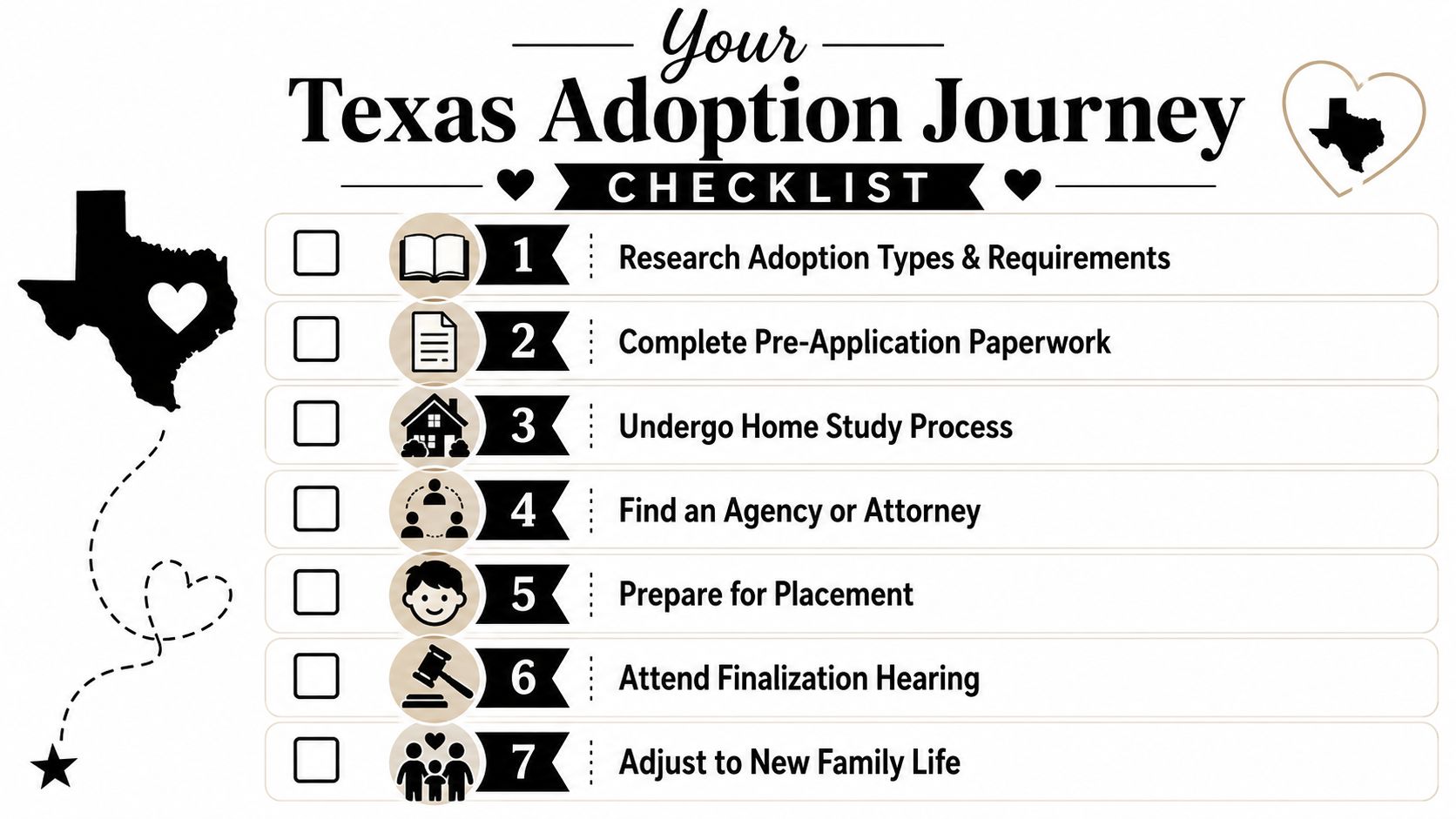
You may be staring at a calendar, trying to guess whether your adoption will move in months or stretch much longer. A checklist helps because it turns a process that feels emotional and uncertain into a series of concrete steps. It also helps you spot the legal trigger that matters most in your case. For one family, that trigger is home study approval. For another, it is whether a biological parent's rights have already been terminated.
Before the home study
Start by getting clear on your adoption type. That choice shapes your timeline the same way the first turn on a road trip affects every mile after it. A stepparent adoption, a relative adoption, a foster adoption, and a private domestic adoption can all reach the same destination, but they do not start with the same legal conditions.
As you prepare, focus on these early action items:
- Confirm your legal path: Ask whether your case involves a stepparent, relative, foster, or private domestic adoption, and whether termination of parental rights is already complete, still pending, or likely to be contested.
- Build a case file: Keep your records in one place so you can respond quickly when an agency, evaluator, or court asks for them.
- Choose the right help: Some families need an agency. Some need an attorney. Some need both. If you want guidance on petitions, consent issues, and finalization, review these Texas adoption attorney services.
- Get your home ready for review: The goal is safety and honesty, not perfection. Courts and evaluators are looking for stability, not a staged photo.
During matching or placement
This stage often feels like waiting, but it is really an active part of the timeline. Different adoption types pause here for different reasons. In a private domestic adoption, the wait may center on matching and consent. In a foster or relative adoption, the larger question is often whether the child's legal status is clear enough for finalization to move ahead.
That is why side-by-side comparisons matter. Two families can both say, "We already have placement," and still face very different calendars. One may be counting down to post-placement requirements. The other may still be waiting for notice, consent, or termination issues to be resolved.
While your case is in this stage, keep doing the small things that prevent avoidable delay:
- Report changes quickly: A new address, job change, or change in who lives in the home can affect the file.
- Respond promptly: A missed email or voicemail can postpone a meeting, update, or court setting.
- Track your questions: Stress makes details easy to forget. A written list helps you use each call or meeting well.
- Ask what the current trigger is: If the case is not moving, ask what specific legal step is still open. The answer is often more useful than a general estimate of how long adoption "usually" takes.
As finalization approaches
Families often feel a mix of relief and nerves here. That is normal. Finalization is the last major legal step, but it is also the moment when many parents realize how much this process has meant to them.
Use this final review:
- Check every detail in the paperwork: Names, dates, and identifying information should match across all documents.
- Confirm the hearing requirements: Ask who needs to attend, what the judge may ask, and whether any final filings are still outstanding.
- Prepare your family for the day: Children and parents may feel excited, emotional, quiet, or overwhelmed. All of those responses can be normal.
A good checklist does more than keep you organized. It helps you tell the difference between ordinary waiting and a delay tied to a specific legal issue. Once you know which trigger controls your timeline, the process usually feels less confusing and more manageable.
Navigating the Timeline with an Experienced Attorney
An experienced adoption attorney doesn't just file forms. A good attorney looks ahead and asks what could stall the case before the family feels that delay.

Where legal guidance changes the pace
If a biological parent's consent is uncertain, that issue needs a strategy. If notice requirements are complicated, those steps need to be handled correctly. If a family is close to finalization, but one procedural detail is missing, someone needs to catch it before a hearing is wasted.
Those moments are where legal guidance can reduce confusion and help keep the process moving. The value isn't just speed. It's avoiding preventable setbacks.
Families looking for direct legal help with petitions, court filings, and finalization can review the firm's Texas adoption attorney services. The Law Office of Bryan Fagan, PLLC handles adoption matters involving many family situations across Texas.
What reassurance looks like in practice
Sometimes reassurance is not "this will be fast." Sometimes reassurance is, "this step is slow for a reason, and what happens next."
That kind of clarity matters. It can help a stepparent stay patient during a consent issue. It can help a relative understand why a familiar caregiving role still needs formal legal work. It can help a hopeful adoptive parent stay grounded during a long private adoption wait.
Good legal guidance doesn't erase the emotional weight of adoption. It gives that emotion a roadmap.
Frequently Asked Questions About Texas Adoption Timelines
Can the six-month post-placement waiting period ever be waived in Texas
Yes. Texas law allows a court to waive the six-month living requirement if the court finds that waiver is in the child's best interest. Whether that happens depends on the facts of the case and the judge's review.
How long does an adult adoption typically take
Texas allows adult adoption, but the verified timeline data provided here doesn't include a fixed timeframe for adult adoption. In many cases, adult adoption is more straightforward than a contested child adoption because it doesn't center on the same placement and parental-rights issues. Still, the exact timing depends on court procedure, paperwork, and whether the filing is complete.
Does choosing an open adoption affect the legal timeline
An open adoption usually affects the relationship and communication expectations between the parties more than the legal pace itself. The legal timeline still turns on required steps such as screening, placement, consent, termination of parental rights where required, and finalization. If everyone is cooperative, communication may feel smoother. If legal prerequisites remain unresolved, openness alone won't make the case move faster.
Is the final hearing the main thing that determines timing
Usually, no. Families often focus on the court date, but the larger timing issue is whether all legal prerequisites are complete before the hearing can even be set or successfully finished. That is why two families may both be "waiting on court" while really facing very different underlying issues.
If you're trying to understand how long your adoption may take, the most helpful next step is getting advice based on your exact situation, not a generic average. The attorneys at Law Office of Bryan Fagan, PLLC help Texas families with adoption planning, paperwork, court filings, and finalization. If you'd like clear guidance about your timeline and the legal steps ahead, schedule a free consultation.
