
Starting your adoption journey is an incredibly exciting time, but it’s natural for questions about the cost to feel a little overwhelming. If you're looking for a straight answer, here it is: Texas adoption costs can range from nearly zero for a foster care adoption to $60,000 or more for a private infant adoption. The biggest factor in what you'll spend is the specific path you choose to build your family.
Your Guide to the Financial Journey of Adoption in Texas
Deciding to adopt is one of the biggest, most heartfelt choices you can make. It’s a path filled with hope, love, and a deep desire to build a family. Here at The Law Office of Bryan Fagan, PLLC, we understand the emotion behind that decision. We also know that alongside all the emotional preparation, the practical questions about Texas adoption costs are top of mind for most families. Our goal is to offer a clear, compassionate financial map, showing you that with thoughtful planning, your dream of adopting is absolutely within reach.
This guide is for every hopeful adoptive parent, birth parent considering their options, or relative exploring adoption. We believe that financial concerns should never be the one thing that stands between a child and a loving, permanent home.
The Three Main Paths and Their Costs
In Texas, your adoption journey will most likely follow one of three main routes, each with a very different financial landscape. Understanding these differences is the first step toward creating a realistic budget and a solid plan that works for you.
- Private Agency Adoption: This is a common path for those hoping to adopt an infant. It comes with fees for the agency's professional services, the home study, legal work, and compassionate support for the birth mother. It's often the most expensive option, but it also provides a great deal of built-in guidance and support.
- Foster Care Adoption: Adopting a child from the Texas foster care system is by far the most affordable route. In most cases, the state covers or reimburses nearly all expenses, meaning your out-of-pocket cost is minimal, if anything at all. The focus is on finding a loving home for a child who needs one.
- Stepparent or Kinship Adoption: When a stepparent or another relative adopts a child, the costs drop dramatically because you skip agency matching fees. The expenses are mainly for the legal work required by the Texas Family Code to make the adoption official and permanent.
The chart below gives you a quick visual breakdown of what you can generally expect to pay for each of these paths in Texas.
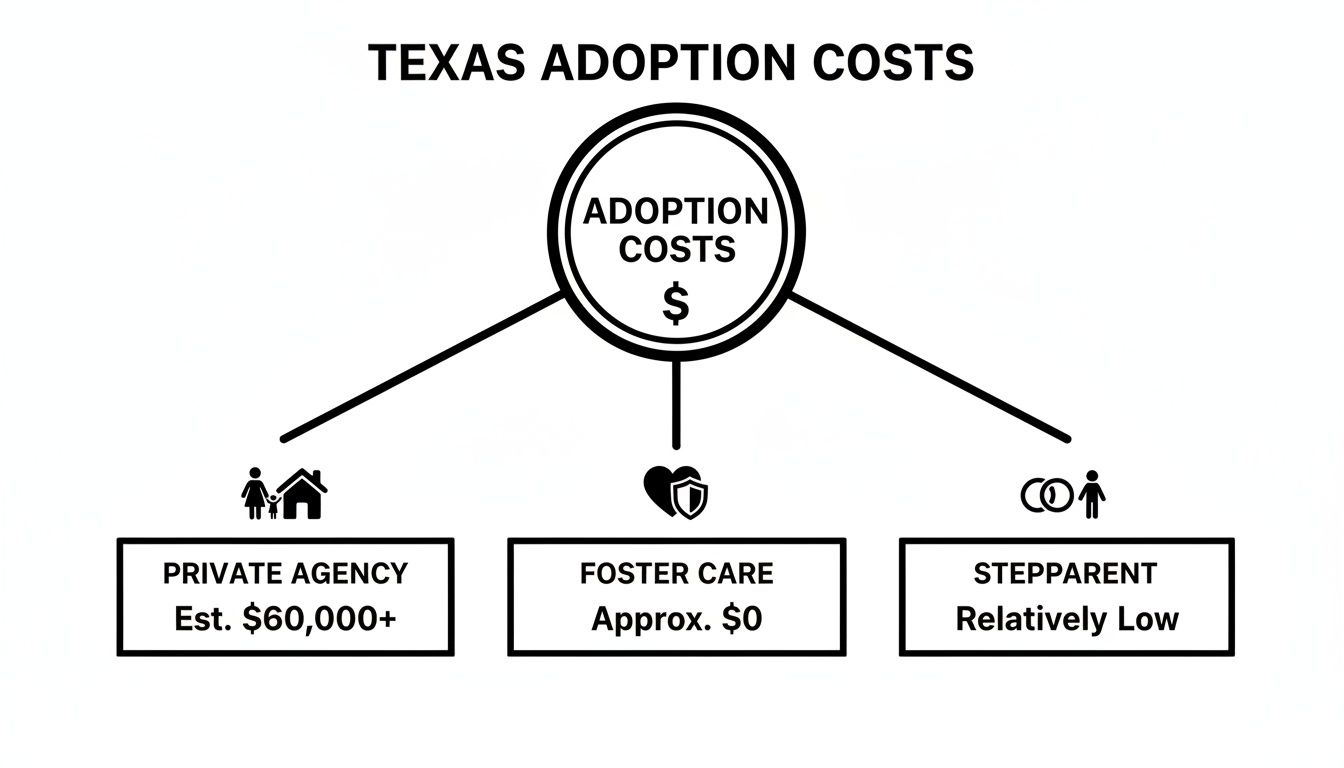
As you can see, the financial commitment varies a lot. This empowers you to find a path that aligns with both your family’s goals and your financial comfort level.
Breaking Down Private Adoption Agency Costs
For many hopeful parents dreaming of adopting an infant, private agencies offer a clear, supportive path forward. But it's understandable that the financial side of things can feel like a significant hurdle. The first step to feeling confident and in control is understanding exactly where that money goes.
Let's pull back the curtain on the typical texas adoption costs you'll encounter with a private agency and explain each part in plain English.

Think of an adoption agency as your expert guide through a very complex journey. Their fees cover all the professional services needed to ethically and legally connect you with a birth mother and, finally, with your child. These costs ensure every single step is handled with care and in the best interest of the child, from the first piece of paperwork to the day you celebrate in court.
The Initial Fees: Application and Home Study
Your journey begins with an application fee. This is a fairly modest, non-refundable cost, usually between $300 and $500. It covers the administrative work of processing your initial paperwork and officially welcoming you as a prospective adoptive family.
Next up is one of the most important steps required by the Texas Family Code (Chapter 162): the home study. A licensed social worker conducts a thorough review to ensure your home is a safe, nurturing place for a child. This isn't just a formality; it involves interviews, background checks, and home visits. The cost typically runs from $1,500 to $3,000, and it's a vital part of preparing your family for this incredible new chapter.
Core Program and Birth Mother Support Fees
The largest portion of private adoption costs is the agency program fee, which can range from $15,000 to $25,000. This fee is the engine that powers the entire adoption process. It covers a wide range of essential services:
- Matching Services: This is the heart of the agency's work—ethically connecting you with expectant mothers who are considering an adoption plan.
- Counseling and Support: Providing compassionate, professional counseling for birth parents before, during, and after the birth is crucial for their well-being.
- Professional Staff: Paying the salaries of the social workers, coordinators, and support staff who guide you every step of the way.
- Operational Costs: Covering the agency's day-to-day administrative and operational expenses.
Another significant—and deeply important—cost is for birth mother expenses. Texas law allows adoptive families to provide financial help for a birth mother’s reasonable living and medical costs during her pregnancy and recovery. These funds, which can range from $5,000 to $15,000, are always managed by the agency or an attorney to ensure everything is handled ethically and legally. This support provides stability and peace of mind to the birth mother, which is crucial for the well-being of both her and her baby.
To help you visualize where this money goes, here’s a sample breakdown of what you can expect.
Sample Private Adoption Cost Breakdown in Texas
This table provides an estimated range for common fees associated with private agency adoption, helping families understand where their investment goes.
| Fee Category | Typical Cost Range | What It Covers |
|---|---|---|
| Application Fee | $300 – $500 | Initial paperwork processing and administrative setup. |
| Home Study Fee | $1,500 – $3,000 | Licensed social worker assessment, background checks, and home visits. |
| Agency Program Fee | $15,000 – $25,000 | Matching services, counseling for birth parents, staff salaries, and overhead. |
| Birth Mother Expenses | $5,000 – $15,000 | Legally permitted living expenses, medical bills, and other pregnancy-related support. |
| Legal & Finalization | $3,000 – $7,000 | Attorney fees for court filings, termination of parental rights, and final adoption hearing. |
| Estimated Total | $25,000 – $65,000 | Comprehensive range covering the entire private agency adoption process. |
Keep in mind these are just estimates, and every adoption journey is unique. The key is that these fees reflect a commitment to supporting everyone involved with professionalism and compassion.
The total investment in a private agency adoption reflects a commitment to supporting everyone involved—the child, the birth family, and the adoptive family—with professionalism and compassion. It’s a comprehensive approach that prioritizes the best interest of the child above all else.
Legal and Finalization Costs
Finally, you have the legal fees required to make the adoption official and permanent. These costs cover the work of an experienced adoption attorney who will handle all the necessary court filings, manage the termination of the biological parents’ parental rights as outlined in the Texas Family Code, and represent you at the finalization hearing. In Texas, legal fees for a private adoption generally fall between $3,000 and $7,000.
When you add it all up, the financial picture becomes much clearer. Private domestic agency adoptions in Texas often range from $25,000 to $65,000, a figure that reflects the detailed, professional services needed to build a family this way. As we explore further in our guide to private adoption costs in Texas, these numbers cover everything from agency fees and home studies to crucial birth parent support and legal finalization.
The Rewarding and Affordable Path of Foster Care Adoption
When many people think about adoption, their minds often jump straight to the cost. It’s a valid concern, but what if there was a path to growing your family that is not only incredibly meaningful but also surprisingly affordable? Adopting a child from the Texas foster care system is that path—a journey that puts a child’s need for a loving, permanent home above everything else.

This route is genuinely one of the most powerful ways to build your family. The Texas adoption costs are minimal because the focus isn't on hefty fees; it's on finding safe, supportive, and permanent families for children who desperately need them.
Why Foster Care Adoption Costs Are So Low
So, how can the costs be so low compared to private adoption? It all comes down to the state's deep commitment to these children. The Texas Department of Family and Protective Services (DFPS) actively supports families who step up to adopt from foster care, which means the state covers or reimburses most—if not all—of the essential expenses.
Adopting from the foster care system is, by far, the most affordable way to adopt in Texas, with total costs typically ranging from $0 to just $2,500. This incredibly low financial barrier is possible because the state often waives application and home study fees, keeps legal fees to a minimum, and handles post-placement supervision.
This state-level support makes the entire process financially manageable, letting you focus on what really matters: preparing your heart and home for your new child. We've actually put together a detailed guide exploring the cost of adopting from foster care that breaks down these minimal expenses even further.
Understanding Key Financial Supports
The financial assistance from DFPS is specifically designed to remove barriers for loving families. Here are the key areas where you can expect major support:
- Home Study Fees: The home study is a mandatory step under the Texas Family Code, but it’s often provided at no cost to families pursuing a foster care adoption.
- Legal Fees: The state will usually reimburse families for non-recurring adoption costs, including reasonable attorney fees and the court costs needed to finalize everything.
- Training: All the required pre-adoption training is provided free of charge to prepare you for this important role.
This comprehensive system is proof that your financial situation shouldn't stand in the way of a deserving child finding their forever family.
Ongoing Support Through Adoption Assistance
The support doesn't stop once the adoption is finalized. For children with specific needs, Texas offers Adoption Assistance, often called an adoption subsidy. This program is a crucial lifeline designed to help families provide for the ongoing care of children who might otherwise have a harder time finding a permanent home.
"Adoption Assistance is a promise to the child and the family. It ensures that a child with medical, emotional, or developmental needs will have access to the resources they require to thrive, long after they've left the foster care system."
This assistance is determined on a case-by-case basis before the adoption is finalized and can come in a few different forms:
- Monthly Financial Payments: A monthly stipend to help cover the child's daily living and care expenses.
- Medicaid Coverage: The child typically stays eligible for Medicaid until age 18, which covers medical, dental, and therapeutic services.
- One-Time Reimbursements: Help may also be available to cover specific, non-recurring expenses related to the child’s condition.
This program gives families the financial stability to meet their child's unique needs, reflecting a deep understanding that the commitment to a child's well-being is a lifelong journey. Choosing to adopt from foster care is more than just an affordable option; it's a chance to make a profound, lasting difference in a child's life.
Understanding Costs for Stepparent and Kinship Adoptions
Not every adoption begins with an agency or a stranger. In fact, some of the most powerful adoption journeys happen right inside an existing family, making official the bonds that have been there all along. This is the world of stepparent and kinship (or relative) adoptions, and their financial path looks very different—and much more manageable.
When a stepparent, grandparent, or another relative steps up to adopt, the process is far more direct. You're not navigating the complicated and expensive world of matching with a birth mother or paying hefty agency program fees. Those costs, which are the biggest hurdles in private adoption, are completely off the table, making this a financially realistic option for countless Texas families.
The Primary Focus: Legal Finalization
Without the need for matching services or birth mother support, the Texas adoption costs for these family-based adoptions are almost entirely centered around the legal work. These are the essential fees required to make your family relationship permanent and unshakable in the eyes of the law.
The total cost generally falls between $2,000 and $5,000—a small fraction of other adoption types. This investment ensures every legal detail is handled correctly, protecting your family’s future. For a deeper dive into what makes up these costs, our detailed guide on the cost of stepparent adoption breaks it all down.
These legal fees typically cover a few critical steps:
- Filing the Adoption Petition: The formal document that kicks off the legal process with the court.
- Court Filing Fees: Standard administrative costs that the Texas court system requires.
- Termination of Parental Rights: The crucial legal action to end the rights of the non-custodial or absent biological parent.
- Finalization Hearing: Representing your family in court for the final hearing where the judge makes the adoption official.
A Common Scenario: The Stepparent Adoption
Let’s put this into perspective with a real-life scenario. Imagine a stepfather who has been raising his stepson since he was just a toddler. The child’s biological father hasn’t been in the picture for years. To give his stepson the legal security and sense of permanence he deserves, the stepfather decides to adopt.
In this situation, the most critical—and sometimes the most complex—part of the process is terminating the biological father's parental rights. This is governed by the Texas Family Code and can happen one of two ways: voluntarily, if the other parent agrees, or involuntarily, if you can prove grounds like abandonment or neglect. This is exactly where having an experienced family law attorney becomes so important.
An attorney ensures the termination process is handled by the book, preventing future legal challenges and giving you true peace of mind. They are the ones who secure the legal foundation your child’s future will be built on.
Trying to navigate court procedures and meet every single requirement of the Texas Family Code on your own can be incredibly stressful. A good attorney manages every document, deadline, and court appearance, which frees you up to focus on what matters most: your family. This legal guidance isn’t just a service; it's the safeguard that ensures your blended family’s unity is legally solid for a lifetime.
How to Fund Your Adoption and Make Your Dream a Reality
Seeing the potential Texas adoption costs laid out can feel intimidating, but please don't let the numbers discourage you. This is the part of the journey where hope and practical planning come together, shifting the question from "How much does it cost?" to "How can we make this happen?"
The good news? You don't have to figure this out alone. A wide range of financial resources exists specifically to help families like yours bring a child home.

Think of funding your adoption not as a single massive hurdle, but as building a bridge plank by plank. Each financial tool is a piece of that bridge, bringing you closer to the other side. Let’s explore some of the most powerful resources available.
The Federal Adoption Tax Credit
One of the most significant financial tools for adoptive families is the Federal Adoption Tax Credit. This isn't just a deduction that lowers your taxable income; it's a powerful dollar-for-dollar credit that directly reduces what you owe the IRS.
For 2024, the maximum credit is a substantial $16,810 per child. It's a nonrefundable credit, which means it can wipe your tax bill down to zero, but you won’t get any of it back as a refund beyond that. However, if you can't use the full amount in one year, you can carry forward any unused portion for up to five years.
This credit is designed to help offset "qualified adoption expenses," which include things like:
- Reasonable and necessary adoption fees
- Court costs and attorney fees
- Travel expenses, including meals and lodging
- Other costs directly related to the legal adoption of a child
For many families, this tax credit single-handedly covers a huge portion of the costs tied to private or independent adoptions.
Exploring Adoption Grants and Loans
Beyond tax credits, many families find incredible support through grants and loans designed specifically for adoption. These resources can be absolute game-changers, filling financial gaps and easing the burden of large, upfront costs.
Adoption Grants: A grant is a gift of money you do not have to repay—plain and simple. Numerous national and local organizations offer grants to prospective adoptive families, with awards ranging from a few thousand dollars to over $10,000. Many families also find support through faith-based initiatives; you can learn how to apply for Christian grants for adoption and other similar resources.
The search for grants requires persistence and organization, but the payoff can be life-changing. It’s a testament to the community of support that surrounds adoption, with people and organizations dedicated to helping build families.
Adoption Loans: Several financial institutions offer low-interest loans tailored for adoption expenses. While this is money that has to be paid back, these loans often have favorable terms and provide the immediate cash flow needed for agency fees or travel costs. They offer a structured way to manage expenses over time rather than all at once.
Other Powerful Funding Strategies
Thinking creatively about funding can unlock even more opportunities. Most families don't rely on a single source; instead, they successfully combine several strategies to meet their financial goals, proving there are many paths to a fully funded adoption.
Here are a few other powerful options to consider:
- Employer-Provided Benefits: More and more companies are offering adoption assistance in their benefits packages. This could be direct reimbursement for expenses or paid leave after placement. It's always worth checking with your HR department.
- Personal Fundraising: Never underestimate the power of your own community. Platforms like GoFundMe or even local events can be incredibly effective. Your story is compelling, and you might be surprised how many friends, family members, and even strangers are moved to support your journey.
- Saving and Budgeting: It sounds simple, but a dedicated savings plan is the foundation of any adoption budget. Creating a specific "adoption fund" and setting clear, achievable goals can make a tremendous difference over time.
To help you visualize these options, we've put together a table summarizing the key financial resources available to families in Texas.
Key Financial Resources for Adoptive Families
| Resource Type | Description | Typical Amount/Benefit |
|---|---|---|
| Federal Adoption Tax Credit | A nonrefundable tax credit that directly reduces your federal tax liability for qualified adoption expenses. | Up to $16,810 per child (for 2024), with a five-year carryforward for unused amounts. |
| Adoption Grants | Non-repayable funds (a gift) from non-profits, foundations, and faith-based organizations to help cover costs. | Varies widely, from $500 to $15,000+. |
| Adoption Loans | Low-interest personal loans from financial institutions specifically for adoption-related expenses. | Can cover most adoption costs, with repayment terms designed for families. |
| Employer Assistance | Benefits offered by a growing number of companies, such as expense reimbursement or paid leave. | Typically ranges from $5,000 to $25,000, plus paid time off. |
By exploring all these avenues—from federal credits and grants to the support of your own community—you can build a comprehensive financial plan that turns the overwhelming cost of adoption into a series of manageable, achievable steps.
Ready to Take the Next Step?
Feeling informed is the first real step toward feeling empowered on your adoption journey. As we've walked through, the financial paths to building a family are as diverse as the families themselves. The key thing to remember is this: while Texas adoption costs can vary a great deal, there's almost always a way forward, no matter your budget.
Whether you're drawn to the minimal expense of foster care adoption, the straightforward legal process of adopting a stepchild, or the comprehensive support of a private agency, your dream of growing your family is within reach. The numbers and processes might seem complex at first, but they are just pieces of a larger, beautiful picture—the one of you and your future child.
From Information to Action: Getting Personalized Guidance
Every adoption story is one-of-a-kind, with its own unique circumstances, questions, and legal hurdles. This is where moving from general information to personalized legal guidance becomes so critical. An experienced adoption attorney can help you cut through the noise and understand the specific costs and steps that apply to your situation, ensuring you feel secure and prepared for what’s ahead.
This is so much more than a legal transaction; it's the official beginning of your family's next chapter. Making sure that beginning is built on a solid legal foundation is one of the most important investments you can make.
Your adoption journey is a story of hope, love, and commitment. Our job is to provide the legal clarity and compassionate support you need to turn that story into a reality, making sure every step is handled with the care it deserves.
We invite you to schedule a free, no-pressure consultation with us. Let the team at The Law Office of Bryan Fagan, PLLC, provide the dedicated legal support you need to confidently move forward. Your story matters to us, and we are here to help you write its next beautiful chapter.
Frequently Asked Questions About Texas Adoption Costs
Navigating the financial side of adoption can feel like putting together a puzzle. To help you see the full picture and plan with confidence, we’ve put together clear, straightforward answers to the questions we hear most often from families about Texas adoption costs.
Can I Really Adopt a Child with No Out-of-Pocket Costs?
Yes, it’s absolutely possible, and the most common way to do it is through the Texas foster care system. The state’s number one goal is to find loving, permanent homes for children under its care, and it provides incredible financial support to make that happen.
In most cases, the Texas Department of Family and Protective Services (DFPS) covers or reimburses all the major expenses. This isn't just a small discount—we're talking about the home study, required training, and even the legal fees to finalize the adoption. This support system makes adopting from foster care a virtually zero-cost path for many Texas families.
How Does the Adoption Timeline Affect the Overall Cost?
The timeline can definitely sway your total expenses, especially in private adoptions. A longer wait to be matched with an expectant mother might mean you’re paying ongoing agency or marketing fees for a longer period. It could also extend the time you're providing legally allowable financial support for the birth mother, which would naturally increase that part of your budget.
On the other hand, adoptions from foster care and stepparent adoptions usually have more predictable costs that aren't so closely tied to how long the process takes.
Timelines in adoption can be unpredictable, but that doesn't mean your finances have to be chaotic. A well-built financial plan gives you the stability to handle potential delays without adding extra stress to your journey. Think of it as building a budget with both a strong foundation and a little bit of flex.
Are Payments to a Birth Mother Regulated in Texas?
Yes, and they are regulated very strictly. The Texas Family Code is crystal clear: any payments can only cover reasonable and necessary expenses that are directly tied to the pregnancy and birth.
This isn’t a “fee” for the adoption itself; it’s a form of support to ensure the well-being of the birth mother and her child. Allowable costs typically include things like:
- Medical Expenses: Co-pays, hospital bills, and other healthcare needs not covered by her insurance.
- Legal Fees: The cost for her to have her own independent legal counsel to advise her.
- Living Expenses: A portion of her rent, utilities, food, and maternity clothes during the pregnancy and for a short recovery period afterward.
Critically, every single payment must be documented and approved by the court when the adoption is finalized. This keeps the entire process ethical, transparent, and legal, protecting everyone involved. Having an experienced adoption attorney manage these payments is the best way to ensure everything is handled correctly.
Your dream of building a family is worth every step of the journey, and getting a firm handle on the financial side is a huge part of that. The compassionate attorneys at The Law Office of Bryan Fagan, PLLC are here to give you the clear, personalized legal guidance you need to move forward with confidence. Schedule your free consultation today to talk about your unique situation and take the next step toward growing your family.
