
If you’re wondering, “can singles adopt?” let’s start with the answer you’re hoping for: Yes, you absolutely can adopt as a single person in Texas. The desire to provide a loving, stable home for a child is what truly matters, and Texas law is designed to focus on one thing above all else—the best interests of the child. Your marital status does not define your ability to be a wonderful parent.
At The Law Office of Bryan Fagan, PLLC, we’ve walked alongside many hopeful single parents on their journey to build a family. We understand the mix of excitement and uncertainty you might be feeling, and we’re here to offer clear, compassionate guidance every step of the way.
You Can Build a Family on Your Own Terms in Texas
The dream of parenthood isn't reserved for couples. That deep desire to nurture, protect, and love a child is a powerful calling, and here in Texas, it’s a dream that is entirely within your reach.
The legal foundation for adoption is laid out in the Texas Family Code (specifically Chapter 162), and it makes no special distinction between married couples and single individuals. What truly matters to the court is your ability to be a committed, capable, and nurturing parent. This means your journey will be evaluated on your individual strengths, your emotional and financial stability, and the supportive environment you can offer a child.

Sarah's Story: A Single Professional's Path to Parenthood
To bring this to life, let’s consider a common scenario. Imagine Sarah, a dedicated teacher in her late 30s living near Houston. She loves her career, has a close-knit circle of friends and family, and feels a deep desire to become a mother. For years, she assumed adoption was an option only for married couples.
After speaking with an adoption attorney, Sarah felt a huge wave of relief and excitement. She discovered that not only could she adopt as a single woman, but many agencies and even birth parents see single parents as uniquely qualified. A single parent can often offer a child their undivided attention and a calm, stable home environment.
That realization empowered Sarah to take the first step. She started learning about the different types of adoption and began thinking about how to present her loving home and strong support system in the best possible light.
What Texas Prioritizes for Single Adoptive Parents
Sarah's story highlights what Texas courts and adoption agencies truly care about. They aren't looking for a specific family structure; they are looking for a loving, secure home where a child can thrive. When you're applying as a single person, they'll focus on a few key areas to ensure you're ready for this beautiful journey.
The table below breaks down what they’re looking for and how you can confidently show you’re prepared.
| Key Factor | Why It Matters for a Single Adopter | How You Can Demonstrate It |
|---|---|---|
| Emotional Maturity & Stability | The court needs to see that you can provide a consistent, emotionally secure environment on your own. | Through your personal history, heartfelt references from friends and family, and your thoughtful answers during the home study process. |
| Financial Stability | As the sole provider, you need to show you can meet a child's needs without undue financial stress. | Provide proof of stable income, a family budget, and a plan for childcare costs. You don't need to be wealthy, just responsible. |
| A Strong Support System | Who is your "village?" This is critical for single parents. The court wants to see a network of people who will be there for you and your child. | Create a list of supportive friends, family, and community members. Gather letters of support that describe their commitment to being part of your child’s life. |
| A Safe and Nurturing Home | Your physical living space must be safe, clean, and prepared for a child's arrival. | Prepare your home for the home study inspection. This includes basic childproofing, ensuring you have adequate space, and creating a welcoming environment. |
| Commitment to Parenthood | You must demonstrate a full understanding of the lifelong commitment of raising a child, with all its joys and challenges. | Your personal statement, completion of required training, and the sincere desire you express during interviews will show your dedication. |
As you can see, your marital status isn't what matters. Your capacity to love, nurture, and provide for a child is the heart of the adoption process in Texas.
Exploring Your Adoption Pathways As a Single Applicant
Now that you know your dream of parenthood is possible, the next step is figuring out which path feels right for you. As a single applicant in Texas, you have several wonderful options for building your family. Understanding them is key to moving forward with confidence.
Just like Sarah in our earlier example, you'll want to explore each route to see which one best aligns with your life, resources, and hopes for your family. Let’s walk through the main adoption pathways available to you.
Adopting a Child from Foster Care
For many single parents, adopting from the foster care system is an incredibly rewarding path. The primary goal of the Texas Department of Family and Protective Services (DFPS)—often called CPS—is to find safe, loving, and permanent homes for children who cannot be reunited with their biological families. Your marital status is not a barrier; your ability to provide stability and love is what matters.
This is a common route for single adopters for a few key reasons:
- Lower Costs: Adoptions from foster care are often state-subsidized, which significantly lowers the financial barrier compared to private adoptions.
- A Clear Need: Thousands of children in Texas are currently waiting for a forever family. You would be meeting an urgent need.
- Support and Training: The state provides extensive training and resources to prepare you for parenting a child who may have experienced trauma or instability.
If the idea of giving a healing, permanent home to a child in need resonates with you, you can learn more by exploring our detailed guide on adopting from foster care in Texas. This path is about offering a future to a child who desperately needs one.
Private Domestic Infant Adoption
Another common path is private domestic adoption, where you work with an adoption agency or an attorney to be matched with an expectant birth mother who is making a loving plan for her baby.
As a single applicant, it's important to be realistic—some birth mothers may prefer a two-parent family. However, many others are specifically looking for a single parent who can give their child focused attention and a calm, stable home. Your personal story, your strengths, and your dedication are what will shine through in your adoption profile.
This journey is about making a genuine human connection. The right birth mother will see the incredible parent you can be and choose you not despite your single status, but because of the unique strengths you bring.
Kinship and Relative Adoptions
Sometimes, the child you are meant to raise is already part of your family. A kinship adoption occurs when you adopt a relative, like a grandchild, niece, or nephew. This is a beautiful way to provide legal permanency and stability for a child within their existing family, ensuring they are raised with love by someone they already know and trust.
These adoptions often follow a more streamlined legal process because the focus is on formalizing an existing, loving relationship for the child’s well-being. Texas courts strongly support preserving family bonds.
A Note on International Adoption
While adopting a child from another country is a dream for some, it can present more challenges for single applicants. Many foreign countries have their own laws regarding adoptive parents, and a significant number give priority to or only work with married couples.
This doesn't mean it's impossible, but your options may be more limited and the process more complex. If your heart is set on international adoption, thorough research and working with an experienced agency are absolutely essential.
Statistically, the path you choose can influence your journey. While single parents make up just 6.8% of private domestic adoptions and 12.8% of international adoptions, that figure jumps to an incredible 28% for adoptions from foster care. These numbers highlight just how welcoming the foster care system is to single parents ready to provide a loving home. You can discover more insights about these demographics of adoptive parents.
Meeting the Legal Requirements for Single Adopters
The legal side of adoption can feel intimidating, but it is far more straightforward than you might think. Texas law is built around a single goal—the safety and well-being of the child. Once you understand the core requirements, the process becomes a clear path forward.
Whether you’re single or married, the foundational legal requirements in the Texas Family Code are the same for every hopeful parent. These steps are not roadblocks; they are safeguards to ensure every child is placed in a home prepared to provide a secure and loving future.
Let’s break down what this means for you.
Core Eligibility Criteria in Texas
To begin the adoption process in Texas, you need to meet a few basic criteria. Think of these as a baseline to show you're ready for the immense responsibility—and incredible joy—of parenthood.
You must be:
- At least 21 years old. This ensures a certain level of maturity and life experience.
- Financially stable. This is a common source of anxiety, but it simply means you can manage your money responsibly and cover a child's needs—food, housing, healthcare, and clothing. You do not need to be wealthy.
- Able to pass comprehensive background checks. This is a non-negotiable step that includes checks for any criminal history or past instances of child abuse. Every adult living in your home must complete this to guarantee a safe environment.
These are the foundational rules. But the heart of the process is the home study, where an adoption professional gets to know you as a person.
This decision tree gives a great visual of the main adoption paths available.
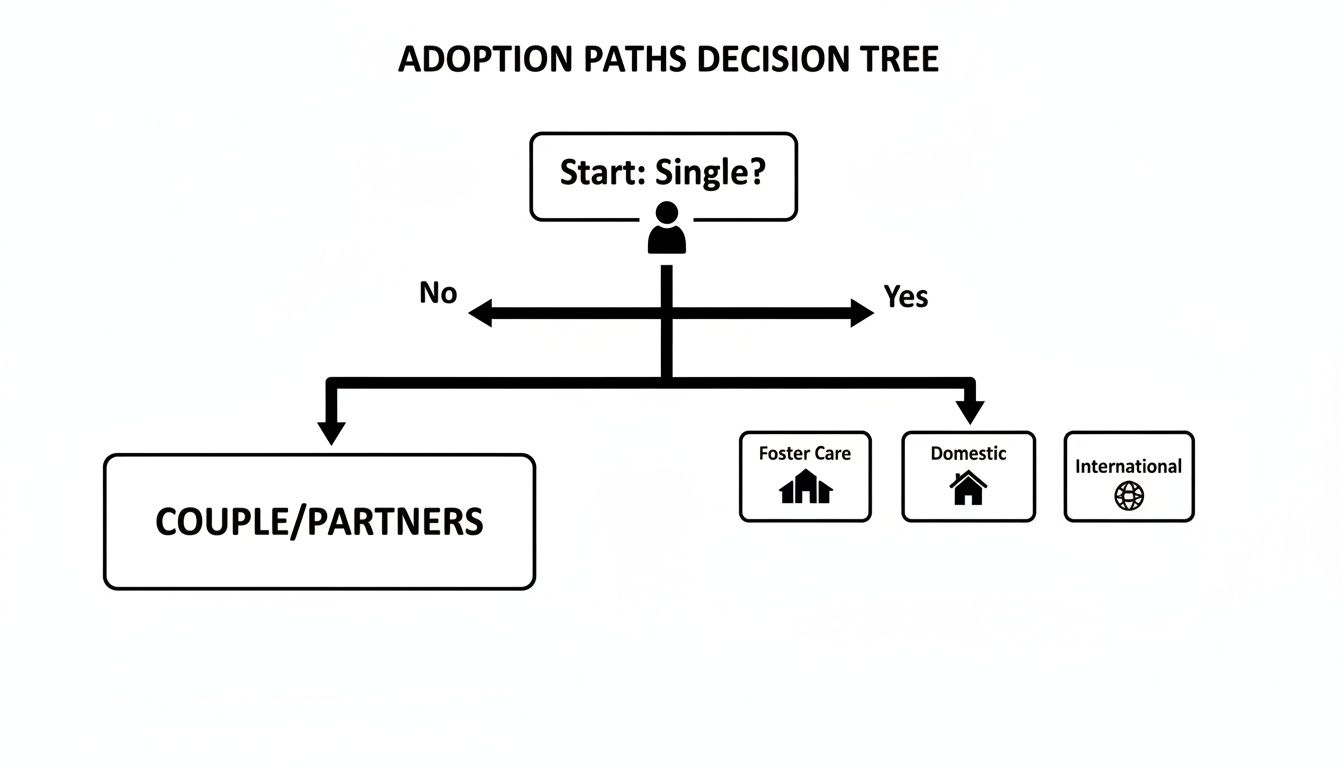
As you can see, being single simply means you're on a different branch of the same tree leading to parenthood. Foster care, domestic adoption, and even some international options are all still on the table.
Demystifying the Single Parent Home Study
The term "home study" can sound formal and even invasive. In reality, it’s mostly a series of supportive conversations and a review of your life to ensure you’re truly ready to be a parent. It’s a collaborative effort, not a test you can fail. For a single applicant, the social worker will naturally focus on a few key areas to see how you've prepared for this journey.
The home study isn’t about finding a perfect person or a perfect house. It's about finding a prepared, stable, and loving parent who can give a child a safe, nurturing home.
Your social worker is on your side. They want to see you succeed and will be looking for your unique strengths and how you plan to parent on your own terms.
Here’s what they’ll be looking at:
- Your Support System: Who is your "village?" They'll want to hear about the friends, family, and community members who will be there for you, both emotionally and practically.
- Your Childcare Plan: How will you balance your career and parenting? Having a solid plan for daycare, after-school care, or help from family shows you’re thinking ahead.
- Your Home Environment: Is your home a safe place for a child? You don’t need a mansion; a rented apartment can be a wonderful, loving home. The focus is on safety, stability, and having enough space for a child to thrive.
Remember Sarah, the teacher? During her home study, she didn't worry about not having a spouse. Instead, she showcased her strengths. She presented letters from her parents, who were excited to be grandparents. She laid out her plan to use her school's after-school program for childcare. She showed the social worker the cozy bedroom she had already set up, filled with books and ready for a child.
By focusing on her preparedness and her strong "village," Sarah proved she was more than ready to be an amazing single mom. Meeting the legal requirements is your first big step in showing the world that you are, too. With a little preparation and the right guidance, you can walk through this process with total confidence.
Preparing for Your Single Parent Home Study
The home study. For many hopeful parents, just hearing those two words can cause a spike of anxiety. It's easy to picture a white-glove inspection where someone is searching for perfection. But let's reframe that.
Think of the home study not as a test, but as a conversation. A social worker isn't there to judge your decorating skills. They're there to get to know you and confirm you can provide a safe, stable, and loving home for a child. They're looking for a prepared parent, not a perfect one.
As a single applicant, the process is nearly identical to that for a couple. The main difference is that the social worker will want to understand how you've prepared to parent on your own. This is your chance to highlight the unique strengths you bring.

Key Focus Areas for a Single Applicant's Home Study
The social worker’s number one goal is to protect the child's best interests. To do that, they need a clear picture of how your life is set up to welcome a new family member.
Three areas, in particular, will be on their radar:
- Your Support Network: Who is your "village"? Be ready to talk about the friends, family, and neighbors who will be your emotional and practical backup.
- Your Childcare Plan: Since you’ll be the primary caregiver, a solid childcare plan is essential. This includes a plan for daily care if you work, as well as for sick days, emergencies, or just a night off for yourself.
- Balancing Work and Parenting: The social worker will want to hear how you plan to juggle your career with the demands of being a parent. Be prepared to discuss your work schedule, any flexibility you have, and your financial stability.
Thinking through these areas ahead of time shows foresight and commitment—two of the most powerful signs of a great parent.
Sarah’s Home Study Preparation: A Real-World Example
Remember Sarah, the teacher? When her home study was scheduled, she didn't waste time worrying about what she didn't have. Instead, she focused on what she had in abundance: a community.
She collected heartfelt letters of support from her parents, her best friend, and her school principal. She created a detailed childcare document that outlined her daily after-school program, a list of trusted babysitters, and a confirmation from her mom to help during school breaks. This wasn't just a dream; it was a well-thought-out plan. It also helps to show you're thinking about safety; learning how to childproof your home is a great way to demonstrate your readiness.
Your home study is your chance to tell the story of the family you are ready to build. Focus on your strengths, your support system, and your unwavering commitment to being a parent.
Required Documents and What They Show
Yes, there's paperwork. But every document helps paint a complete picture of your life and readiness to parent. It’s not about bureaucracy; it’s about building a strong, credible case. For a comprehensive checklist, see our guide to the essential required documents for a Texas adoption home study.
You'll generally be asked to pull together:
- Financial Statements: To show you can manage your money responsibly and provide for a child's needs.
- Health Records: To confirm you're physically and mentally healthy enough to handle the joys and challenges of parenting.
- Personal References: Letters from people who know you best, speaking to your character, stability, and potential as a parent.
- Background Checks: These are mandatory to ensure a child will be in a safe environment.
When you walk into your home study with preparation and honesty, you turn a potentially stressful step into a confident stride forward on your journey to becoming a parent.
Building Your Village Before Bringing a Child Home
They say it takes a village to raise a child, and this is especially true for a single parent. While the legal and financial boxes are critical, the emotional and practical foundation you build with your support system is what will carry you through for years to come.
Texas adoption agencies and the courts understand this. It’s why they place so much emphasis on your network during the home study. This isn’t about judging your social life; it’s about ensuring a child will be surrounded by a community of love and support. A strong village shows you're ready for everything from unexpected sick days to simply needing a moment for yourself.

Proactively Building Your Support System
You might already have a great circle of people, but now is the time to be intentional. Don’t wait until a child is in your arms to figure out who you can call for advice or help. Start having those conversations now.
Here are a few practical steps you can take:
- Talk to Your Inner Circle: Have open conversations with your closest friends and family. Tell them about your adoption plans and discuss specific ways they can help—whether it's babysitting, dropping off a meal, or just being there to listen.
- Identify Your Go-To Helpers: Who lives nearby and has some flexibility? Who is the person you call when things get tough? Make a mental list of people you know you can count on.
- Connect with Other Single Parents: Find local or online groups for single adoptive parents. There is nothing more valuable than getting advice and understanding from people who are walking the same path.
Think back to Sarah's story. Before her home study, she invited her closest friends and family over. She didn't just tell them her plans; she asked them to be part of her official "support team." That simple gesture made them feel genuinely invested in her journey and turned a group of loved ones into a proactive network, excited and ready to welcome a child home.
Asking Your Agency the Right Questions
Your adoption agency is a huge part of your support system. When you speak with them, feel empowered to ask about the resources they offer after placement. Having a list of questions to ask your adoption agency ready can help you learn about counseling services, connections to other adoptive families, and other post-placement support they provide.
Building your village is one of the most powerful things you can do to prepare for the beautiful, messy, and incredible reality of being a parent.
Your Questions About Single Parent Adoption, Answered
It's completely normal to have questions as you think about building your family through adoption. The journey is a mix of hope, excitement, and uncertainty. We’re here to provide clear, plain-English answers to some of the most common concerns we hear from hopeful single parents in Texas, so you can move forward with confidence.
Do I Need to Own My Home to Adopt in Texas?
No, you absolutely do not. This is one of the biggest myths about adoption. The home study is about the quality of your home environment, not who holds the deed.
Whether you rent an apartment, own a house, or live in a townhome, what matters is your ability to provide a safe, stable, and nurturing space for a child. Social workers are looking for a clean, secure home with enough room for a child to live, play, and feel comfortable.
Is There a Minimum Income Requirement for Single Adopters?
Texas law does not specify a minimum income. Instead, the focus is squarely on financial stability. This means showing that you can manage your finances responsibly and provide for a child’s needs without constant financial strain.
During your home study, you’ll be asked for documents that paint a picture of your financial health, such as:
- Pay stubs or other proof of income
- Tax returns
- A breakdown of your monthly expenses
The goal is to demonstrate that you have a solid plan to support a child. You don’t need to be wealthy—just financially responsible.
Can I Adopt as a Single LGBTQ+ Person in Texas?
Yes, absolutely. Both Texas state law and landmark U.S. Supreme Court rulings firmly protect the right of every qualified person to adopt, regardless of their sexual orientation or gender identity.
Adoption agencies, social workers, and Texas courts cannot legally discriminate against you because you're part of the LGBTQ+ community. The focus remains right where it should be: on your ability to provide a loving, safe, and permanent home for a child. Your capacity to be a wonderful parent is what matters.
How Long Does the Single Parent Adoption Process Take?
The timeline for adoption can vary widely depending on the path you choose, so there’s no single answer. However, here are some general estimates:
- Adopting from Foster Care: This path can often move more quickly, typically taking between 9 to 18 months from the start of the home study until the adoption is finalized in court.
- Private Domestic Adoption: This timeline is less predictable because it depends on the matching process with a birth mother. It could take a few months or extend over a few years.
Patience is a vital part of any adoption journey. An experienced adoption attorney can give you a more personalized estimate based on your unique situation and the type of adoption you hope to pursue.
Getting your questions answered by a legal professional you trust can bring incredible peace of mind. By arming yourself with the facts, you can replace worry with empowered action as you take the next steps.
Taking the Next Step in Your Adoption Journey
You've made it this far, which means you're already turning a dream into a plan. You now know that being single is not a barrier to adoption in Texas, and you have a clearer picture of the path ahead. Every family's story is different, and you don’t have to walk this one alone.
Having a compassionate legal guide in your corner can make all the difference. It means having someone to help you navigate the paperwork, prepare confidently for the home study, and celebrate the day your adoption is finalized. The process is a series of manageable steps, and each one brings you closer to welcoming your child home.
Preparing for the Realities of Parenthood
As you move forward, remember that getting ready for parenthood goes beyond legal checkboxes. It's about preparing for the incredible, messy, beautiful day-to-day reality of raising a child. As you get ready to become a single parent, there are fantastic resources available. Exploring general parenting advice for new parents can offer practical insights and build your confidence for the journey ahead.
Remember, the goal of the adoption process isn't to find a perfect parent, but to find a loving, stable, and permanent home for a child. Your commitment and your unique strengths are what truly matter.
Embracing this journey means building your "village," knowing your strengths, and having a solid plan. With the right support system, you can build the family you've always imagined with confidence and joy.
Taking that first step is often the hardest, but it's also the most rewarding. If you're ready to explore your options and want to build your family with an experienced legal team by your side, we're here to help.
If you are ready to take the next step toward building your family, The Law Office of Bryan Fagan, PLLC invites you to schedule a free, no-obligation consultation with our team. Let us provide the compassionate legal guidance you need to make your dream a reality.
