
Deciding to adopt your stepchild is a deeply personal and loving act, one that legally solidifies the bond you've already built in your heart. The journey to make your family whole begins with understanding the right paperwork, specifically the stepparent adoption forms Texas courts require to officially recognize your family.
Your First Steps in Texas Stepparent Adoption

Stepparent adoption is far more than a legal formality. It’s about giving your stepchild the stability, security, and peace of mind that comes from having two legally recognized parents at home.
When you adopt, you gain the legal authority to enroll them in school, make medical decisions, and be named as their parent on every official document. The entire process kicks off when you file an initial petition with the court, which lays the foundation for this life-changing event. Every form you fill out is designed to ensure one thing above all else: the best interests of the child. Think of the paperwork as the way you tell your family's story to the judge, demonstrating the love and stability you provide.
The Key Players and Their Roles
Before you dive in, it's helpful to understand who's involved. In any stepparent adoption, the court is looking at three key people:
- The Adopting Stepparent: That's you—the person seeking to become the child's legal parent.
- The Custodial Parent: Your spouse, who is the child's biological or legal parent and will join you in filing the petition.
- The Other Biological Parent: The parent whose legal rights must be addressed, either by their consent or through a legal termination by the court.
How your family’s journey unfolds depends greatly on the situation with the other biological parent. This leads to two very different paths, each with its own set of forms and timeline.
Two Paths for Your Adoption Journey
Your adoption will follow one of two main routes. The first, and simplest, is an uncontested adoption. This happens when the other biological parent willingly signs off on the adoption and agrees to give up their parental rights. It's the most cooperative and straightforward path, often leading to a much faster, more peaceful finalization.
The second route is a contested or involuntary termination adoption. You'll go down this path if the other parent can't be found, refuses to consent, or has given legal grounds for a judge to terminate their rights. These grounds might include abandonment, failing to support the child, or endangering their welfare. It's more complex, but the process is there to protect the child's well-being. Our guide on a do-it-yourself stepparent adoption in Texas offers more context on how this works.
Stepparent adoption is the most common form of adoption in the United States, reflecting a deep desire within blended families to formalize their bonds and provide children with legal and emotional security.
This isn't just a national trend; we see it right here in Texas. Stepparent adoptions make up about 50-51% of all private domestic adoptions in the U.S. Here at home, total domestic adoptions climbed from 2,117 in 2020 to 2,500 in 2022, showing a strong and growing desire for these kinds of family-based adoptions. You can explore more adoption statistics to see these trends for yourself.
No matter which path your family takes, the goal remains the same: creating a legally permanent and secure home for your child. Understanding these initial steps will empower you to move forward with confidence.
Assembling Your Original Petition for Adoption
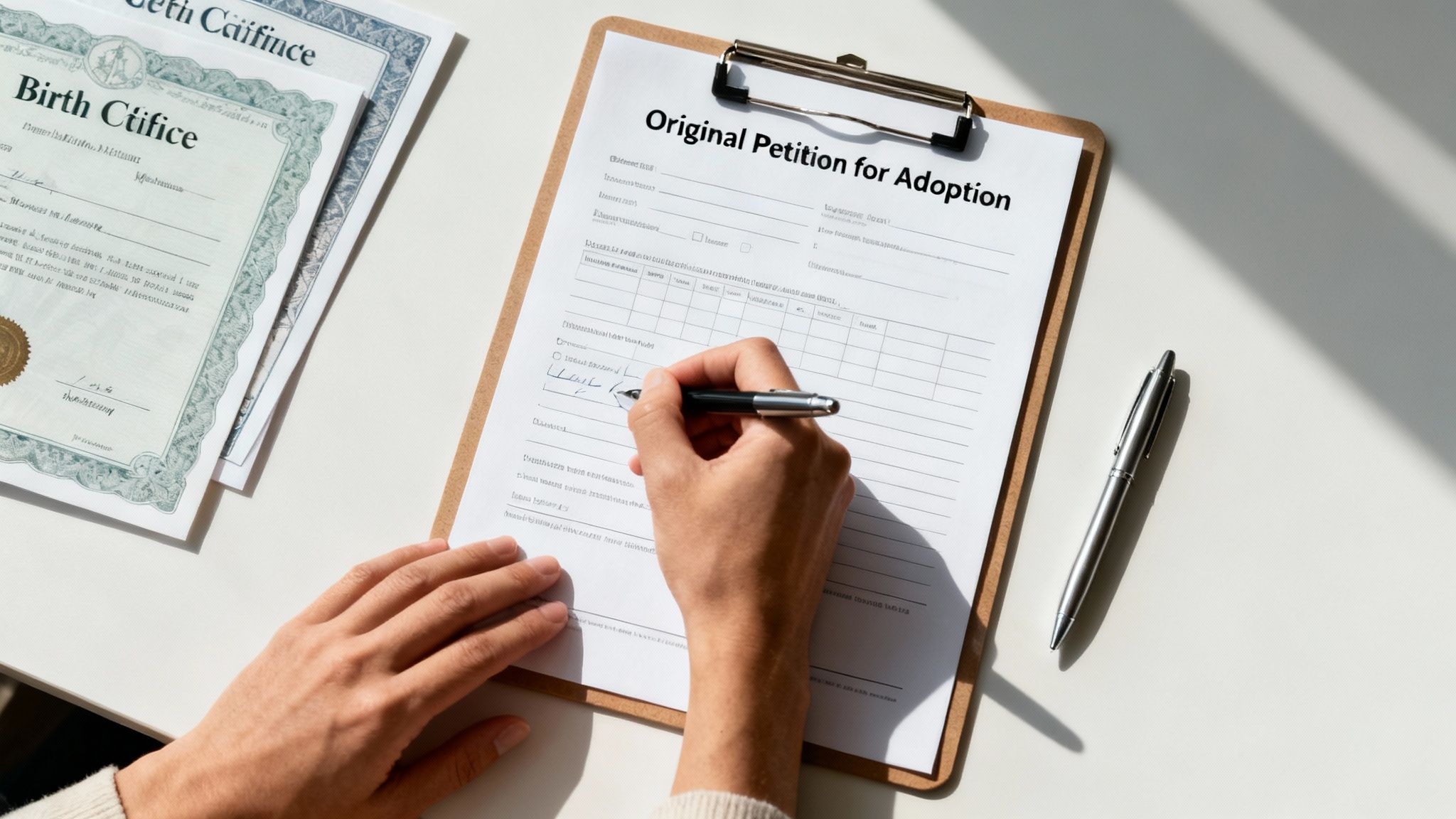
The first official move you'll make in your adoption journey is filing the Original Petition for Adoption. This document is much more than a form; it's your family's formal introduction to the court. It tells the judge who you are, who your stepchild is, and why this adoption serves the child's best interests.
Think of it as the foundational chapter of your legal story. Getting it right from the very beginning helps pave a smoother path forward. This petition, which you and your spouse file together as co-petitioners, lays out all the essential details the court needs to understand your unique family situation.
What Goes into the Petition
The petition itself is a structured legal document that asks for specific information. Every piece of data helps build a complete picture for the judge, ensuring all legal requirements under the Texas Family Code are met. It’s where you lay out the facts of your case in a clear, organized way.
Let’s break down the key sections you’ll need to complete.
- Identifying Information: This includes the full legal names and current addresses for you (the stepparent), your spouse (the custodial parent), and the child. Accuracy here is critical.
- Child’s Details: You'll need to provide the child's date and place of birth. If the child is 12 years or older, they must personally consent to the adoption, a fact that is usually noted right here in the paperwork.
- Your Marriage: The petition asks for the date and location of your marriage to the child's parent. This establishes the legal relationship that makes a stepparent adoption possible.
This initial information sets the stage, confirming everyone’s identity and relationship to one another before you get into the more detailed parts of your request.
Describing Your Parent-Child Relationship
This is where your story truly comes to life for the court. The petition requires you to state exactly how long the child has lived with you. Under Texas law, a child must generally live with the adopting stepparent for at least six months before an adoption can be finalized. This requirement is all about demonstrating a stable, established home environment.
For instance, maybe you married your spouse two years ago, and your stepson has lived with both of you ever since. You would state this clearly, showing the court that you've been a consistent, parental figure in his life long before filing any paperwork. Judges see this residency period as a strong indicator of stability.
The Original Petition isn't just about legal facts; it's your opportunity to show the court the loving, stable family unit you've already built. It formalizes the parent-child bond that already exists in your daily life.
You will also need to attach certain supporting documents to your petition, most commonly certified copies of the child’s birth certificate and your marriage certificate. Having these ready to go when you prepare your petition will help you avoid frustrating delays.
Addressing the Other Biological Parent
A crucial, and often sensitive, part of the petition involves the other biological parent. The court must know their status and how their parental rights will be handled.
There are two primary scenarios you'll address in the paperwork:
- Consent is Given: If the other parent agrees to the adoption, your petition will state this. You'll later file a separate legal document—an "Affidavit of Waiver of Interest"—which they will sign to make their consent official.
- Termination is Required: If the other parent is absent, unknown, or refuses to consent, your petition must formally ask the court to involuntarily terminate their parental rights. This is a serious legal step, and you must state the specific grounds for termination as defined by the Texas Family Code (Chapter 161).
For example, if the other parent has had no contact with or provided any financial support for the child for over a year, you would cite abandonment and failure to support as the legal grounds. An experienced adoption attorney is key here; they will help you articulate this correctly and start gathering the evidence needed to prove it in court. This part of the petition officially starts the legal process of making your stepchild your legal child in every sense of the word.
At The Law Office of Bryan Fagan, PLLC, we understand the emotional weight behind every line of these forms. We are here to help you tell your family’s story with clarity and compassion, empowering you to take this important first step.
Handling Parental Consent and Termination Forms

This is often the most emotionally charged part of the entire adoption journey: navigating the other biological parent's rights. It’s a stage that calls for a gentle hand, crystal-clear communication, and a solid grasp of the legal pathways available. Your family's future hinges on getting this step right, and we're here to guide you through it with empathy and clarity.
Without a doubt, the smoothest path forward is one of cooperation. When the other biological parent supports the adoption, it simplifies everything—not just legally, but emotionally for everyone involved. This agreement is formalized with a specific document that allows them to voluntarily give up their parental rights, clearing the way for the stepparent to adopt.
When a Parent Consents to the Adoption
If the other biological parent agrees the adoption is what’s best for the child, they will sign a form called an Affidavit of Waiver of Interest in Child. This is a powerful, sworn legal statement where they voluntarily and permanently give up their parental rights. It's not a decision made lightly, and the document reflects that gravity.
For this affidavit to be legally binding in Texas, it must be:
- Signed after the child is born. A parent cannot legally sign away their rights before the birth.
- Witnessed and notarized. A notary public has to verify the parent's signature, confirming their identity and intent.
Once this form is correctly signed and filed with the court, it gives the judge the legal grounds to terminate that parent's rights and approve the adoption. It signifies a selfless act, one that puts the child’s stability above all else. You can learn more about the specifics of a release of parental rights form and what it means for everyone.
Think about a common scenario: Maria and her husband, David, want David to adopt Maria’s son, Leo. Leo's biological father lives out of state but agrees this is the best move for Leo. He signs the Affidavit of Waiver of Interest, gets it notarized, and mails it back. That one act of cooperation makes their adoption journey far more direct and less stressful for everyone, especially Leo.
When Consent Is Not an Option
Life isn't always that simple. Sometimes, getting consent just isn't possible. The other biological parent might refuse to agree, or worse, you may have no idea where they are. Texas law provides a path forward in these tough situations, with the child's well-being always at the center. This is called involuntary termination.
In this case, your Original Petition for Adoption must specifically ask the court to terminate the other parent's rights and clearly state the legal grounds for doing so. These aren't minor issues; they are serious allegations that you must be able to prove with clear and convincing evidence.
Common grounds for involuntary termination under Texas Family Code § 161.001 include:
- Abandonment: The parent has voluntarily left the child and shown no intent to return.
- Failure to Support: The parent has not financially supported the child according to their ability for a significant time, usually one year.
- Endangerment: The parent has knowingly placed the child in conditions that endanger their physical or emotional well-being.
- Lack of Contact: The parent has gone long stretches without communicating with the child.
This route requires a formal legal process to notify the parent of the lawsuit, giving them a fair chance to respond.
A court's decision to involuntarily terminate parental rights is never made lightly. It is a profound legal step taken only when there is compelling evidence that doing so is essential for the child's safety, stability, and overall well-being.
But what if you can't find the other parent to notify them? The court has procedures for this. Your attorney will likely have to perform a "diligent search" to try and locate them. If that search comes up empty, the court can authorize other ways to give notice.
Citation by Posting means a notice is posted at the courthouse. Citation by Publication involves publishing a notice in a local newspaper. These methods provide the required legal notice so the case can move forward, ensuring a child isn’t left in legal limbo just because a parent is missing. It's the court's way of making sure every reasonable effort has been made before a final decision is made in the child’s best interest.
Getting Your Final Court Documents in Order
As you approach the finish line—the final hearing—your attorney will take the lead in drafting a few incredibly important documents. You won't be filling these out yourself. Instead, these are the legal orders the judge will sign to make your new family official in the eyes of the law. This is the moment where all your hard work, patience, and hope become a permanent, legal reality.
Think of these final papers as the official capstone of your adoption journey. They legally cement the changes your family has been working toward, making sure every detail is recorded and recognized by the State of Texas. Knowing what they are and what they do can turn that final court appearance into a moment of pure joy and celebration, free from any confusion.
The Order of Termination
Before any adoption can be finalized, the parental rights of the other biological parent have to be legally cut. The Order of Termination is the powerful court order that makes this happen. Your lawyer will draft it and hand it to the judge to sign.
This document officially and permanently severs the legal connection between that parent and your child. Whether the termination came from a voluntary signature on an Affidavit of Waiver or a court ruling based on abandonment, this order makes it final. It's the legal green light that clears the path for the adoption to move forward.
For example, if the biological father willingly signed a waiver, the order will specifically mention his voluntary relinquishment. If the court had to step in because of a long-term absence and lack of support, the order will lay out the specific legal grounds that were proven. This document is a critical shield for your child's stability and your family's unity.
The Final Decree of Adoption
This is the one you've been waiting for. The Final Decree of Adoption is the court order, signed by the judge on your adoption day, that formally declares you are the child's legal parent. It creates a brand-new, permanent parent-child relationship between you and your child, complete with all the rights and responsibilities that come with it.
The decree itself will lay out key details, including:
- A formal statement that the adoption is granted.
- Confirmation that the adoption is in the child's best interest.
- The child’s new legal name, if you've decided to change it.
- A clear declaration that you now have all the legal rights and duties of a parent.
This decree is, without a doubt, the most important piece of paper from your entire journey. It’s the official proof of your new family structure, and you'll use certified copies of it for everything from school registration to getting a driver's license for years to come.
"The moment the judge signs the Final Decree of Adoption is often filled with emotion—it's the culmination of love, hope, and legal diligence. This single document represents a new beginning and a lifetime of security for a child."
Critical Supporting Paperwork
Alongside the big-ticket court orders, your attorney will put together a couple of other key documents the state requires. These forms are less about the courtroom drama and more about the practical details of updating your child's official records.
One of these is the Health, Social, Educational, and Genetic History Report. It sounds like a mouthful, but it's basically just a summary of the child's background. In a stepparent adoption, this is usually pretty straightforward since the family already knows most of this information. The report simply ensures the court has a complete picture of the child's history and well-being before signing off.
Finally, your attorney will prepare a form called the Certificate of Adoption for the Texas Bureau of Vital Statistics. After the judge signs the decree, this form gets sent to the state to request a new birth certificate for your child. The new certificate will list you as the parent, officially updating your family tree and cementing your legal bond forever.
Filing Your Forms and Navigating Timelines
Once you have all your paperwork perfectly organized, you’re ready to kick off the official legal process. This is the moment your loving intention becomes a formal court case. Filing your stepparent adoption forms Texas means getting them to the right courthouse and knowing what to expect next, especially when it comes to timelines.
Your first move is filing the Original Petition for Adoption. You'll do this at the district court in the county where either you or the child lives—most families just file in their home county for convenience. The court clerk will stamp your documents, assign your case a cause number, and collect a filing fee, which usually runs between $300 and $400, give or take, depending on the county.
Serving the Other Parent and Setting Expectations
With the petition filed, the next crucial step is to legally notify the other biological parent about the adoption. In legal terms, this is called service.
If the other parent is on board and has already agreed to sign the consent forms, this part is fairly straightforward. Your attorney can simply send them the waiver to sign and return.
But if the parent is uncooperative or you can’t find them, things get more formal. A sheriff or a private process server has to personally hand them a copy of the lawsuit. This is a non-negotiable step that ensures they have a legal opportunity to respond. Our guide on understanding and filing Texas consent to adoption forms digs much deeper into this delicate part of the journey.
The timeline for a stepparent adoption is not one-size-fits-all. It is shaped entirely by your family's unique circumstances, especially the level of cooperation from the other biological parent. Patience and realistic expectations are your best allies.
When you're dealing with sensitive legal documents, making sure they're sent securely is a big deal. You might want to look into the security of fax versus email when sending critical papers to your lawyer or others involved in the case.
Estimated Timelines for Texas Stepparent Adoption
The path your adoption takes—whether it’s a smooth, cooperative process or a contested one—will dramatically impact how long it takes to get to that final hearing. The difference can be months, or even longer.
Here’s a breakdown of what you can generally expect.
| Milestone | Uncontested Adoption (Typical Timeline) | Contested Adoption (Typical Timeline) |
|---|---|---|
| Petition Filing & Initial Steps | 1-2 weeks | 2-4 weeks |
| Service & Consent/Termination | 2-4 weeks (Parent signs waiver promptly) | 1-6+ months (Locating/serving a parent, legal responses) |
| Amicus/Ad Litem Attorney | 1-2 months (Typically waived or simple review) | 2-4 months (Investigation, interviews, and report) |
| Scheduling Final Hearing | 1-2 months | 3-6+ months (Requires mediation or trial setting) |
| Total Estimated Timeline | 3-6 Months | 6-12+ Months |
As you can see, a contested case involves far more legal hurdles, from formal discovery and mediation to a potential trial, each adding significant time.
Uncontested vs. Contested: A Closer Look
The difference between a smooth journey and a long, complicated one almost always comes down to the other parent's cooperation.
An uncontested adoption is the fastest path forward. This happens when the other biological parent willingly signs the necessary consent forms to terminate their rights. Once that signed waiver is in the court's file, your case can move quickly toward a final hearing, often wrapping up in just 3 to 6 months.
A contested adoption, on the other hand, takes much longer. This is where the other parent either fights the termination of their rights or has simply disappeared and can't be located. This route involves more legal legwork, like formal discovery, mediation, and possibly even a full-blown trial. It’s not uncommon for these cases to stretch out for 6 to 12 months or even longer. For instance, an attorney might spend months trying to track down an absent parent, and once they're found, they could hire their own lawyer, kicking off a series of negotiations that can drag on.
The flowchart below shows what happens with the final court documents once the judge has made a decision.
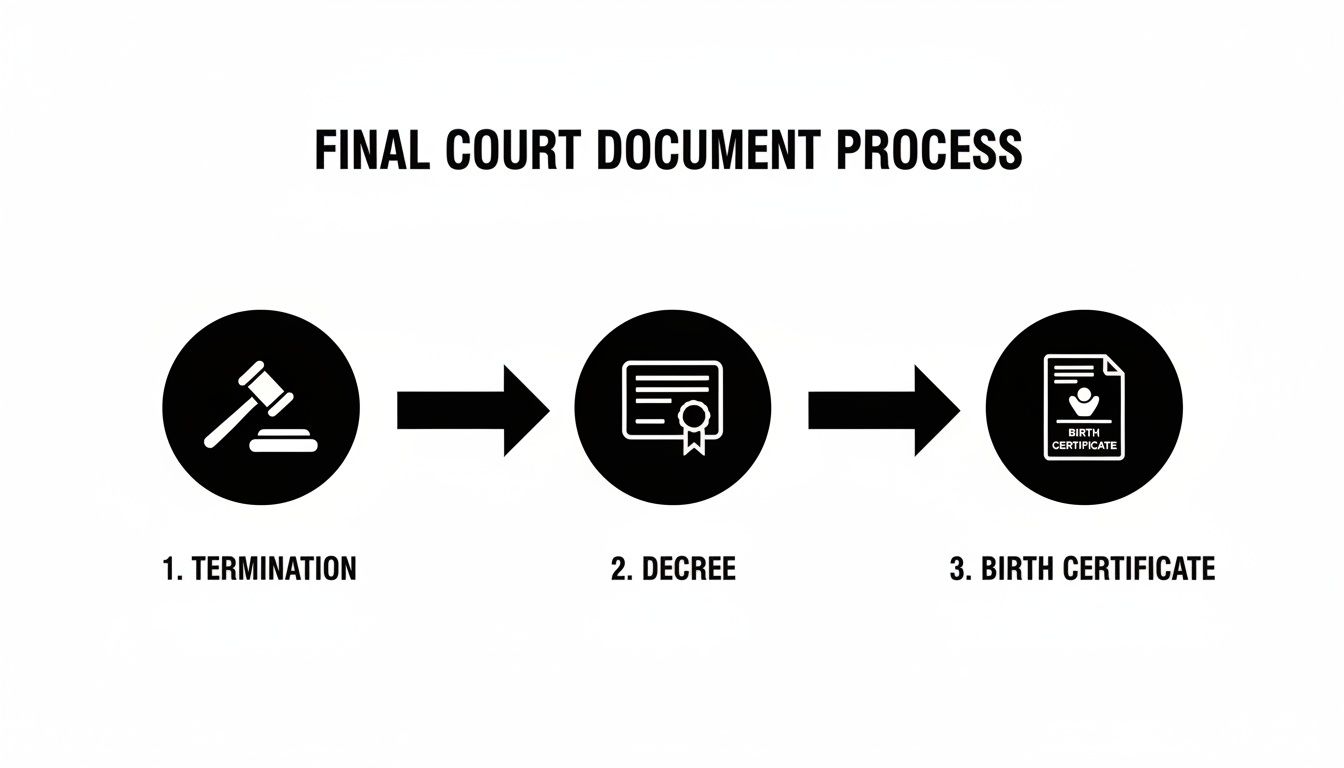
Essentially, once the parental rights are terminated, the way is cleared for the judge to sign the Decree of Adoption. From there, you can apply for a new birth certificate, officially and legally solidifying your new family.
Stepparent Adoption FAQs
Taking the step to legally become your stepchild’s parent is a huge decision, and it’s natural to have a lot of questions. This is a journey filled with both legal and emotional turns. Below, we’ve answered some of the most common questions our firm hears from families just like yours, offering the kind of clear, straightforward answers you need to move forward with confidence.
Does the Other Biological Parent Have to Consent?
This is probably the biggest question we get. While getting consent from the other biological parent makes the process much smoother and faster, it isn't an absolute requirement. If they refuse to agree, a judge can involuntarily terminate their parental rights, but only if it's proven to be in the child's best interest.
This is a high legal bar to clear and requires solid evidence. A court might terminate rights on grounds like:
- Abandonment (no contact or support for a significant period)
- Failure to provide any financial support
- Endangering the child's physical or emotional well-being
Because you are asking a court to permanently sever a legal parent-child relationship, this becomes a complex legal matter. It's not something you want to tackle without an experienced family law attorney who knows how to build and present a strong case.
Is a Home Study Always Required in Texas?
Thankfully, no. In most Texas stepparent adoptions, the home study is waived. The law recognizes that the child is already living in a stable home with their parent and you, the stepparent.
Because of this, a formal, expensive home study is usually seen as unnecessary. Your attorney will file a motion with the court asking the judge to waive the requirement, and it’s almost always granted unless there are specific, unusual concerns about the child’s welfare in your home.
What Happens After the Final Decree Is Signed?
The moment the judge signs the Final Decree of Adoption, it's official. Your legal journey is complete, and you now have all the same legal rights and responsibilities as a biological parent.
The next practical step is to use that decree to update your child’s official records. Your attorney will help you file the paperwork with the Texas Bureau of Vital Statistics to have a new birth certificate issued. This new birth certificate will list you as a legal parent. From there, you can use it to update Social Security records, school information, and insurance, fully cementing your new family status.
"The final decree is more than just a piece of paper; it's the legal recognition of the emotional bond you've already built. It provides a lifetime of security and belonging for your child."
Can We Start the Adoption if We Are Not Married?
No, you must be legally married to the child's biological parent to file for a stepparent adoption in Texas. The entire legal framework for this specific type of adoption is built around formalizing the relationship between a child and their parent's spouse.
If you aren't married yet, you'd have to look into other types of adoption, which have entirely different requirements and a much more intensive process. For a stepparent adoption, the marriage certificate is the legal foundation.
Navigating the legal and emotional path of stepparent adoption can feel overwhelming, but you don't have to do it alone. At The Law Office of Bryan Fagan, PLLC, our compassionate team is here to answer all your questions and guide you through every form and court appearance with clarity and care. Schedule your free consultation today to learn how we can help your family take this beautiful final step.
