
Adopting your stepchild in Texas is about so much more than signing papers. It's the moment the law finally catches up to what your heart has known all along—that you are a parent, and this is your child. This beautiful legal step makes your family whole, granting you the full parental rights that match the bond you’ve already built.
Your Path to Legally Uniting Your Family
Deciding to legally adopt your stepchild is a profound, beautiful choice. It’s the final piece of the puzzle for so many blended families, providing a sense of permanence and security that puts everyone at ease—especially the child.

We know this journey is filled with both excitement and a little bit of uncertainty. That’s why we created this guide—to give you a clear, compassionate roadmap that explains the legal steps and helps you navigate any challenges with confidence.
More Than Just Paperwork: A Lifelong Commitment
Stepparent adoption is a powerful way to formalize your role in a child's life. It’s what gives you the legal standing to:
- Make crucial healthcare decisions when they get sick or injured.
- Enroll them in school and handle all their educational needs.
- Secure their inheritance rights as a full member of your family.
- Add them to your health insurance and other benefits.
This is actually one of the most common ways families grow in the U.S. In fact, stepparent adoptions made up over 50% of the 52,536 private domestic adoptions nationwide back in 2020. Here in Texas, an uncontested case can often be completed in just three to six months, making it a relatively quick path to legal unity.
The journey of adoption is about creating legal and emotional permanency. It tells a child, "You are wanted, you are secure, and you belong here, always." This legal finality is often the greatest gift you can give.
Of course, the legal process is just one part of the picture. Building a strong, connected family is the real work. If you're looking for ways to deepen your bond, especially with older kids, resources like A Parent's Guide to the 5 Love Languages for Teens can offer some wonderful insights.
At The Law Office of Bryan Fagan, PLLC, we don't see this as just another case file. We see it as the official start of your family's next chapter. We're here to walk beside you, offering the clear guidance and supportive partnership your family deserves.
Checking if You Qualify for a Stepparent Adoption
Before you start the incredible journey of legally adopting your stepchild, it’s smart to first make sure you meet the specific requirements laid out by Texas law. The Texas Family Code provides a clear roadmap, and getting this right from the beginning ensures your adoption process starts on solid ground.

Think of this as building the legal foundation for your case. It’s where you show the court that your family’s situation ticks all the necessary boxes for a stepparent adoption to move forward.
Your Marital and Home Life Status
First things first, let's talk about the absolute basics. For a stepparent adoption in Texas, you must be legally married to the child’s custodial parent. This is a hard-and-fast rule; the law doesn’t allow for stepparent adoptions by unmarried partners.
Texas also has a residency rule to make sure the child has been in a stable environment. The law requires the child to have lived with you (the stepparent) and your spouse for at least six months before the adoption can be finalized. This gives the court confidence that a solid, blended family dynamic is already in place.
But we all know life can be unpredictable. The law gets that.
In some cases, a judge can waive the six-month residency rule if it's clearly in the child's best interest. This is called a "good cause" waiver, and it shows how the court will always prioritize a child's well-being over a rigid checklist.
For example, imagine a military family gets sudden orders to relocate. A judge might agree to waive the six-month rule to avoid delaying the legal security the adoption provides the child. Our firm can help you figure out if your situation might qualify and build a strong argument for the court.
The Background Check Requirement
The court's number one priority is the child's safety. A thorough background check is a crucial step to ensure the child will be in a secure and loving home.
As the stepparent seeking to adopt, you will have to undergo and pass a comprehensive criminal history check. This isn't as intimidating as it sounds and usually involves three main components:
- An FBI Fingerprint Check: This is a nationwide search for any criminal history.
- A Texas DPS Check: This is a state-level check for any records here in Texas.
- A Central Registry Check: This search of the Texas Department of Family and Protective Services (DFPS) database looks for any history of child abuse or neglect.
It is absolutely vital to be honest and upfront during this part of the process. A mistake in your past doesn't automatically mean you can't adopt. The court looks at the big picture, focusing on who you are today and whether you can provide a safe home. We can help you present this information clearly and confidently, addressing any potential issues head-on to build a case that earns the court’s trust.
The Other Parent: Securing Consent and Handling Parental Rights
Let's talk about one of the most delicate parts of any stepparent adoption: the other biological parent. Before you can legally adopt your stepchild, Texas law requires the parental rights of the non-custodial parent to be formally terminated.
Why? A child can only have two legal parents. This crucial step clears the path for you, the adopting stepparent, to step into that role legally and permanently. It can feel like a huge hurdle, but it's a legal safeguard designed to protect everyone—especially the child.
This can play out in one of two ways: the other parent agrees, or a court has to get involved.
The Smoothest Path: Voluntary Consent
By far, the simplest and most peaceful way forward is when the other biological parent voluntarily agrees to the adoption. This happens when they recognize it’s in their child’s best interest to have legal permanence with you and are supportive of solidifying your family.
This isn't just a handshake deal. The consent has to be documented in a specific legal paper called an Affidavit of Relinquishment of Parental Rights.
For this document to be valid, it must be:
- Signed by the parent after the child is born.
- Signed in front of a notary public.
- A clear, knowing waiver of all their parental rights and duties.
Think of a father who, for whatever reason, hasn't been a part of his child’s life for years. He sees that the stepfather is the one showing up to parent-teacher conferences and coaching soccer games. He agrees that formalizing this relationship is what's best for his child, so he works with an attorney to sign the affidavit. This makes the entire court process faster and far less stressful for everyone.
An undisputed, voluntary relinquishment is the gold standard in a stepparent adoption. It signals to the court that everyone is on the same page about the child's best interests, which can dramatically speed up your timeline to finalization.
When Consent Isn't an Option
Unfortunately, not every case is that simple. What if the other parent refuses to consent? Or what if they've completely vanished and you can't find them?
In these tough situations, you have to ask the court to involuntarily terminate their parental rights. This is a very serious legal move, and a judge won't grant it lightly. You must provide clear and convincing evidence that termination is in the child’s best interest and that the parent has done something that warrants it under the Texas Family Code.
Common legal grounds for involuntary termination include:
- Abandonment: Knowingly leaving the child for at least six months with no intent to return, meaning no contact and no support.
- Endangerment: Acting in a way that has endangered the child's physical or emotional well-being.
- Failure to Support: Failing to provide financial support for the child for a period of one year (ending within six months of when you file your case), despite being able to do so.
- Incarceration: Being imprisoned for a long time, which directly impacts their ability to parent.
For families facing this, knowing the specifics is critical. To get a deeper understanding of who needs to provide their agreement, you can find more detail in our article on who must provide consent for a Texas adoption.
Building Your Case for Involuntary Termination
If you have to go the involuntary route, your attorney's job is to help you gather the proof needed to make a powerful case to the judge. This isn't about punishing the other parent; it’s about proving that legally cementing your family unit is what’s best for your stepchild's stability and future.
Evidence could be anything from text messages and emails to testimony from friends or teachers who can speak to the parent's absence. Financial records showing a lack of support are also powerful. While this process can be emotionally draining, it's a necessary step toward giving your stepchild the legal security and permanence they deserve.
The Legal Journey: From Filing The Petition To The Final Hearing
Once you’ve navigated the initial hurdles of consent and parental rights, you can finally start the official legal process. This is where your family’s reality gets its legal recognition, and it all begins by filing the right paperwork with the Texas courts.
The journey formally kicks off when your attorney files the Original Petition for Adoption. This document tells the court you’re asking to legally adopt your stepchild. If you’re also seeking to involuntarily terminate the other parent's rights, a Suit to Terminate Parental Rights will be filed right alongside it.
The Court's Role And The Child's Voice
From the moment papers are filed, the court’s top priority is the child's best interest. In some cases, especially if the adoption is contested, a judge may appoint an ad litem attorney. This is a neutral lawyer whose only client is the child.
The ad litem’s job is to give the child a voice in the proceedings. They will talk to the child (in an age-appropriate way), you, your spouse, and maybe even teachers or counselors. Their goal is to get a clear picture of the situation from the child's perspective and then recommend to the judge what they believe is best for that child.
The Adoption Evaluation: A Home Study Waiver Is Likely
Next up is a step that often causes a lot of anxiety: the adoption evaluation, also known as a home study. But here’s some good news for most stepparents in Texas. The law recognizes that in a stepparent adoption, the child is already in a stable home with their family.
Because of this, the Texas Family Code gives a judge the power to waive the home study requirement. A waiver is very common in an uncontested stepparent adoption, particularly when:
- The other biological parent agrees to the adoption.
- Your criminal background checks come back clear.
- The child has already been living with you and your spouse for a while.
Your attorney will file a motion requesting this waiver, which is a huge help. It saves you time, money, and a lot of stress. For a closer look at the paperwork involved, our guide on essential stepparent adoption forms in Texas breaks it all down.
This timeline gives you a bird's-eye view of the key milestones, from filing the first document to celebrating the final hearing.
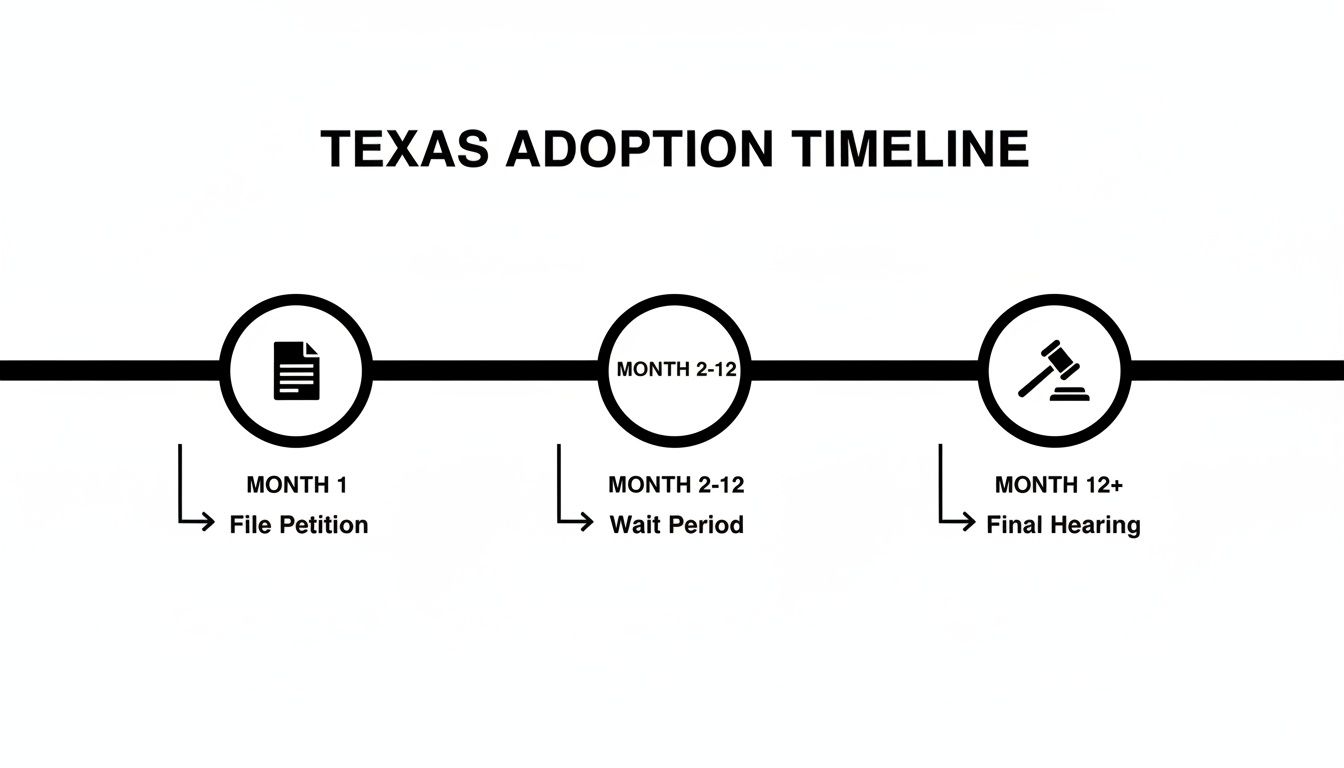
As you can see, the biggest factor influencing your timeline is whether the adoption is contested.
The table below offers a clearer picture of how the timelines can differ. While every case is unique, this gives you a general idea of what to expect.
Texas Stepparent Adoption Timeline Overview
| Phase | Uncontested Adoption (Typical Timeline) | Contested Adoption (Typical Timeline) |
|---|---|---|
| Preparation & Filing | 2-4 weeks | 4-8 weeks |
| Serving the Other Parent | N/A (Consent is signed) | 1-3 months (May require diligent search) |
| Court Process | 2-4 months (Includes waiting periods and scheduling) | 6-18+ months (Includes discovery, mediation, and potential trial) |
| Final Hearing | Scheduled shortly after waiting period | Scheduled only after termination is granted |
| Total Estimated Time | 3-6 months | 9-24+ months |
An uncontested case, where everyone is on the same page, moves much faster. A contested adoption requires more court intervention, which naturally extends the process as the judge carefully weighs every piece of evidence.
Your Day In Court: The Final Hearing
The final hearing is the moment this whole journey has been leading up to. Forget what you’ve seen in courtroom dramas—this isn't a trial. It’s a celebration. The atmosphere is almost always joyful, not intimidating.
You, your spouse, and your child will stand before the judge. The judge will ask a few simple questions to confirm your identity, your wish to adopt, and your promise to parent this child as your own. If your child is 12 or older, the judge will also confirm their consent.
This is the moment it all becomes real. The judge signs the final Decree of Adoption, and in that instant, your stepchild legally and forever becomes your child. It’s an incredibly emotional and powerful experience for the whole family.
After the hearing, your attorney will help you tie up the loose ends. This means ordering an amended birth certificate that lists you as the parent and updating the child’s Social Security records. These final steps make your family’s new status official everywhere.
Ready to Build Your Family? Take the Next Step
We've covered a lot of ground, and it's easy to feel overwhelmed. But the journey to legally solidify your family through stepparent adoption in Texas is more than just a series of legal hurdles—it’s a deeply rewarding process when you have the right team in your corner. Our goal is to make sure you feel confident and supported every step of the way.
From meeting eligibility requirements and securing the necessary consents to filing the petition and standing before the judge, every part of this process is designed with one thing in mind: protecting the best interests of your child.
Your Partner in This Journey
At The Law Office of Bryan Fagan, PLLC, we’ve guided countless Texas families just like yours through this exact process. We bring more than just legal experience to the table; we bring a genuine understanding that this isn’t just a case file. It’s your family’s future.
We’ve seen the challenges that can pop up and know how to find clear, effective solutions to keep things moving forward.
Your commitment to your stepchild deserves to be recognized by law. This process is about making sure the legal paperwork finally catches up to the love and dedication you already show every single day. We’re here to make that a reality.
When you work with us, you’ll feel the difference right away. We don’t just see clients; we see people. We take the time to listen to your story, understand what makes your family unique, and build a strategy that helps you reach your goals with as little stress as possible.
Taking the First Step Toward Clarity
You don’t have to piece this all together on your own. The most important step you can take is often the very first one: reaching out for information.
Whether you have questions about terminating the other parent’s rights, aren't sure if a home study is required in your situation, or just want a clear picture of the timeline and costs, we have the answers you need.
If you’re ready for clarity and peace of mind, we invite you to take that step today. Let us handle the legal complexities so you can focus on what truly matters: building your family.
Schedule a free, confidential consultation with one of our experienced adoption attorneys. We’ll listen to your story, talk through your specific situation, and give you the personalized advice you need to move forward. Let’s start building your future together.
Common Questions About Texas Stepparent Adoption
The path to making your family legally whole is exciting, but it’s natural to have questions pop up along the way. Families want to feel ready for anything. Here, we tackle some of the most common concerns we hear from parents, giving you the straightforward answers you need to move forward with confidence.
What if We Cannot Find the Other Biological Parent?
It happens more often than you might think: the other biological parent is nowhere to be found. But you can't just skip that part of the process. The court needs proof that you’ve made a genuine effort to locate them, a process known as a diligent search.
This isn't just a quick Google search. A true diligent search means you've exhausted every reasonable option. This often involves:
- Hiring a professional process server or a private investigator to conduct a search.
- Scouring public records and social media platforms.
- Reaching out to their last known relatives, friends, or even former employers.
Only after these extensive efforts come up empty can your attorney ask the court for an alternative: service by publication. This involves posting a legal notice in a newspaper approved by the court, which acts as the official notification. Getting this right is a procedural minefield, and having an experienced attorney is crucial to prevent your case from being delayed or dismissed.
Does My Child Have to Consent to the Adoption?
In Texas, a child’s voice matters deeply in the adoption process, especially as they get older. The law recognizes their right to be part of this life-changing decision.
If your stepchild is 12 years of age or older, the law requires them to give their written consent to be adopted. This is usually handled in a calm, supportive way, often with the judge in chambers or during the final hearing. It’s a powerful moment where the child officially becomes an active participant in creating their new family.
A judge wants to see that the child is genuinely on board, as this is some of the best evidence that the adoption is in their best interest. While a judge can technically waive this in extremely rare circumstances, the child's consent is a respected and standard part of the journey for pre-teens and teens.
This moment of consent is incredibly affirming for the child. It empowers them, validates their feelings, and makes them an active participant in creating their new, legally recognized family.
Will We Definitely Need a Home Study?
The words "home study" can sound pretty intimidating, but here’s some good news: for most stepparent adoptions in Texas, it’s not something you’ll have to worry about.
While a home study is a standard requirement in many other types of adoptions, the Texas Family Code allows judges to waive this requirement for stepparents. A waiver is extremely common in an uncontested case, particularly when:
- The other biological parent agrees to the adoption.
- The stepparent has a clean criminal background check.
- The child has already been living in a stable, loving home with both the stepparent and the biological parent for a while.
Your attorney can file a motion asking the judge to waive the home study, explaining that the child is already in a safe and established family unit. This simple step saves the family a great deal of time and money, making the entire process smoother.
What Happens to Child Support After the Adoption?
This is a critical financial question, and it has a two-part answer that every family needs to understand.
Once the judge signs the final adoption decree, the parental rights of the other biological parent are terminated—forever. At that very moment, their legal duty to pay any future child support stops completely. As the adopting stepparent, you are now taking on full legal and financial responsibility for the child.
However, the adoption does not wipe out any past-due child support, also known as arrears. Any unpaid child support that built up before the adoption was finalized is still a legally collectible debt. The Office of the Attorney General can and will continue to pursue that debt, even after the adoption is complete. It’s a crucial detail to go over with your attorney to make sure there are no financial surprises down the road.
At The Law Office of Bryan Fagan, PLLC, we believe every family deserves clarity and compassionate guidance. If you are considering stepparent adoption, we invite you to schedule a free consultation with our experienced attorneys. Let us help you take the next confident step toward solidifying your family’s future. Contact us today to learn more.
