
Formally adopting your stepchild is more than just a legal process; it's a profound act of love that solidifies the emotional bond you already share into a permanent, legal one. For many blended families in Texas, this step is the beautiful culmination of building a life together, creating unshakable security and unity for the child at the heart of it all.
If you’re ready to learn how to adopt your stepchild in Texas, know that the path forward is clear and designed with your family’s well-being in mind. The journey has two critical starting points: you must be married to the child's parent, and the parental rights of the other biological parent must be addressed. At The Law Office of Bryan Fagan, PLLC, we understand the delicate emotions involved and are here to guide you with compassion and clarity every step of the way.
Your Compassionate Guide to Stepparent Adoption in Texas

When you decide to adopt your stepchild, you are making a powerful promise to love, protect, and provide for them as your own, forever. Texas law offers a clear pathway to make that promise legally binding, and this guide is here to walk you through it with empathy and understanding.
This journey is about so much more than paperwork. It’s about cementing the bond that already exists in your heart and giving your child the profound sense of security and belonging they deserve.
Why Stepparent Adoption Matters for Your Family
Taking this step grants you full parental rights, eliminating any legal ambiguity about your role in the child's life. It provides the legal standing you need to make fundamental decisions for their well-being, ensuring you can always be there for them without question.
Key benefits of a finalized stepparent adoption include:
- Medical and Educational Authority: You gain the undisputed right to make healthcare decisions and be involved in your child’s schooling. No more navigating tricky situations at the doctor's office or parent-teacher conferences; you are their parent, period.
- Legal Security: It ensures your parental rights are protected, even in the unthinkable event of your spouse's death or a divorce. This provides unshakable stability for your child when they need it most. For example, if your spouse were to pass away, your adoption guarantees you remain your child’s legal parent, preventing any custody challenges from other relatives.
- Inheritance Rights: Your child will have the legal right to inherit from you and your family, just like a biological child, securing their financial future.
- Family Unity: The adoption provides a deep sense of permanence and belonging for the child, officially and emotionally uniting your family under one legal umbrella.
The Foundation of Texas Stepparent Adoption
The entire process, as outlined in the Texas Family Code (Chapters 162-166), hinges on one single, guiding principle: what is in the best interest of the child. This standard aligns perfectly with your goal—to provide a stable, loving, and permanent home.
The courts look very favorably upon stepparents who are already acting as a parent in every meaningful way—the ones showing up for school plays, handling late-night fevers, and providing daily love and support. Your commitment is the heart of your case.
At The Law Office of Bryan Fagan, PLLC, we see stepparent adoption as one of the most positive and life-affirming parts of family law. It’s where the legal system finally catches up to the emotional reality of your family.
Think of this guide as your roadmap. It’s here to help you understand each requirement, from initial eligibility checks to that final, joyous court hearing. With the right information and support, you can navigate every milestone with confidence.
Our goal is to empower you with the knowledge you need to take the next step. If you’re ready to learn more about how to adopt your stepchild in Texas, our compassionate team is here to listen. Schedule a free consultation with us today to discuss your family’s unique situation.
Are You Eligible for a Stepparent Adoption in Texas?
Before diving into paperwork and court dates, let's pause to ensure you meet the eligibility requirements. Think of this as the first, most important step. Confirming these details from the beginning will save you time and prevent potential headaches down the road.
Texas law has a few non-negotiable rules in place. They aren't meant to be obstacles; they’re designed to ensure the adoption is truly in the child’s best interest and that your family is on solid legal ground.
The Foundational Requirements
What does the court actually look for? The Texas Family Code lays out a few core criteria that every stepparent must meet before an adoption can move forward.
Here’s a simple checklist of what you’ll need:
- You must be legally married to the child’s biological or adoptive parent. This is the legal cornerstone of a stepparent adoption.
- You and your stepchild must have lived in Texas for at least the last six months before you file your petition. This simple residency rule confirms that a Texas court has jurisdiction over your case.
- You must be at least 21 years old. This is a standard age requirement for all adoptions in the state.
If you can tick these boxes, you’ve cleared the first major hurdle. For example, if you and your spouse have been married for two years and your family has lived together in Houston that whole time, you easily meet these initial requirements.
Background Checks: Protecting Your Child
Next up is something that can make people feel a bit nervous: the criminal background check. It’s completely normal to feel uneasy about this, but please know it's a standard and routine part of the process for you and any other adult living in your home.
This isn’t about judging your past. The court is simply performing its due diligence to ensure your stepchild is in a safe, stable environment. A minor issue from many years ago, like a misdemeanor, will likely not disqualify you. The judge is trained to look at the big picture—your life today, your character, and your ability to provide a loving home.
"The court's focus is always on the best interest of the child. A background check is a tool to confirm what you already know: that you provide a safe, stable, and loving environment for your stepchild to thrive."
What if Your Stepchild is Older?
Here’s a really meaningful part of the process in Texas. If your stepchild is 12 years of age or older, the law requires their written consent for the adoption to proceed.
This is a powerful moment. It empowers your stepchild by giving them a voice and making them an active participant in formalizing your family. It's common for judges to take the time to speak with the child privately in their chambers, in a gentle and friendly way, to make sure their consent is genuine and that this is what they truly want. This act respects their maturity and ensures the adoption is a joyful decision for everyone.
Stepparent adoption is one of the most common types of adoption in Texas, and the laws are set up to support and strengthen blended families. In an uncontested case where the other parent agrees, the entire process can be finalized in as little as three to six months. To learn more about how this streamlined process works, you can explore detailed insights on Texas stepparent adoption.
Navigating the Termination of Parental Rights
Let’s talk about what is often the most delicate part of a stepparent adoption: the rights of the other biological parent. For your adoption to move forward, Texas law is clear: a child can only have two legal parents. This means the non-custodial parent's rights must be legally terminated before yours can be granted.
This part of the process can feel overwhelming, but understanding your options is crucial. The law provides two main pathways, both designed to ensure the adoption is legally sound and creates the stable, permanent family your stepchild deserves.
The Path of Voluntary Termination
The smoothest and most harmonious route is voluntary termination. This occurs when the other biological parent agrees that the adoption is in the child’s best interest. They make their consent official by signing a legal document called an Affidavit of Relinquishment of Parental Rights.
Imagine a scenario where the other parent has moved on, perhaps started a new family, and recognizes that you are the one providing daily care and love. By signing the affidavit, they acknowledge this reality and give their blessing for you to become the legal parent. This selfless act makes the process faster, less expensive, and far less stressful for everyone—especially the child.
Before you even get to this stage, though, you have to meet some basic criteria. This chart gives you a quick visual of the eligibility requirements.
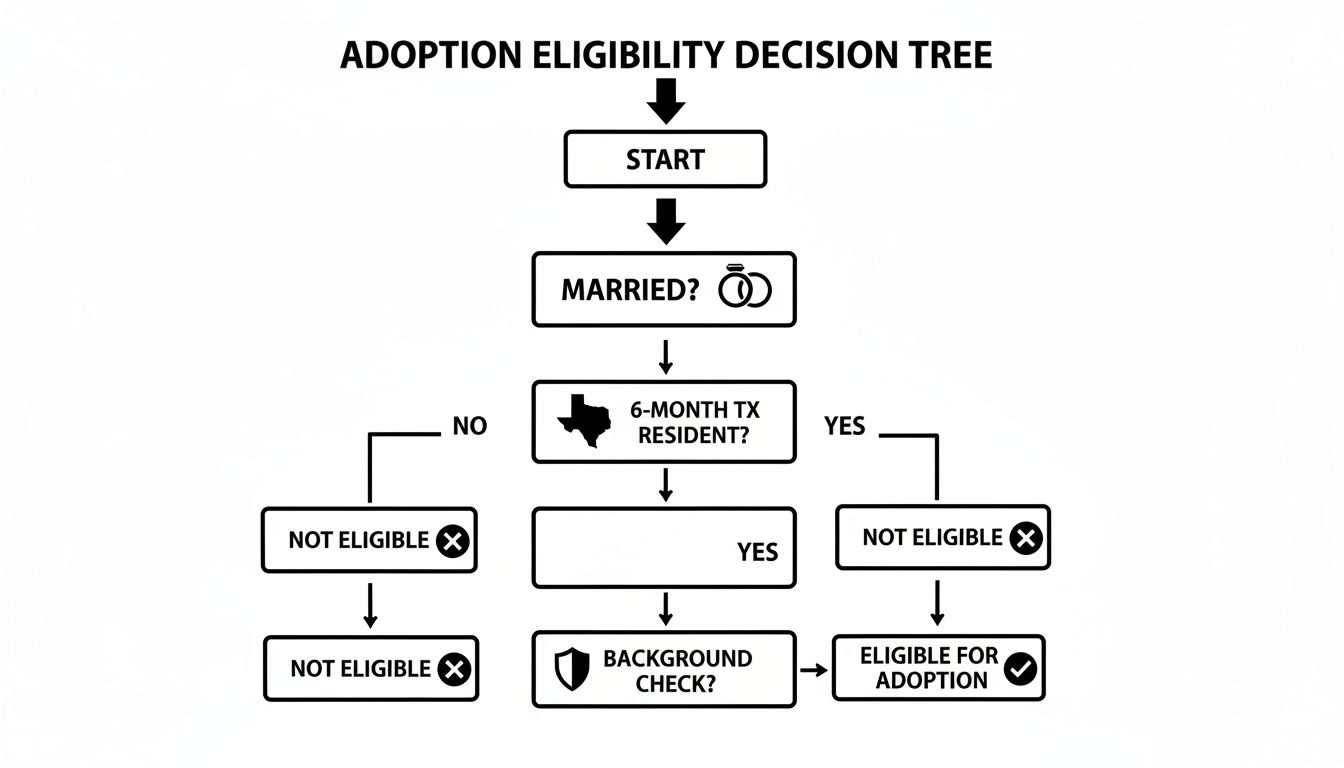
Think of it as the legal foundation. You have to have these pieces in place before you can build the rest of your adoption case.
When Cooperation Isn't an Option
Of course, voluntary consent isn't always possible. The other parent might be unwilling to sign, impossible to locate, or completely absent from the child's life. In these tough situations, you must pursue an involuntary termination of their parental rights through the court.
This is a serious legal step, and a judge will not take a parent's rights away lightly. The Texas Family Code lays out specific grounds for termination, and you must provide "clear and convincing evidence" that termination is in the child's best interest.
Some of the most common grounds for involuntary termination include:
- Abandonment: The parent has left the child and clearly shown they don't intend to return.
- Endangerment: The parent has acted in a way that endangers the child's physical or emotional well-being.
- Failure to Support: For at least one year ending within six months of filing your petition, the parent has failed to provide financial support, despite being able to.
- Constructive Abandonment: The parent has effectively vanished, with no contact or support for a long period, essentially abandoning their parental role.
Consider a real-life scenario we often see: the other biological parent hasn't seen, called, or sent a single dollar for the child's care in over two years, despite knowing where the child lives. This creates a strong case for a judge to grant an involuntary termination, allowing you to provide the legal stability the child needs. Our firm can help you gather the proof needed to present a compelling argument. You can find more details in our complete guide on the termination of parental rights in Texas.
The court's primary duty is to protect the child. When one parent has disappeared from a child's life, the law provides a way for a loving and present stepparent to provide the permanence and security that child deserves.
Handling an Unknown or Missing Parent
What happens if you don't even know where the other parent is? This is a common and very real concern. You cannot simply skip this step; the court requires you to make a diligent search to find and notify them.
In these cases, a judge will often appoint an attorney ad litem. This is an independent attorney whose only job is to conduct a thorough, official search for the missing parent. They'll check public records, old addresses, and various databases.
If that exhaustive search comes up empty, the legal notice requirement can be satisfied through "service by publication"—posting a formal notice in a newspaper or another public forum. After that's done, the court can proceed with terminating the unknown parent’s rights, clearing the way for your adoption to continue.
The Legal Paperwork And Court Process Explained

Once you’ve sorted out your eligibility and have a plan for addressing the other parent’s rights, it’s time to begin the court process. This part of the journey can feel intimidating, filled with legal jargon and formal procedures. But we encourage you to see it differently.
Think of the paperwork not as a hurdle, but as the vehicle that takes you from hopeful stepparent to legal parent. It’s the official way to tell the court your family's story and request that the law recognize the bond you already cherish. With a clear guide, you can navigate these steps with confidence.
Kicking Off The Court Process
The first official action you’ll take to adopt your stepchild in Texas is filing an Original Petition for Adoption of a Child by a Stepparent. It sounds formal, but it simply introduces your family to the court and states your heartfelt request to become the child’s legal parent.
This isn’t a fight; it’s a request that sets all the good things in motion.
To support your petition, you'll need to gather a few key documents. Having these ready from the start makes everything go much more smoothly.
- Your Marriage License: This officially proves your relationship with the child's parent.
- The Child's Birth Certificate: The court needs the original to confirm the child's identity and current legal parents.
- Criminal History Background Check Results: This is the standard check for all adults in the home to ensure a safe environment.
- Termination Documents: This is crucial. You'll need either the signed Affidavit of Relinquishment or the court order from an involuntary termination.
Getting all this paperwork organized and filed correctly is essential. Mistakes can cause delays. While some try to manage this alone, services exist to help. You can even Hire Paralegal Assistants who offer dedicated support for these filings. However, the guidance of an experienced attorney provides the most security.
The Social Study Explained
In many Texas adoptions, a "home study" is an intensive requirement. But for stepparent adoptions, the law recognizes that you’re already a functioning family unit. The process is often simplified into a social study or adoption evaluation, which is a much less intrusive review of your family’s life.
The goal is to provide the judge with an impartial report confirming that the adoption is in the child’s best interest. It usually involves a few interviews with you, your spouse, and your stepchild, along with a review of your family's stability.
Here’s some great news: one of the most reassuring parts of the Texas Family Code for stepparents is that a judge has the power to waive the social study requirement completely. This happens frequently in uncontested cases where the family has been together for a while and there are no red flags.
An experienced family law attorney knows exactly how to request this waiver from the court, which can save you significant time, money, and stress. Our firm has a strong track record of securing these waivers for our clients, streamlining the path to finalization. For a closer look at the paperwork involved, you can review our guide on stepparent adoption forms in Texas.
To give you a clearer picture of the overall journey, here’s a simplified breakdown of the major milestones.
Stepparent Adoption Key Milestones
This table outlines the typical flow of an uncontested stepparent adoption, from filing the first document to celebrating the final decree.
| Milestone | Typical Duration | Key Action |
|---|---|---|
| Initial Filing | 1-2 Weeks | Prepare and file the Original Petition for Adoption and related documents. |
| Termination of Rights | 1-4 Weeks | Obtain a signed Affidavit of Relinquishment from the non-custodial parent. |
| Social Study | 2-8 Weeks | Complete the required evaluation or, ideally, file a motion to have it waived. |
| Final Hearing | 1 Week | Attend the final court hearing to have the adoption decree signed by the judge. |
| Post-Adoption | 4-12 Weeks | File for a new birth certificate with the Texas Bureau of Vital Statistics. |
Remember, these are estimates for an uncontested case. A contested case or a search for a missing parent can extend this timeline, but for a straightforward adoption, the process can move fairly quickly.
The Final Hearing: A Joyful Celebration
The final step in your adoption journey is the court hearing. And please, get any image of a tense courtroom drama out of your head. For a smooth, uncontested stepparent adoption, this hearing is nothing short of a celebration.
You, your spouse, and your child will appear before the judge, often in their private chambers rather than a formal courtroom. Your attorney will briefly present the case, the judge will review the paperwork, and they might ask a few simple, gentle questions. If your child is 12 or older, the judge will also confirm their consent.
Then comes the moment you’ve been waiting for. The judge signs the Final Decree of Adoption. In that instant, the law finally catches up to your heart. You are, officially and forever, your child’s parent. It is a powerful, emotional, and beautiful milestone that legally solidifies your family.
Understanding the Costs of a Stepparent Adoption
Let's talk about one of the most practical questions families ask: what does a stepparent adoption actually cost? While the emotional rewards are priceless, understanding the financial side helps you plan with confidence.
The total cost depends heavily on one key factor: whether the other biological parent agrees to the adoption. An uncontested adoption, where everyone is on board, is always the most straightforward and affordable path, as it avoids court battles where expenses can accumulate.
A Breakdown of Potential Expenses
No matter how smooth your adoption goes, there are a few standard costs that are part of the legal process in Texas.
Here are the main expenses to plan for:
- Court Filing Fees: This fee to officially open your case with the court typically runs between $300 and $500, varying slightly by county.
- Background Check Fees: You, your spouse, and any other adults in the home will need to complete mandatory criminal background checks. These fees are usually minor.
- Attorney Ad Litem Fees: This cost only arises if the other parent is missing. The court appoints an attorney ad litem to perform an official search, and you are responsible for their fees.
Another potential expense is the social study. While judges often waive this for stepparents, you should be prepared for the possibility. If ordered, the cost for this evaluation will be part of your budget. For a more detailed breakdown, you can read our guide on the cost of stepparent adoption.
The Value of Experienced Legal Guidance
The biggest variable in what you'll spend to adopt your stepchild in Texas is your legal representation. While a DIY approach might seem cheaper, navigating the legal system alone is risky. A simple mistake on a form can cause long delays or even lead to denial of your petition.
Investing in an experienced family law firm is about more than filing paperwork. It's about gaining a trusted partner who can anticipate challenges, prevent errors, and provide invaluable peace of mind during one of the most important moments of your family's life.
An attorney from The Law Office of Bryan Fagan, PLLC, knows exactly how to petition for a social study waiver, ensure every document is filed correctly, and represent your family’s best interests with compassion and authority. We believe in being transparent about costs, so you can focus on what truly matters: your family.
If you're ready to get a clear idea of the road ahead, we invite you to schedule a free, no-obligation consultation with our team.
Tying Up the Loose Ends: What Happens After the Adoption Is Finalized

The moment the judge signs that Final Decree of Adoption, you can finally exhale. It's a huge moment of relief and joy—the legal system has finally recognized what you've known in your heart all along. Your family is officially whole.
While the emotional weight is lifted, a few administrative tasks remain. Think of this as the final step in making your new family official in every way, ensuring every aspect of your child's life reflects your permanent bond.
First Things First: Getting the New Birth Certificate
The most important post-adoption task is obtaining a new birth certificate for your child. This isn't just a document; it’s a powerful symbol of your legal parenthood. The new certificate will list you as the child's legal parent, replacing the name of the parent whose rights were terminated.
Our firm handles this for you by filing a certified copy of the adoption decree with the Texas Bureau of Vital Statistics. They will then issue a new, amended birth certificate. If you requested a name change for your child as part of the adoption, this document makes it official.
This new birth certificate is the ultimate proof of your parent-child relationship. It simplifies everything from school enrollment to getting a driver's license, removing any future questions about your parental authority.
Updating Your Child's Records Everywhere Else
With the new birth certificate in hand, it's time to update your child's information in all other essential areas. This is a crucial step that solidifies your role as their parent in every practical matter.
Here's a quick checklist of key updates:
- Social Security Administration: Notifying the SSA is important for their records and any future benefits.
- School and Medical Records: Provide the school and all of your child's doctors with a copy of the new birth certificate and adoption decree. This ensures you are listed as the legal parent and emergency contact.
- Insurance Policies: Add your child to your health, dental, and life insurance plans as your legal dependent.
- Estate Planning: This is critical. Update your will, trusts, and other estate documents to officially include your child and protect their inheritance rights.
Once you’ve checked these items off, you can officially close the chapter on the legal process. At The Law Office of Bryan Fagan, PLLC, we provide our clients with a clear post-adoption checklist to make sure nothing is missed. If you’re ready to start this life-changing journey, schedule a free consultation with our compassionate team today.
Frequently Asked Questions About Texas Stepparent Adoption
As you consider adopting your stepchild, it’s natural for questions to arise. This is a journey full of hope, and getting clear answers is the first step toward building your family with confidence. Here are some of the most common questions we hear from hopeful stepparents just like you.
Does My Stepchild Need to Consent to the Adoption?
Yes, if your stepchild is 12 years of age or older, Texas law requires their written consent. This isn't just a legal formality; it's a powerful moment where your child is empowered to be an active voice in solidifying your family.
A judge will typically talk with your child privately, often in their chambers, in a low-pressure conversation to make sure they understand what adoption means and that it's genuinely what they want. It’s a compassionate part of the process that truly respects the child's wishes.
What if We Cannot Find the Other Biological Parent?
This is a common and understandable worry. If the other parent’s location is unknown, you can't just move forward. The court requires you to perform a "diligent search" to locate them.
To facilitate this, a judge will usually appoint an independent attorney known as an "attorney ad litem." This attorney’s sole job is to conduct a thorough search using public records and other databases to find the missing parent.
If the search is unsuccessful, the law has a solution. The parent's rights can be terminated through a legal process called "service by publication." This allows your adoption to proceed without being stuck in limbo, ensuring your child gets the permanence they deserve.
Is a Full Home Study Always Required for a Stepparent Adoption?
Usually, no. This is one of the significant ways Texas law simplifies adoption for blended families. While other adoptions demand an intensive home study, stepparent adoptions typically only require a more focused "social study."
Even better, in many straightforward cases where everyone agrees, the judge has the power to waive this requirement entirely. An experienced attorney can file a motion asking the court to skip the study, and judges often grant this when it’s clear the family has a stable, loving home. This makes the process faster, cheaper, and less stressful.
At The Law Office of Bryan Fagan, PLLC, we are dedicated to helping families just like yours navigate the adoption process with clarity and compassion. We believe in empowering you with the knowledge and support you need to take this beautiful step. If you have more questions or you feel ready to begin, our experienced attorneys are here to provide the guidance you deserve.
Schedule a free, confidential consultation with us today to discuss your family's future.
