 Skip to content
A lot of families come to open adoption with two emotions sitting side by side. One is hope. The other is fear.
A hopeful couple may be wondering whether they can grow their family without shutting out the child’s story. A birth mother may be asking whether she can make an adoption plan and still know her child is safe, loved, and connected. A grandparent, aunt, or stepparent may be trying to understand whether openness will help a child feel more secure or make life more complicated.
Those questions are normal. In Texas, adoption no longer looks like it did decades ago. Today, open adoption texas arrangements are common, and many families choose some level of continued contact because they believe honesty serves the child better than secrecy. As McClure Law Group explains in its discussion of open and closed adoption in Texas, open adoption is the predominant form of adoption in Texas, with most domestic infant adoptions involving some level of ongoing contact.
For many people, that feels less like a legal trend and more like common sense. Children usually do better when the adults around them respect the truth of where they came from, who loves them, and how their family came together.
Building Your Family Through Open Adoption
A couple in Houston spends months preparing a nursery, completing paperwork, and wondering whether anyone will ever choose them. At the same time, a pregnant woman in Dallas is reading family profiles late at night, trying to picture what kind of life she wants for her child. She doesn’t want her child to grow up with confusion or shame. She wants peace. They want to become parents. Everyone is carrying something tender.
That is often where open adoption begins. Not with a legal form, but with people trying to make a loving decision in a difficult moment.
Why openness matters to many families
Modern adoption in Texas has moved away from the older idea that adoption had to be secret to be successful. Many families now see openness as a way to protect a child’s identity rather than threaten family stability. A child can know, in age-appropriate ways, that they were greatly loved by both the family who placed them and the family raising them.
For adoptive parents, this can ease the pressure of feeling like they must have every answer. For birth parents, it can bring comfort to know the child’s life is not a mystery. For the child, it can remove a heavy silence that many older closed adoptions created.
Open adoption often works like a bridge. It doesn’t erase grief, but it can reduce the distance between love and loss.
The child stays at the center
People sometimes worry that open adoption will confuse a child. In healthy situations, the opposite is often true. Children usually feel more secure when the adults around them speak truthfully and respectfully about their story.
That doesn’t mean every open adoption looks the same. Some families exchange letters and photos. Others text, share school updates, or meet in person. Some start with more contact and adjust over time. The point is not to force one model on everyone. The point is to build a relationship that supports the child’s best interests.
A good way to think about open adoption is this:
- It is not co-parenting: The adoptive parents become the child’s legal parents.
- It is not all-or-nothing: Families can choose different levels of contact.
- It is not a sign of weakness: It is often a sign that the adults are acting with courage and honesty.
Many readers feel relief when they hear that. You can build a permanent family and still leave room for connection.
What Open Adoption Really Means in Texas
People often hear the phrase open adoption and assume it means one fixed arrangement. It doesn’t. In Texas, openness is more like a dimmer switch than an on-off button. Some families choose a little light. Others choose a lot. The right setting depends on trust, safety, comfort, and the child’s needs.
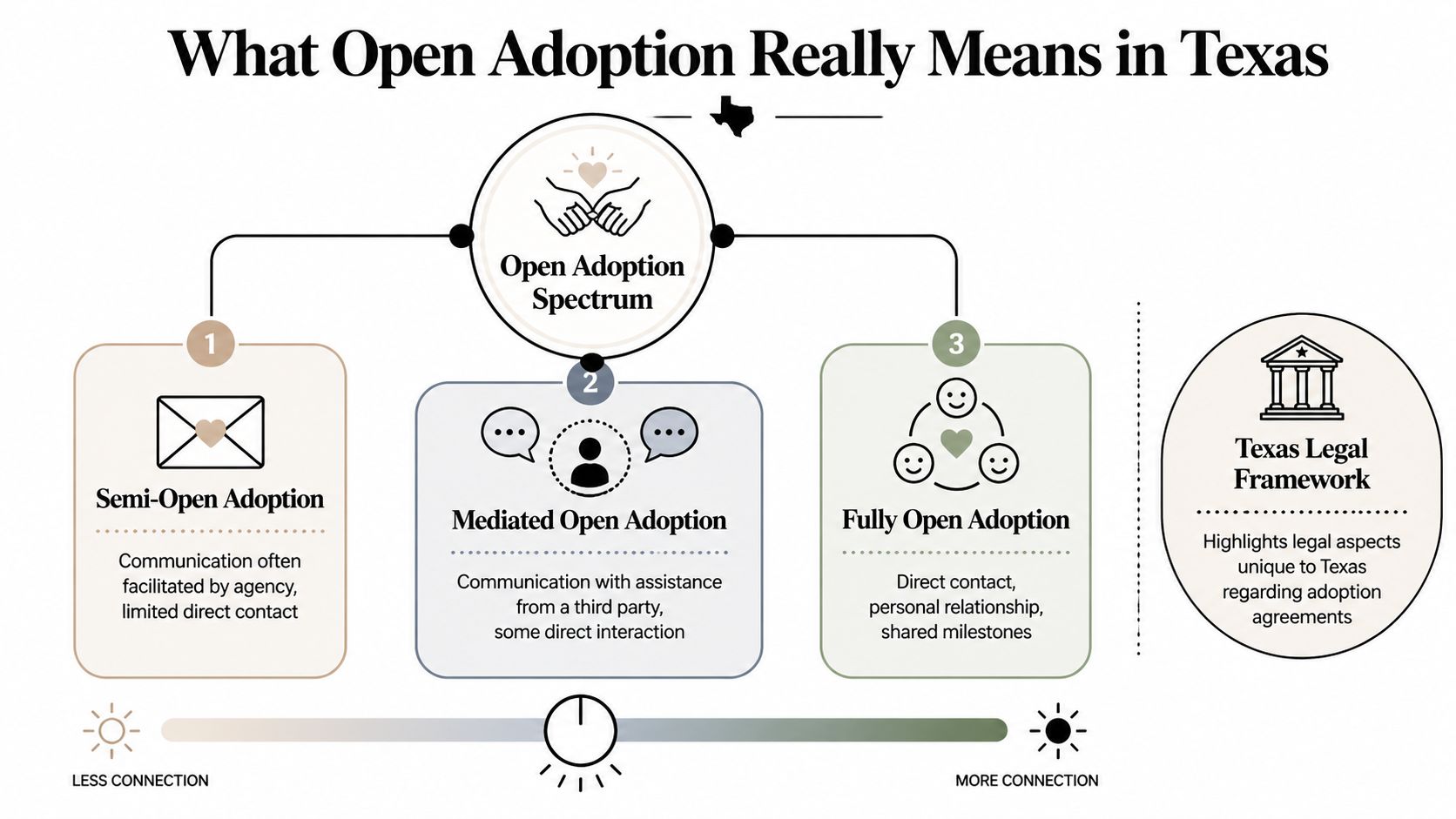
Semi-open adoption
This is often a good fit when everyone wants connection, but direct communication feels too intense at first. Updates may move through an agency, attorney, or agreed channel rather than directly between the families.
A birth mother might receive photos and a short yearly letter. The adoptive parents may learn helpful medical or family background information without sharing private contact details right away. This can create breathing room while still honoring the relationship.
Mediated open adoption
This sits in the middle. There is more communication, but a third party still helps manage it. That might include shared emails through an agency, scheduled calls, or planned updates with support from a counselor or adoption professional.
This type of arrangement can be especially helpful when emotions are still fresh. The third party acts a bit like a traffic signal. They help everyone move forward safely and keep communication respectful.
Practical rule: The best level of openness is the one the adults can maintain consistently and kindly, not the one that sounds best on paper.
Fully open adoption
In a fully open adoption, the families may know each other’s names, communicate directly, and sometimes spend time together in person. That could mean texts on birthdays, video calls, shared photos, or occasional visits.
For example, a family in Austin might send school pictures, exchange holiday messages, and meet for a park visit once or twice a year. Another family in San Antonio may stay connected mostly through direct messages and occasional phone calls. Both can be fully open in spirit, even if the details look different.
What stays the same in every version
No matter where an adoption falls on the spectrum, one legal truth remains. The adoptive parents are the child’s legal parents once the adoption is finalized. Openness describes the relationship, not shared legal custody.
That distinction matters because some families confuse contact with parental authority. Open adoption can include warmth, familiarity, and ongoing updates, while still giving the child one legal home and one set of legal parents.
A simple way to compare the spectrum:
| Level | What contact may look like | Why families choose it |
|---|---|---|
| Semi-open | Letters, photos, updates through a third party | More privacy and gentler boundaries |
| Mediated open | Some direct interaction with help from an agency or counselor | Support during an emotionally complex transition |
| Fully open | Direct calls, messages, visits, shared milestones | Stronger ongoing relationship and greater transparency |
When families understand that openness is flexible, they usually feel less pressure. You don’t have to choose a perfect script. You need a workable relationship.
The Truth About Open Adoption Agreements in Texas
Many people assume that if they put an open adoption agreement in writing, a Texas court will enforce it later. That is one of the biggest misunderstandings in this area of family law.
In Texas, families often create a Post-Adoption Contact Agreement, commonly called a PACA. This written plan can spell out how contact may happen after the adoption, such as letters, photos, phone calls, visits, or social media boundaries. It can be detailed and thoughtful. It can reflect real care and good intentions.
The hard legal truth
The difficult part is this. Texas does not have a statute that makes PACAs legally binding after finalization. As American Adoptions explains in its Texas open adoption overview, if an adoptive family later decides to stop contact, the birth family generally has no legal recourse through the courts to force the original agreement.
That can feel painful to read, especially for birth parents who need reassurance before making an adoption plan. It can also unsettle adoptive parents who thought a signed agreement would answer every future question.
The reason matters. Once an adoption is finalized, Texas law places full parental authority with the adoptive parents. Courts focus on the child’s best interests and the legal finality of adoption. The law does not treat open-contact promises like a custody order that can be enforced line by line.
Why a PACA still matters
If PACAs aren’t enforceable in the usual way, why bother with one?
Because a good PACA still does important work. It creates a shared map. It turns vague hopes into clear expectations. It gives both families a chance to talk openly before emotions shift, life changes, or misunderstandings grow.
A strong agreement can address questions such as:
- How often updates happen: yearly photos, birthday notes, or more frequent check-ins
- Which method works best: email, a shared photo album, mailed letters, or agency mediation
- Who starts contact: the adoptive parents, the birth parent, or a neutral professional
- What happens if plans need to change: notice periods, pause-and-reset conversations, or mediation
A PACA may not be a courtroom tool in Texas, but it can still be a relationship tool.
Families often do better when they write down expectations in plain language. “We’ll stay in touch” is kind, but it’s too soft to guide a real relationship over time. “We’ll send photos twice a year and revisit in-person visits after the child starts school” gives everyone something concrete.
Build for trust, not pressure
The healthiest PACAs read less like threats and more like promises rooted in the child’s well-being. For example, families may choose language that emphasizes respectful communication, flexibility as the child grows, and use of counseling or mediation if conflict arises.
Some families like to draft ideas before meeting with their attorney. If you want to organize those thoughts, tools such as LegesGPT's AI legal templates can help you think through structure and questions to discuss. They are not a substitute for Texas legal advice, but they can help families prepare for a more productive conversation.
What a thoughtful roadmap can include
A useful PACA often covers more than contact dates. It may include practical ground rules.
- Privacy boundaries: whether photos can go on Facebook or Instagram
- Holiday expectations: whether birthdays or major holidays include contact
- Emergency communication: how urgent medical or family information should be shared
- Adjustment periods: whether contact starts slowly after placement and increases later
Families usually feel calmer when they understand this clearly: in Texas, the strength of an open adoption agreement is not court enforcement. It is the trust built when everyone speaks plainly, listens carefully, and makes commitments they can realistically keep.
Your Path to Open Adoption Agency vs Private Routes
When families start exploring domestic adoption, one of the first big choices is the path itself. In Texas, many open adoptions begin through either a licensed agency or a private adoption arranged with attorney guidance. Both routes can lead to a loving, legally secure adoption. They just work differently.

A helpful way to think about it is this. An agency path gives you a built-in team. A private path gives you more direct involvement in how the match and communication unfold.
The steps both paths share
No matter which route you choose, Texas law requires core legal steps. The MW Family Law discussion of open and closed adoption in Texas explains that the process requires a home study, background checks, and court oversight under Texas Family Code §162.006 and §162.008. After a birth parent signs an irrevocable affidavit of relinquishment, the court reviews the case under §162.001 to decide whether the adoption serves the child’s best interests before entering a final order.
Those shared steps usually include:
Initial planning
You decide what kind of adoption you’re pursuing and what level of openness feels realistic.Home study and screening
A social worker evaluates your home, background, and readiness to adopt.Matching
A birth parent and adoptive family are connected, either through an agency or more directly in a private case.Placement and legal consents
The child is placed, and the required legal documents are signed.Post-placement supervision
Texas requires supervision after placement before finalization.Final court hearing
A judge reviews the adoption and, if approved, signs the final order.
The agency route
With an agency adoption, a licensed child-placing agency usually handles much of the matching and support process. Agencies often provide counseling, profile presentation, help with communication, and guidance for everyone involved.
This path can feel reassuring if you want structure. Many adoptive parents appreciate having professionals coordinate details, especially during emotionally intense moments. Birth parents may also value agency counseling and a neutral point of contact.
Agency adoptions often fit families who want:
- More support: help with matching, communication, and logistics
- A guided process: established procedures and staff oversight
- Mediated openness: a buffer if direct contact feels overwhelming at first
If you’re comparing agencies, this guide on choosing a private adoption agency in Texas can help you frame the right questions.
The private route
A private or independent adoption often gives families a more direct role. The birth parent and adoptive parents may connect through personal networks, attorneys, or other lawful channels, and attorneys then handle the legal process.
This route can feel more personal. It may also require more initiative. Families often need clearer communication from the beginning because they don’t always have an agency standing in the middle.
Private adoption can work well for people who want:
- More direct communication: the chance to build the relationship personally
- Greater flexibility: fewer layers between the families
- Customized planning: more customized decisions about contact and expectations
That said, private adoption is not “informal.” It still involves serious legal requirements, court review, and careful attention to parental rights.
A side-by-side comparison
| Feature | Agency Adoption | Private/Independent Adoption |
|---|---|---|
| Matching process | Usually coordinated by a licensed agency | Often more direct, with attorney guidance |
| Support services | Counseling and communication help are often built in | Families may need to arrange more support separately |
| Contact style | Often starts mediated or semi-open | May begin with direct communication sooner |
| Process feel | Structured and guided | Flexible and hands-on |
| Decision-making pace | Can follow agency procedures | Can depend more on the families and their professionals |
A short video can help if you learn best by hearing legal ideas explained aloud.
How families choose between them
A couple who wants counseling support, a formal matching process, and help managing post-placement communication may lean toward an agency. A birth mother who has already identified the adoptive family she wants may feel more comfortable with a private adoption supported by attorneys.
Neither choice is more loving. Neither is more “real.” The better path is usually the one that matches your communication style, emotional needs, and comfort with decision-making.
The legal finish line is the same. The difference is how much support, structure, and direct contact you want along the way.
If you’re a stepparent, relative, or kinship caregiver, your path may look different from a domestic infant adoption. Those cases often involve different family dynamics, but the same principle still guides the court: the child’s best interests come first.
Navigating the Relationship After Finalization
Finalization is a legal ending, but in an open adoption, it is also the beginning of an ongoing relationship. Many families need the most grace at this point. The paperwork is done, but real life starts moving.
A visit may feel easy when the child is a baby and more complicated when school, sports, distance, and emotions enter the picture. A social media post may seem harmless to one person and upsetting to another. A child may ask questions at age five that are very different from the questions they ask as a teenager.

Why relationships sometimes get strained
One practical challenge in open adoption is that expectations can drift over time. As Adoption Choices of Texas notes in its discussion of post-placement boundaries, 20 to 30 percent of open adoptions face contact disruptions due to unclear expectations. That doesn’t mean the adoption failed. It usually means the adults need better communication, firmer boundaries, or help resetting the relationship.
That is why planning matters long after placement.
Boundaries that protect everyone
Healthy boundaries aren’t cold. They are protective. They help each person understand what is welcome, what is private, and what needs a conversation first.
A few examples make this easier to see:
- Visits: A family may agree that early visits happen in a park or agency office rather than at someone’s home.
- Photos online: The adults may decide that no one posts the child’s image without checking first.
- Direct messages: One birth parent may prefer email because texting feels too immediate or emotional.
- New partners or family members: Contact may continue, but the adults may agree to discuss changes before involving additional people.
If your family is working through those questions, this guide to Texas post-adoption contact agreements and family considerations offers useful context.
Some of the strongest open adoptions are not the ones with the most contact. They are the ones with the clearest expectations.
How to handle change without panic
Relationships change because life changes. Someone moves from Houston to Amarillo. A child starts asking for more privacy. A birth parent enters recovery and wants to rebuild trust slowly. An adoptive family grows and schedules get harder.
When that happens, try this approach:
Name the issue plainly
“We need to change how visits work this year” is kinder than going silent.Explain the reason without blame
Focus on logistics, emotional readiness, or the child’s needs.Offer an alternative
If in-person visits aren’t workable, suggest video calls, photos, or letters.Set a date to revisit the plan
Temporary changes feel safer when everyone knows the conversation isn’t over forever.
Talking with the child
Children benefit when the adults speak about adoption without shame or competition. If a child asks, “Why didn’t I grow in your tummy?” or “Do I have another mom?” the answer should be calm, truthful, and simple.
You don’t have to tell the whole story at once. You do need to tell the truth in ways the child can carry at their age.
A child can understand that:
- they were loved from the beginning,
- adoption was a grown-up decision,
- and the adults are working together to care for them.
When the adults stay respectful, the child does not have to choose loyalty between families. That is one of the greatest gifts an open adoption can offer.
Understanding Costs and Timelines for a Texas Open Adoption
Families often want someone to answer two questions right away. How much will this cost? How long will it take?
The honest answer is that both vary. Open adoption in Texas can move more quickly or more slowly depending on the type of adoption, whether you work with an agency or pursue a private route, how quickly the home study is completed, and how the matching process unfolds.
What costs usually include
Texas families commonly budget for several categories of adoption expenses. The exact mix depends on the kind of case.
- Home study fees: payment for the social work evaluation and required documentation
- Attorney fees: legal guidance, drafting, filing, and court representation
- Agency fees: if you work with a licensed agency, these may include matching and support services
- Counseling costs: some families choose or need professional support before and after placement
- Court costs: filing and court-related expenses
- Allowed pregnancy-related support: in some cases, certain birth mother expenses may be handled within Texas law and under attorney guidance
Those categories can feel overwhelming at first. Many families find it helpful to separate “required legal steps” from “support services” so they can budget more clearly.
For a broader breakdown of common adoption expenses, see this resource on how much it costs to adopt in Texas.
Why the timeline can feel uneven
Some parts of the process are predictable. Others are not.
The home study and background screening usually move on a professional schedule. Gathering records, scheduling interviews, and completing safety checks takes time. Court review also follows legal procedures that cannot be rushed, even if a family is emotionally ready.
The less predictable part is matching. A family may connect quickly, or they may wait. That is one reason adoption can feel emotionally tiring. There can be periods of intense activity followed by quiet stretches.
A simple planning framework
A realistic way to plan is to think in phases rather than exact dates.
| Phase | What happens |
|---|---|
| Preparation | Education, choosing a path, paperwork, home study |
| Matching | Profile sharing, conversations, relationship building |
| Placement | Birth, consents, placement arrangements |
| Supervision and court | Post-placement visits, reports, final hearing |
Families cope better when they plan for a process, not a single deadline.
If you are a stepparent, relative, or foster parent, your costs and timeline may look different from a domestic infant adoption. Some steps may be simpler, and some may involve added issues related to parental rights, notice, or prior court cases. The safest approach is to get advice based on your exact facts rather than another family’s story.
Common Questions About Open Adoption in Texas
Families often ask their most important questions after they understand the basics. That makes sense. Once the emotional fog clears a bit, the practical worries come into focus.

What if the birth father is unknown or won’t cooperate
That issue can affect timing and legal strategy. Texas courts take parental rights seriously, so notice, consent, and termination issues must be handled carefully. The exact steps depend on the facts, including whether the father is known, can be located, or has established legal rights. This is one of the clearest times to get legal advice early rather than hoping the problem resolves itself.
Can an open adoption agreement be changed later
Yes, families can change how contact works later if everyone agrees. In real life, they often do. A plan that made sense when a child was an infant may no longer fit when the child is in school or asking for more privacy.
The key is to treat changes as a conversation, not a surprise. A written update, even if informal, can help everyone stay on the same page.
How should we explain open adoption to our child
Use simple truth, repeated over time. Young children usually need short answers. Older children often want more detail and may revisit the same question at different ages.
Helpful language sounds like this: “You were born to your birth family, and you joined our family through adoption. We all care about you.” Children don’t need a polished speech. They need honesty and calm.
What if someone breaks the PACA
Families need to understand Texas law clearly. As Family Lawyers San Antonio explains in its review of open and closed adoption in Texas, there is no legal enforcement mechanism in Texas courts if a PACA is violated after finalization. Once the adoption is complete, Chapter 162 gives adoptive parents full authority. The response is usually relational rather than legal, often involving mediation, counseling, or renewed discussion based on the child’s best interests.
That can be profoundly disappointing, but it is better to know the truth before finalization than after.
Does open adoption mean the birth parent can make parenting decisions
No. Open adoption does not give the birth parent legal decision-making power after the adoption is finalized. The adoptive parents become the child’s legal parents. Ongoing contact may continue, but legal authority does not stay shared.
Is open adoption right for every family
Not always. Some families need more privacy. Some situations involve safety concerns or instability that make openness harder or inappropriate. The better question is not “Is open adoption good?” but “What level of openness supports this child in this situation?”
That question usually leads to better decisions than trying to follow someone else’s model.
If you're considering adoption, placement, or kinship care in Texas, personalized guidance can make the road feel much steadier. The Law Office of Bryan Fagan, PLLC helps families across Texas understand their options with compassion, clarity, and practical legal support. If you need help with open adoption planning, private adoption, stepparent adoption, kinship adoption, or post-adoption concerns, schedule a free consultation to talk through your family’s next step.

