
Yes, in Texas, a birth mother can choose the adoptive parents, and she can't sign consent until at least 48 hours after birth. That right is a core part of Texas adoption law, and for many people, it's the difference between feeling powerless and feeling heard.
If you're asking, "can I choose adoptive parents texas," you're probably not asking a casual legal question. You're trying to make sense of something very personal. Maybe you're pregnant and considering adoption. Maybe you're a relative trying to help. Maybe you're an adoptive parent wondering how much control an expectant mother really has. Whatever brought you here, the short answer is reassuring. Texas law recognizes that this decision belongs to the birth parent in a very real way.
That doesn't mean every adoption works the same way. A private infant adoption feels very different from a CPS case. A kinship adoption has its own rhythm. And the legal paperwork matters just as much as the emotional fit. The families may be loving, the intentions may be good, but if the process isn't handled carefully, confusion and heartache can follow.
The practical question isn't only whether you can choose. It's how that choice works, when it becomes legally meaningful, and what can protect it from pressure, miscommunication, or last-minute disruption.
Answering the Most Personal Question in Adoption
Some questions come with law books behind them. This one usually comes with sleepless nights.
A woman may be sitting on her couch late at night, looking through adoptive family profiles on her phone, wondering whether she gets any real say in what happens next. A couple hoping to adopt may be asking from the other side of the process whether the expectant mother will have the power to pick them or pass them by. In Texas, that choice is not symbolic. It is part of the legal structure of private adoption.

Why this question feels so heavy
Choosing adoptive parents isn't like checking a box on a form. Most birth parents are thinking about ordinary things that carry enormous weight. Will this family talk openly with my child about adoption? Do their values feel steady? Will my baby grow up with warmth, patience, and support? If I want pictures or updates, will they honor that?
Those questions matter because adoption isn't only a court case. It's a long family story that starts with one very hard decision.
The best adoption plans usually begin when the birth parent feels informed, not rushed.
Texas law leaves room for that. It allows a birth mother to look at families, ask questions, consider different levels of openness, and make a decision after birth when the law allows consent to be signed. That combination of emotional space and legal protection is important.
What people often misunderstand
Many people hear "you can choose" and assume the process is informal. It isn't. Choice exists inside a legal framework. Families still have to qualify. Courts still have to approve the adoption. Parental rights still have to be handled correctly.
For that reason, a thoughtful adoption plan usually works best when three things line up:
- The personal fit is real. The family feels right on a human level, not just on paper.
- The legal path is clear. Consent, termination, and finalization have to be done correctly.
- Expectations are honest. Open, semi-open, and closed arrangements should be discussed clearly before anyone relies on assumptions.
When those pieces come together, the process feels steadier. When they don't, people can end up feeling blindsided.
Your Fundamental Right to Choose in a Texas Adoption
A lot of expectant mothers ask me some version of the same question: Do I get to decide who raises my baby, or does someone else make that decision for me?
In a Texas private adoption, that choice is usually yours. Texas law does not require you to hand over that decision to an agency, a hopeful adoptive family, or a hospital social worker. Your role is central, and your legal rights are part of what keeps the process fair. A clear overview of birth mother rights in a Texas adoption helps explain that foundation. As explained in this discussion of Texas Family Code Section 162.010 and the 48-hour consent rule, a birth mother cannot sign an affidavit of voluntary relinquishment until at least 48 hours after the child's birth.
That waiting period matters for a practical reason. Childbirth is physically draining and emotionally intense. Texas builds in time so a life-changing legal decision is more likely to be made with a clear head and without immediate pressure.
Choice, though, is not unlimited.
A birth mother may choose the family she wants to place with, but the adoption still has to meet legal requirements. The adoptive family must be approved through the proper process. The paperwork must be signed correctly. The court must accept the case. Many people misunderstand this. They hear "you can choose" and assume any handshake arrangement will hold. It will not.
What this right usually includes
In a private or agency adoption, the right to choose often means you can review waiting families, ask questions, and decide which home feels right for your child. That decision may turn on very personal factors, including:
- Parenting style. Structure, discipline, education, and day-to-day routines.
- Family background. Religion, culture, language, extended family involvement, and home environment.
- Future contact. Whether you want updates, photos, visits, or a more private arrangement.
- Practical stability. Work schedules, support systems, other children in the home, and location.
Those preferences are not superficial. They are often the heart of the decision.
The legal document that gives the decision force
Texas uses a formal surrender document called an affidavit of voluntary relinquishment. Once that document is signed properly, it carries serious legal weight. It is the mechanism that allows the case to move from a plan you are considering to a placement the court can recognize.
This is one of the biggest legal protections in the process. It protects your right to decide, but it also creates risk if the document is signed before you fully understand the consequences. An attorney's job is not just to put papers in front of you. It is to confirm that timing, consent, notice, and termination issues are handled correctly so your decision is respected and less vulnerable to later disputes.
Practical rule: If anyone is pushing you to pick a family fast or sign before your questions are answered, slow the process down.
The trade-off is straightforward. Texas gives birth parents meaningful say in a private adoption, but that choice has to be exercised inside a legal structure. That structure protects you when it is handled carefully. It creates problems when people cut corners.
The 48-hour rule helps with that. So does proper legal advice. A careful match, a clear consent process, and realistic expectations about future contact give your choice the best chance of holding up the way you intended.
How You Choose Depends on the Adoption Path You Take
A woman sits in my office and asks a very direct question: "Do I get to pick the family, or does someone else decide?" The honest answer in Texas is that her level of control depends on the type of adoption case. That distinction matters because private adoption, agency adoption, CPS cases, and kinship cases use different decision-makers, different procedures, and different protections.
If you want a clearer view of those categories, this overview of the main types of adoption in Texas is a helpful starting point.
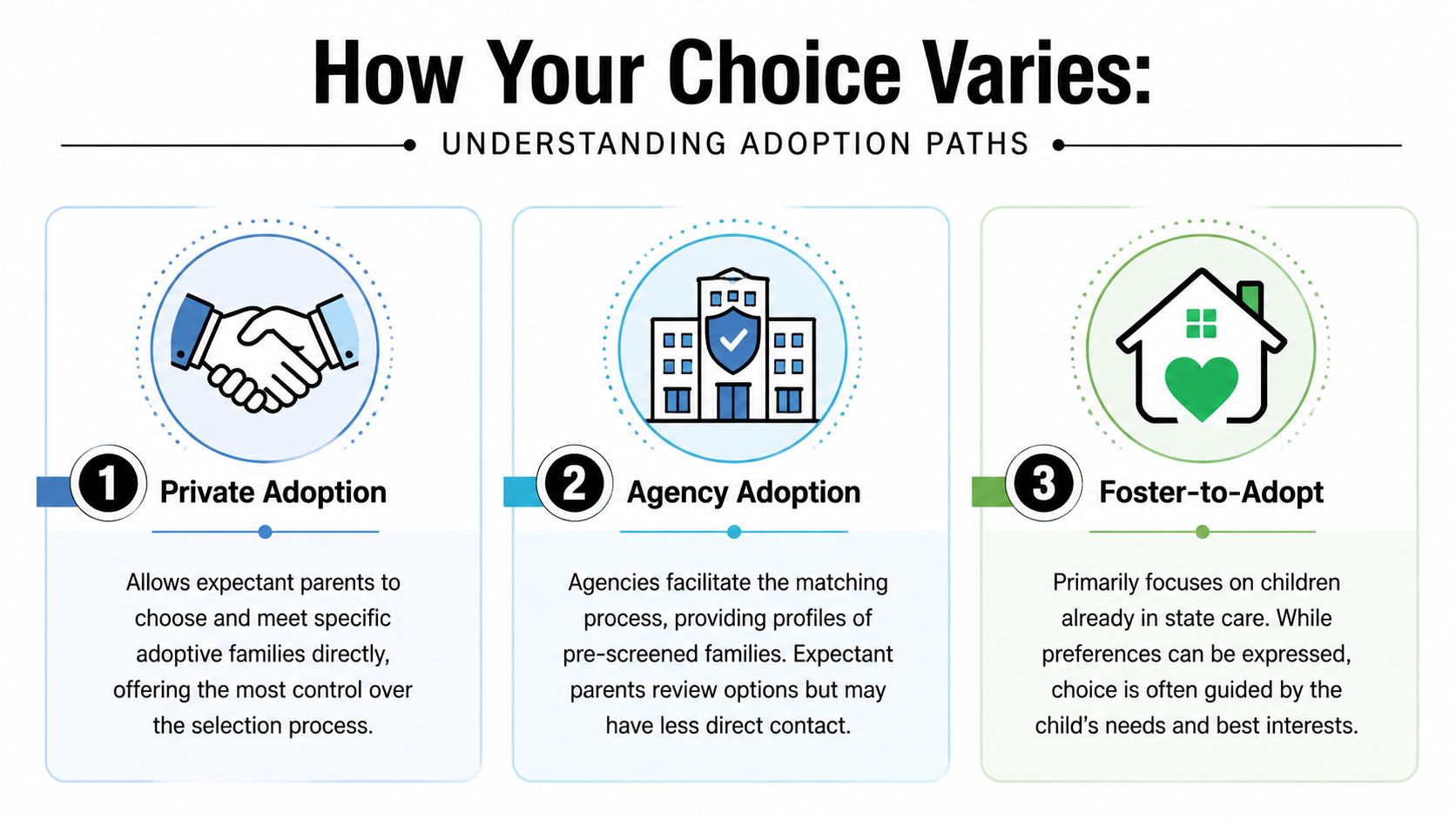
Private and agency adoptions
In a private infant adoption, the birth parent usually has the most direct say. She may review profiles, ask for a meeting or call, and decide which family she wants to pursue. That is the setting people usually mean when they say a birth mother can "choose the adoptive parents" in Texas.
Agency cases can still allow real choice, but the process is more controlled. The agency often decides which approved families to present, how many profiles you see, when contact happens, and how communication is managed. For some women, that structure feels protective. For others, it feels too filtered.
That trade-off is real. More structure can reduce chaos. It can also narrow your options if you want to compare families more broadly or ask hard questions directly.
CPS and foster care adoptions
CPS cases work differently because the legal focus shifts toward the child's current placement, safety, and permanency plan. A birth parent may have opinions about who should raise the child, but she usually is not reviewing a stack of family profiles and making an open-ended selection.
In many of these cases, the child is already living with a foster family or relative. Courts and caseworkers often give serious weight to continuity, attachment, and the child's day-to-day stability. That can frustrate a parent who wants a different outcome, but it reflects how Texas handles children already inside the child welfare system.
From a legal standpoint, this is one of the biggest differences in the article's central question. In private adoption, choice is often direct. In CPS adoption, influence is often limited and indirect.
Kinship and relative adoptions
Kinship adoption usually starts with an existing relationship, not a search. A grandparent, aunt, adult sibling, or another relative may already be caring for the child. The practical question becomes whether that relative can serve as the permanent adoptive placement and whether the court will approve it.
For some parents, this path brings peace because the child stays connected to family history, siblings, culture, and familiar routines. For others, it creates conflict fast. Relatives may disagree about who is best suited, and old family problems do not disappear just because everyone cares about the child.
Your Level of Choice in Different Texas Adoptions
| Adoption Type | Level of Choice | How It Works |
|---|---|---|
| Private adoption | Highest | Birth parent usually reviews families and selects the adoptive family directly |
| Agency adoption | Strong, but guided | Agency presents approved families and helps structure the matching process |
| CPS or foster-to-adopt | More limited | Agency and court focus on the child's needs, existing placements, and permanency planning |
| Kinship adoption | Usually relationship-based | Choice often comes through identifying a trusted relative who can adopt |
Some choices happen through profiles and interviews. Others happen through the legal weight given to an existing placement.
The trade-offs people should see clearly
Each path gives something different.
- Private adoption gives the most personal control. It also puts more pressure on the birth parent to evaluate families carefully and get clear answers about openness, expenses, and expectations.
- Agency adoption adds screening and process management. That can make the experience feel safer, but it may limit how much direct access you have to waiting families.
- CPS and foster care cases protect continuity for the child. They usually leave less room for a birth parent to shape the final match.
- Kinship adoption keeps the child within the family circle. It can also lead to disputes about boundaries, caregiving history, and whether adoption is the right legal step.
A lawyer's role changes with the path too. In a private or agency case, counsel helps protect your selection and the consent process behind it. In a CPS or kinship matter, counsel often focuses more on explaining what influence you do and do not have, identifying legal risks early, and helping you make decisions based on the actual structure of the case rather than hope alone.
The Practical Steps of Choosing a Family
A lot of birth mothers reach this point with one pressing question: How do I know which family is right, and how do I make sure my choice is protected?
That question deserves a practical answer. Choosing a family in Texas is part personal judgment, part legal process. The goal is not to find people who present well. The goal is to identify a family that fits your child, fits your boundaries, and can follow through inside a valid adoption plan.

Start with your standards before you review any profile
Profiles are useful, but they can blur your priorities if you look at them too soon. I usually tell clients to decide what matters first, then compare families against that list.
Write down what you want your child's daily life to look like. Keep it simple. A page with three columns often works well: "required," "preferred," and "not a fit."
Your list may include:
- Openness after placement. Letters, photos, calls, visits, or no ongoing contact
- Home environment. Quiet home, active home, two-parent home, single-parent home, other children, pets
- Values. Faith, education, cultural background, discipline style, extended family involvement
- Practical stability. Work schedules, childcare plans, support system, housing, ability to handle stress
- Location and community. Distance from you, school options, neighborhood, family network
This step protects your judgment. A polished album can create pressure to like a family before you know whether they meet your standards.
Review families for substance, not presentation
An appealing profile is not a legal or emotional guarantee. Good photos and thoughtful letters tell you something. They do not tell you everything.
Look for specifics. Does the family explain how they make decisions together? Do they describe how they handle conflict, loss, or unexpected change? Do they speak clearly about adoption, or do they use broad promises without details?
The strongest matches usually have ordinary, concrete answers. They tell you what dinner looks like on a Tuesday, who helps when one parent gets sick, and how they plan to talk with a child about adoption from the beginning.
Texas adoption placements also involve screening on the adoptive family's side. By the time a family is presented seriously, there should be real vetting behind them, such as background checks, a home study, and other required approvals. If you want to understand how consent fits into that larger process, this explanation of Texas adoption consent and timing helps put the family choice in the right legal context.
Meet the family and ask questions that test real life
A profile starts the conversation. A meeting usually tells you much more.
Some families look perfect on paper and feel guarded in person. Others come across as far more genuine once you talk with them. Pay attention to whether the conversation feels honest, respectful, and calm. You are not judging who is most impressive. You are judging who seems prepared to parent your child.
Questions that tend to produce useful answers include:
- What will our child hear about me and the adoption as they grow up?
- What does contact after placement look like in your mind?
- Who will be part of this child's day-to-day life?
- How do you handle stress or disagreement in your home?
- What support do you have if work, health, or finances become difficult?
- Why do you feel connected to this specific adoption plan?
Listen for directness. Listen for humility too. A family that can answer hard questions without getting defensive is often easier to work with later.
Then pause.
You do not need to choose in the room, on the call, or because someone else wants an answer by tomorrow.
Get the plan out of everyone's memory and onto paper
Once you identify the family you want, the next step is to turn preferences into a concrete plan. At this juncture, many avoidable disputes begin or end.
Important points to discuss and document include:
- who will be at the hospital
- who may hold the baby and when
- whether the adoptive parents will be present for delivery or recovery
- what contact is expected after placement
- how updates will be shared
- what expenses are being paid and how they are being handled
- who is responsible for communication between now and placement
A written plan does not solve every problem, but it reduces confusion. It also gives your attorney something clear to confirm with the agency, adoptive family, or placement professional so your selection does not get weakened by assumptions.
This video gives a useful overview of adoption planning issues families often discuss before placement.
Watch for the trade-offs that matter
Every family brings strengths and risks. The legal file may be in order, and the match may still be wrong for you. A family may also feel warm and sincere, but have weak communication around openness or boundaries.
A few patterns come up often:
- Steadier choice. The family answers hard questions clearly and consistently.
- Higher-risk choice. The family says what you want to hear, but avoids specifics.
- Steadier choice. Expectations about updates, visits, and communication are discussed early.
- Higher-risk choice. Everyone assumes they are on the same page and avoids uncomfortable details.
- Steadier choice. Your attorney confirms the placement process, paperwork, and timing.
- Higher-risk choice. Important terms are left as verbal understandings.
The right family is usually not the one that sounds perfect. It is the one that feels truthful, stable, and workable in both real life and under Texas law.
Understanding the Legal Limits and Protecting Your Choice
The comforting part of Texas law is that it gives birth parents meaningful rights. The hard part is that rights still have limits, and consent has consequences. People deserve to know both.
A common misunderstanding goes like this: if a birth parent can choose the adoptive family, then she can also change every part of the plan at any time with little legal effect. That's not how adoption works. Choice is real, but it sits inside a legal process that eventually becomes final.
Consent is powerful because it is meant to last
Once a voluntary relinquishment is signed correctly, the law treats that act with seriousness. As explained in this discussion of Texas adoption consent and disruption risks and in this resource on adoption consent in Texas, consent is generally irrevocable after signing, protections against coercion do exist, overturning signed consent is difficult and rare, and disrupted placements can leave families with non-refundable costs such as home study fees of $2,000 to $5,000.
That doesn't mean a birth parent should feel trapped. It means the decision deserves careful legal guidance before papers are signed.

Pressure, coercion, and quiet red flags
Coercion doesn't always look dramatic. Sometimes it looks like repeated pressure to hurry. Sometimes it looks like legal documents being explained poorly. Sometimes it looks like everyone in the room acting as if the birth parent has already decided when she hasn't.
Watch for warning signs such as:
- Rushed timelines. Someone keeps pushing signatures or commitments before questions are answered.
- Selective information. You hear the warm parts of adoption but not the permanent legal effects.
- Emotional pressure. Someone suggests you're selfish or unfair for asking for more time.
- Blurred roles. The same person seems to be advising everyone, even when interests differ.
If a decision only holds together under pressure, it wasn't secure enough to begin with.
Independent legal counsel helps because an attorney for the adoptive family or agency isn't there to give neutral advice to the birth parent. Separate guidance protects the freedom to choose.
What happens if the birth father is unknown or not participating
This question comes up often, and it matters. In some cases, the process can move forward without the birth father's input if he is unknown or if his rights are terminated under Texas law. The legal path depends on the facts, including notice requirements, paternity issues, and whether a court finds grounds to terminate rights.
This is one of the areas where families get into trouble by assuming too much. A birth mother may think the father's absence solves everything. An adoptive family may think silence means consent. Neither assumption is safe. The paperwork and court findings have to match the actual circumstances of the case.
Bias can shape the process even when the law is neutral
Texas law allows adoptions by singles, married couples, relatives, and LGBTQIA+ parents if they meet legal requirements. But human systems can still carry preferences and gatekeeping. In agency settings, some families may feel favored while others feel passed over.
That doesn't always mean anyone broke the law. It does mean birth parents should know they can ask questions, push for clarity, and insist that their preferences be heard plainly. If an agency or intermediary seems to be steering the decision too aggressively, that is worth slowing down and examining.
Real Scenarios of Choosing Adoptive Parents in Texas
At this stage, the legal question usually becomes personal. A birth mother may be looking at two hopeful families and wondering which one will keep promises about contact. A grandmother may be deciding whether to formalize the home a child already knows. A parent in a CPS case may realize her preference carries weight, but not in the same way it would in a private adoption.
These examples are fictional, but they reflect the choices people make in real Texas cases.
An open adoption built around trust
Maria was working, pregnant, and trying to decide whether adoption was the right plan. She knew her decision would turn on one point. If she placed her child, she wanted ongoing contact that felt respectful and realistic.
She reviewed several family profiles and quickly saw the difference between polished language and practical follow-through. One couple said they believed in openness, but gave vague answers about visits, updates, and how they would talk to the child about adoption over time. Another family answered plainly. They described how often they were comfortable sharing photos, what kind of communication they expected, and how they would handle hard conversations as the child grew.
Maria chose the family that gave clear answers. That usually leads to a better adoption plan than choosing the family with the most appealing profile. In my experience, the safer choice is often the family willing to discuss boundaries, expectations, and uncomfortable details before anyone signs anything.
A kinship adoption that protected family ties
A grandmother had been caring for her grandson for a long time while the child's parents dealt with serious instability. By the time adoption became part of the conversation, the child was already settled in her home, enrolled in school nearby, and attached to that daily routine.
Her choice looked different from a private infant adoption. She was not comparing profile books or screening strangers. She was deciding whether to ask the court to make an existing safe placement permanent.
The legal work was still substantial. Parental rights still had to be addressed. The court still had to decide whether adoption served the child's best interest.
If the child is older, the child's own position can matter directly. As noted earlier, Texas generally requires a child age 12 or older to consent to the adoption unless the court waives that requirement. In practice, that means a kinship adoption often works best when the adults stop talking around the child and start including the child in an age-appropriate, honest way.
A CPS case where the birth mother's preference still mattered
Danielle's case involved CPS, so she did not have the same level of selection a birth mother usually has in a private placement. Her child had already been living with foster parents. Over time, Danielle came to believe that if reunification was not going to happen, that home was where her child felt secure and attached.
Her preference did not control the case by itself. The agency's recommendations, the child's needs, the foster family's status, and the court's best-interest analysis all carried real weight. Still, her view was not meaningless. By clearly supporting the foster family and explaining why, she gave the court a fuller picture of continuity and stability for her child.
That is an important distinction. In a private adoption, the birth parent's choice often starts the match. In a CPS case, the parent's preference is one factor inside a larger court process.
What these scenarios show in practice
Texas law can give a birth parent meaningful choice, but the form that choice takes depends on the path of the case. In private adoption, choice is often active and direct. In kinship adoption, choice often centers on protecting an existing bond. In CPS matters, choice is narrower and usually expressed through support, input, and objections inside a court-supervised process.
The legal risks also change from one scenario to another. A vague open adoption discussion can create hurt and conflict later. An informal kinship arrangement can leave a child in limbo if no one completes the court process. A CPS case can move in a direction a parent did not expect if her wishes are never clearly stated or properly documented.
That is where legal counsel helps protect the decision itself. A good adoption attorney does more than explain forms. The attorney helps confirm which choices are yours under Texas law, where the limits are, and how to put your preferences on the record in a way the court and the other parties cannot easily misunderstand.
Your Next Steps to a Confident Adoption Plan
A lot of clients reach this point with one question still sitting heavy on their mind. If I choose a family, how do I make sure that choice is respected?
In Texas, the answer depends on two things. First, whether your case is a private adoption, an agency placement, a kinship matter, or a CPS case. Second, whether your preferences have been clearly documented before anyone asks you to sign papers. Choice is strongest when the legal path is identified early and your expectations are put in plain language.
Start with your priorities.
Some parents care most about ongoing contact. Others focus on religion, school options, location, medical history, or whether siblings will be raised together. There is no single right list. The goal is to get specific enough that you can evaluate a family with a clear head, not under pressure.
Then match those priorities to the actual adoption process in front of you:
- Private or agency adoption: ask to review family profiles, home study approval, and the family's expectations about contact after placement.
- Kinship adoption: confirm whether the relative is willing and legally able to complete the court process, not just provide informal care.
- CPS or foster care case: make your position known early through your attorney, because your preference may be considered by the court but does not control the outcome in the same way it can in a private case.
- Stepparent or relative adoption: look closely at consent requirements, termination issues, and whether everyone involved agrees on the long-term plan for the child.
Good planning also means asking uncomfortable questions before placement, not after. How often will updates happen? Will visits be discussed? Who pays pregnancy-related expenses if this is a private adoption? What happens if either side later remembers the agreement differently? Those are not side issues. They are the issues that often cause conflict.
An attorney helps protect your choice by doing more than preparing forms. The attorney can confirm what decisions are legally yours, spot promises that are too vague to rely on, review consents and relinquishment documents for timing and validity, and create a record of your preferences before the case reaches the point of no return.
That protection matters because Texas law values permanency. Once an adoption is finalized, reversing course is usually very difficult. Careful legal work on the front end reduces the risk of misunderstandings, pressure, and avoidable disputes.
If you need clear, compassionate guidance about choosing adoptive parents, protecting your rights, or moving an adoption forward in Texas, the Law Office of Bryan Fagan, PLLC offers free consultations for birth parents, adoptive parents, stepparents, and relatives. A confidential conversation can help you understand your options, avoid costly mistakes, and build an adoption plan that protects both your voice and the child's best interests.
