 Skip to content
The adoption hearing is over. The judge has signed the order. You may have taken photos in the hallway, called grandparents, or finally let yourself breathe after months of waiting.
Then a quieter question shows up. How do you make sure your child's legal documents match this new chapter of your family's life?
That's where many Texas families pause. They've done the hard emotional work, the court work, and the waiting. But changing a birth certificate after adoption in Texas can still feel intimidating because it involves state forms, certified paperwork, and rules that don't leave much room for error. The good news is that this step is manageable when you know what belongs in the packet, where it goes, and what mistakes to avoid.
A New Beginning on Paper The Final Step in Your Adoption Journey
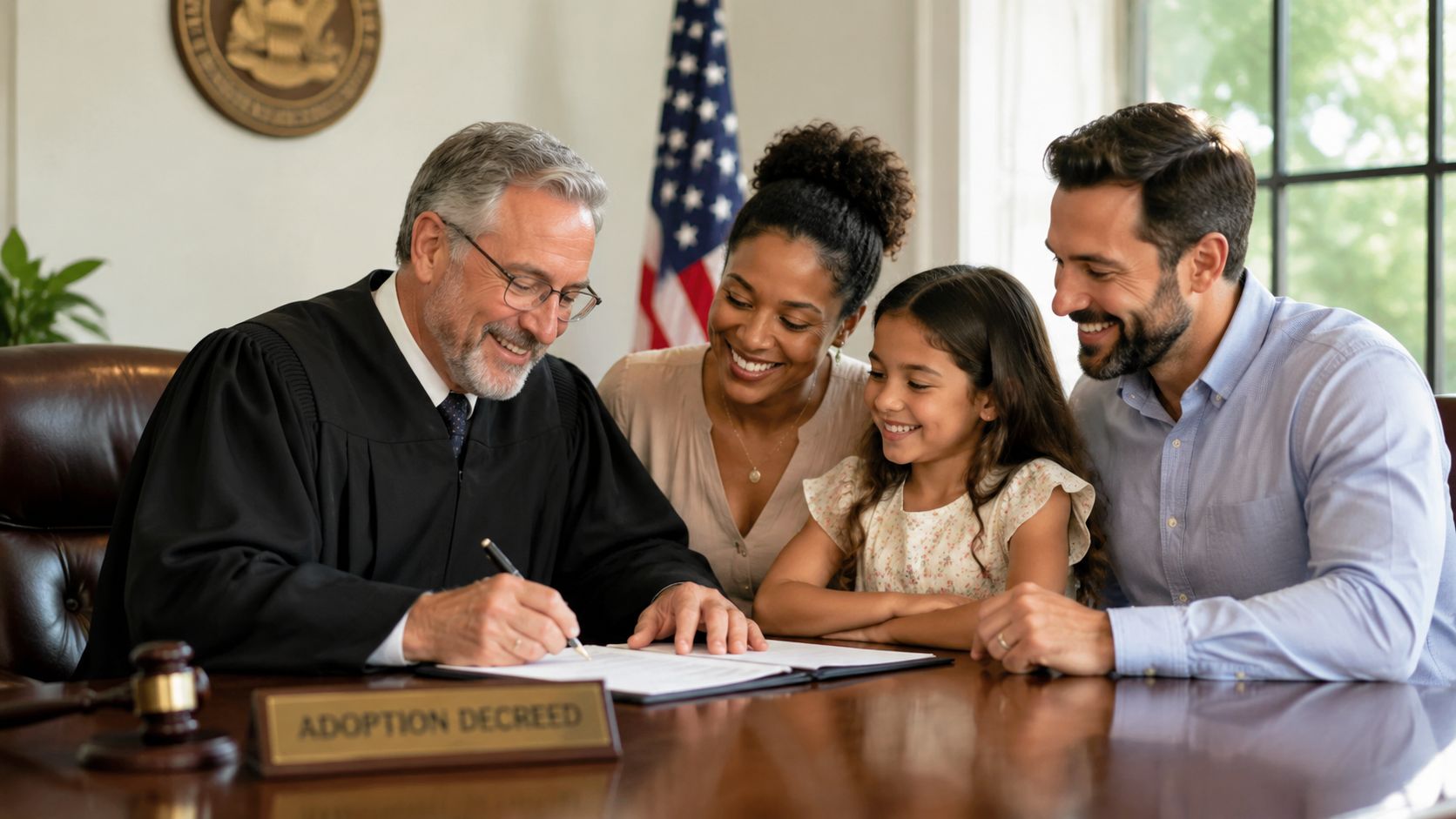
For many parents, the final decree of adoption feels like the finish line. In truth, it's also the beginning of the next practical step. The court order makes the adoption legally final. The amended birth certificate helps the child's records reflect that legal reality in everyday life.
Think about a stepparent who has loved and raised a child for years. Or grandparents who stepped in during a hard season and became the child's legal parents. When the adoption is complete, the new birth certificate is more than a document. It becomes part of how schools, doctors, insurance providers, and future agencies identify the family.
Why this step matters emotionally and legally
Parents often tell me the paperwork feels small compared to the adoption itself. I understand that. But this final record change can spare your family confusion later.
A child may need the amended certificate for school enrollment, insurance, travel, or long-term recordkeeping. Just as important, it gives your family a clear legal paper trail that matches the court's order. That kind of consistency matters.
The amended birth certificate doesn't create the parent-child relationship. The adoption decree does that. The birth certificate records the new legal reality so the rest of life can move forward more smoothly.
A simple way to think about it
If the final decree is the judge saying, “This child is now legally part of your family,” the birth certificate update is the state record system catching up to that truth.
That's why learning how to change a birth certificate after adoption in Texas is worth your time and care. It's one of those tasks that feels administrative on the surface, but it touches identity, belonging, and future access to records in a very real way.
Gathering Your Essential Documents and Information
A lot of parents reach this point and feel a new kind of anxiety. The adoption is final, everyone is relieved, and then the question hits: “What exactly do I need to send so my child's new birth certificate is done correctly?”
That feeling is normal.
This part of the process works like packing a child's hospital bag before delivery. If the right things are ready ahead of time, the day goes much more calmly. If one item is missing, you can still fix it, but it often creates delay, extra calls, and unnecessary stress.
What to gather before you start
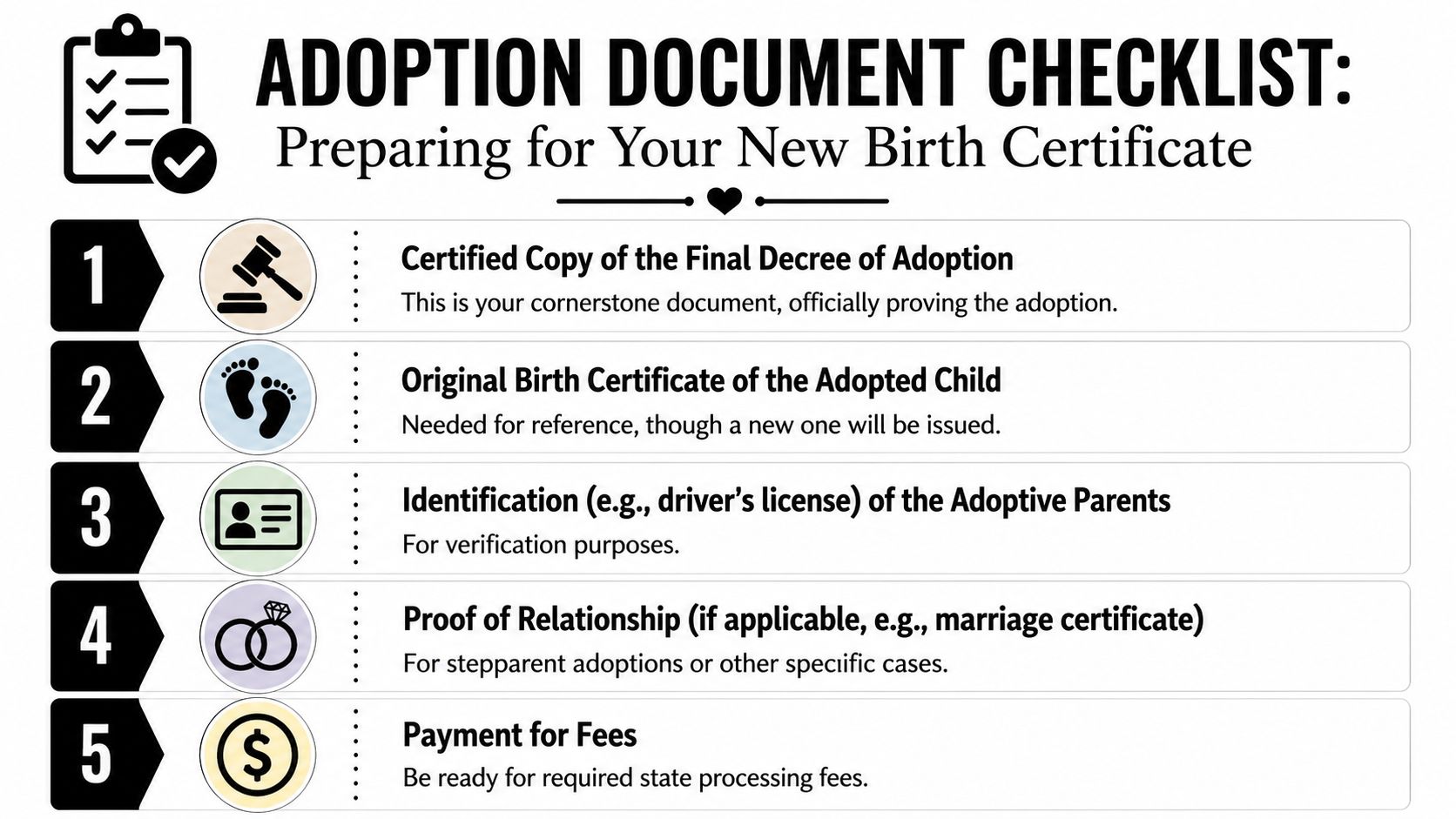
Set aside a single folder, paper or digital, for everything tied to the amended birth certificate request. Your goal is simple: make sure the state receives documents that clearly match the adoption order and identify the right child, the right parents, and the right new legal name.
Start with these items:
- Certificate of Adoption, Form VS-160: This is the form used to create the new birth record after adoption.
- Certified copy of the final adoption decree: This shows the court has already finalized the adoption and states the legal changes that should appear on the new record.
- Valid photo ID: The state uses this to confirm the identity of the person submitting the request.
- Payment for the filing fee: Follow the current payment instructions carefully so the packet is not rejected for a technical reason.
- Child's identifying information: Gather the child's full name before adoption, date of birth, place of birth, and new legal name if the decree changed it.
One small mismatch can slow things down. A missing middle name, an old spelling, or a photocopy where a certified copy is expected can all create avoidable problems.
The document that causes the most confusion
The final decree is often where families get tripped up.
A signed copy from court is not always the same thing as a certified copy. The certified copy is the court-backed version Texas typically expects for record changes. If you are holding paperwork and wondering whether it is official enough, pause and confirm with the court clerk before you mail anything.
That extra phone call can save weeks of waiting.
Required Documents and Fees for Texas Birth Certificate Amendment
| Item | Description | Where to Obtain |
|---|---|---|
| Certificate of Adoption (VS-160) | State form used to request creation of the new birth certificate after adoption | Texas Department of State Health Services |
| Certified final decree of adoption | Court-certified proof that the adoption is final | Clerk of the court that finalized the adoption |
| Valid photo ID | Identification for the applicant submitting the request | Issuing agency for your driver's license or other photo ID |
| Required fee | Payment that must be included with the request packet | Follow the payment instructions from Texas Vital Statistics |
Build a family record set while you do this
This is also a good moment to create your long-term family file. Keep copies of what you send, notes about where the adoption was finalized, and a record of the child's identifying details before and after adoption. Years from now, that file can help with school forms, passport questions, or respectful conversations your child may have about their history.
If you are still sorting out what paperwork belongs in that permanent file, this guide to essential Texas adoption required documentation can help.
Some parents also prefer to send or store paperwork electronically during this stage. If that would make the process easier for you, this digital fax service overview explains one option for handling documents securely.
Keep copies of everything you send
Make a full copy of the packet for your own records, unless a document's rules say otherwise. Include the form, decree, identification copy, payment record, and any cover letter or notes.
That way, if Texas Vital Statistics asks a follow-up question, you are not relying on memory. You can look at the exact packet and answer with confidence.
For many families, this paperwork feels like the last careful stitch in a quilt that is finally finished. It is administrative, yes, but it also protects your child's legal identity and helps preserve a clear record of how your family was formed.
Completing and Submitting Your Application to Texas Vital Statistics
You have the signed adoption order in hand, and it is tempting to feel like the paperwork is over. For most families, though, this filing is the step that brings the court's decision into the state record system so your child's updated birth certificate can be issued.
That matters later in ordinary moments. School enrollment. Insurance forms. A passport application. A doctor's office asking for proof of parentage. The amended certificate often becomes the document people expect to see, so accuracy here saves stress later.
Fill out the form with the court order beside you
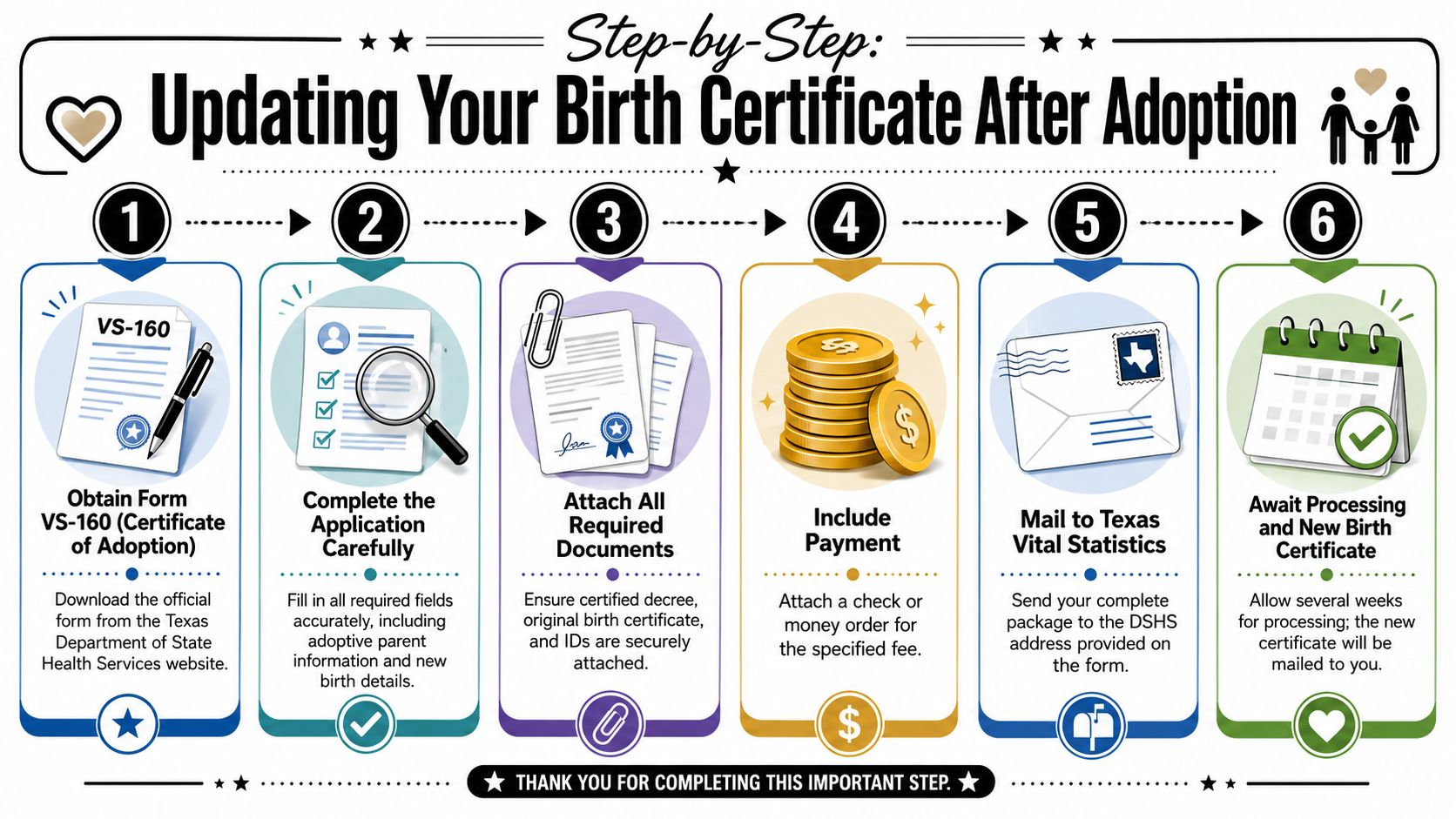
The VS-160 Certificate of Adoption is the form that connects the adoption decree to Texas Vital Statistics. A good way to handle it is to treat the decree like your answer key. If the form asks for a name, date, court detail, or identifying fact, compare it to the signed order before you write anything down.
Small inconsistencies can cause delays. A missing middle name, a transposed date, or an old spelling can turn a routine filing into a back-and-forth with the state.
Use a slow, steady review:
- Read the full form before completing it. That helps you spot any sections that may require information from the decree or identification.
- Copy names and dates exactly as they appear where required. Consistency matters more than speed.
- Pause on any blank that seems confusing. Guessing creates problems that are harder to fix after mailing.
- Review the mailing instructions one more time before sending the packet. This is the legal equivalent of checking the address on a very important package.
What to send and what to expect
Texas generally requires the completed adoption certificate form, supporting court paperwork as instructed, identification, and the filing fee. As noted earlier, the state's instructions explain the packet contents and where to send them in Austin.
Processing is rarely immediate. If you need the amended certificate for benefits, school records, or travel documents, build in extra time rather than assuming it will arrive right after the adoption hearing. Families are often surprised by this part, because the court case may feel finished while the record update is still catching up.
Some parents also end up sending copies of related paperwork to schools, HR departments, or insurance carriers while they wait. If one of those offices still asks for faxed documents, this digital fax service overview explains a practical way to send them electronically.
Here's a short video that may help you think through the filing stage:
Mistakes that commonly slow things down
This stage is a lot like mailing a passport application. The packet may be straightforward, but only if every piece is complete, readable, and submitted the way the agency expects.
Families often run into trouble for a few predictable reasons:
- Using a copy when a certified document is required. A regular photocopy may look fine to you and still be rejected.
- Leaving part of the form blank. One skipped field can hold up the entire request.
- Writing information that does not match the decree. Differences in names, dates, or court details can trigger questions.
- Changing or marking up the form in a way the agency does not accept. Clear and neat is best.
- Missing a mailing instruction or fee requirement. Administrative details matter here.
If you are unsure about one item, stop and verify it before sending the packet. A one-day pause is usually easier than having the application returned weeks later.
A real-world example
A family in Houston finalizes a kinship adoption and wants the amended certificate so they can update school and insurance records before the next semester starts. They complete the form, attach the supporting documents, and then do one final line-by-line review with the decree open on the table.
That last review is often what protects families from preventable delays.
This filing may feel administrative, but it carries real meaning. It places your child's new legal information into the state record system, and it also sets the stage for later questions your family may have about the original record, sealed files, and how your child's history is preserved even after a new certificate is issued.
Navigating Special Adoption Scenarios
Not every adoption follows the same emotional path, even when the record-change process looks similar on paper. Families often feel unsettled when their situation doesn't match a generic checklist. That's understandable.
The legal system may use one set of forms, but the meaning behind those forms can be very different from family to family.

Stepparent and kinship adoptions
A stepparent adoption often feels less like “bringing home a child” and more like protecting a bond that already exists. The child already knows who packs lunches, helps with homework, and sits through school events. Updating the birth certificate formalizes that relationship in a way schools, doctors, and other institutions can recognize more easily.
Kinship adoptions carry a similar emotional weight. Maybe an aunt has raised her niece for years. Maybe grandparents stepped in during a crisis and became the stable center of the child's world. The amended certificate doesn't erase the child's history, but it does reflect the legal family structure that now supports the child going forward.
In these cases, families often aren't creating a bond from scratch. They're giving legal shape to the bond that has already carried the child through hard circumstances.
Interstate, international, and adult adoptions
Other cases raise more paperwork questions than emotional ones. If the adoption involved another state or another country, families may need extra legal steps before Texas can issue or recognize the new record correctly. The exact path can depend on where the child was born and what court orders already exist.
Adult adoptions can also surprise people. The emotional reason is often simple. A longtime parent-child relationship never got formalized, and both people want it recognized. The record work still matters because legal documentation can affect identity records and family recognition moving forward.
These situations tend to call for careful review of the court order and the state's filing instructions rather than guesswork.
When your facts don't fit the form neatly
Difficulties often arise for families. Maybe the child was born outside Texas. Maybe names changed more than once. Maybe one document uses a middle name and another uses a full legal name. Those details don't always mean there's a serious problem. They do mean you should pause and make sure every submitted record tells the same legal story.
If your adoption was handled through a Texas court but the surrounding facts are unusual, keep your court papers organized and read each state instruction precisely. When in doubt, ask before filing instead of hoping the agency will sort it out for you.
Understanding Sealed Records and Future Identity
One of the most tender questions adoptive parents ask isn't about filing forms. It's about the original birth certificate. They want to know what happens to it, whether their child will ever be able to see it, and how to talk about that with honesty and care.
In Texas, families should understand that post-adoption records involve two different paths. One path creates the amended birth certificate after adoption. The other deals with an adult adoptee's access to the original record later in life.
What sealed records mean in real life
When adoption changes the legal parent-child relationship, the original birth record is no longer the public-facing record used for ordinary legal purposes. Families often describe that as the original certificate being “sealed.” The important thing to understand is that sealed does not mean emotionally erased.
Children grow into adults, and many eventually have questions about identity, origin, medical history, or family story. Those questions aren't a rejection of the adoptive family. They're often part of healthy human development.
A thoughtful adoption conversation makes room for two truths at once. A child can be fully part of your family and still be curious about where their life began.
Texas adult adoptee access
Texas has a narrower access rule than some families expect. An adult adoptee who is at least 18 years old and knows the names of the parents listed on the original birth certificate may obtain a noncertified copy of that record without a court order by submitting form VS 145 and a $10 fee to the Vital Statistics Unit, according to Texas adoptee rights guidance.
That detail matters because many general adoption articles stop at the amended certificate and never explain the future identity question. But your child may ask one day, “Will I ever be able to see my original record?” In Texas, the answer depends in part on what identifying information the adult adoptee knows.
For families thinking ahead about privacy, identity, and records, this discussion of how to unseal adoption records in Texas can help frame those later conversations.
How parents can prepare now
You don't need to have every answer today. You do want to keep accurate records, preserve paperwork, and speak about adoption in a way that leaves room for future questions. Secrecy tends to make these conversations harder. Steady, age-appropriate honesty usually makes them easier.
If you know identifying facts, keep them in a secure place. If you don't know them, say so gently and truthfully. Your child's story belongs to them too, and one of the kindest things you can do is keep their records as complete and organized as possible.
When to Partner with a Compassionate Family Law Attorney
Some families can handle the birth certificate update on their own, especially when the adoption order is clear and the paperwork is straightforward. Others run into issues that are small on paper but stressful in real life. A missing certification, an out-of-state decree, conflicting names across documents, or uncertainty about record access can quickly turn a simple filing into a source of anxiety.
That's usually the point where legal guidance becomes less about complexity and more about peace of mind. A family law attorney can review the decree, confirm what Texas Vital Statistics needs, and help you avoid preventable delays.
Signs you may want legal help
You might benefit from support if any of these sound familiar:
- Your adoption involved another state or country: Extra review may be needed before filing record changes in Texas.
- Your paperwork doesn't match perfectly: Name differences, incomplete certifications, or missing court details can create confusion.
- You're unsure about parental rights issues: This can happen in stepparent and contested family situations.
- You feel emotionally drained: That matters. Families don't have to white-knuckle the last step of the process.
One practical option for support
If you want guidance from a Texas firm that handles adoption matters, the adoption representation services offered by the Law Office of Bryan Fagan, PLLC include help with family-law adoption issues and related court paperwork.
Getting help doesn't mean you've failed at the process. It means you're protecting your child's records and your own peace of mind.
The best interests of the child remain the center of all adoption work under Texas law, including the practical steps that follow finalization. A careful filing today can save your family frustration later. And if your case has unusual facts, asking for help early is often easier than fixing a rejected or delayed request after the fact.
If you have questions about how to change a birth certificate after adoption in Texas, or you want help making sure every final document is handled correctly, the Law Office of Bryan Fagan, PLLC welcomes you to schedule a free consultation. Whether you're finalizing a stepparent adoption, a kinship adoption, or another adoption matter anywhere in Texas, compassionate legal guidance can help you move forward with clarity and confidence.

