
You ask the question, then the room gets quiet for a second.
Maybe you and your spouse are at the kitchen table after the kids are asleep, trying to decide whether adoption fits your family. Maybe you are a stepparent who already handles school pickup, doctor visits, and bedtime, yet the law still treats you as an outsider until a judge signs an order. Maybe you are raising a grandchild, niece, or nephew and want the child to have permanence instead of uncertainty. In each of those moments, the same question rises to the top. How long will this take?
In Texas, the answer depends less on a single average and more on what has to happen before the court can say yes. Some family adoptions move in a matter of months. Others take much longer because one legal event can change the whole pace of the case. A missing consent, an unfinished home study, a waiting period, or a contested termination of parental rights can slow things down in a way no checklist can fix overnight.
That is why broad estimates often leave families frustrated. A private agency adoption and a foster care adoption may both end with the same final order, but the road to get there is not the same. Choosing TARE instead of a private agency creates a different starting point. Stepparent and kinship cases often move faster because the child is already known to the family, yet they can still stall when another parent's rights must be addressed. The timeline works less like a countdown clock and more like a series of gates. Each gate has to open before the next one matters.
Texas law adds those gates for a reason. Chapters 162 through 166 of the Texas Family Code set rules about consent, termination of parental rights, required evaluations, and the court's final review. The judge is not just checking forms. The court is asking whether the legal foundation is complete and whether the adoption serves the best interests of the child.
For hopeful parents, that difference matters. Knowing the "why" behind the timeline gives you a clearer way to plan, ask better questions, and see where your case may move quickly or pause for reasons outside your control.
Your Adoption Journey Begins With a Question
A lot of families start in the same place. They aren't asking for a perfect forecast. They just want to know whether this is a matter of months, a year, or longer.
Take a common example. A married couple decides to pursue a private infant adoption. They feel ready, they've talked about parenting styles, and they've already started cleaning out the spare room. Then the practical questions show up. How long will the home study take? When does matching happen? What if a birth father hasn't been identified yet? Those questions are normal, and asking them early often makes the process smoother.
For a stepparent, the question can feel even more personal. The child may already call you Mom or Dad. You may already share daily life, school routines, and holidays. But Texas law still requires a legal process to create that permanent parent-child relationship. That process often moves faster than other adoptions because there usually isn't a matching phase, but it can still slow down if another parent's rights have to be addressed.
Why families get confused
Most confusion starts when people hear one adoption timeline and assume it applies to every adoption.
It doesn't.
A private infant adoption usually includes preparation, profile creation, and waiting to be matched. A foster care adoption may turn mostly on whether parental rights have already been terminated. A stepparent adoption often centers on consent and termination issues rather than matching. A kinship adoption may move more quickly because the child already knows the family and may already be living in the home.
Practical rule: The biggest timeline question isn't just "How long does adoption take?" It's "What kind of adoption am I pursuing, and what legal step is most likely to control my case?"
Texas courts also look at adoption through the lens of permanence and child safety. That is why the process includes background checks, court filings, and in many cases a home study or post-placement review. These steps can feel slow when your heart is already committed, but they're meant to protect children and support stable family unity.
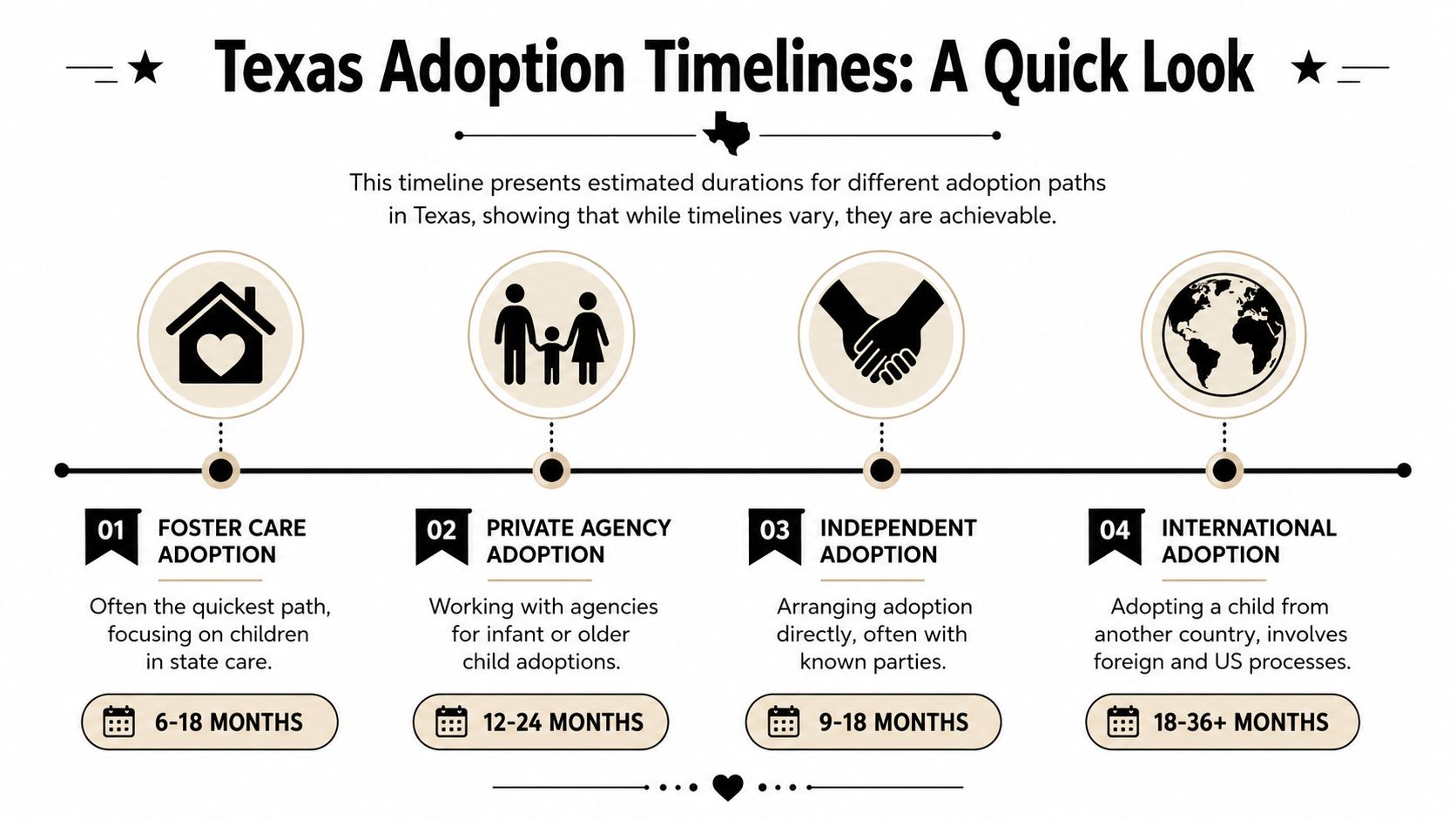
Texas Adoption Timelines at a Glance
Two families can file for adoption in Texas in the same month and reach the finish line on very different dates. The reason usually is not luck. It is the legal path in front of them.
| Adoption Type | Typical Timeline |
|---|---|
| Stepparent adoption | Often shorter |
| Kinship or relative adoption | Often shorter |
| Private infant adoption | Often longer |
| Foster care adoption | Varies widely |
| International adoption | Usually the longest |
Those broad ranges matter less than the reason behind them. A case tends to move faster when the child is already placed with the family, the adults who must consent are identified, and no contested termination of parental rights stands in the way. A case usually takes longer when it includes matching, multiple agencies, interstate or international approvals, or a court fight over a biological parent's rights.
Why stepparent and kinship cases often move faster
Stepparent and kinship adoptions often start several steps ahead. The child already knows the home, the daily routine is already in place, and there usually is no waiting period to be chosen by an expectant parent or matched through an agency.
That does not mean these cases are automatic. The timeline often turns on one legal question. Has every required parent consented, or must the court terminate someone's rights first? If consent is signed and the paperwork is in order, the path is usually more direct. If a parent cannot be located or contests the case, the process can stretch.
If your situation fits that path, Stepparent Adoption in Texas explains the most common Texas adoption and how it works.
Why private adoptions often take longer
Private infant adoption usually has more moving parts. Families often complete education, background checks, a home study, profile preparation, matching, placement, and finalization. It works a bit like building a bridge in sections. One part has to be finished before the next can safely carry weight.
The early preparation stage alone can create real delay if documents expire, references come in late, or interviews are hard to schedule. Families who want a clearer picture of that first stretch often review how long a home study can take in Texas.
Consent timing matters too. Even after a match, the legal steps around relinquishment and termination can affect when the case is ready for court.
Why foster care and international timelines can be hard to predict
Foster care adoption often depends on the child's legal status at the moment you enter the case. If parental rights were already terminated, the road may be shorter. If the case is still headed toward termination, the timeline may depend on hearings, service plans, appeals, and whether anyone contests termination.
International adoption has a different source of delay. You are not dealing with one legal system, but at least two. The timing can change based on the child's country, document authentication, immigration processing, and foreign court or administrative requirements.
A helpful way to read the chart is this: shorter timelines usually mean fewer unanswered legal questions. Longer timelines usually mean more approvals, more decision-makers, or a harder issue about parental rights that must be resolved before a Texas judge can finalize the adoption.
The Four Key Stages That Shape Your Timeline
A Texas adoption timeline is shaped less by the calendar than by a series of legal checkpoints. The court does more than wait for time to pass. It is confirming, step by step, that the placement is safe, the required consents or terminations are in place, and the adoption serves the child's best interests under the Texas Family Code.
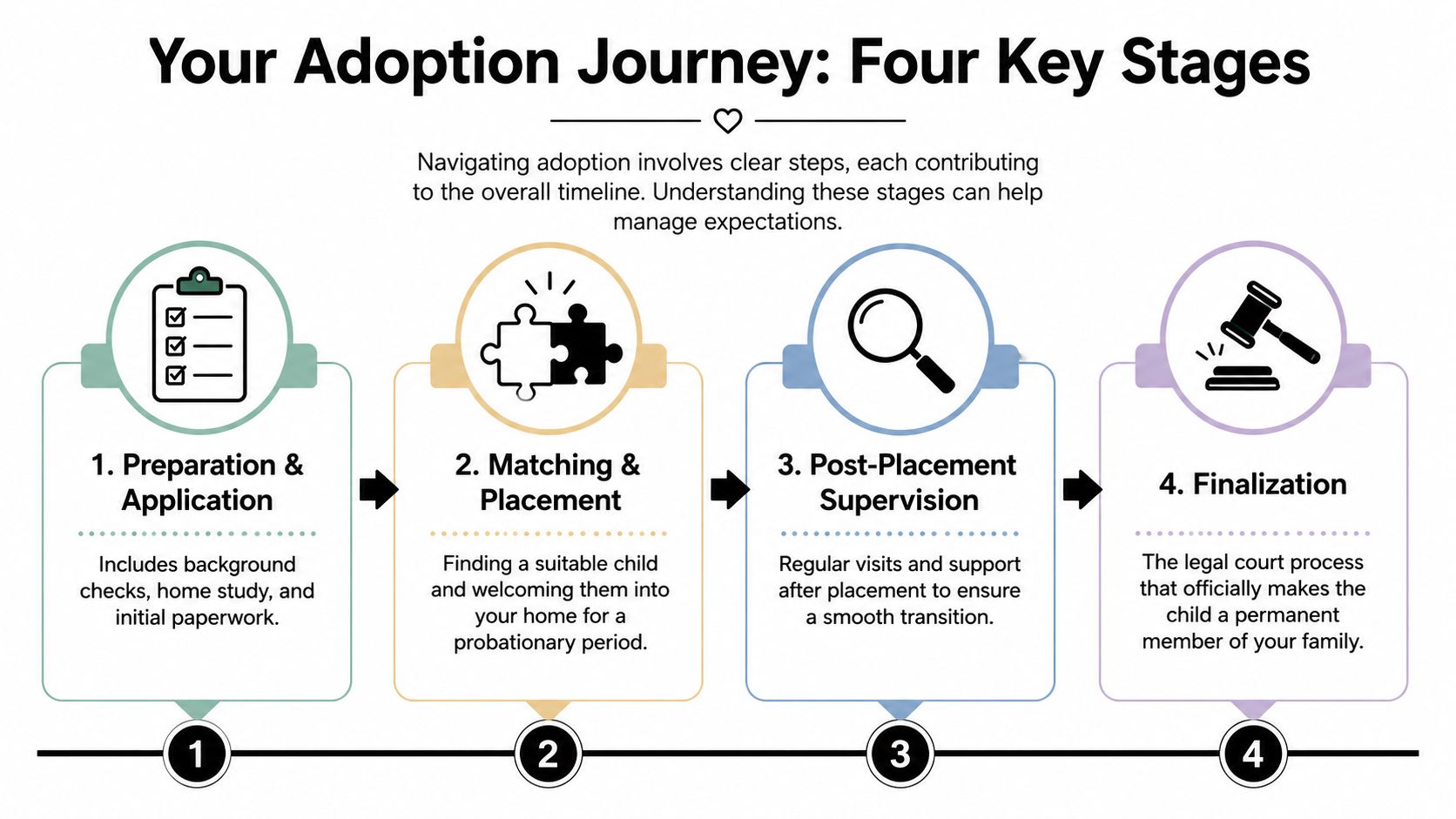
Preparation and application
This first stage lays the foundation. Families usually complete forms, gather medical and financial records, clear background checks, and finish a home study, which is the formal review of the home and family.
A home study works like the footing under a house. If that footing is delayed, every later step waits with it. Interviews must be scheduled. References must come in. Safety items may need to be corrected. If a document expires before the file is complete, part of the process may need to be redone.
The path you choose also starts shaping the timeline here. A private agency adoption, an independent adoption, and a Texas foster-to-adopt path can ask for different training, paperwork, and approvals. Families often focus on the final hearing, but the early file-building stage is where many timelines first speed up or slow down.
Matching and placement
Matching happens only after the groundwork is ready. That is true whether the match comes through a private adoption, an agency, a relative or stepparent case, or foster care.
This stage can move quickly or take time because it depends on human decisions, not just forms. In a domestic infant adoption, a prospective birth parent may be reviewing profiles and considering openness, contact preferences, medical history, and family fit. In foster care, placement may depend on the child's legal status, the agency's goals for the case, and whether reunification is still being considered.
Specific preferences can lengthen this stage. Broader openness can shorten it. Neither choice is wrong. It changes the path.
This short video gives a useful overview of the process families often experience:
Post-placement supervision
Many families feel a wave of relief when a child comes home. Then they learn there is still another legal stage to complete.
After placement, Texas commonly requires a 6-month post-placement supervision period before finalization in many adoption cases. During that time, the court and the professionals involved want updated reports showing that the child is adjusting well and that the home remains appropriate for a permanent order.
This stage exists for a reason. Adoption changes a child's legal identity and family ties in a lasting way, so the court wants a short period to confirm that the placement is stable before signing the final order.
Placement is a major milestone. For many families, the legal countdown to finalization starts after the child is already home.
Finalization in court
Finalization is the hearing where the judge signs the adoption order. It is joyful, but it is also the point where every earlier piece has to line up.
The court will usually need completed filings, proof that required consents were properly signed or that parental rights were terminated, and any post-placement reports required for that case. If one legal piece is still unresolved, the hearing may need to wait. That is why two families with the same start date can end up with very different timelines.
For hopeful parents asking how long it takes to adopt a child in Texas, these four stages explain the answer. Cases move forward when legal questions are answered, approvals are complete, and the court has what it needs to protect the child and make the adoption permanent.
Understanding the Foster Care Adoption Timeline
Foster care adoption often causes the most confusion because people use one label for very different legal situations. Some children are already legally free for adoption. Others are still in the middle of a case involving parental rights. That difference can reshape the entire timeline.
Texas foster care adoptions generally operate on a 6-to-18-month timeline post-certification, and the biggest variable is Termination of Parental Rights, often called TPR. The process has two parts: a variable pre-placement TPR phase that can last 0 to 12+ months, plus a standardized 6-month post-placement supervision period (Texas foster care adoption timeline and TPR breakdown).
Why TPR matters so much
TPR means a court has legally ended the biological parents' parental rights. In foster care adoption, that legal step often controls the pace more than anything else.
If TPR is already complete, the child is legally free for adoption. That can make the case much more straightforward. If TPR is still pending or contested, everyone may have to wait before the case can move toward adoption.
Many families find themselves blindsided. They hear that foster care adoption can be a shorter path, which can be true. But that usually depends on the legal status of the child, not just the family's readiness.
TARE and private agency paths
Families also hear the term TARE, which refers to the Texas Adoption Resource Exchange. In practical terms, this can be an important difference because some children listed through TARE already have parental rights terminated. When that happens, the adoption path may move more directly toward placement and finalization.
A private agency foster adoption may involve added front-end steps such as training, certification, and coordination before placement is made. A TARE case may feel more direct when the child's legal status is already settled. That doesn't mean one path is always better. It means the timeline often turns on whether the legal barriers have already been cleared.
Families exploring this route may want to compare options such as foster to adopt in Texas to understand how certification, matching, and legal status affect the path ahead.
In foster care adoption, the child's legal status often matters more than the calendar. A family can be fully prepared and still wait if the court hasn't resolved parental rights.
A simple example
Consider two families.
One family is approved and matched with a child whose parental rights were already terminated. Their timeline is shaped mostly by placement, supervision, and finalization.
Another family is ready to adopt a child they know through the system, but the case still involves disputed parental rights. Their emotional commitment may be strong, yet the law requires that issue to be resolved before the adoption can proceed.
Both families are pursuing foster care adoption. Their timelines can still look very different.
Common Delays and How an Attorney Can Help
A family can do everything asked of them, finish the classes, gather the records, answer every email, and still hit a slowdown. That is one of the hardest parts of adoption in Texas. The wait often has less to do with effort and more to do with which legal step must happen before the next door opens.
That is why it helps to ask a different question. Instead of asking only, "How long is this taking?" ask, "What is the case waiting on?" Adoption timing works a bit like a relay race. One runner cannot start until the baton is passed. If consent is unresolved, or a home study needs clarification, or the court has not set a hearing, the rest of the process pauses behind that issue.
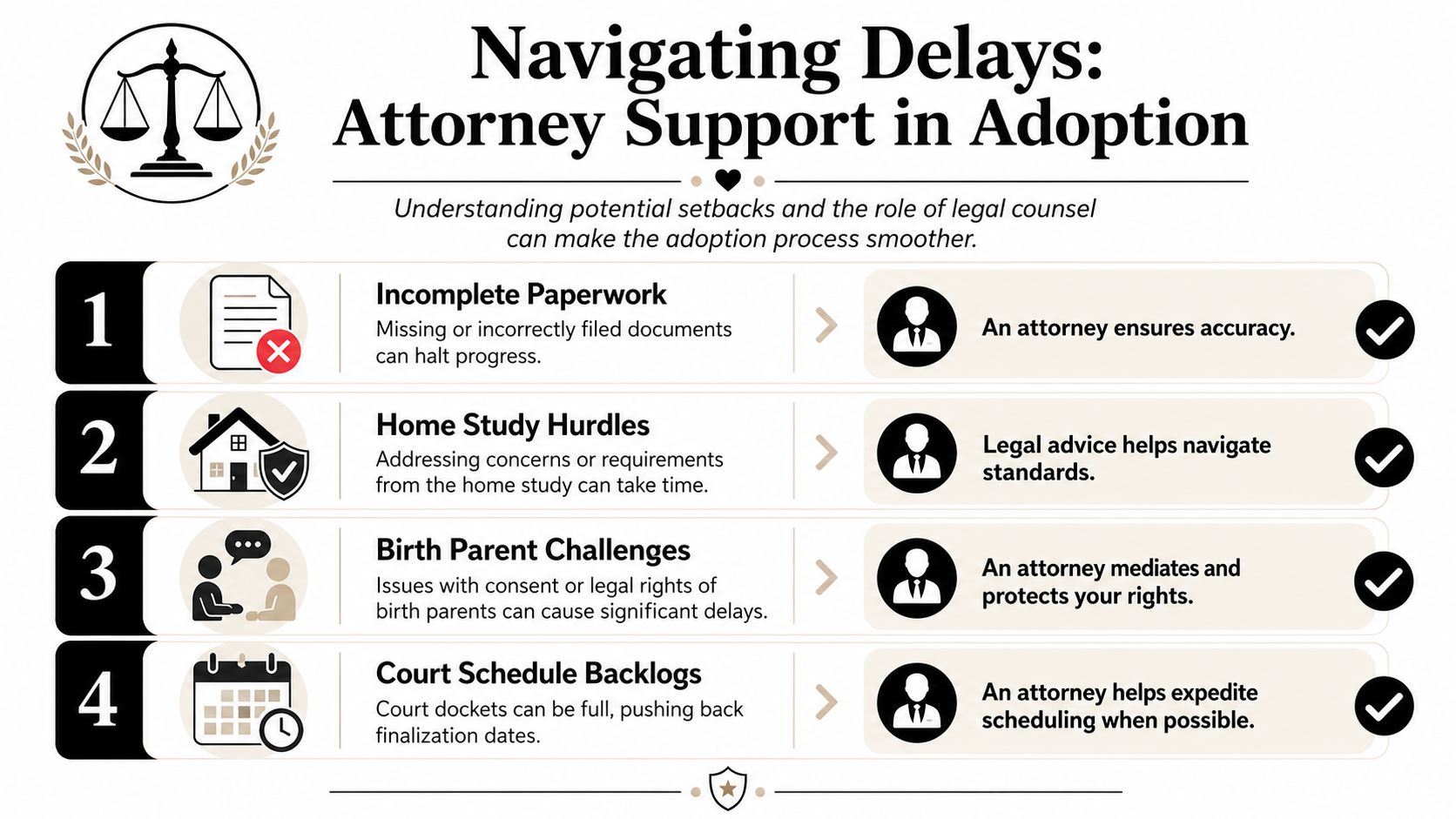
The delays families see most often
Some delays are routine, even in strong cases.
- Incomplete paperwork: Courts and agencies need correct forms, supporting records, and signatures. A small omission can send a filing back for correction.
- Home study concerns: Many are fixable, but they still must be addressed before the case can continue.
- Consent or termination issues: These questions affect a parent's legal rights, so courts treat them with care.
- Court scheduling: A case may be ready on paper and still wait for an open hearing date.
Background screening is a good example. Families are often surprised by how much timing can turn on fingerprinting, identity verification, and follow-up requests. If you are preparing for that step, a local resource on an FBI background check can help explain what that process usually involves.
The delay many families do not expect
The longest delays are often tied to legal status, not family readiness.
A contested termination of parental rights can change the whole shape of the timeline because the court must resolve that issue before adoption can move to finalization. That is the "why" many articles skip. A family may be emotionally ready, financially ready, and fully approved, but the law still has to answer a foundational question first: who has the legal right to make decisions for this child?
If that question is disputed, the case can slow for reasons that are serious and necessary. Notice may have to be served correctly. Hearings may be contested. Evidence may need to be presented. Appeals can add more time. In those cases, the calendar stretches not because the system forgot the family, but because the court is being asked to make a life-changing decision that must be legally sound.
A realistic explanation helps more than a cheerful estimate. Families cope better when they understand why the wait exists.
What an attorney does in this process
An adoption attorney cannot erase every delay. A lawyer can, however, reduce the avoidable ones and address the serious ones early.
That help often includes:
- Reviewing filings before submission: This lowers the risk of rejected or corrected paperwork.
- Handling notice and consent issues: If a biological parent is difficult to locate or contests the case, the legal steps must be done carefully.
- Watching county-specific procedures: Texas law is statewide, but court practices can differ from one county to another.
- Keeping deadlines and documents organized: Adoption often involves agencies, evaluators, background checks, and court requirements all at once.
If you want a plain-English explanation of that role, this guide on what an adoption lawyer does step by step is a helpful place to start. One option families in Texas sometimes consider for help with filings, hearings, and procedural requirements is the Law Office of Bryan Fagan, PLLC.
Good legal help does not guarantee a fast adoption. It helps keep a manageable case from becoming a longer one because of preventable mistakes.
Taking the Next Step on Your Path to Adoption
A family often reaches this point after weeks or months of asking the same question in different ways. How long will this take. Is the case still on track. What happens if a parent contests termination. Would a different adoption path have changed the timeline.
Those questions matter because adoption timing is shaped by legal events, not just calendar estimates. A stepparent adoption with clear consent follows a very different path than a foster care case waiting on termination of parental rights. A family working through a private agency may face one sequence of approvals, while a family pursuing TARE may face another. The timeline starts to make more sense once you can see what is causing the wait.
That clarity helps.
You can begin by identifying which part of the process is likely to control your timeline. For one family, it is the home study. For another, it is notice to a biological parent. For another, it is whether the child is already legally free for adoption. Those are not small details. They are often the reason one case moves in months while another takes much longer.
You can also prepare for the parts you can influence. Gathering records early, responding quickly to requests, and asking direct questions about consent, placement, and court procedure can prevent avoidable slowdowns. If you are a birth parent or relative considering adoption or guardianship, it also helps to ask which option gives the child the most stable legal footing, not just the fastest short-term answer.
Keep your eyes on the reason behind the wait
The process can feel like standing in line without being told what the line is for. In reality, each step serves a purpose. Courts are checking that parental rights were handled correctly. Agencies and evaluators are looking at safety and readiness. Judges are making sure the final order will hold up and give the child lasting stability.
That does not make the waiting easy. It does make it easier to understand.
Whether you are pursuing a stepparent adoption, kinship adoption, private infant adoption, LGBTQ+ adoption, or a CPS-related case, your next step is usually a specific one, not a generic one. You may need to confirm legal status. You may need to decide whether now is the right time to bring in counsel. You may also want to review when to hire a Texas adoption attorney if you are trying to decide how much legal help your situation calls for.

If you are ready for guidance specific to your family, schedule a free consultation with Law Office of Bryan Fagan, PLLC. A conversation can help you understand which legal events are likely to shape your timeline, what steps come next, and how to handle the process with more clarity and confidence.
