 Skip to content
When Texas families start exploring adoption, the words “foster care” and “orphanage” often get tangled up, creating a lot of confusion. As a law firm dedicated to helping families navigate the adoption process with empathy and clarity, we want to clear the air.
The bottom line is this: modern child welfare in Texas is built entirely on family-based foster care, not institutional orphanages. An orphanage was a large, institutional facility for housing children—a model that is no longer used in Texas. Foster care, on the other hand, provides a temporary, nurturing home with a family, with the ultimate goal of achieving permanency for the child.

Why Texas Moved From Orphanages to Foster Care
Decades ago, orphanages were the common answer for children who couldn't be cared for by their parents. But as our understanding of child development grew, a critical truth became impossible to ignore: children don’t just need shelter; they need to belong. They thrive in family settings, not institutions.
This realization sparked a nationwide shift, and Texas has firmly committed to placing children in safe, loving homes. When a child enters state care today, the entire system is designed around providing stability and support within a family, always keeping the child's best interests at heart.
This approach is guided by a few core principles from the Texas Family Code:
- Family-Based Care: The goal is always to place children with licensed foster families who can give them one-on-one attention, help them form healthy emotional bonds, and provide a true sense of belonging.
- Reunification First: The primary legal goal is always to work toward safely reuniting children with their birth parents whenever possible and appropriate. This promotes family unity and is considered to be in the child's best interest.
- Permanency When Needed: If reunification isn’t a safe option, the focus shifts to finding a permanent, loving family for the child, usually through adoption.
Key Differences at a Glance
Let’s break it down. The old orphanage model and the modern foster care system are fundamentally different in their approach, goals, and environment.
| Aspect of Care | Foster Care (Modern Texas System) | Orphanage (Outdated Model) |
|---|---|---|
| Living Environment | A private family home with licensed caregivers. | A large, institutional building with rotating staff. |
| Primary Goal | Temporary care with the goal of family reunification or adoption. | Long-term housing for children without parental care. |
| Caregiver Model | Consistent parent figures who provide daily care and emotional support. | Staff who work in shifts, limiting consistent bonding. |
| Legal Path to Family | Serves as the primary pathway to adoption when reunification fails. | Was not designed as a pathway to legal adoption. |
This modern approach recognizes that a family is essential for a child’s well-being. It’s a model Texas follows closely, aligning with a global understanding. While an estimated 5.7 million children live in institutional care worldwide, the vast majority of children who have lost parents are cared for by extended family, not in facilities. In the U.S., the system overwhelmingly prioritizes family placements.
This focus on family is why getting familiar with the Texas foster care and adoption process is so crucial for hopeful parents. It’s not about walking into an institution to find a child. It’s about becoming a safe harbor for a child who is on their journey toward a permanent, loving home.
So, what about the large residential facilities you sometimes see? These are not orphanages. They are typically Residential Treatment Centers (RTCs) or group homes, and they serve a very different, therapeutic purpose.
What Is a Residential Treatment Center?
Think of an RTC not as a home, but as a short-term therapeutic facility. It’s designed to provide intensive, specialized care for children with significant emotional, behavioral, or medical challenges that cannot be met in a family setting. These are clinical environments, not family homes.
- Their Goal: RTCs are all about stabilization and treatment. They are staffed 24/7 by trained professionals working on structured schedules and detailed therapy plans to help a child heal.
- The Adoption Path: Here’s the key takeaway for hopeful adoptive parents: an RTC is not an adoption pathway. The entire goal is to help a child heal so they can successfully transition to a less restrictive, family-based placement, like a foster home, where their journey to permanency can continue.
The overwhelming majority of children who enter state care in Texas are placed directly into foster homes.
For a child, the difference is profound. A residential facility provides care, but a foster home provides a family. This core belief guides every decision made by the Texas Department of Family and Protective Services (DFPS) and is enshrined in the Texas Family Code.
How Foster Care Works in Texas
Foster care is a temporary service with one primary mission: to give a child a safe, nurturing home while their birth family works to resolve the issues that brought the child into care in the first place. The guiding principle is always, and without exception, what is in the best interests of the child.
Let’s walk through what this looks like on the ground. Imagine two young siblings, an eight-year-old and a ten-year-old, are removed from their home due to neglect. A DFPS caseworker is immediately assigned.
The very first priority is finding a safe place for them to land—and, if at all possible, keeping them together. The caseworker’s first calls will be to find a suitable relative, like a grandparent, aunt, or uncle, to step in. This is what’s known as kinship care, a path strongly preferred under Texas law to maintain family connections.
If no relatives are available or suitable, the caseworker turns to a network of licensed foster families. They'll search for a home that has been thoroughly trained, background-checked, and approved to provide care. The search is specific, looking for a family that can meet the children's needs, like having the space and willingness to keep siblings together.
Once placed, those kids become part of the family. They go to the local school, eat dinner at the family table, and join in on neighborhood activities. This stability is absolutely critical for their emotional and developmental health. All the while, the legal process, guided by the Texas Family Code, is moving forward with the ultimate goal of finding a permanent home for the children—first by working toward reunification, but if that isn’t possible, through adoption.
A Child's Experience: Foster Home vs. Group Home
To really grasp the difference between modern foster care and the institutional models of the past, it helps to see it through a child's eyes. The world looks, sounds, and feels completely different depending on whether a child lands in a family foster home or a residential group home. Texas law and decades of child development research all point to one truth—a family is where a child heals best.
Think about a child's day. In a foster home, it often looks a lot like any other kid's life on the block. They might wake up to the smell of pancakes, catch a ride to school with a foster parent, and later argue with a foster sibling over the TV remote. This isn't by accident; it's by design, creating the kind of normalcy and routine that every child needs to feel safe and secure.
Daily Life and Emotional Well-being
In a foster home, a child isn’t just a resident; they become part of a family. This means they are present for family dinners, weekend trips to the park, and have a consistent adult there to check their homework or listen after a hard day. These small, everyday interactions are the building blocks of secure emotional attachment—the very foundation of a child's healthy development. The goal is simple: to give them a place to belong.
A residential group home, often called a Residential Treatment Center (RTC), runs on a totally different operating system. Life there is highly structured, built around therapy appointments, group sessions, and rotating shifts of staff members. While the staff are dedicated professionals trained to provide care, the constant shift changes make it incredibly difficult for a child to form a deep, lasting bond with one single caregiver.
For a child who has already been through the trauma of being separated from their family, having a consistent, nurturing caregiver isn't a "nice-to-have"—it's essential for their healing. This is the core strength of the foster family model.
This infographic breaks down the different placement options within the Texas child welfare system, but notice how they all point toward the same ultimate destination: permanency.
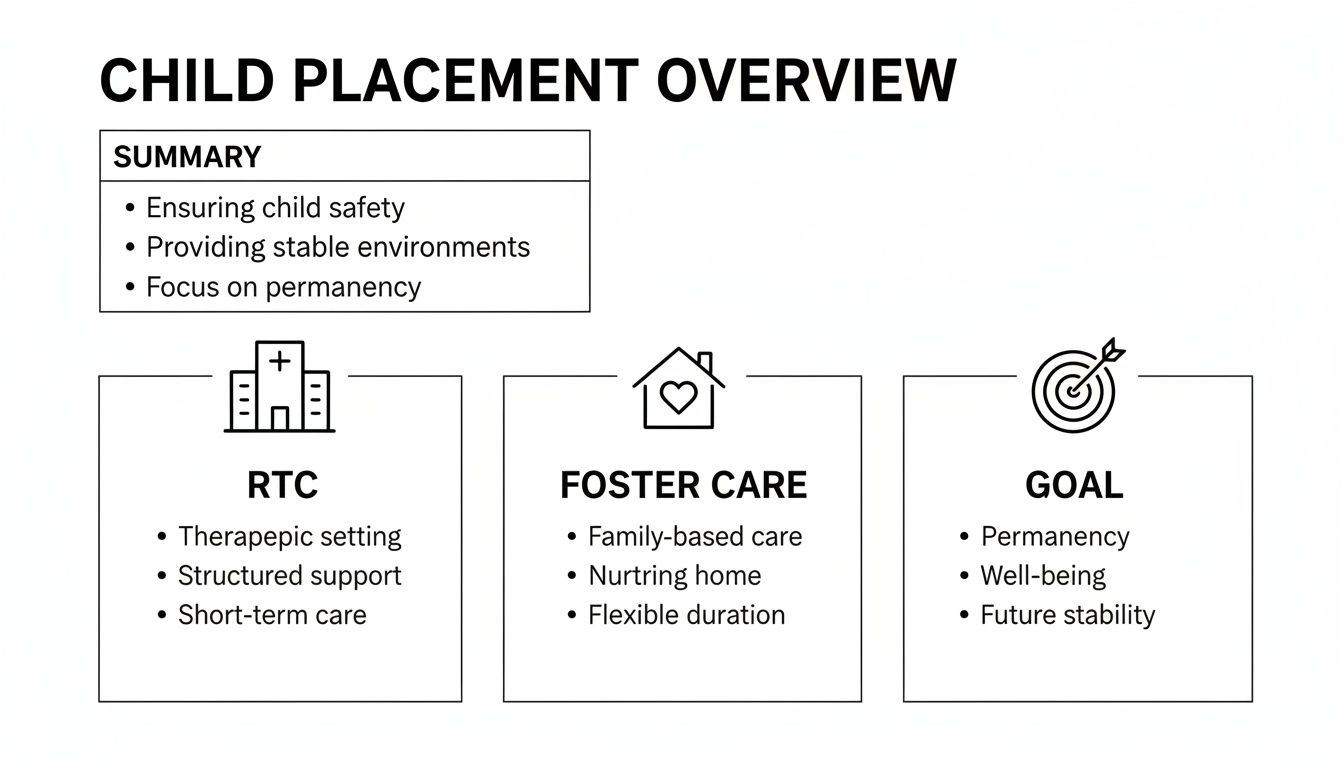
It’s a clear visual reminder that while a child might have a temporary stay in a specific type of placement, the entire system is built to guide them toward a stable, permanent family.
Legal Status and The Path to Permanency
A child's legal journey is another area where these two paths diverge dramatically. In either situation, the child is legally in the custody of the Texas Department of Family and Protective Services (DFPS). From there, however, the road forward looks very different.
For a child in foster care, the legal system is actively pushing toward permanency. This means the courts and caseworkers are focused on achieving one of three primary goals:
- Reunification: Helping the child return safely to their birth parents if the home situation has improved.
- Adoption: Creating a new legal family for the child, which is often the foster family they have been living with.
- Permanent Managing Conservatorship: A form of legal guardianship, frequently granted to a relative.
This entire process, laid out in Chapters 162–166 of the Texas Family Code, is designed to keep children from getting stuck in legal limbo. The system has firm timelines and requires regular court reviews to ensure everyone is moving toward the goal of giving that child a forever family.
Children in an RTC are also under DFPS custody, but the facility is never meant to be a permanent home or a direct path to adoption. It’s a temporary stop for intensive, specialized treatment. A child is only placed in an RTC for as long as their specific therapeutic needs require it. The long-term plan is always to transition them back to a family-based setting—like a foster or kinship home—where they can finally start moving toward true permanency.
At a Glance: Foster Family vs. Residential Group Home
The table below contrasts the day-to-day reality for a child in these two very different environments.
| Aspect | Foster Family Care | Residential Group Home |
|---|---|---|
| Living Environment | A private family home in a neighborhood, part of the community. | A licensed, clinical facility with a structured institutional setting. |
| Primary Caregivers | Consistent foster parent(s) who serve as parental figures. | Rotating shifts of trained staff, counselors, and therapists. |
| Daily Routine | Mirrors normal family life, with school, chores, and community activities. | Highly structured schedule centered on therapy, education, and group programs. |
| Emotional Bonding | Designed to build secure attachments with consistent caregivers. | Difficult to form deep bonds due to the nature of staff rotation. |
| Legal Goal | Achieve permanency through reunification, adoption, or guardianship. | Provide short-term stabilization and treatment before moving to a family setting. |
As you can see, one is a home, and the other is a treatment facility. Both serve a vital purpose, but only one is built to feel like family.
Navigating the Pathways to Permanency
When a child enters foster care in Texas, the clock starts on a legal journey toward one critical destination: permanency. This isn't just a legal buzzword; it's the promise of a stable, loving, and lasting family. For parents hoping to adopt, understanding these pathways is the first step to seeing exactly how you can become the answer for a child in need.
The entire system, guided by the Texas Family Code, is built to move a child out of temporary care and into a forever home. It’s a deliberate process with clear goals and timelines, all designed to keep children from getting lost in legal limbo. While the journey can have its twists and turns, the destination is always a place where a child can finally put down roots.
The Three Roads to a Forever Family
In Texas, every child’s case plan is built around one of three specific outcomes. The court, caseworkers, and your legal team all work together to figure out which path is in the best interests of the child.
Reunification: The first and primary goal is always to safely reunite children with their birth parents. The system provides resources—parenting classes, counseling, and support services—to help parents address the issues that led to the child’s removal. If parents can demonstrate they’ve created a safe and stable home, reunification is the celebrated outcome.
Adoption: When reunification just isn't possible or safe, the focus shifts to creating a new legal family. This is where foster-to-adopt parents play a life-changing role. Adoption legally and permanently makes the child a full member of your family, with all the rights and responsibilities that come with it.
Permanent Managing Conservatorship (PMC): Think of this as a form of legal guardianship, often granted to a relative (kinship caregiver) or a long-term foster parent. PMC gives the caregiver the legal right to make important decisions for the child, providing stability without completely terminating the birth parents' rights.
This is the key difference between modern foster care and the orphanages of the past. Orphanages were warehouses; the Texas foster care system is a purpose-driven process designed to build families.
From Foster Care to Finalization: A Journey of Hope
Let's walk through a real-world scenario to see how this journey unfolds. Imagine a Texas couple, Sarah and Mark, who have just become licensed foster parents. They get a call about a 4-year-old girl named Lily who needs a safe home. This is where their journey toward permanency begins.
Initial Placement: Lily arrives at their home. Sarah and Mark focus on providing love, stability, and a normal routine. Legally, the goal is still reunification with her birth parents.
Court Reviews: Every few months, they attend court hearings. A judge reviews the progress of Lily’s parents and ensures her needs are being met in Sarah and Mark's care.
Shift in Goal: After a year, the court determines that Lily's parents have not been able to create a safe environment for her return. The legal goal officially changes from reunification to adoption.
Termination and Adoption: The birth parents' rights are legally terminated. Sarah and Mark, who have become Lily’s trusted caregivers, file their Petition for Adoption. After a six-month post-placement period and one final court hearing, the judge declares Lily to be their legal daughter—forever.
This story highlights the hopeful reality for thousands of families. Statistics from the U.S. foster system confirm this is a common and celebrated path. In a typical year, about a quarter of all children exiting foster care are adopted. Many more are successfully reunified, underscoring the system's dual focus. You can find out more by reading the full statistics on foster care and adoption.
For every child who ages out of care without a family, the cost is immeasurable. The Texas foster care system is designed to prevent this, making adoption not just an option, but a vital goal for children who cannot go home.
This journey demands patience and heart, but the legal framework is there to guide you. If you're exploring this path, understanding the requirements for becoming a Texas foster parent is a great next step.
The Legal Steps for Adopting from Foster Care in Texas

When you’re ready to grow your family through foster care, understanding the legal journey is what transforms good intentions into a forever home. It’s a path that can seem complex, but it's a well-traveled road designed to turn a dedicated caregiver into a legal parent, and we are here to walk it with you.
This process is guided by the Texas Family Code, which sets clear rules to protect the child and give everyone involved a predictable path forward. As your legal team, we handle the legal heavy lifting so you can stay focused on what really matters: loving the child who needs you.
The Foundation: Becoming a Licensed Home
Before a child can be placed with you, the state needs to know you’re ready. The first real step is getting your home licensed for foster care or adoption. This shows that you can provide a safe, stable, and nurturing environment.
This stage breaks down into a few key parts:
- Application and Training: You’ll start by filling out an application with a state-licensed child-placing agency and attending required training. This isn't just paperwork; it’s vital preparation for parenting a child who has known trauma.
- The Home Study: Mandated by Chapter 162 of the Texas Family Code, the home study is a comprehensive look at your family life. It includes background checks, personal interviews, and a home safety inspection. It's a cooperative process designed to ensure you are prepared.
- Receiving Your License: Once you’ve completed these requirements, you’ll be officially licensed as a foster-to-adopt family. You’re now ready to receive a placement.
Accepting a Placement and the Waiting Period
After you’re licensed, your agency will start calling about children in need of a home. Once you accept a placement and a child moves in with you, a critical waiting period begins.
This is a mandatory six-month residency period required by the Texas Family Code. It’s designed to give the child time to settle into your home and build attachments before the adoption becomes permanent. This period is crucial for ensuring the placement is a healthy, long-term fit for everyone.
During these months, you’re the child’s day-to-day parent, but legal custody remains with the Department of Family and Protective Services (DFPS).
The six-month waiting period is not just a formality; it's a compassionate and practical step mandated by Texas law. It ensures that the transition to a permanent family is stable and in the child’s best interests, giving everyone time to build the foundation for a lifetime together.
The Turning Point: Termination of Parental Rights
For a child to be adopted, the legal rights of their birth parents must be permanently ended. This is often the most significant legal hurdle in the entire process and the moment that makes a child legally available for adoption.
Parental rights can be ended in one of two ways:
- Voluntary Relinquishment: In some cases, a birth parent signs legal documents to voluntarily give up their parental rights.
- Involuntary Termination: More often, a judge terminates parental rights after a trial. This happens when the court finds that it’s not in the child’s best interest to return home and that ending the legal parent-child relationship is necessary for their safety and well-being.
This step, outlined in Chapter 161 of the Texas Family Code, is a legally and emotionally profound moment. It officially closes one chapter of a child’s life and opens the door for a new, permanent family to be legally formed through adoption.
Finalizing the Adoption
Once parental rights are terminated and the six-month waiting period is complete, it’s time to make it official. With our guidance, you will file a Petition for Adoption with the court, which is the formal legal request to make the child a permanent and legal member of your family.
The court then schedules a final hearing. This day is usually a celebration—a joyful end to a long journey. The judge reviews all the legal paperwork, confirms every requirement has been met, and signs the final Decree of Adoption.
In that moment, the child is legally yours in every way. A new birth certificate is issued with your names on it, and your family is complete. This is the moment we work toward with every family we serve.
Making a Heartfelt—and Informed—Decision for Your Family
The path to building a family through adoption is filled with big questions and even bigger emotions. We’ve walked through the key differences between modern foster care and the outdated orphanage model, and one thing is clear: in Texas, the road to permanency is through a family, not an institution.
For hopeful parents, this means the conversation isn't really about "foster care vs. orphanages." The real question is how to align your dream of parenthood with the actual needs of children waiting right now. These kids aren't in vast, impersonal facilities; they're living in temporary foster homes, holding out hope for a forever family to finally call their own.
Embracing the Realities of Foster Care Adoption
Many prospective parents start out dreaming of adopting an infant. But the most significant need in the Texas foster care system is for families willing to open their hearts to older children, sibling groups, and kids with unique needs.
Choosing this path means embracing the beautiful, complex reality that your child has already lived a life before they ever meet you. It requires patience, resilience, and a tremendous amount of love. But it also comes with an incredible support system. The foster care system is designed to equip you with training, resources, and often financial assistance to help you meet your child's needs.
The most profound decision you can make is to meet children where they are. By being open to adopting an older child or siblings, you aren’t just building a family—you’re rewriting a future and making sure no child has to face life alone.
Aligning Your Heart with Their Need
The children waiting in the Texas foster care system aren't just statistics; they're real kids with favorite colors, secret fears, and limitless potential. Right now, thousands of children—from toddlers to teenagers—are legally free for adoption. Their biological parents' rights have been terminated, and they are simply waiting for someone to step forward and say, “I choose you.”
As you think about your own family goals, consider what this could look like:
- Older Children: Adopting an older child means you skip the diaper stage and jump right into conversations, hobbies, and shared memories. You get the chance to be their guide and mentor as they navigate their most formative years.
- Sibling Groups: Keeping brothers and sisters together is a powerful act of love. It preserves their most important family bond and gives them a built-in support system as they adjust to a new life with you.
- Children with Unique Needs: Every child is unique, but some have medical, emotional, or developmental challenges that require extra care. For these kids, a dedicated and loving parent isn't just a wish—it's a lifeline.
Your adoption journey is deeply personal, but you don't have to walk it alone. Understanding the legal steps, preparing your heart and home, and having a compassionate guide by your side can make all the difference.
If you feel a pull toward creating a forever family for a child who needs one, we are here to help you understand your options. We invite you to schedule a free, compassionate consultation with our team. Let’s talk about your hopes, answer your questions, and give you the clear legal guidance you need to take the next step with confidence.
Your Questions About Foster Care and Adoption in Texas, Answered
Deciding to build your family through foster care or adoption is a huge step, and it’s natural to have a million questions swirling in your mind. We get it. Having clear, straightforward answers can make all the difference, giving you the confidence to take that next step.
Here are some of the most common questions we hear from families just starting their journey.
Can I Adopt a Baby from Texas Foster Care?
This is one of the first questions many hopeful parents ask. The honest answer is that while it's possible, it’s not very common. The number one goal of the foster care system is always to reunite a child with their birth family, and that process takes time. Most infants who enter care are eventually reunified with their parents or placed with relatives.
Families who are open to adopting toddlers, school-aged kids, sibling groups, or children with unique needs often find a more direct path to adoption through the system. These kids are every bit as deserving of a permanent, loving home, and they are waiting right now.
What Is a Home Study and Why Do I Need One?
A home study is a mandatory part of the process for anyone wanting to foster or adopt in Texas. Don't let the name intimidate you—it’s not about judging your housekeeping skills. Think of it as a collaborative process to prepare you for this unique parenting journey and to ensure your home is a safe place for a child.
The home study is a partnership between you and your licensing agency. It’s designed to make sure you’re prepared and to help find a child whose needs you are perfectly suited to meet. It’s the foundation of a successful, lifelong placement.
The process typically involves:
- Background checks on every adult living in the house.
- Interviews with you and your family.
- A safety check of your home.
- Specialized training to prepare you for parenting a child who has been through trauma.
What’s the Difference Between Foster-to-Adopt and Straight Adoption?
In a foster-to-adopt placement, you start out as the licensed foster parent for a child. The legal rights of their birth parents haven't been terminated yet. If the court later decides the child cannot go home, you—the caregiver who has already built a trusting bond with the child—are almost always given the first chance to adopt.
A straight adoption (sometimes called a "matched adoption") happens when a child's biological parents' rights have already been legally and permanently terminated. These children are legally free and immediately ready for their forever family. In this case, you are matched with a child who is waiting for adoption, and you move directly toward finalizing it after the required waiting period.
Your dream of building a family is worth fighting for, but you don't have to navigate the legal maze alone. The Law Office of Bryan Fagan, PLLC is committed to offering warm, clear guidance to Texas families. Schedule a free, compassionate consultation to talk about your situation and take the first step toward your forever family.

