 Skip to content
A parent may learn that an adoption has moved forward, or even been finalized, and suddenly realize that a termination order was signed months earlier. The news can bring grief, confusion, and fear. Many people don't know whether the deadline began when they received paperwork, when they discovered the order, or when another family welcomed the child.
Texas Family Code § 161.211 creates a strict six-month limit to attack a termination order. The rule reflects the child's need for a stable, permanent home, while a narrow constitutional exception may protect a parent who never received constitutionally adequate notice. Because the exact order date and service history matter, anyone facing this issue should seek legal advice without delay.
Why the Finality of Adoption Matters in Texas
Consider a birth parent who has been struggling to understand court papers, relocation, or a difficult family transition. Later, the parent learns that a termination order was signed and that the child may now be living with an adoptive family. The parent may feel that the door has closed before they understood what was happening.
That reaction is human. Termination and adoption cases carry intense emotional consequences for birth parents, relatives, stepparents, foster families, and hopeful adoptive parents. Texas courts must still apply legal deadlines because a child cannot remain in prolonged uncertainty while adults continue litigating the same question.

Permanency protects a child's future
Texas has tied the finality of termination judgments to a clear permanency policy. Courts have explained that the law seeks to help children achieve stable placements without prolonged litigation, and the Texas Supreme Court has described this approach as a legislative effort to promote permanency in child rearing as early as possible. Texas Family Code § 161.211 reflects that policy.
This doesn't erase the pain of a parent who believes the order was wrong. It means the law balances that concern against the child's need for safety, continuity, and family unity. Adoption procedures under Chapters 162 through 166 also depend on reliable final orders, proper consents, required investigations, and court findings focused on the child's best interests.
For families asking what happens after an adoption is challenged, this explanation of adoption challenges after finalization can provide helpful background. It shouldn't replace advice about a specific termination order, service record, or deadline.
Understanding the Six-Month Deadline for Challenges
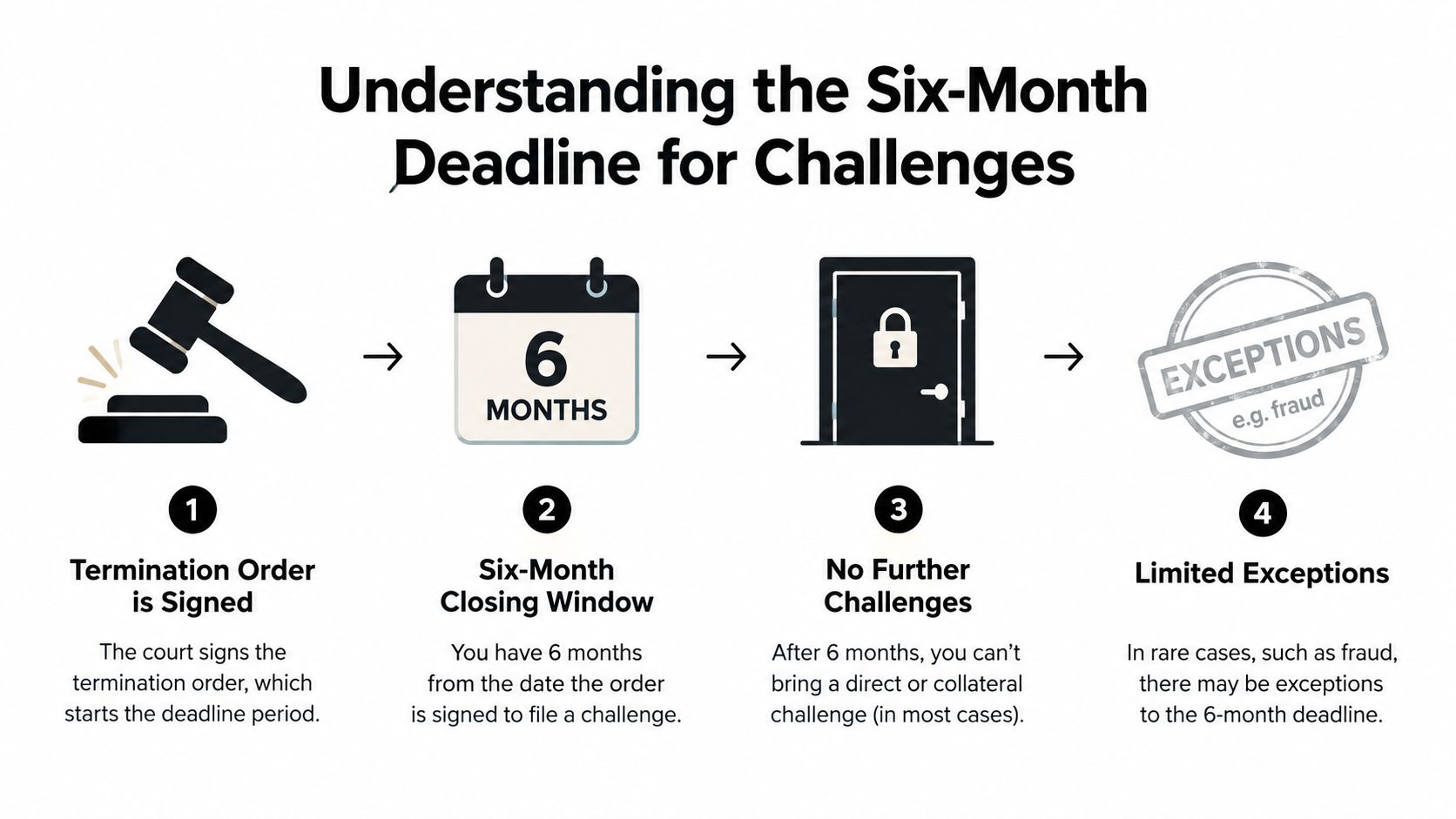
A parent may learn about a termination order after the child has begun a new family transition. Under Texas Family Code § 161.211(a), a parent in the covered categories generally cannot attack the order, directly or collaterally, after six months from the date the judge signed it. Subsection (b) applies the same bar when the parent received service by citation by publication. The statutory text sets out both parts of the rule.
The provision operates as a statute of repose, a fixed legal closing point intended to protect stability. In a Texas example, the clock starts with the signed termination order. Unlike a limitations period that may toll while a parent is unaware, this repose generally runs from that date regardless of when the parent discovers the order or receives a copy. For context on other Texas deadline rules, see these nine exceptions to the statute of limitations in Texas.
How to identify the controlling date
Begin with the court file and locate the termination order. Confirm the judge's signature date, then ask a Texas family law attorney to calculate the deadline under the applicable facts and procedural rules. A mailed copy, a later conversation, or the date an adoptive family mentions the order may not control.
Practical rule: Treat the signed order date as urgent information.
A parent may review Termination of Parental Rights Before Adoption because termination commonly precedes adoption. The two proceedings remain distinct, however. A challenge to the termination order requires prompt examination of the termination case, including service, notice, and the signed order.
The six-month limit generally reaches direct challenges, such as an appeal or motion aimed at the order, and collateral challenges raised in another proceeding. Its purpose is to prevent a later filing from reopening a judgment after the child and family have built their lives around its finality. A narrow constitutional notice exception may apply in rare circumstances, so that issue requires separate legal analysis rather than assumption.
Strict Application of the Statute by Texas Courts
Texas appellate courts have treated Family Code § 161.211 as a jurisdictionally strict deadline. In practical terms, courts generally can't extend the period just because a parent had a compelling personal reason for delay, misunderstood the paperwork, or hoped the issue could be addressed later.
Texas appellate guidance describes the statute as leaving no room for a motion for new trial or another challenge filed more than six months after the termination order was signed. Texas Bar Practice guidance explains this strict treatment and connects it to the state's permanency policy.
Why a late filing can fail
Suppose a termination order was signed, and a parent files a challenge after the statutory window has closed. The court may dismiss the filing because the law removes the court's authority to consider the attack, rather than because the judge has weighed the parent's evidence and decided against them.
A Dallas appellate case illustrates the point. The court treated a challenge filed more than six months after the signed order as untimely. That distinction matters emotionally and legally. A dismissal under the deadline may prevent the court from reaching the underlying allegations.
| Reader concern | What the rule generally means |
|---|---|
| “I didn't receive the order right away.” | The ordinary calculation focuses on the date the order was signed. |
| “I can file a motion for new trial later.” | A late motion can still be barred. |
| “I'll challenge it in another case.” | A collateral attack can also be prohibited. |
| “The child needs stability.” | Permanency is a central reason courts enforce the statute strictly. |
The Texas Supreme Court has described the statute as a legislative device intended to promote permanency in child rearing as early as possible. That policy affects every family differently, but it explains why courts don't treat the deadline as a casual filing preference.
Who Is Affected by the Six-Month Bar?
The statute applies to several categories of parents. It isn't limited to a parent who personally appeared in court and understood every legal consequence. A parent may fall within the rule because of the way service occurred, the document signed, or the statutory basis for termination.
The covered categories include:
- Personal service: A parent who was personally served with the proceeding may be subject to the six-month bar.
- Affidavit of relinquishment: A parent who signed an affidavit of relinquishment falls within the category identified by the statute.
- Affidavit of waiver of interest: A parent who signed an affidavit waiving an interest may also be covered.
- Termination under Section 161.002(b): A parent whose rights were terminated under Texas Family Code § 161.002(b) is included in the statutory language.
- Citation by publication: A parent served by publication may face the same bar under subsection (b), subject to the constitutional-notice issue discussed later.

Documents deserve careful review
People often use “consent,” “relinquishment,” and “waiver” as if they mean the same thing. They don't always have the same legal effect, and the exact document, signing circumstances, notice, and court findings matter. A family member exploring adoption should also understand Who Can Adopt in Texas and the basic eligibility requirements, while a parent considering relinquishment should obtain independent legal advice before signing anything.
The safest way to identify your position is to obtain the complete court record. An attorney can review the petition, citation, returns of service, affidavits, termination order, and later adoption filings. That review can show whether the statute appears to apply and whether a constitutional notice question requires deeper investigation.
For hopeful adoptive parents and relatives, this process can feel unsettling. The purpose isn't to create unnecessary conflict. It is to make sure the child's legal status, placement, and long-term family relationships rest on a sound court record.
The Constitutional Notice Exception Explained
The six-month bar is powerful, but it isn't absolute in every constitutional circumstance. Texas courts recognize that a deadline can't eliminate a parent's right to constitutionally adequate notice of the proceeding. If a parent never received legally sufficient notice, the court may need to address that due-process problem even though the statutory period has passed.
This issue often arises in cases involving citation by publication. Publication service can satisfy legal requirements in some circumstances, but it doesn't automatically answer whether the parent received constitutionally adequate notice. Courts examine the facts surrounding notice, the steps taken to locate the parent, and whether the service method was constitutionally sufficient.
What evidence may matter
A parent raising a notice challenge may need records showing:
- where the parent lived or worked,
- what contact information was available,
- what efforts the parties made to locate the parent,
- what notices were sent or published,
- whether the parent had actual knowledge of the case,
- and what the court file says about service.
The issue isn't whether the parent saw the order. The question is whether the proceeding provided the notice that due process required under the circumstances. A Texas appellate decision addressing publication-based service and the notice exception shows why statutory finality and constitutional adequacy must be analyzed separately.
A missed deadline and a notice defect are not the same legal question.
This is a narrow exception, not a general way to revive every late challenge. A parent can't assume that unfamiliarity with the case, emotional distress, or delayed paperwork automatically defeats the statute. A Texas attorney must compare the service record with the constitutional standard and determine whether the facts support an argument.
Families moving through adoption may find The Texas Adoption Process Step by Step useful for understanding the core stages from selecting an adoption type to obtaining a final decree. A notice challenge, however, concerns the validity and constitutional foundation of the termination proceeding, so it needs separate legal analysis.
Procedural Routes for Appeals and Motions Before the Deadline
A parent who believes a termination order is wrong may have more than one procedural route, but each route demands immediate attention. The available option depends on the order, the procedural history, the grounds for challenge, and whether the court still has authority to act.
Direct appeal
A direct appeal asks an appellate court to review an alleged error in the trial court's decision. The appeal generally focuses on the existing record, including pleadings, evidence, objections, findings, and the signed order. Counsel must identify the correct appellate deadlines and filing requirements rather than assuming that the six-month period is the only deadline that matters.
Motion for new trial
A motion for new trial asks the trial court to reconsider the judgment or address an error through a post-judgment motion. It may be useful in some cases, but it isn't a substitute for calculating all applicable deadlines. Texas appellate guidance warns that a motion filed after the statutory period can be barred under Family Code § 161.211. A discussion of contested adoption litigation may help readers understand why case strategy must fit the record.

Collateral attacks
A collateral attack raises the challenge indirectly, often in a later proceeding rather than through the original appeal route. Section 161.211 generally bars this type of attack after the six-month period as well. Filing in a different court or using a different title doesn't automatically avoid the statute.
| Route | Main question |
|---|---|
| Direct appeal | Did the trial court commit a reversible legal error? |
| Motion for new trial | Should the trial court reconsider the judgment under the applicable rules? |
| Collateral attack | Can the order be challenged indirectly in another proceeding? |
The constitutional-notice exception must be evaluated separately. A parent should not choose a procedural route based only on the name of the filing. The correct strategy starts with the order date, service history, and legal grounds.
Immediate Steps to Take After a Termination Order
If you believe a termination order affects your parental rights, act immediately. Don't wait for another letter, an adoption hearing notice, or a later conversation with relatives.
- Locate the signed order. Obtain a file-stamped or certified copy from the court or clerk and identify the date the judge signed it.
- Contact a Texas family law attorney. Ask for urgent review of the order, filing history, and available procedural options.
- Gather service records. Collect citations, returns of service, publication notices, affidavits, addresses, and correspondence.
- Preserve evidence about notice. Keep documents and messages showing where you lived, how people could contact you, and when you first learned about the case.
- Discuss every possible challenge. Ask whether an appeal, motion for new trial, direct attack, or constitutional notice argument fits the facts.
- Don't rely on informal assurances. A statement from a relative or another party can't replace review of the court record.
Act promptly: The order date may control even if you learned about the case later, unless a recognized due-process issue changes the analysis.
This checklist applies whether you are a birth parent, relative, stepparent, or another person trying to protect a child's legal and emotional future. The best interests of the child remain central, but protecting those interests requires accurate dates and a careful legal record.
Contact Our Compassionate Texas Family Law Team
Termination of parental rights and adoption can affect a child's identity, relationships, placement, and sense of security. The legal questions are difficult, especially when a parent is trying to understand service, consent, finality, or a possible notice problem while also coping with profound emotions.
The Law Office of Bryan Fagan, PLLC helps Texas families understand adoption and guardianship procedures, parental rights, and court options with empathy and clarity. The firm serves families across Texas, including Houston, Dallas, Austin, San Antonio, and surrounding communities, with in-person and virtual consultations available statewide.
Don't wait if a termination order may be approaching or beyond its deadline. A prompt review can help you understand the order date, service record, and possible next steps.
The Law Office of Bryan Fagan, PLLC offers guidance on termination, adoption, guardianship, home studies, and final court proceedings. Schedule a free consultation by visiting Law Office of Bryan Fagan, PLLC to discuss how the six-month limit and any notice concerns may affect your family.

