
When you marry someone with children, you don’t just gain a spouse—you welcome an entire family into your heart. It’s a journey of love, and a common question we hear from caring stepparents is, "Do stepparents have custody rights in Texas?"
The short, simple answer is no. Marrying a child's parent doesn't automatically give you any legal say in their life. Your role is deeply important, but Texas law draws a firm line between being a loving caregiver and being a legal parent. This guide is here to walk you through what that means for your family and how you can create a permanent, legally secure bond with the child you love.
Your Role as a Stepparent and Its Impact on Custody Rights

Stepping into a child's world is a huge act of love. You're the one driving to soccer practice, helping with homework, and offering a hug after a tough day. In your home and in your heart, you feel like a parent. Legally, though, it's a different story.
Without a court order, a stepparent is more like a trusted guardian than a legal decision-maker. You can handle the day-to-day care with the biological parent’s permission, but you can't make the big calls on things like education, healthcare, or upbringing. This gap becomes crystal clear during an emergency or if your spouse is suddenly unable to care for the child.
Why Legal Status Matters
This legal distinction isn't meant to diminish your role; it's designed to protect the child and the fundamental rights of biological parents. The law operates on the presumption that biological parents will always act in their child's best interests. To gain the legal power to make those critical decisions—to actually have custody rights—a stepparent must take formal legal action. This is the only way to turn that powerful emotional bond into a legally recognized relationship.
And this isn't a niche issue. The reality is that blended families are incredibly common. A staggering 40% of all married couples with children in the U.S. are stepcouples, where at least one partner has a child from a previous relationship. This just goes to show how many families are navigating these complex, loving dynamics. You can explore more of these family statistics to see just how common your situation is.
Your daily contributions are priceless, but securing your legal standing is the key to ensuring you can always be there for your stepchild, no matter what happens. This isn't about replacing anyone; it's about adding a permanent layer of love and security.
To make this clearer, let's break down the key differences between a stepparent's default status and that of a legal parent in Texas.
Stepparent vs. Legal Parent: A Quick Comparison of Rights in Texas
This table shows exactly what you can and can't do without a court order, highlighting why formalizing your role is so important.
| Legal Right | Stepparent (Without Court Order) | Legal Parent (Biological or Adoptive) |
|---|---|---|
| Medical Decisions | Cannot consent to major medical procedures. | Has full authority to make all medical decisions. |
| School Enrollment | Cannot legally enroll the child in school or access records. | Has full authority to make educational decisions. |
| Inheritance | Child does not automatically inherit from the stepparent. | Child has automatic inheritance rights. |
| After Divorce | No guaranteed right to visitation or custody. | Retains parental rights and responsibilities. |
| After Spouse's Death | No automatic right to custody; the other biological parent typically gains sole custody. | Assumes sole custody of the child. |
Looking at this table, it becomes obvious why taking a legal step like stepparent adoption is so critical. It’s about ensuring the stability and well-being of your family for the long haul.
How Stepparents Can Get Their Foot in the Courthouse Door

While Texas law doesn't automatically grant stepparents custody rights, it does offer a unique pathway to the courthouse. Think of it as earning a special key. In family law, this key is called “standing,” and it's your legal right to file a lawsuit asking for custody or visitation of your stepchild. Without it, a judge can't even hear your case.
So, how does a stepparent get this key? The Texas Family Code lays out a very specific rule.
You can gain standing if you have had “actual care, control, and possession” of the child for at least six months. Critically, this six-month period must end no more than 90 days before you file your case with the court.
That legal phrase might sound a little clunky, but it’s really about the day-to-day reality of your life as a stepparent.
What Does “Actual Care, Control, and Possession” Really Mean?
This isn't about just sharing a roof. It’s about being the person the child truly depends on for their daily, fundamental needs. It means you were the one acting like a parent, making the small but crucial decisions that keep a child safe, healthy, and happy.
Let’s put it in a real-world scenario:
A stepfather, Mark, is the primary caregiver for his 8-year-old stepdaughter, Emily, while his wife is on a year-long military deployment. Mark is the one waking Emily up for school, packing her lunch, taking her to doctor's appointments, and tucking her in at night. He’s her constant. In this situation, Mark has clearly had actual care, control, and possession of Emily.
This is the kind of deep, consistent involvement the court is looking for. It’s about being the primary caregiver in practice, even if you’re not one on paper.
Why Gaining Standing Is the Critical First Step
It's crucial to understand that standing is just the beginning. It doesn't automatically give you custody or visitation. What it does do is unlock the courthouse door so you can present your case and ask a judge to make orders that are in the child’s best interest.
Standing gives you a voice. It allows you to show the court the loving, stable home you provide and explain why your continued presence is vital for the child's well-being.
Once you have standing, you can ask the court to name you a "conservator" of the child. You can learn more about what it means to be appointed a sole managing conservator in our detailed guide, which breaks down the rights and responsibilities that come with that role. For any stepparent looking to protect their bond, gaining standing is the first—and most important—move to make.
Legal Pathways to Securing Stepparent Rights
Once you have standing, the real work begins. This is where you move from being a daily caregiver to asking the court for an officially recognized role in your stepchild’s life. Texas law provides a few different routes, from short-term solutions designed for a crisis to the permanent, unbreakable bond of adoption.
Figuring out which path to take is all about matching your family's needs with the right legal tool. It’s about building a legal foundation that’s as strong as the emotional one you've already poured your heart into.
Temporary Orders and Conservatorship
Sometimes, you need legal authority, and you need it fast. Imagine your spouse—the child's biological parent—is suddenly hospitalized or deployed, leaving them unable to care for the child. In emergencies like these, you can petition a court for temporary orders or to be named a conservator.
These orders give you the legal power to make critical decisions, like authorizing medical treatment or handling school enrollment, but only for a specific period. They are incredibly useful in a pinch, but it’s crucial to remember they’re a bridge, not a final destination.
Stepparent Adoption: The Most Secure Path
The most complete and permanent way to secure your rights is through stepparent adoption. This is the only legal process that fully transforms you from a stepparent into a legal parent, granting you all the same rights and responsibilities as a biological one.
Adoption isn't about replacing a biological parent; it's about legally formalizing the parental bond you've already built through love, care, and commitment. It provides the ultimate security for your child, ensuring your legal connection is unbreakable.
Under Chapter 162 of the Texas Family Code, a stepparent adoption legally creates a brand-new parent-child relationship. This means you gain the authority to make all major decisions for the child, they can inherit from you just like a biological child, and your parental status is protected—no matter what happens, including divorce or the death of your spouse.
Terminating the Other Parent's Rights
For a stepparent adoption to move forward, the parental rights of the other biological parent (the one you aren't married to) must be legally addressed. This is a critical and often sensitive step. Their rights must be terminated, which can happen in two main ways:
- Voluntary Termination: This is the most straightforward path. The other biological parent willingly signs a legal document consenting to the adoption and giving up their parental rights.
- Involuntary Termination: If the other parent refuses to consent or simply can't be found, you'll have to ask the court to terminate their rights against their will. This is a much heavier legal lift. A court will only grant this if you can show "clear and convincing evidence" of serious issues like abandonment, neglect, or endangerment.
This part of the process ensures the child has two committed, legally recognized parents moving forward, creating a clear and stable family structure.
Historically, legal systems worldwide have viewed adoption as the gold standard for stepparents seeking permanent rights. While other limited arrangements exist, full custody has almost always required it. For example, data from the UK shows stepparent adoptions dropped from 14,000 in 1974 to just 924 in 2009. This trend highlights a global pattern: even as blended families become more common, adoption remains the primary legal tool for stepparents to gain permanent parental status. You can read a full analysis of this topic in this paper on the legal responsibility of stepparents.
Navigating the Texas Stepparent Adoption Process
Making the decision to adopt your stepchild is a huge moment. It’s about turning a relationship built on love and trust into a permanent, legal family bond. The legal process might seem intimidating, but knowing what's ahead can make all the difference. Think of it less like a list of hurdles and more like a clear path to securing your family's future.
The Texas stepparent adoption process is designed to make sure every decision serves the child’s best interests. Let’s walk through the key stages together, one step at a time.
Step 1: Meeting Eligibility and Consulting an Attorney
First things first, you have to confirm you meet the basic requirements. In Texas, the stepparent must be married to one of the child's biological or adoptive parents. Also, the child needs to have lived in your home for at least six months before you can file the adoption petition.
This is the perfect time to talk with a family law attorney. A good lawyer can look at your specific situation, explain your rights, and give you a clear roadmap of what to expect. It's about getting professional guidance and peace of mind from the very beginning.
Step 2: Filing the Adoption Petition
Once you’re ready to move forward, your attorney will help you prepare and file a formal "Petition for Adoption" with the court. This is the legal document that officially kicks off the whole process. It lays out all the essential information about you, your spouse, the child, and the child's other biological parent.
The petition also includes a request to terminate the parental rights of the other biological parent. This is a critical legal step that clears the way for the adoption to happen, allowing you to legally become the child's parent.
Step 3: Addressing the Other Biological Parent's Rights
This is often the most sensitive and emotionally charged part of the entire journey. For the adoption to be finalized, the other biological parent's rights must be legally terminated.
This can happen in one of two ways:
- Voluntary Consent: This is the ideal scenario. The other parent agrees to the adoption and signs a legal affidavit voluntarily giving up their parental rights. It's the most straightforward and cooperative path.
- Involuntary Termination: If the other parent fights the adoption or simply can't be found, you'll have to ask the court to terminate their rights involuntarily. This means proving specific grounds under the Texas Family Code, like abandonment, neglect, or endangerment of the child.
This step is always handled with great care, focusing on what’s best for the child’s stability and security.
The chart below maps out the common legal routes for a stepparent, from getting temporary authority to the permanent security of adoption.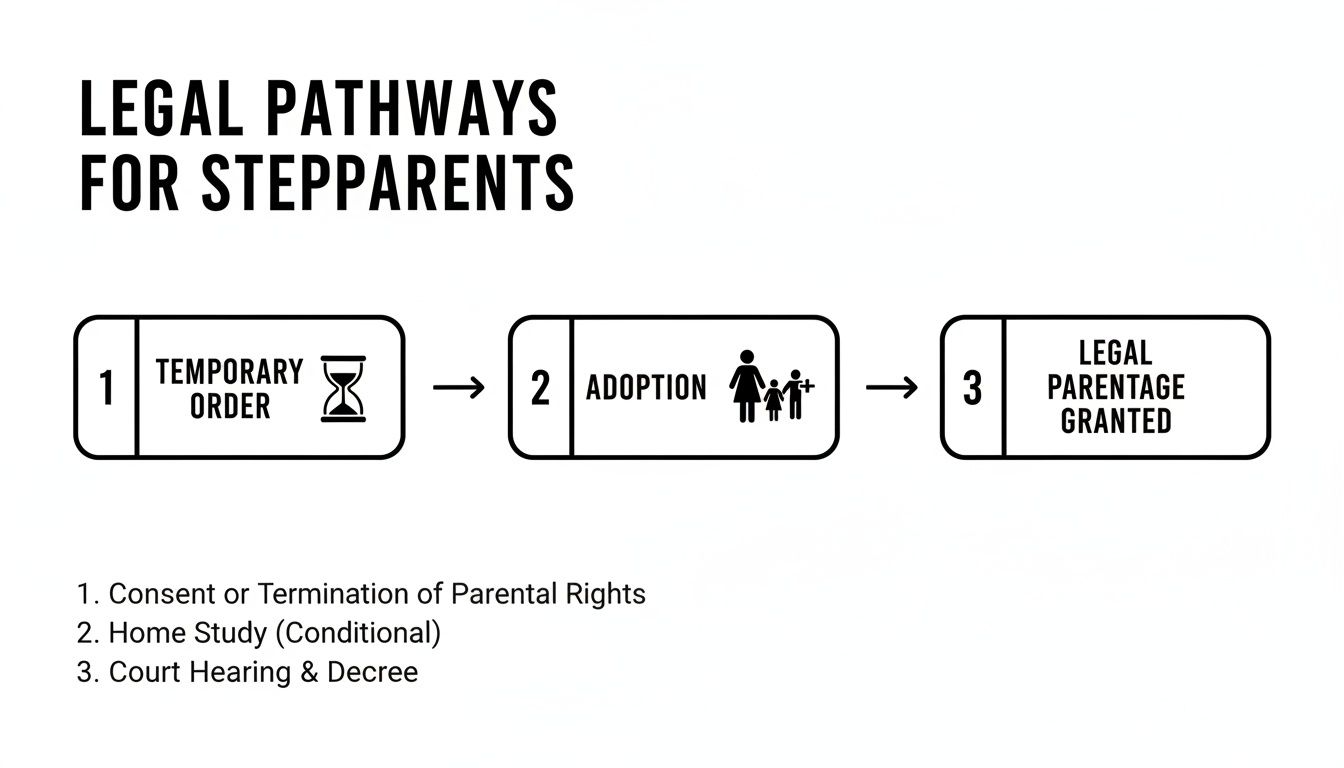
As this visual guide shows, while temporary orders are crucial in emergencies, adoption is the only way to become a full, permanent legal parent.
Step 4: Completing the Social Study
The court needs to be sure that your home is a safe, stable, and loving place for the child. This is usually done through a social study, which involves a home visit and interviews with your family.
The good news? In many stepparent adoptions, the court may waive the social study. Since the child is already living in a stable home with one biological parent and the stepparent, the judge often sees it as unnecessary, which helps simplify and speed up the process.
Step 5: The Final Adoption Hearing
The last stop is a hearing in front of a judge, which is usually a happy and celebratory day. You, your spouse, and your child will appear in court. The judge will review the file and ask a few simple questions to make sure everything is in order.
Once the judge is satisfied that the adoption is in the child's best interest, they will sign the final decree of adoption. In that moment, you officially become the child's legal parent, with all the rights and responsibilities that entails. The court will then issue an amended birth certificate with your name on it, cementing your family forever.
For a deeper dive into the specifics, you can explore our guide to stepparent adoption requirements in Texas.
Understanding the Best Interest of the Child Standard

Whether you’re hoping for custody or moving forward with a stepparent adoption, every decision a Texas judge makes comes down to a single, powerful idea: the best interest of the child. This isn't just a legal catchphrase; it's the North Star for every family law case, ensuring a child's well-being is always the top priority.
This standard forces the court to look past what the adults want and focus squarely on what environment will help the child thrive—emotionally, physically, and mentally. For a stepparent, this means showing the court that your presence isn't just helpful, but a vital source of stability, love, and security in that child's life.
The Holley Factors: What Courts Actually Look For
To give this broad concept some teeth, Texas courts lean on a set of criteria known as the "Holley Factors." Think of these as the judge's toolkit for building a complete picture of the child's world and figuring out what living situation truly serves their best interests.
While it’s not a rigid checklist, these factors create a framework for the court’s decision-making. They include things like:
- The child's emotional and physical needs, both right now and in the future.
- Any emotional or physical danger the child might face.
- The parenting abilities of the people seeking custody.
- The stability of the proposed home.
- The plans and resources available to care for the child.
- Any actions or failures to act by a parent that suggest an unhealthy relationship.
When a judge weighs these factors, they're really trying to gauge who can provide a nurturing and dependable home. A big piece of this is showing the characteristics of a good parent in a way that proves you’re essential to the child's overall well-being.
A Real-Life Example of "Best Interest"
Let's imagine a stepfather, David, who has been raising his 10-year-old stepson, Leo, since he was a toddler. Leo's biological father has been mostly out of the picture, with only a few calls and visits over the years. David is the one who helps with homework, coaches the baseball team, and provides day-in, day-out emotional support.
Now, David and his wife decide it's time for a stepparent adoption, but the biological father objects. This is where the Holley Factors come into play.
A judge would look at the stable, loving home David provides. They would see Leo's deep emotional bond with David and contrast it with the weak relationship he has with his biological father. The court would almost certainly find that making David's role official through adoption is in Leo's best interest. Why? Because it guarantees the continuation of the only consistent father-figure relationship he has ever known.
This process often involves the tough but necessary step of ending the other parent's legal connection, a topic we cover in our guide on terminating parental rights in Texas.
Ultimately, your case isn’t just about your desire to be a legal parent. It’s about demonstrating to the court that your relationship is a cornerstone of the child's happiness and security, and that legally solidifying that bond is the best possible outcome for them.
Common Questions About Stepparent Rights in Texas
When you step into the role of a stepparent, your heart doesn't see the legal lines—you just see a child you love. But the law sees things differently, and that gap between love and legality is where a lot of tough questions come up. You've poured your life into this child, and you need to know your family is protected, no matter what the future holds.
Let's clear up the confusion around some of the most common worries we hear from stepparents every day. Our goal is to give you straight, honest answers so you can feel confident in your next steps.
If My Spouse Dies Do I Automatically Get Custody
This is probably the most difficult question a stepparent has to ask, and the answer can be just as hard to hear. No, you do not automatically get custody of your stepchild if your spouse passes away.
In the eyes of the Texas courts, the surviving biological parent is next in line for sole custody, as long as they are fit to parent. Your bond, no matter how strong, isn't legally recognized without a formal adoption. This means that in the midst of grieving, your family could be torn apart, and your stepchild could be moved to live with a biological parent who has barely been in their life.
It's a heartbreaking reality, and it’s precisely why stepparent adoption is so important. Adoption creates a permanent, legal bond that tragedy cannot break. It makes you a legal parent, period, with every right to keep raising the child you love.
Must the Other Biological Parent Agree to the Adoption
Yes, for a stepparent adoption to move forward, the parental rights of the other biological parent have to be legally terminated. This is a critical step to ensure the child has two—and only two—legal parents.
Ideally, this happens smoothly and cooperatively. There are really two ways this can play out:
Voluntary Consent: The simplest path is when the other biological parent agrees that the adoption is what's best for the child. They'll sign a legal document, an affidavit of voluntary relinquishment, which officially ends their parental rights and opens the door for you to adopt.
Involuntary Termination: Things get more complicated when the other parent won't consent or simply can't be found. In that case, you have to petition the court to terminate their rights against their will. This is a very serious legal action, and a judge won't take it lightly. You'll need to present clear and convincing evidence that there are legal grounds for termination under the Texas Family Code, such as abandonment, neglect, or behavior that endangers the child.
Every family's story is different, and this part of the journey requires careful, compassionate legal advice to ensure the child's best interests remain the top priority.
What Happens if We Get Divorced
The fear of divorce is another heavy weight for many stepparents. If you haven't adopted your stepchild, a divorce effectively ends your legal relationship with them. You are not considered a legal parent, so you have no automatic right to fight for custody or even guaranteed visitation.
Once the marriage that created the stepparent-stepchild relationship ends, so does your legal connection. It's a painful reality that underscores the importance of formalizing your parental role when you have the chance.
This is where adoption changes everything. It transforms your parental status from one based on marriage to one based on law. An adopted child is legally your child, forever. If you and your spouse were to divorce later on, you would have the exact same rights as a biological parent to seek custody and stay in your child's life. Adoption ensures your bond is built to last.
How Long Does a Stepparent Adoption Take
There's no single timeline for a stepparent adoption in Texas because every family's situation is unique. The biggest factor is how cooperative the other biological parent is.
If the other parent is on board and consents to the adoption, the process can be pretty straightforward. In these best-case scenarios, an adoption can often be finalized in as little as four to six months.
However, if the adoption is contested and you have to go to court to terminate the other parent's rights, the process will take significantly longer. Contested cases involve gathering evidence, court hearings, and more complex legal work, which could stretch the timeline to a year or more. The county you're in and the court's own schedule also play a role. A good adoption attorney can look at your specific circumstances and give you a much clearer idea of what to expect.
Understanding your rights is the first step toward securing your family's future. If you are a stepparent in Texas considering adoption, you don't have to navigate this journey alone. The dedicated team at the Law Office of Bryan Fagan, PLLC is here to provide the compassionate guidance and legal expertise you need. We invite you to schedule a free consultation to discuss your unique situation and learn how we can help you build a permanent, legally protected bond with the child you love. Visit us at https://texasfamilyadoption.com to get started.
