 Skip to content
Bringing a newborn into your home is one of life’s most profound experiences. For many hopeful parents in Texas, the idea of newborn foster care adoption feels like the perfect way to build a family. And while it is possible to adopt an infant from the Texas foster care system, it’s important to understand that this is almost always a foster-to-adopt journey. The primary focus of the Texas Department of Family and Protective Services (DFPS) is, first and foremost, the child's safety and the potential for them to be reunified with their birth family.
This path requires a special kind of heart—one filled with love, incredible patience, and a deep respect for the system's goal of family unity whenever possible.
The Reality of Adopting a Newborn from Foster Care

Many families dream of adopting a newborn straight from the hospital through foster care, but it’s crucial to frame this journey with realistic expectations. When a newborn enters state care, the primary legal goal, as outlined by the Texas Family Code, is almost always reunification with the biological parents.
As a foster family, your role is to provide a safe, loving, and stable home for that infant while their parents work to complete a court-ordered service plan. You are, first and foremost, a foster parent. The chance to adopt only comes if the court decides that reunification is not in the child's best interest and terminates the biological parents' rights. This entire legal process is guided by the Texas Family Code, which puts the child’s long-term well-being above all else.
The Overwhelming Need for Infant Care
The need for loving homes for our state's youngest children is undeniable. Newborns and infants are among the most vulnerable children entering the system. In 2023, infants under one year old entered foster care at a much higher rate than older children—about 9.4 infants per 1,000. That’s more than three times the entry rate for children ages 1 to 5. These numbers underscore just how critical it is to have foster families who are ready for the unique demands of caring for a newborn.
Part of that readiness is understanding an infant's immediate health needs. Getting familiar with assessments like the Apgar score can help you become a better advocate for the child in your care from their very first days.
This journey is less about finding a child for your family and more about becoming a family for a child in need. It's a path defined by unconditional love, resilience, and the willingness to support a child, whatever the outcome.
At The Law Office of Bryan Fagan, PLLC, we see the immense courage and heart it takes to step into this role. Our guide on adopting from foster care in Texas provides a deeper look into the overall process.
Preparing Your Heart and Home for a Newborn
The road to adopting a newborn from foster care in Texas doesn't start the moment a baby is placed in your arms. It begins much earlier, with the thoughtful, sometimes intense, process of preparing your home and your heart. This foundational stage is all about becoming a licensed foster home—the main pathway to adopting an infant from state care.
Let's imagine a hopeful couple, Sarah and David. They've dreamed of being parents for years and feel a strong pull toward opening their home to a child in need. Their first real step is reaching out to a licensed child-placing agency in their local Texas community. This agency will become their guide, walking them through the initial requirements with clarity and compassion.
Understanding the Core Eligibility Requirements
Before anything else, Texas has a set of core requirements to make sure every potential foster parent is ready for this huge responsibility. Every situation is unique, of course, but the state is looking for a solid baseline of stability and maturity.
Here are the key eligibility criteria you'll need to meet:
- You must be at least 21 years old.
- You don’t need to be rich, but you must show you can support your household financially without the foster care stipend.
- You need a stable living situation, whether you own or rent your home.
- Every adult living in the home has to pass comprehensive criminal background and child abuse registry checks.
These rules, laid out in the Texas Family Code, aren't meant to be obstacles. They’re safeguards designed to put the child's well-being first.
The Application and Training Process
For Sarah and David, the next phase is all about paperwork and training. They’ll submit a detailed application to their agency, sharing information about their background, lifestyle, and what’s driving their desire to foster. This is a time for some real, honest self-reflection—a chance to truly consider the commitment they're about to make.
The paperwork might feel like a mountain, but every single question serves a purpose: to build a complete picture of the loving home you can offer. Think of it as a collaboration between you and your agency, all working toward the same goal of creating a safe haven for a child.
A huge part of this stage is the mandatory training. Most agencies in Texas use a curriculum called PRIDE (Parent Resources for Information, Development, and Education). This isn't just a boring lecture series; it’s an interactive experience. You'll learn about how the foster care system works, trauma-informed parenting, and the unique needs of children who have been through the trauma of separation and loss. Sarah and David found these sessions incredibly eye-opening, allowing them to connect with other hopeful parents and gain a much deeper understanding of the emotional side of foster care.
As you get your home ready, it helps to have a good checklist. This detailed newborn essentials shopping list can be a lifesaver, ensuring you have everything you need before your new arrival comes home.
This whole licensing phase—from that first phone call to the final approval—is a journey in itself. It’s followed by an even more personal step: the home study. To get a better handle on this crucial component, you can learn more about what a home study for adoption entails in our detailed guide. Completing these initial steps officially opens the door for you to be considered for a placement, bringing you one step closer to welcoming a child into your life.
Navigating the Home Study and Matching Journey
The home study. For many hopeful parents, this is the part of the process that brings on a case of the nerves. There's a common fear that it’s a white-glove inspection, where a stranger will judge every corner of your life under a microscope.
Let’s reframe that. The home study is actually a partnership between you and your social worker. Its goal isn't to find a "perfect" family—because those don't exist. The real purpose is to make sure you can provide a safe, stable, and loving home for a newborn who desperately needs one. This entire process is guided by the Texas Family Code, which puts the child’s best interests above all else. It's about your ability to care, not about surface-level perfection.
What the Texas Home Study Truly Involves
At its core, a home study is just a series of conversations paired with a basic home safety check. Your social worker wants to get to know you. They’ll ask about your background, your relationship with your partner (if you have one), your ideas about parenting, and the circle of friends and family you lean on for support.
Be prepared to talk about your own childhood, what led you to adoption, and how you cope with stress. This is your chance to be real. For example, if you have a family member who went through recovery years ago, don't hide it. Talk about how that experience gave you a deeper understanding of trauma and resilience. This isn't a test with trick questions; it’s an opportunity to show you have empathy and a real-world perspective.
The safety check is much more straightforward than people think. Your social worker is just looking for the basics:
- Working smoke detectors
- A plan to secure medications and cleaning supplies
- A safe place for a baby to sleep
- Covered electrical outlets
These aren’t meant to be complicated hurdles. They’re simple, practical steps to get your home ready for a vulnerable infant.
To give you a better sense of where the home study fits in, here’s a look at the overall preparation process.
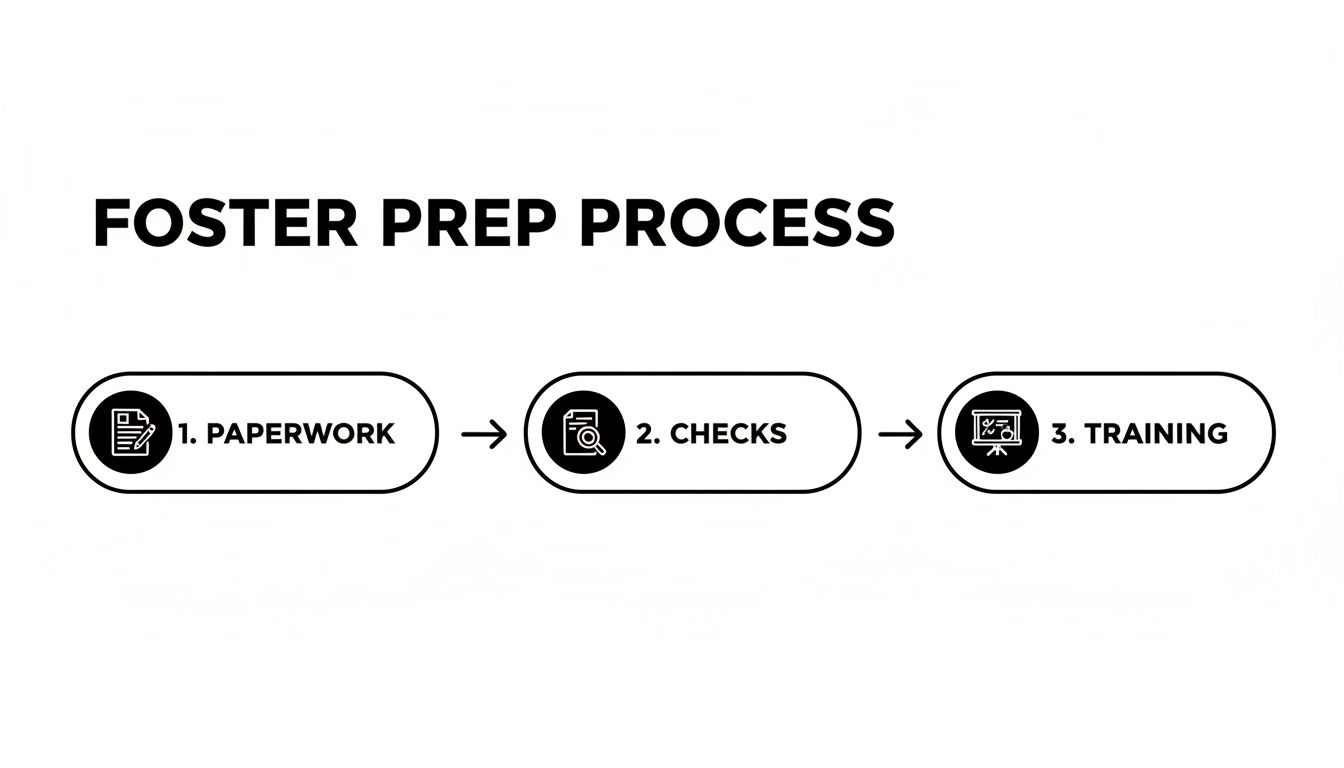
As you can see, the home study is just one piece of a structured journey designed to prepare you for success.
To give you a clearer picture of the entire journey, here's a breakdown of the major milestones involved in the Texas foster-to-adopt process.
Key Stages of the Texas Foster-to-Adopt Process
| Stage | Primary Goal | Key Activities |
|---|---|---|
| Initial Inquiry & Info Session | Learn about the process and agency options. | Attending informational meetings, choosing a licensed child-placing agency. |
| Application & Training | Fulfill state requirements for prospective parents. | Completing paperwork, attending PRIDE training, background checks, fingerprinting. |
| Home Study & Licensing | Ensure the home is safe and the family is prepared. | Interviews with a social worker, home safety inspection, finalizing the report. |
| Waiting & Matching | Identify a potential child placement. | Agency reviews your profile when a child needs a home; caseworkers look for the best fit. |
| Placement | Welcome a child into your home. | Receiving "the call," preparing for the child's arrival, initial adjustment period. |
| Post-Placement Supervision | Support the family and monitor the child's well-being. | Regular visits and check-ins from your social worker for at least six months. |
| Finalization | Legally complete the adoption. | Filing the adoption petition in court, attending the finalization hearing. |
This table helps put each step into perspective, showing how everything from training to the final court date fits together to build your family.
The Matching Process: Patience and Honesty Are Key
Once your home study is approved and you’re officially a licensed foster home, the waiting begins. And this is where patience becomes your most important tool. When a newborn needs an emergency placement, caseworkers from DFPS and your agency don't just go down a list. This is not a "first-come, first-served" system. They carefully review the profiles of available families to find the best possible fit for that specific child's needs.
Being honest with yourself and your agency about what situations you feel equipped to handle is one of the most important things you can do. It doesn't show weakness; it shows self-awareness and puts the child's needs first.
Many newborns entering foster care, for instance, have had prenatal exposure to substances. If you feel prepared to care for a baby who might experience withdrawal or have other medical challenges, say so. If you're in a two-parent household where one parent can stay home, that could make you a perfect match for an infant with a lot of doctor's appointments.
On the other hand, if you know you don't have the capacity to handle certain high-level medical needs, it is crucial to be upfront about it. A good caseworker will appreciate your honesty because it helps them make a stable, sustainable match—which is the goal for everyone involved.
"The call" can come at any time, day or night. It might be a fast, direct conversation: "We have a baby boy at the hospital who needs a placement. Can you be there in an hour?" In that single moment, all the training, paperwork, and waiting come together. By tackling this journey with an open heart and a flexible mindset, you position yourself to be the safe harbor that child so desperately needs.
The Legal Path to Becoming a Forever Family
Once a newborn is placed in your home, the journey enters a deeply emotional and legally critical phase. This is where the hope of building a forever family meets the complex realities of the Texas legal system.
The path forward hinges on a process known as the termination of parental rights, a necessary legal step before any adoption can be finalized. It’s a period guided by the Texas Family Code, which prioritizes one thing above all: a child's need for a safe, permanent home. While the law respects the rights of biological parents, the child’s well-being remains the central focus of every court decision.
Understanding Termination of Parental Rights
For an adoption to move forward, the legal ties between the biological parents and the child have to be permanently severed. In Texas, this happens in one of two ways: either through voluntary relinquishment or involuntary termination.
Voluntary relinquishment is when a birth parent makes the difficult and often loving decision to sign legal documents giving up their parental rights. It's a profound choice, made with specific legal formalities to be valid.
Involuntary termination, on the other hand, is a court-ordered process. This happens when a judge determines, based on clear and convincing evidence, that a parent has engaged in conduct harmful to the child and that ending their rights is in the child’s best interest. The grounds for this are strictly defined in Texas Family Code Chapter 161.
Some of these grounds include:
- Endangering the child's physical or emotional well-being
- Failing to complete court-ordered services designed for reunification
- Abandoning the child without support or contact
- Knowingly placing the child in dangerous conditions
This legal process can feel overwhelming, but it’s designed with one unwavering goal: to provide permanency for a child. Each step is a deliberate legal action to ensure a child doesn't linger in the uncertainty of temporary care.
Navigating the nuances of this process requires a deep understanding of Texas law. For a more detailed look, our firm offers a complete guide on the termination of parental rights in Texas.
A Scenario: The Wait for Permanency
Imagine you’ve been caring for a baby boy, Leo, since he was three days old. For six months, you’ve attended every doctor’s appointment, soothed him through sleepless nights, and celebrated every tiny milestone. Meanwhile, his birth parents have been working on their court-ordered service plan.
You attend every court hearing, listening as the judge reviews the parents' progress. The court’s primary goal is always reunification, if possible. But as the months pass, it becomes clear the parents aren't meeting the requirements needed to provide a safe home for Leo. Eventually, the caseworker changes the permanency goal from reunification to adoption.
This is the turning point. The state’s attorney will now petition the court to terminate parental rights, leading to a trial where evidence is presented. As foster parents, you may be asked to testify about Leo’s progress and your commitment to him. It’s an emotionally charged time filled with uncertainty, but it’s a necessary legal step toward giving Leo the stable future he deserves.
The Post-Placement Period and Finalization
After the court has terminated the biological parents' rights, the journey isn't quite over. The next stage is the post-placement supervision period. According to the Texas Family Code, a child must live with the prospective adoptive parents for at least six months before the adoption can be finalized.
During this time, your social worker will continue to visit your home. These visits are supportive, meant to ensure that your family and the baby are adjusting well and to serve as a resource for you.
This period also highlights the pressing need for loving homes. In fiscal year 2024, 34,817 children remained in foster care despite being legally free for adoption with a primary plan of adoption. To learn more about the national landscape, you can discover more insights about foster care and adoption statistics.
Once the post-placement period is complete and all legal requirements are met, the final step is the adoption finalization hearing. This is the joyful day you officially go to court to become a forever family. A judge will review the case, confirm everything is in order, and sign the final adoption decree. It’s a moment of profound celebration—the culmination of a long, emotional, and ultimately beautiful journey. This is the day you are no longer foster parents; you are simply parents.
How an Adoption Attorney Becomes Your Advocate
The journey to adopt a newborn from foster care is full of hope, but it can also be a rollercoaster. You're dealing with uncertain timelines, confusing court dates, and the real possibility that reunification could change your family’s future. It’s in these moments that a skilled adoption attorney stops being just a legal guide and becomes your family's fiercest advocate.

When the legal waters get choppy, that shift from guidance to advocacy is everything. The right legal support protects your rights as a prospective adoptive parent, but just as importantly, it gives you peace of mind during one of the most personal and stressful times of your life.
Navigating Unexpected Legal Challenges
Let’s imagine a scenario we see all too often. You've been fostering a beautiful baby girl, Maya, for nearly a year. You’re bonded, she’s thriving, and DFPS has officially changed the goal to adoption. Then, out of the blue, a relative you’ve never heard of comes forward demanding custody. Suddenly, your future is thrown into chaos.
It's a terrifying, gut-wrenching moment. Do they have a real claim? What are your rights as foster parents? Could you actually lose the child who is already a part of your family? This is precisely when an attorney from The Law Office of Bryan Fagan, PLLC steps in to champion your cause.
Your attorney’s first move is to dive deep into the case, making sure every detail aligns with the Texas Family Code. They will:
- Investigate the Claim: Your lawyer will dig into the relative's legal standing. Do they even meet the criteria to be considered a placement option?
- Advocate for the Child's Best Interest: They’ll build a powerful case showing that Maya’s best interest—the court’s number one priority—is to remain in your stable, loving home.
- Represent You in Court: In every hearing, your attorney will be your voice, presenting clear, compelling arguments to the judge so you are heard loud and clear.
In these high-stakes situations, your attorney is more than just a legal representative; they are your strategic partner, fighting to protect the family you've already built. They provide the legal muscle you need when all your emotional energy is focused on caring for your child.
Ensuring Meticulous Legal Compliance
Beyond courtroom drama, an adoption attorney manages the mountain of details that can make or break a case. The legal process for a newborn foster care adoption is a minefield of deadlines, specific documents, and procedural rules laid out in Chapters 162-166 of the Texas Family Code.
A single missed deadline or an improperly filed form can cause massive delays or even jeopardize the entire adoption. Your attorney is your safeguard. They make sure every legal box is ticked with precision, from filing the initial adoption petition to coordinating with DFPS and the court to lock in that finalization hearing. This obsessive attention to detail lifts the administrative weight off your shoulders so you can focus on what really matters—being a parent.
Providing Compassionate Counsel and Peace of Mind
Ultimately, your adoption attorney’s most important job is to be a calm, steady presence. They understand the emotional toll this journey takes. They’re there to answer your late-night questions, translate confusing legal notices into plain English, and offer reassurance when you feel like you’re at your breaking point.
Knowing you have an experienced advocate from The Law Office of Bryan Fagan, PLLC in your corner gives you the confidence to face whatever comes next. With the right legal support, those hurdles become manageable steps on your path to building a forever family.
If you are navigating the complexities of a foster care adoption, you don’t have to do it alone. We invite you to schedule a free consultation with our team. Let us empower you to take the next step toward building your family.
Common Questions About Texas Newborn Adoption
Starting the journey to adopt a newborn from foster care in Texas naturally comes with a lot of questions. Below, we've tackled some of the most common ones we hear from hopeful families, offering clear answers to help you feel more confident as you move forward.
How Much Does It Cost to Adopt a Newborn from Foster Care?
This is often the first question on everyone's mind, and the answer usually comes as a huge relief: adopting from the Texas foster care system is typically free or costs very little. The state’s goal is to remove financial hurdles for loving families. Because of this, state and federal subsidies are available to cover most—if not all—of the legal fees and court costs tied to the adoption.
On top of that, many families also qualify for ongoing financial support and Medicaid coverage for their child until they turn 18. This means your main expenses will be for getting your home ready and the day-to-day costs of raising a child, not the legal process itself.
Can I Specify That I Only Want a Newborn?
Yes, you can absolutely state a preference for an infant when you start the process. But it’s important to remember that flexibility is probably the single most valuable trait for a successful foster-to-adopt parent. The top priority for the Texas Department of Family and Protective Services (DFPS) is always reunification with the birth family, whenever it’s safe and possible.
When a newborn comes into your home, it's a foster placement first. Adoption only becomes the official goal after a judge decides that reunification isn't in the child’s best interest and terminates parental rights. Learning to embrace that uncertainty is a huge part of the journey.
What Happens if the Birth Parents Complete Their Service Plan?
This is a real possibility, and it's an emotionally tough one that every foster parent needs to be prepared for. If the biological parents successfully do everything required by their court-ordered service plan and the judge agrees it’s in the child’s best interest, the child will go back to their care.
It’s an incredibly difficult outcome for foster parents who have already bonded deeply with the child.
This is where an experienced adoption attorney becomes invaluable. They can make sure you understand the legal standards for reunification, keep you in the loop after every court hearing, and protect your rights as foster parents throughout the case.
Having a lawyer in your corner brings clarity and support during these shaky moments. It’s also a reminder that your role in giving that child a safe harbor was priceless, no matter what the final decision is.
How Long Does the Entire Process Take?
There's no single answer here—timelines can be wildly different from one case to the next, so patience is key. But here’s a general breakdown of what you can probably expect:
- Licensing: Getting your home licensed to foster can take anywhere from 4 to 8 months. This includes all the training, background checks, and the home study.
- The Legal Case: After a newborn is placed with you, the legal case for the birth parents can last from 6 to 18 months, sometimes even longer, as the court works toward a permanent solution.
- Finalization: Once parental rights are legally terminated for good, the adoption itself is usually finalized within a few more months.
All in all, from your very first info session to the day you stand before the judge for finalization, the entire journey for a newborn foster care adoption often takes between 1.5 to 3 years.
Building your family through adoption is a journey of the heart, and you don’t have to walk it alone. The compassionate attorneys at The Law Office of Bryan Fagan, PLLC are here to provide the legal guidance and advocacy you need at every step. If you're ready to explore your options or need support with your case, please schedule a free, no-obligation consultation with our dedicated team today.

