 Skip to content
You may be reading this late at night, with a lot on your mind.
Maybe you're an expectant mother trying to protect your privacy while making an act-of-love decision. Maybe you're a hopeful adoptive parent who wants to grow your family but also wants clear boundaries from the start. Maybe you're an adult adoptee carrying quiet questions about where you came from. In Texas, all of those feelings can exist at once. Hope. Grief. Relief. Fear. Love.
Closed adoption can sound simple at first, but it rarely feels simple to the people living it. Legal terms like sealed records, relinquishment, and finalization can make an already emotional decision feel even heavier. That’s why it helps to slow the process down and explain it in plain English.
If you're considering this path, it may also help to read about how placing a baby for adoption works in Texas. Many families start there because it answers the first, most human question: what happens next?
Embarking on Your Adoption Journey in Texas
A closed adoption texas case often begins with a very personal need for privacy.
For one birth mother, that might mean wanting to move forward without ongoing contact because the pregnancy came during a painful chapter of life. For an adoptive couple, it might mean wanting clarity and stability so they can focus on bonding with their child. For both sides, the choice usually isn't about being cold or distant. It's about safety, peace, and emotional boundaries.
Texas law recognizes that adoption doesn't look the same for every family. Some adoptions are open. Some are semi-open. Some are closed. Each option creates a different level of contact and a different legal structure after the child is placed.
A good adoption plan isn't the one that sounds nicest on paper. It's the one that fits the child's needs and the adults' ability to live with it honestly and respectfully.
When families first hear the phrase closed adoption, they often assume it means secrecy in every possible sense. That isn't quite right. It means the legal process is designed to keep identifying information and records confidential after the adoption is finalized. That privacy can feel comforting to some families and hard to others.
The most important starting point is this. Choosing an adoption path isn't a test you have to pass. It's a decision you deserve to understand. When you understand the legal rules and the emotional tradeoffs, you can make a choice with more calm and less fear.
What Closed Adoption Truly Means in Texas Today
A closed adoption means there is no ongoing contact and no sharing of identifying information between the birth family and the adoptive family after the adoption is finalized. In Texas, that privacy is backed by sealed records and court procedures, not just by an informal promise. If you'd like a basic legal definition first, this guide on what closed adoption means in Texas is a helpful companion.
Think of it like a sealed file
One way to understand closed adoption is to picture a sealed time capsule kept by the court and the state. The adoption still happens. The child still becomes a legal member of the adoptive family. But the identifying records connected to the child's original birth and the court case are locked away from public access.
That does not mean the child is unloved, hidden, or cut off from all truth. It means the law places a firm privacy boundary around the adoption.
Families often get confused here because the word closed can describe two related ideas at once:
- Legal confidentiality: the records are sealed.
- Relationship boundaries: the parties don't continue direct contact after placement.
In everyday conversation, people blend those together. In practice, both matter.
How common is closed adoption now
Closed adoption is not equally common in every kind of Texas adoption. According to American Adoptions of Texas on what closed adoption is, approximately 95% of domestic infant adoptions today are open, leaving closed adoptions accounting for only about 5% of these cases. In contrast, for foster care adoptions, 85% are closed.
That distinction matters.
If you're looking at a private infant adoption, a fully closed arrangement is now less common. Many agencies and professionals encourage some level of openness because it can reduce uncertainty and preserve access to background information. But less common does not mean impossible. Texas families can still choose a private closed adoption if the legal requirements are met.
If you're looking at a foster care adoption, closed arrangements are far more typical. Those cases often involve terminated parental rights and a stronger need for privacy and legal finality.
Plain-English takeaway: In modern Texas practice, closed adoption is a narrower lane in private infant cases, but it's still a very real and important option for some families.
Why some families still choose it
Families choose closed adoption for different reasons, and none of those reasons should be reduced to a stereotype.
A birth parent may want privacy from family conflict, trauma, or social pressure. Adoptive parents may believe strong boundaries will help everyone heal and move forward. In some situations, safety concerns make distance feel necessary. In others, emotional closure matters most.
A child-centered approach asks a different question. Not "Which model sounds ideal?" but "Which structure gives this child stability, honesty, and protection?"
That question often leads people to very different answers.
The Legal Foundation of Closed Adoptions in Texas
Texas doesn't treat a closed adoption as a casual arrangement. It treats it as a legal status created and protected by court order.
The main rules come from Texas Family Code Chapters 162 through 166. In plain language, those chapters govern how an adoption is filed, how parental rights are addressed, how the court reviews the case, and how confidentiality works after finalization.
What the court seals
In a Texas closed adoption, the court seals the original birth certificate and the adoption court file. As explained in this discussion of closed adoption meaning in Texas, original birth certificates and all court files are sealed by court order.
That sealing serves a purpose. It protects privacy for the child, the birth family, and the adoptive family. It also reinforces finality, which is a major value in adoption law. Once the court finalizes the adoption, the adoptive parents step fully into the legal role of parents.
Here’s the practical effect of sealing:
- Public access is blocked: these records aren't open for general viewing.
- Birth family access is restricted: they can't directly request the file because they were part of the child's history.
- Adoptive family access is also limited: they don't automatically get every original record just because they finalized the adoption.
That surprises many people. They assume the adoptive parents "own" the file after finalization. They don't. The court controls sealed adoption records.
The meaning of good cause
Texas law does allow a person to ask the court to unseal records later. But the standard is high. A petitioner has to show good cause, meaning a compelling reason that outweighs the state's interest in keeping the adoption confidential.
Simple curiosity isn't enough.
Legal reality: Courts don't reopen sealed adoption records just because someone wants fuller family history. The person asking has to present a serious reason that justifies breaking confidentiality.
That can matter greatly for adult adoptees, birth relatives, and adoptive parents facing medical questions. But even in emotionally understandable situations, the court still applies a strict standard.
Why finality matters so much
Closed adoption can feel rigid, especially when emotions change over time. Yet Texas law values finality because children need permanence. The legal system tries to prevent a child from living in uncertainty about who their parents are or whether past relationships can reopen the case.
That finality also explains why families need to think carefully before agreeing to a closed arrangement. The decision isn't just about how everyone feels this month. It's about the long-term legal structure around the child.
A compassionate lawyer's role is not to push one model over another. It's to help you understand what the law protects, what the law limits, and what may be very hard to undo later.
A Guide for Birth Parents Adoptees and Adoptive Families
Every closed adoption texas story has more than one heart in it.
The law creates the structure, but people live inside that structure for years. A birth mother may carry grief and peace at the same time. Adoptive parents may feel joy mixed with uncertainty about future questions. An adoptee may grow up loved and secure, yet still wonder where certain features, talents, or health history came from.

For birth parents
For some birth parents, closed adoption offers breathing room.
If contact would reopen trauma, intensify family pressure, or make healing harder, privacy can feel merciful. A closed plan can create a defined ending point. That matters when a person is already making one of the hardest decisions of their life.
But privacy doesn't erase grief. A birth parent may feel confident in the decision and still mourn a great deal. Both can be true.
A common real-life example looks like this: a young woman chooses adoption because she isn't in a stable place to parent and doesn't want continued contact because it would keep her in a painful relationship dynamic with the child's father or with her own family. Closed adoption gives her a path that feels safer. It does not mean she cares less. Often it means she is trying to survive the decision with as much dignity as possible.
For adoptive parents
Adoptive parents often come to closed adoption hoping for clarity.
They may want to focus on attachment without the uncertainty that ongoing contact can sometimes bring. They may also believe a clean legal boundary will reduce conflict and help them establish family routines. Those are understandable hopes.
Still, closed adoption asks parents to prepare for future identity questions from their child. A child might ask about medical history, ethnicity, family traits, or the reasons behind the adoption. Loving parents don't need to have every answer. They do need to make room for the questions.
Helpful habits often include:
- Keep age-appropriate honesty: tell the child's story gently and truthfully.
- Save nonidentifying details: any lawful background information can become meaningful later.
- Avoid shame-based language: don't treat the adoption as something secretive or embarrassing.
- Stay open emotionally, even if the adoption is closed legally: your child needs safety around curiosity.
Children handle hard truths better than hidden tension. They usually sense when adults are afraid of the topic.
For adoptees
For adoptees, closed adoption can become a lifelong identity journey.
Some children ask many questions early. Others don't ask much until the teen years or adulthood. Neither response is wrong. Curiosity about origins doesn't mean disloyalty to adoptive parents. It means the person is human.
An adult adoptee may wonder, "Who do I look like?" Another may want medical history before becoming a parent. Another may want to know the story of why the adoption happened.
Those questions can stir up abandonment pain, even in loving families. Some adoptees find it helpful to learn from Securely Loved when working through feelings tied to separation, identity, and attachment. Emotional support and legal information often need to work together.
For relatives trying to support everyone
Grandparents, siblings, and extended family members often feel left out or helpless in a closed adoption.
They may want to support the child while also respecting the legal boundary. The best way to help is usually simple and steady: respect the adoption plan, avoid blame, and speak about all parties with care. Children benefit when the adults around them resist turning adoption into a battlefield of competing loyalties.
The Step-by-Step Process for a Private Closed Adoption
A lot of Texas families choose private infant adoption because they want a more direct path than foster care. Then the paperwork starts, the hospital questions come up, and the process can suddenly feel hard to read. It helps to see the legal steps in order, the way you would follow a map before a long drive.

For a private closed adoption in Texas, the path usually has five parts: choosing the right professionals, completing the home study, setting clear boundaries for a closed placement, filing the legal case, and waiting through post-placement supervision until finalization. Each step has its own job. Together, they create the legal foundation that turns a hoped-for placement into a recognized parent-child relationship.
Start with the right professionals
Private infant adoptions usually begin with assembling the people who will guide the case. That may include an adoption attorney, a licensed child-placing agency, or both.
Their roles are different. An attorney handles legal documents, court filings, consent issues, termination of parental rights, and the final hearing. An agency often helps with education, screening, matching, and placement support. The Law Office of Bryan Fagan, PLLC is one Texas firm that assists families with adoption filings, home-study preparation, and court proceedings.
This early stage is a bit like building the frame of a house. If the structure is crooked at the start, every later step becomes harder. Ask direct questions before you commit. Who speaks with the expectant mother? Who explains the difference between pre-birth communication and post-finalization privacy? Who keeps track of deadlines and signatures?
Home study and screening
Before a Texas court finalizes most private adoptions, the adoptive home must be evaluated through a home study.
That review usually includes background checks, interviews, documents about the household, and a safety review of the home. Families sometimes worry that the process is looking for perfection. It is not. The court wants a clear picture of whether this home is safe, stable, and prepared for a child.
You can usually expect requests for:
- Personal records: identification, financial information, and household background details.
- Home safety information: sleeping arrangements, general safety conditions, and child-ready features.
- Interviews: questions about parenting beliefs, marriage or relationship stability, daily routines, and support systems.
- Adoption goals: a clear explanation of why a closed arrangement is being requested and how that boundary will be respected.
This part can feel personal. That is normal. A home study is less like a test and more like a careful review the court uses before placing a child in a new legal family.
Matching and planning boundaries
In a private infant case, some communication often happens before placement even if the adoption will be closed after finalization.
That point trips up many families. "Closed" does not always mean there is no contact at any point. It usually means there will be no ongoing direct relationship and no continuing exchange of identifying information after the adoption is finalized, unless the legal structure later changes or records are accessed through a lawful process.
Before placement, professionals may still pass along medical information, discuss delivery and hospital preferences, and confirm how the child will be placed. That limited communication works like a relay system. Information can move where it needs to go without creating an ongoing direct connection between the parties.
Clarity matters here. If one side expects updates later and the other believes contact will fully end, the misunderstanding can leave everyone hurt. Put the boundaries in plain language from the start.
Texas also has timing rules for relinquishment. As explained in this overview of Texas adoption rules, a birth mother must wait at least 48 hours after birth before signing an affidavit of relinquishment of parental rights. That waiting period gives space for a serious decision to be made with legal formality and care.
Filing the case and moving toward placement
Once the required consents and termination documents are in place, the adoption case is filed with the court. If another legal parent's rights must be terminated or addressed, that issue must be handled correctly before the adoption can be finalized.
This is often the point where families feel buried in forms. Each document has a specific purpose. One may show consent. Another may establish identity, notice, or eligibility. The court is checking that every legal piece fits where it should, much like making sure every page of a contract is signed before a closing.
A short explainer can help if you want to hear more about the process in plain terms:
Post-placement supervision and finalization
Placement is a major milestone, but it is not the end of the legal process. Texas requires a period after placement before the final hearing, and during that time the court receives updated information about how the placement is going.
Post-placement supervision gives the judge a current picture of the child's living situation and the family's adjustment. In a private infant closed adoption, this step often feels quieter than the earlier stages, but it still matters. It is the court's final check before making the adoption permanent.
Then comes the finalization hearing.
For many adoptive parents, this is the moment when months of uncertainty finally settle. The judge signs the order completing the adoption, and in a closed adoption, the records are generally sealed in line with Texas law. What began as a private plan becomes a legal family, recognized and protected by the court.
Exploring Alternatives Open and Mediated Adoptions
Closed adoption isn't the only path Texas families consider. Many families compare it with semi-open and open adoption before making a final decision. The best fit depends on privacy needs, emotional capacity, safety concerns, and the child's long-term interests.
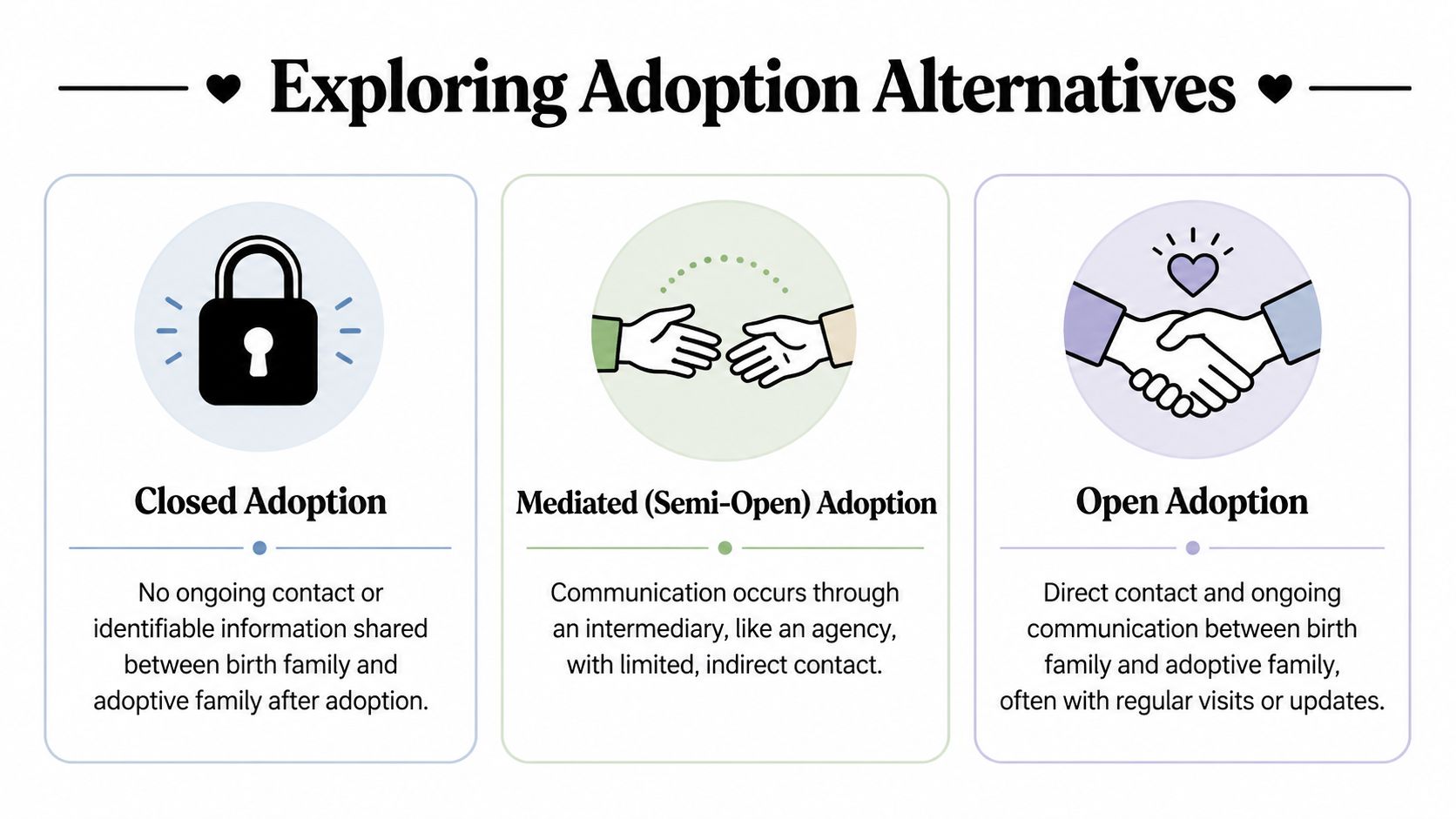
A side-by-side view
| Feature | Closed Adoption | Semi-Open Adoption | Open Adoption |
|---|---|---|---|
| Level of contact | No ongoing direct contact after finalization | Limited contact, often handled through an agency, attorney, or agreed channel | Direct ongoing communication between birth and adoptive families |
| Identifying information | Not shared | Often limited or partially protected | Usually shared more openly |
| Communication style | None after finalization | Updates or messages may pass through an intermediary | Direct messages, calls, visits, or updates depending on the relationship |
| Privacy boundary | Highest level of formal privacy | Moderate privacy | Lowest privacy, but often more relational transparency |
| Future flexibility | Usually limited by the original structure and sealed records | Can feel more adaptable if everyone cooperates | Can evolve over time if boundaries remain healthy |
| Legal certainty about no contact | Strongest from the outset | Relies on continued cooperation | Relies heavily on continued cooperation and healthy boundaries |
The middle ground of mediated adoption
Semi-open adoption often appeals to families who want some connection without fully blending family roles.
For example, a birth mother may want updates about the child but not face-to-face visits. Adoptive parents may want medical and background information while still protecting their home life and privacy. In those situations, an intermediary can help carry letters, photos, or agreed updates.
That middle ground can be comforting. It can also become confusing if the adults don't share the same expectations about how much contact is enough.
A key legal point about contact agreements
Texas allows families to create Post-Adoption Contact Agreements, often called PACAs. But there is a major legal limit. According to this explanation of open and closed adoption in Texas, PACAs are legally permissible to create but non-enforceable once the adoption is finalized.
That means adoptive parents may choose to honor the agreement, but birth parents do not have legal recourse to force contact after finalization.
This surprises many people because an agreement sounds binding. In this setting, it isn't.
If your peace depends on guaranteed future contact, Texas law may not give you the certainty you think a written agreement provides.
Questions to ask before choosing a model
A family choosing between closed, semi-open, and open adoption often benefits from a short set of honest questions:
- What kind of contact can we realistically sustain over time?
- Would privacy help us heal, or would it create more unanswered questions?
- Are there safety concerns that make distance necessary?
- How will this choice affect the child when they are older and asking deeper questions?
No chart can answer those questions for you. But asking them early can prevent heartache later.
Common Scenarios and Finding Answers
Some of the hardest closed adoption questions come years later.
A child grows up. An adoptee turns eighteen. A parent wonders whether records can ever be opened. A foster family asks whether their adoption will work the same way as a private infant case. These are practical questions, and they deserve practical answers.
When an adult adoptee wants to search
For many adult adoptees, the first legal step is not filing a court case. It is registering through the state system. As described by this guide to privacy and implications in Texas closed adoption, an adoptee in a closed Texas adoption can begin at age 18 by registering with the Texas Voluntary Central Adoption Registry, and a reunion can happen only if a birth parent or biological sibling has also registered.
That often brings mixed emotions. The registry gives a path forward, but it does not guarantee a match.
If you're considering that route, it also helps to understand the separate court process described in this resource on unsealing adoption records in Texas. Registration and court unsealing are not the same thing.
Two different paths people confuse
Families often blur these options together, so it helps to separate them:
- Registry path: an adult adoptee, birth parent, or biological sibling registers and waits to see if another eligible person has also registered.
- Court path: a person petitions the court and must meet the legal standard for access to sealed records.
The registry is about mutual consent. The court route is about legal justification.
How CPS and foster care cases differ
A foster care adoption usually feels different from a private infant adoption because the history is different.
In many CPS cases, the court has already terminated parental rights after serious concerns about the child's safety or welfare. That background often leads to a stronger privacy boundary after finalization. Families adopting from foster care may therefore encounter a process that feels more structured and less relationship-based than a private match.
A simple example helps. In a private infant adoption, adults may work together around a voluntary placement plan. In a CPS adoption, the state has often already been extensively involved because the child needed protection. Those different starting points shape the kind of adoption that follows.
If you're unsure where your case fits
That uncertainty is common. Some readers are considering kinship care. Others are adopting through CPS. Others are planning a private infant placement with a closed structure. Each path raises different legal questions, even though people use the same phrase, "closed adoption texas," to search for answers.
When the facts of your case don't fit a general article perfectly, that doesn't mean you're doing something wrong. It just means your next step should be personalized advice.
Take Your Next Step with Confidence and Support
A family may sit at the kitchen table late at night, asking the same question from different angles. Is a private infant closed adoption in Texas the right path for this child, for the birth parents, and for us? That question carries legal weight, but it also carries heartache, hope, and the need for privacy.
By this point, you have seen that a closed adoption is not solely a preference about contact. It is a legal structure with long-term effects. For families considering a private infant adoption in Texas, that means the details matter from the start, from consent and termination paperwork to the court process that leads to finalization. Getting clear advice early often prevents painful surprises later.
Adoption works a bit like building a house. The part people notice first is the future they hope to create. The foundation is the legal work underneath. If the foundation is steady, families can make decisions with more confidence and less fear.
No single adoption model fits every situation. Some families need strong privacy boundaries. Some want ongoing contact. Some are still sorting out whether their case involves a private infant placement, foster care, kinship care, or an adult adoptee's search for information. Asking those questions is wise, not a sign that you are behind.
If you want help sorting through your options, schedule a free consultation with Law Office of Bryan Fagan, PLLC. A confidential conversation can help you understand the Texas adoption process, protect your rights, and take the next step with more clarity and peace.

