 Skip to content
The phone rings after the baby is born. A birth mother is crying and asking whether she still has time to stop the adoption. In another home, hopeful adoptive parents are staring at their attorney’s email, afraid to open it because they don’t know whether the placement is secure.
That question carries a lot of fear because it sits at the center of two very human realities. One person may be grieving, exhausted, and unsure. Another may already cherish this child and fear losing the future they’ve been building toward.
Texas law does answer the question, but the answer depends on when the birth mother changes her mind. That timing matters more than is commonly understood. The legal rules are not one broad yes or no. They are a series of decision points, each with different consequences.
If you’re asking, Can a Birth Mother Change Her Mind After Adoption in Texas?, you probably need more than a short answer. You need a clear map of the process, in plain English, without legal jargon getting in the way.
A Compassionate Guide to a Difficult Question
A lot of readers arrive here in the middle of an emotional storm. A birth mother may be wondering if she made a decision too quickly. Adoptive parents may be trying to understand whether placement means finality. Grandparents or relatives may be involved too, especially in kinship situations where family pressure and emotions can become intense.
Texas adoption law tries to balance two concerns that both matter. It gives birth parents a window to make a voluntary decision with legal protections. It also gives children and adoptive families a path toward stability, because children need consistency and secure attachment.

Why this question feels so heavy
For a birth mother, changing her mind may feel like reclaiming control in a moment that has become overwhelming. For adoptive parents, the same moment may feel like the floor dropping out from under them.
Both reactions are understandable.
The confusion usually comes from one mistaken idea. People often think there is one simple “cooling-off period” that applies the same way in every Texas adoption. That isn’t how the law works. The rules turn on specific documents, specific deadlines, and whether a judge has already signed the final order.
The most important part of this issue is not just whether someone has regrets. It is where the case sits on the legal timeline.
The map of the points of no return
The clearest way to understand this area of law is to break it into stages:
- Before any relinquishment papers are signed: the birth mother can still choose not to proceed.
- After signing but within a limited revocation period in some cases: revocation may still be possible, but only by taking the required legal step.
- After that period passes: the consent usually becomes binding.
- After a judge finalizes the adoption: undoing the adoption becomes an extraordinary legal challenge.
That timeline matters in private infant adoptions, relative adoptions, and other Chapter 162 adoption cases alike. The child’s best interests stay at the center throughout, but the legal options narrow dramatically as the process moves forward.
The Legal Impact of Signing Relinquishment Papers
The most important document in this process is the Affidavit of Voluntary Relinquishment of Parental Rights. In plain language, this is the paper a birth parent signs to give up parental rights so an adoption can move forward.
That document is not supposed to be signed in the rush of childbirth. Under Texas adoption consent rules explained by American Adoptions, Texas Family Code Section 162.010 requires a 48-hour waiting period after birth before consent can be signed, and Section 162.011 allows revocation before the adoption order is rendered by filing a signed revocation. Before signing, a birth mother can change her mind freely. After signing, the legal terrain changes sharply.
What the 48-hour rule really does
This rule exists because the hours right after birth are physically and emotionally intense. Texas law builds in a pause so the decision is not made in the immediate shock of delivery.
That doesn’t mean the law assumes every signed affidavit is unfair. It means the law wants the decision to be made after at least some time for rest and reflection.
Here’s the practical takeaway:
- Pregnancy planning is not the same as legal consent. A birth mother may make an adoption plan while pregnant, but that plan is not the final legal step.
- Birth must happen first. No valid relinquishment can be signed before the child is born.
- Then the waiting period applies. Only after that period can the affidavit be signed.
Why signing changes everything
Once the affidavit is signed, the case shifts from a discussion about future possibilities to a legal question about revocation rights and enforceability.
That’s why independent review matters. If a parent speaks a language other than English, accurate document translation may also be essential so the parent fully understands what is being signed. In situations like that, families sometimes use Translators USA legal services to help ensure legal documents are understood clearly.
A signed relinquishment is not “just paperwork.” It is the event that gives the adoption process legal momentum. If you want to see how that document works in practice, this guide to the Texas release of parental rights form is a helpful companion.
Practical rule: Before signing, ask every question. After signing, options become much narrower and more technical.
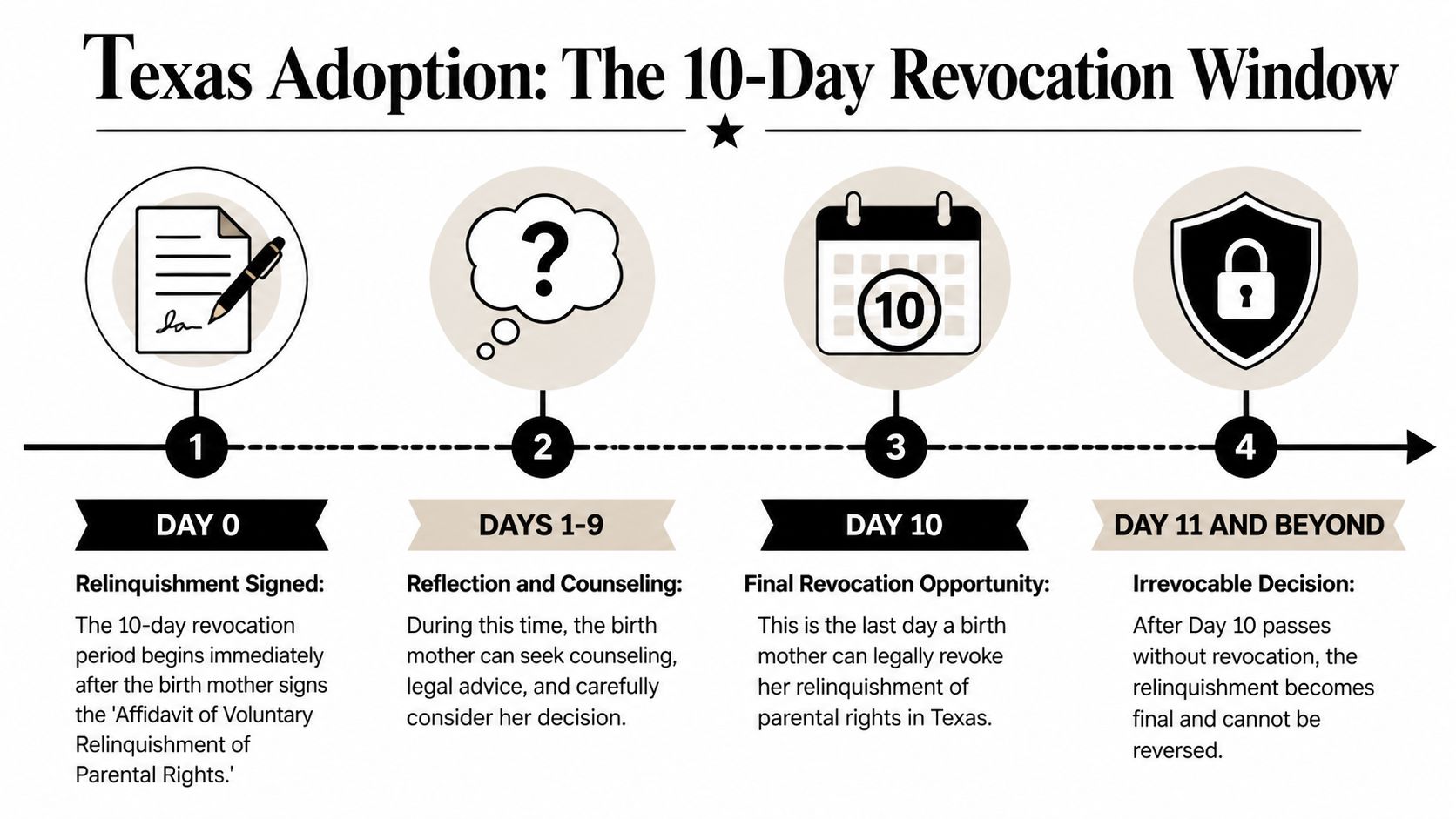
Understanding the 10-Day Revocation Window
Many people hear “10 days” and assume Texas gives every birth mother an automatic grace period. That’s not quite right. The 10-day revocation window usually matters when an affidavit of relinquishment does not state another revocation period and is not immediately irrevocable.
In those cases, the law is not giving someone ten days to feel uncertain. It is giving a short legal opportunity to act.
When the clock starts and what must happen
The clock begins when the affidavit is signed. It does not start at matching, at birth, or when the baby goes home with adoptive parents.
What matters inside that short window is action.
- A change of heart alone isn’t enough. Private thoughts, text messages, or telling a friend usually won’t substitute for the required legal step.
- The revocation has to be signed and filed properly. Texas law treats revocation as a legal act, not just an emotional reaction.
- Waiting is risky. If the deadline passes, the affidavit can become irrevocable.
That’s why lawyers often say the 10-day period is a window, not a cushion.
Why this narrow window matters so much
According to Texas DFPS adoption information, DFPS data from 2015 to 2025 shows that only 1.1% of over 12,000 adoptions involved successful revocations, often within the default 10-day window for unspecified affidavits. That tells you two things at once. Revocation does happen, but it is uncommon, and timing is everything.
The law became more structured over time, including the 1989 reforms that established the 48-hour waiting period. Today, that structure creates clearer points where rights can still be exercised and clearer points where the case becomes much harder to unwind.
For a more detailed look at the filing side of this process, this article on revoking adoption consent in Texas can help.
A simple timeline example
A birth mother signs a relinquishment affidavit on Friday. If that affidavit falls into the default revocation framework, the countdown begins then. If she wants to revoke, she cannot assume talking to the agency or telling a relative is enough. She needs the proper signed revocation filed before the deadline expires.
That is where many families get tripped up. They focus on emotion when the law is focused on procedure.
After the Revocation Period What Happens Next
Once the revocation period passes, the law starts treating the signed consent as binding in a much stronger way. At that point, the court’s attention turns even more sharply toward stability for the child.
This is often the hardest part for people to hear. A birth mother may still feel grief, doubt, or regret. Those feelings are real. But the legal system does not treat regret by itself as enough to undo a binding relinquishment.

Why courts focus on child stability
Picture a child who has already been placed in a home where the adults are feeding, soothing, and caring for them every day. From the court’s perspective, that child needs predictability.
Texas judges are not only looking backward at how the consent happened. They are also looking forward at whether changing course would create instability for the child.
That principle matters in domestic infant adoptions, kinship adoptions, and stepparent matters too. Family structure may differ, but the legal concern about the child’s secure placement stays the same.
Open adoption confusion
Many families also get confused about open adoption promises. Texas law can allow enforceable post-adoption contact agreements if they are court-approved under Chapter 162.302. But most open adoption arrangements are informal. As explained in this overview of open adoption expectations in Texas, a birth mother cannot legally revoke consent because an informal promise about contact was broken.
That surprises many people.
- Informal promises are not the same as court orders
- Disappointment is not the same as legal invalidity
- The court will usually place the child’s stability above a parent’s later remorse
A broken informal promise about visits or photos may be deeply painful, but it usually does not reopen a closed legal door.
A common scenario
A birth mother agrees to an open adoption because she expects regular updates. Months later, communication becomes strained. She may feel misled, hurt, or shut out.
Those emotions matter, and they deserve serious attention. But unless the agreement was properly approved and enforceable, they typically do not restore the right to revoke consent. The law separates post-adoption contact issues from the validity of the relinquishment itself.
Reversing a Finalized Adoption The Rare Exception
After a judge signs the final adoption order, the legal situation changes again. At that stage, the birth parents no longer have the same status they had before finalization. The adoption is meant to be permanent.
Texas courts set an extremely high bar for anyone trying to undo that result. According to HHJ Family Law’s discussion of post-adoption rights, once an adoption is finalized, reversal requires clear and convincing evidence of fraud, duress, or coercion, and courts in Texas rarely reverse a legal adoption and return parental rights to the birth parents.
What those legal words mean in plain English
Fraud usually means someone lied about an important fact in a way that affected the decision.
Duress means unlawful pressure or threats overcame the parent’s free will.
Coercion is similar. It points to pressure so serious that the consent was not voluntary.
Not every painful situation qualifies. Family conflict, sadness, second thoughts, or pressure from ordinary life often won’t meet this standard. The court is looking for strong proof that the legal consent process was significantly tainted.
Why clear and convincing evidence is such a high bar
This standard is much stronger than showing something “might have happened.” The judge must see persuasive evidence that the claim is true.
That often means gathering and presenting things like:
- Documents that show deception or threats
- Messages or recordings if they are legally usable
- Witness testimony from people who saw the pressure happen
- Medical or counseling records when relevant
A final adoption order is not undone because someone makes an emotional appeal. It takes evidence, pleadings, hearings, and often a contested court fight.
For a deeper discussion of finality and the legal obstacles involved, this article on whether an adoption can be reversed in Texas offers useful context.
Finalization is the point where adoption stops being a plan and becomes a permanent legal family relationship, absent extraordinary proof.
Practical Next Steps for Your Family
When emotions are high, families often freeze. That’s understandable, but timing matters in adoption cases. The best next step depends on whether you are the birth mother, the adoptive parent, or a relative involved in the placement.

If you are a birth mother
Act quickly. If papers have not been signed, say clearly that you do not want to proceed until you have legal advice and space to think. If papers were signed recently, do not assume you can wait a few days and sort it out later.
Use this checklist:
- Write down dates immediately. Note the child’s birth date, the date and time you signed any papers, and who was present.
- Gather copies of everything. Keep the affidavit, hospital paperwork, agency communications, and any text messages or emails.
- Describe any pressure in detail. If you believe someone threatened you, lied to you, or pushed you unfairly, record exactly what happened while it is still fresh.
- Ask for independent legal help. If coercion or fraud may be involved, early documentation can matter a great deal.
Broader U.S. family law data discussed in this article on changing your mind about adoption in Texas suggests post-finalization reversal success rates are below 5% in these cases, which is why immediate legal guidance is so important when fraud or duress may be involved.
If you are an adoptive parent
Do not contact the birth mother directly unless your attorney or agency tells you that is appropriate. Even well-meant communication can create confusion or become part of a later dispute about pressure.
A steadier path looks like this:
- Call your adoption attorney right away. Ask what stage the case is in and whether any revocation period is still open.
- Save all communications. Keep messages, emails, and agency updates in one place.
- Follow the legal process exactly. Don’t rely on reassurance from informal conversations.
- Protect the child’s routine. Keep feeding, sleeping, and medical care consistent.
- Get emotional support. This kind of uncertainty can be heartbreaking, and families often need help processing it.
If you are a relative or kinship caregiver
Kinship cases can become complicated because family members sometimes assume the rules are more flexible. Usually, they are not. If a parent signed relinquishment papers, the same concerns about deadlines, validity, and finality still apply.
What helps most is calm documentation and quick legal guidance, not family pressure or side agreements.
Important reminder: The sooner concerns are raised, the more legal options usually exist. Delay often closes doors.
Frequently Asked Questions About Adoption Revocation
Some questions come up again and again because Texas adoption law sounds simpler from a distance than it feels in real life. These short answers can help clear up the last points of confusion.
Adoption Revocation Rights At-a-Glance
| Adoption Stage | Can You Change Your Mind? | Key Consideration |
|---|---|---|
| Before signing relinquishment papers | Yes | A birth mother can choose not to proceed before signing consent papers. |
| After signing, during a valid revocation period | Sometimes | Revocation usually requires a signed filing within the legal deadline. |
| After the revocation period passes but before finalization | Usually not | Consent is generally treated as binding unless extraordinary issues are raised. |
| After finalization | Rarely | Reversal usually requires clear and convincing evidence of fraud, duress, or coercion. |
Does this apply to stepparent and kinship adoptions too
The emotional setting may be different, but Texas courts still take signed consent and final orders very seriously. In kinship and stepparent cases, people often assume family relationships create informal flexibility. Usually, they do not. Once legal steps are taken, the same need for valid consent and child stability still controls.
Can a birth mother revoke because she misses the child
Missing a child is natural. It is not, by itself, a legal reason to revoke after the relevant deadline has passed. Texas courts separate deep emotional pain from the legal standards needed to undo a consent or final order.
What if someone promised an open adoption and did not follow through
That depends on whether the contact agreement was properly approved and enforceable. Many open adoption arrangements are informal. If the promise was informal, disappointment alone usually won’t let a parent revoke consent.
Can a father’s rights affect the process
Yes. Adoption cases can involve separate questions about the rights of the alleged, presumed, or legal father. Those issues can become important in private, CPS, and relative adoptions. They need their own careful legal analysis because they can affect timing, notice, and finalization.
Is adoption final as soon as the baby is placed
No. Placement and finalization are not the same event. A child may be placed with adoptive parents before the judge signs the final order. That period can feel emotionally final, but legally it is still a separate stage.
What about Chapters 162 through 166 of the Texas Family Code
Those chapters cover major parts of the Texas adoption framework, including consent, placement, post-adoption issues, and related procedures. In everyday terms, they form the legal roadmap for how a child moves from placement to a permanent court-recognized family relationship.
If you’re facing this question in real life, you don’t have to sort through these deadlines and legal standards alone. The Law Office of Bryan Fagan, PLLC helps Texas families understand adoption, relinquishment, finalization, and contested issues with compassion and clarity. If you need guidance about your next step, schedule a free consultation and get answers suited to your family’s situation.

