
When your heart leads you to consider adoption, one of the first practical questions that arises is, "How much will this cost?" It's a valid and important question for any hopeful parent. The adoption texas cost can range from nearly $0 for a foster care adoption to over $60,000 for certain international or private adoptions.
This wide range reflects how unique each family's adoption journey is. For private agency adoptions in Texas, the typical cost falls between $25,000 and $50,000. While these numbers might seem daunting, understanding what they cover is the first step toward creating a thoughtful and realistic financial plan to grow your family.
Your Financial Guide to a Texas Adoption
Deciding to grow your family through adoption is a beautiful, life-changing moment. However, we understand that the financial aspect can feel overwhelming. Here at The Law Office of Bryan Fagan, PLLC, our goal is to bring clarity and reassurance to this part of the process.
We want you to see the cost of adoption not as a barrier, but as a well-planned investment in your family’s future. This guide is designed to provide a clear, compassionate breakdown of the costs you might encounter, empowering you to move forward with confidence and peace of mind.

A First Look at Adoption Expenses
The final cost of your adoption is shaped by many factors, but the most significant is the type of adoption you choose. Each path has its own unique financial landscape.
- Private Agency Adoption: This route often involves the most significant investment, typically ranging from $25,000 to $50,000. These fees cover a wide range of essential services, including outreach to birth parents, counseling for everyone involved, all the necessary legal work, and the agency's operational costs.
- Foster Care Adoption: Adopting a child from the Texas Department of Family and Protective Services (DFPS) is by far the most affordable option, with costs typically ranging from $0 to just $2,500. The state covers most expenses because its primary goal is to find loving, permanent homes for children in its care.
- International Adoption: This path tends to be the most expensive due to the complexities of navigating two countries' legal systems. Costs include fees from both the U.S. and the child's home country, significant travel expenses, and complicated immigration processing, often starting at $35,000 and potentially exceeding $60,000.
For perspective, it can be helpful to compare these figures to the average cost of childbirth in Texas with insurance, which is another beautiful way families grow.
The good news is that you don’t have to bear this financial responsibility alone. Resources like the federal adoption tax credit, which can provide over $15,000 per child in relief, as well as grants and other forms of assistance, are available. We’ll explore these options to help you build your financial strategy.
Estimated Adoption Costs in Texas at a Glance
To give you a clearer picture, here is a summary of the typical cost ranges for the most common types of adoption in Texas. Think of this as your quick-glance financial overview.
| Adoption Type | Typical Cost Range | Key Cost Components |
|---|---|---|
| Private/Agency Adoption | $25,000 – $50,000+ | Agency Fees, Home Study, Attorney Fees, Birth Parent Expenses, Court Costs |
| Foster Care Adoption | $0 – $2,500 | Minimal Legal Fees, some Travel (often reimbursed by the state) |
| Stepparent/Relative Adoption | $2,500 – $7,500 | Attorney Fees, Court Filing Fees, Background Checks |
| International Adoption | $35,000 – $60,000+ | Country Program Fees, Agency Fees, Travel, Immigration Processing |
This table is a starting point. As we continue, we’ll break these numbers down further, explaining what each fee covers and how your choices can shape your overall budget.
"Understanding the financial commitment is a vital part of preparing for adoption. It’s not about having immense wealth; it’s about having a stable, loving home and a thoughtful plan to provide for a child's needs."
With the right information and support, the dream of building your family through adoption is absolutely within reach.
Breaking Down Private Adoption Expenses
For many hopeful parents, private adoption feels like the most direct path to growing their family. It’s a profound investment of the heart and also a significant financial one. Understanding the adoption texas cost is the first step toward building a realistic, manageable plan, turning what feels like an intimidating number into a series of understandable steps.
Think of it like building a home. You wouldn’t just look at the final price; you’d want to understand the cost of the foundation, framing, and finishing touches. Private adoption costs work the same way—each fee pays for a critical part of building your family securely and ethically.
Agency Application and Program Fees
Your journey with an adoption agency typically begins with an application fee. This initial cost covers the administrative work to welcome your family into their system and start the process.
Next comes the agency's program fee, which is often the largest single expense. This comprehensive fee is the engine of your adoption, funding essential services that protect everyone involved—you, the birth parents, and most importantly, the child. These funds support:
- Birth Parent Outreach and Screening: Finding and connecting with expectant mothers who are considering an adoption plan.
- Counseling and Support: Providing compassionate, unbiased counseling for birth parents before, during, and after placement.
- Administrative Oversight: Covering the agency's day-to-day costs, such as staff salaries and legal compliance.
- Post-Placement Supervision: Ensuring a smooth and healthy transition for your family after your child is home.
The Home Study: A Texas Requirement
Before any adoption can legally move forward in Texas, a home study is required by law. This isn't a test of perfection; rather, it’s a collaborative process to ensure you can provide a safe, stable, and loving home for a child. A licensed social worker will meet with you, conduct interviews, and review important documents.
The home study fee covers the social worker's time, expertise, and the detailed report they prepare for the court. This step is a cornerstone of the legal process, affirming your readiness to become parents in the eyes of the law.
The home study is fundamentally about preparation and education. It's an opportunity for you to reflect on your parenting style and for the state to ensure every child is placed in a secure and nurturing home, as mandated by the Texas Family Code.
Ethical Support for Birth Parents
One of the most sensitive and important parts of the cost is birth parent expenses. These funds are strictly governed by the Texas Family Code and are paid through the agency or an attorney to provide essential support for the birth mother during her pregnancy and recovery. This is not "paying for a baby" but an act of compassion and ethical support.
Allowable expenses typically cover:
- Uninsured medical and hospital bills related to the pregnancy.
- Reasonable living expenses like rent, utilities, and food.
- Maternity clothing and transportation to medical appointments.
- Necessary counseling services.
This financial support allows a birth mother to focus on her health and well-being without immense financial stress during a vulnerable time. The process is transparent and legally regulated to protect everyone. To learn more, we have a detailed guide answering the common question, "How much does private adoption cost in Texas?"
Legal and Court Fees
Finally, legal and court fees are what make your family official. An experienced adoption attorney is your advocate, ensuring every document is filed correctly and every legal requirement is met. These fees cover the termination of the birth parents' parental rights and the finalization hearing—the incredible day a judge legally declares you as your child's parents, forever.
Financial barriers are a real concern, with private domestic adoptions in Texas generally costing between $25,000 and $50,000. Key agency fees often include a home study ($1,500 to $3,000) and program fees averaging around $23,700, which help cover birth mother support and legal services. Attorney expenses can add another $2,000 to $5,000, though this can increase with legal challenges. You can discover more insights about these costs on angeladoptioninc.com. While the numbers are significant, each one represents a vital service ensuring your adoption is handled with legal integrity and heartfelt care.
Comparing Costs of Different Adoption Paths
The decision to adopt is a journey of the heart, but it’s also a practical one. A huge piece of the puzzle is understanding that not every path comes with the same price tag. The cost to adopt in Texas can swing dramatically depending on the route you choose, which means there are several financially diverse ways to build your family.
Each type of adoption has its own financial landscape, shaped by different legal needs and support systems. By looking at them side-by-side, you can start to see which journey feels most manageable for you and your family.
Let’s break down the most common adoption paths in Texas and what you can generally expect in terms of cost.
Adopting from Foster Care: A Low-Cost Path
For many families, adopting from the Texas foster care system is the most accessible and affordable path. When you adopt a child through the Texas Department of Family and Protective Services (DFPS), the state’s main goal is finding a loving, permanent home for a child in its care. Because of this, the costs are kept as low as possible.
In fact, the out-of-pocket expenses for a foster care adoption are often between $0 and $2,500. The state provides subsidies and reimbursements that cover the biggest costs, including:
- Attorney and court fees
- The required home study
- Travel expenses related to the adoption
This path is a beautiful way to give a stable, loving home to a child who needs one, without the significant financial strain that can come with other types of adoption. Our guide on the cost of adoption from foster care offers a more detailed look into this rewarding process.
The graphic below highlights the main cost components in a private adoption, which is a stark contrast to the minimal expenses of adopting from foster care.
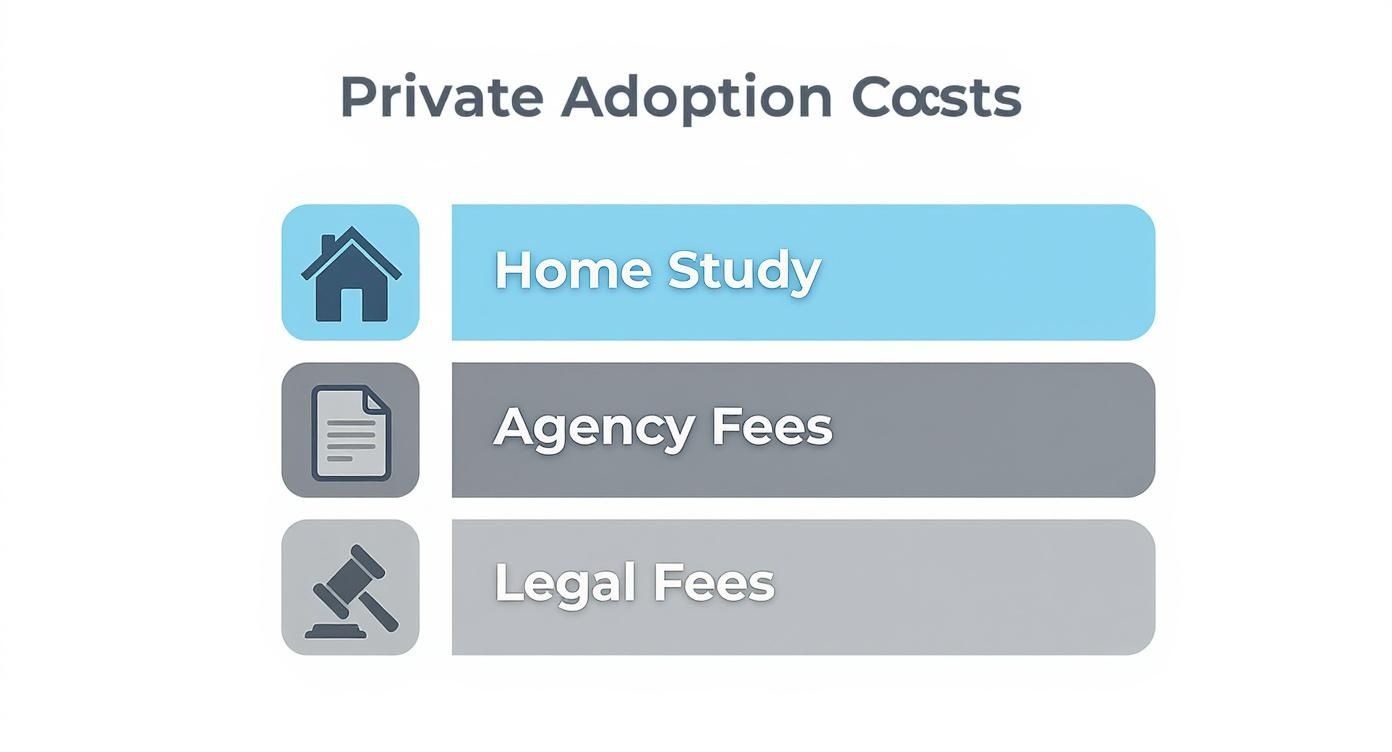
As you can see, private adoption costs are split among essential services like the home study, agency coordination, and legal finalization—each playing a vital role in the process.
Stepparent and Kinship Adoption Costs
Stepparent and kinship (or relative) adoptions are another streamlined and cost-effective route. In these situations, a pre-existing family bond is already there, which simplifies many legal and procedural hurdles. The child is already living in a stable home with someone they know and trust.
Since there’s no need for agency matching or searching for a birth mother, the main expenses are legal. The costs for these adoptions typically include:
- Attorney fees to prepare and file the legal paperwork.
- Court filing fees.
- The cost of terminating the other biological parent's rights, if necessary.
These adoptions are about legally formalizing a family relationship that already exists in heart and home, with the child's best interest at the center of the process.
International and Private Adoption: A Higher Investment
On the other end of the financial spectrum are international and private adoptions. While the costs for private infant adoptions in Texas can vary widely, it’s not uncommon for them to reach $60,000 to $65,000 on average. Compared to the minimal costs of adopting through DFPS, this is a significant investment.
International adoption, which has become less common, also comes with higher costs, often ranging from $25,000 to $50,000. The complexity drives up the expense, as families must navigate the laws of both the U.S. and the child's home country.
To give you a clearer picture, here’s a quick comparison of the different adoption types in Texas.
Cost Comparison by Texas Adoption Type
| Adoption Type | Estimated Cost Range | Primary Expenses |
|---|---|---|
| Private/Agency | $40,000 – $65,000+ | Agency fees, attorney fees, home study, birth parent expenses, marketing/outreach. |
| Foster Care (DFPS) | $0 – $2,500 | Minimal out-of-pocket costs; most fees (legal, home study) are reimbursed or waived by the state. |
| Stepparent | $1,500 – $5,000 | Attorney fees, court filing fees, process service, potential home study (sometimes waived). |
| International | $25,000 – $50,000+ | Agency fees, foreign country program fees, immigration processing, travel, legal fees. |
This table provides a snapshot of the financial commitment involved with each path. Remember, these are estimates, and your actual costs may vary based on your specific situation.
Ultimately, each of these paths offers a beautiful way to build a family. Understanding the financial commitment is simply a key step toward choosing the right one for you.
How to Fund Your Texas Adoption Journey
Figuring out the costs of adoption is one thing, but the next question is often, how are we actually going to afford this? This is where initial sticker shock gives way to a practical plan. The financial side of adoption can feel overwhelming, but you are not walking this path alone. A whole ecosystem of resources is available to Texas families, designed to make the dream of adoption a financial reality.
Think of it like planning a large, important project. You wouldn't start building a house without a blueprint and a budget. Similarly, creating a financial plan for your adoption means exploring every possible avenue—grants, loans, tax credits, and even employer benefits—to help you reach your goal without unnecessary stress.

The Federal Adoption Tax Credit
One of the most powerful financial tools for adoptive families is the Federal Adoption Tax Credit. This is not a standard deduction; it's a nonrefundable credit that reduces your federal tax liability dollar-for-dollar. For 2024, the credit is worth up to $16,810 per child. This can make a massive impact on expenses like agency fees, court costs, attorney fees, and travel.
It’s crucial to understand how it works. You claim the credit on your taxes for the year your adoption is finalized. If the credit is more than what you owe in taxes that year, you can carry the leftover amount forward for up to five years. For families adopting a child with special needs from foster care, you may be able to claim the full credit amount, regardless of your actual out-of-pocket expenses.
Adoption Grants and Loans
Beyond the tax credit, many families turn to adoption grants for support. These are essentially gifts of money from non-profit organizations that you do not have to pay back. It takes time and effort to find and apply for them, but the result can be life-changing.
- National Grant Organizations: Groups like HelpUsAdopt.org and the National Adoption Foundation offer grants to families across the country.
- Faith-Based Grants: Many religious organizations, such as Show Hope and Lifesong for Orphans, provide financial aid to families who share their faith.
- Specialized Grants: Some grants are designated for specific situations, like international adoptions or adopting children with documented special needs.
Low-interest adoption loans are another solid option, offering a structured way to manage costs over time.
"Building a family is an investment of the heart, and financial planning is a practical expression of that commitment. Exploring every available resource empowers you to focus on what truly matters—preparing to welcome your child home."
Employer and State-Level Assistance
Many people are surprised to learn that help might be available right at their workplace. More companies are offering adoption assistance benefits, which can include direct financial reimbursement and paid leave. It’s always worth checking with your HR department.
For families adopting from the Texas foster care system, the state itself provides significant support. The Texas Adoption Assistance Program offers financial help for children with special needs, which can include physical, mental, or emotional challenges. This support comes as monthly payments and Medicaid coverage to help with their ongoing care. You can find out more by reading our guide on how much the adoption subsidy is in Texas.
Finally, never underestimate the power of your community. Personal fundraising has helped countless families bridge the final financial gap. When you share your story with friends and family, you might be amazed by the outpouring of support.
With careful planning and a proactive mindset, the adoption texas cost becomes a series of manageable steps instead of an impossible mountain. The resources are out there. With the right guidance, you can build a financial plan that makes your dream of building a family come true.
How the Adoption Timeline Impacts Your Budget
In the world of adoption, time and money are deeply connected. A critical part of creating a realistic financial plan is understanding how the length of your journey can shift the final adoption texas cost. While every family’s story is different, some factors can stretch the process—and your budget—out.
Think of your adoption budget like a road trip plan. A direct route is predictable. But if you hit detours or unexpected traffic, you’re naturally going to spend more. A longer adoption timeline almost always means more ongoing costs.
Factors That Can Extend the Process and Increase Costs
Several factors can lengthen an adoption timeline, especially in private adoptions. A longer-than-expected search for a birth mother match is one of the most common. The more time your profile is active with an agency, the more you might pay in ongoing administrative or marketing fees.
Legal complexities are another major factor. If it’s difficult to identify or locate a birth father, or if his rights must be contested in court, the legal process becomes more involved. This extra legal work adds to your attorney fees and can add months to your timeline.
It’s important to approach this process with patience and flexibility. An unforeseen legal issue or a longer matching period isn’t a failure—it’s often a necessary part of a thorough, ethical, and legally sound adoption that protects your future family.
Finally, the duration of birth mother support can affect your budget. Texas law allows adoptive families to help with reasonable living expenses for the birth mother during her pregnancy and for a short time after. If you match with her early in her pregnancy, this period of support will naturally be longer.
How a Shorter Timeline Can Lower Your Expenses
On the other hand, a more straightforward journey can help keep costs predictable. This is often the case in stepparent and kinship adoptions, where a loving, established relationship with the child already exists.
Because there is no need for a lengthy matching process or extensive birth parent outreach, these adoptions tend to move much faster. The main costs are the legal fees for terminating the other biological parent's rights and finalizing the adoption in court. With fewer moving parts and a shorter timeframe, the overall cost is significantly lower.
Even in a private infant adoption, a quick match can shorten the timeline. If you’re matched with a birth mother late in her pregnancy, the period for providing financial support is much shorter, which can reduce your overall expenses.
Building a flexible financial plan is one of the most empowering things you can do. When you anticipate potential delays and understand how they connect to your bottom line, you can navigate the uncertainties of the adoption timeline with more confidence and peace of mind.
Partnering with an Adoption Attorney
While you're figuring out the financial side of adoption, it's just as important to think about the legal journey ahead. This is where an experienced adoption attorney becomes your most valuable partner. The adoption texas cost you're budgeting for includes essential legal work that protects everyone involved—your family, the child, and the birth parents—ensuring every step is handled ethically and with care.
Working with a compassionate attorney gives you the peace of mind to focus on what truly matters: preparing your heart and home to welcome your child.
Why Legal Guidance is Essential
An adoption attorney does far more than just file paperwork. They are your guide, your advocate, and your steady hand through the most critical legal milestones of your journey.
Their expertise is indispensable when it comes to:
- Terminating Parental Rights: This is a delicate and legally intensive process governed by the Texas Family Code. A misstep can create future legal challenges. Your attorney ensures it's done correctly.
- Ensuring Legal Compliance: For adoptions across state lines, your attorney will manage compliance with the Interstate Compact on the Placement of Children (ICPC), a complex federal law.
- Handling Contested Adoptions: If a birth parent contests the adoption, your attorney will advocate for your family’s interests in court, working toward a resolution that serves the best interest of the child.
- Finalizing the Adoption: At the finalization hearing, a judge legally creates your family. Your attorney ensures every legal requirement has been met so the court can grant that life-changing adoption decree.
"An adoption attorney does more than manage legal details; they provide the secure legal foundation upon which your family's future is built. Their guidance transforms a complex legal process into a clear, supported journey."
Partnering with a compassionate attorney means you have an expert in your corner, ensuring your adoption is secure, ethical, and legally sound. This professional support is a crucial investment in your family's future.
If you have questions about the legal steps of your adoption or want to understand how an attorney can support your journey, we are here to help. We invite you to schedule a free, confidential consultation with our team to get the clear, compassionate guidance you deserve.
Common Questions About the Cost of Adoption in Texas
Money talk can be one of the most stressful parts of planning an adoption. Let's clear the air. Here are straightforward answers to the financial questions we hear most often from Texas families, so you can move forward with confidence.
Is Adopting from Foster Care in Texas Really Free?
This is a great question. While it’s not always $0, adopting from the Texas foster care system is designed to be extremely low-cost, often ranging from free to just a few thousand dollars. The state’s number one goal is finding stable, loving homes for children.
To achieve this, the Texas Department of Family and Protective Services (DFPS) provides significant financial support. This assistance usually covers or reimburses you for the biggest expenses, including:
- Most—if not all—of your attorney and court fees.
- The cost of your required home study.
- Travel expenses that arise during the placement process.
This approach opens the door for so many wonderful individuals and couples who are ready to provide a permanent home but may not have extensive financial resources.
Do You Have to Be Wealthy to Adopt in Texas?
Let's bust this myth: you absolutely do not need to be wealthy to adopt a child in Texas. What courts and agencies look for is financial stability, not a massive bank account.
They want to see that you can responsibly manage a budget and consistently meet a child's needs. This means having a steady income, a safe place to live, and a realistic plan for handling future expenses. The focus is entirely on your ability to create a secure, nurturing environment where a child can thrive.
What Happens Financially if a Private Adoption Falls Through?
This is a tough, heartbreaking scenario to consider, but it’s a wise question to ask. If a private adoption match doesn’t work out, the financial impact depends on the agreement you signed with your adoption agency or professional.
Some fees, like those for your application or for marketing your profile, are almost always non-refundable because they cover work that's already been done. However, many agencies will allow you to roll over other fees you've paid toward a new adoption opportunity. It is critical to have a clear conversation about an agency’s refund and rollover policies before you sign any contracts. This transparency can protect you both emotionally and financially if the unexpected happens.
At The Law Office of Bryan Fagan, PLLC, we believe clear information is the key to making the best decisions for your family. If you have more questions about the adoption process or need legal guidance, please schedule a free, compassionate consultation with our experienced team today.
