
A lot of Texas families reach the same point in the adoption journey. Their hearts are ready, their home is ready, but one question keeps rising to the top. Can we really afford to meet this child's needs for years to come?
That concern is especially common in foster care adoptions. A child may need counseling, extra school support, more frequent medical appointments, or the steady financial cushion that helps a family say yes with confidence. Worrying about money doesn't make you less committed. It usually means you're taking the child's future seriously.
Texas law and policy recognize that reality. Adoption assistance exists to help children with special needs move from temporary care into permanent family life. It's meant to support stability, not to place another burden on families already trying to do the right thing.
Texas adoption law also sits inside a larger legal framework. In many cases, Chapters 162 through 166 of the Texas Family Code shape the road from placement to finalization. Those chapters deal with adoption procedures, who may adopt, what consents or court findings are needed, and how the court decides whether the adoption serves the child's best interests. For families adopting through foster care, the subsidy conversation usually happens alongside those legal steps, not after everything else is finished.
Building Your Family with Financial Peace of Mind
Maria and James had already said yes in their hearts to adopting a child from foster care. Then practical questions started showing up at the kitchen table. What if their future child needed regular therapy? What if school became harder than expected? What if ordinary monthly bills felt heavier once the adoption was final?
Those questions are normal. Many hopeful parents feel pulled in two directions at once. They want to offer permanence, safety, and belonging, but they also know love doesn't erase grocery bills, child care costs, transportation, and health needs.
That's where Texas adoption subsidy can bring real peace of mind. The program is designed to help families adopt children whose needs or circumstances might otherwise make placement harder. It reflects a simple idea. If the state wants children to leave foster care for permanent homes, families need tools that support long-term success.
Why this support matters to real families
For one family, the issue may be a sibling group that needs to stay together. For another, it may be an older child who has waited longer for adoption. For another, it may be a child with emotional or medical needs that will require steady attention after finalization.
Practical rule: Adoption assistance is about the child's needs. It isn't a reward for the parents, and it isn't the same thing as a foster care payment.
That distinction matters because adoption changes the legal relationship. Once the court finalizes the adoption under the Texas Family Code, the child becomes your child in every legal sense. The goal of subsidy is to help that permanency hold.
Families often compare costs before moving forward. If you're trying to understand the broader money side of the process, this guide on Texas adoption costs can help you place subsidy in the larger picture.
The emotional side is just as important
Financial stress can subtly affect family decisions. Some parents delay saying yes because they fear they won't be able to keep up later. Others worry they'll be judged for asking about assistance at all.
They shouldn't be.
As a family law attorney, I can tell you that asking about support is often a sign of careful, child-centered parenting. The best interests of the child don't depend only on good intentions. They also depend on planning, stability, and a realistic understanding of what daily life will require.
What Is the Texas Adoption Subsidy
The Texas adoption subsidy is commonly called adoption assistance. In plain English, it is a support agreement that helps certain children adopted from care move into permanent families with fewer financial barriers.
It's important to understand what this program is, and what it isn't. It is not a temporary foster care arrangement that continues unchanged after adoption. It is not extra income meant to benefit the parents personally. It is a structured agreement tied to the child's circumstances and needs.
A legal agreement tied to permanency
In practice, adoption assistance is usually handled through an agreement between the adoptive family and the Texas Department of Family and Protective Services, often called DFPS. That agreement needs careful attention because timing matters. If a family waits until after finalization to raise subsidy issues, they may lose options that should have been addressed earlier.
Under the Texas Family Code, adoption itself typically involves several legal building blocks:
- Termination or prior legal authority: In many foster care cases, the court must first determine that the child cannot safely return home and that parental rights have been terminated or otherwise legally addressed.
- Home study and screening: Families usually complete a home study and related evaluations before placement can move forward.
- Placement and supervision: The child is placed in the adoptive home, and the placement is monitored.
- Court finalization: A judge signs the adoption order after deciding the adoption is in the child's best interests.
Adoption assistance fits into that larger process. It's part of building a safe, lasting transition into family life.
How it differs from foster care payments
Families often get confused on this point. Foster care payments support a temporary placement. Adoption assistance supports a permanent one.
Once adoption is finalized, the legal relationship changes completely. The child is no longer in foster care. The subsidy exists because some children would face greater barriers to adoption without ongoing support.
The question isn't whether a child deserves permanency. The question is whether the adults around that child have the tools to make permanency work.
That's why the program should be viewed as a partnership. The state has an interest in helping children with special needs leave foster care for stable homes. Families have an interest in understanding the child's needs realistically and planning for them well.
Understanding Eligibility for Adoption Assistance
Eligibility is the point where many families feel overwhelmed. The easiest way to think about it is this. Texas focuses on whether the child meets the legal definition of special needs, not whether the adopting adults are wealthy, middle income, or struggling.
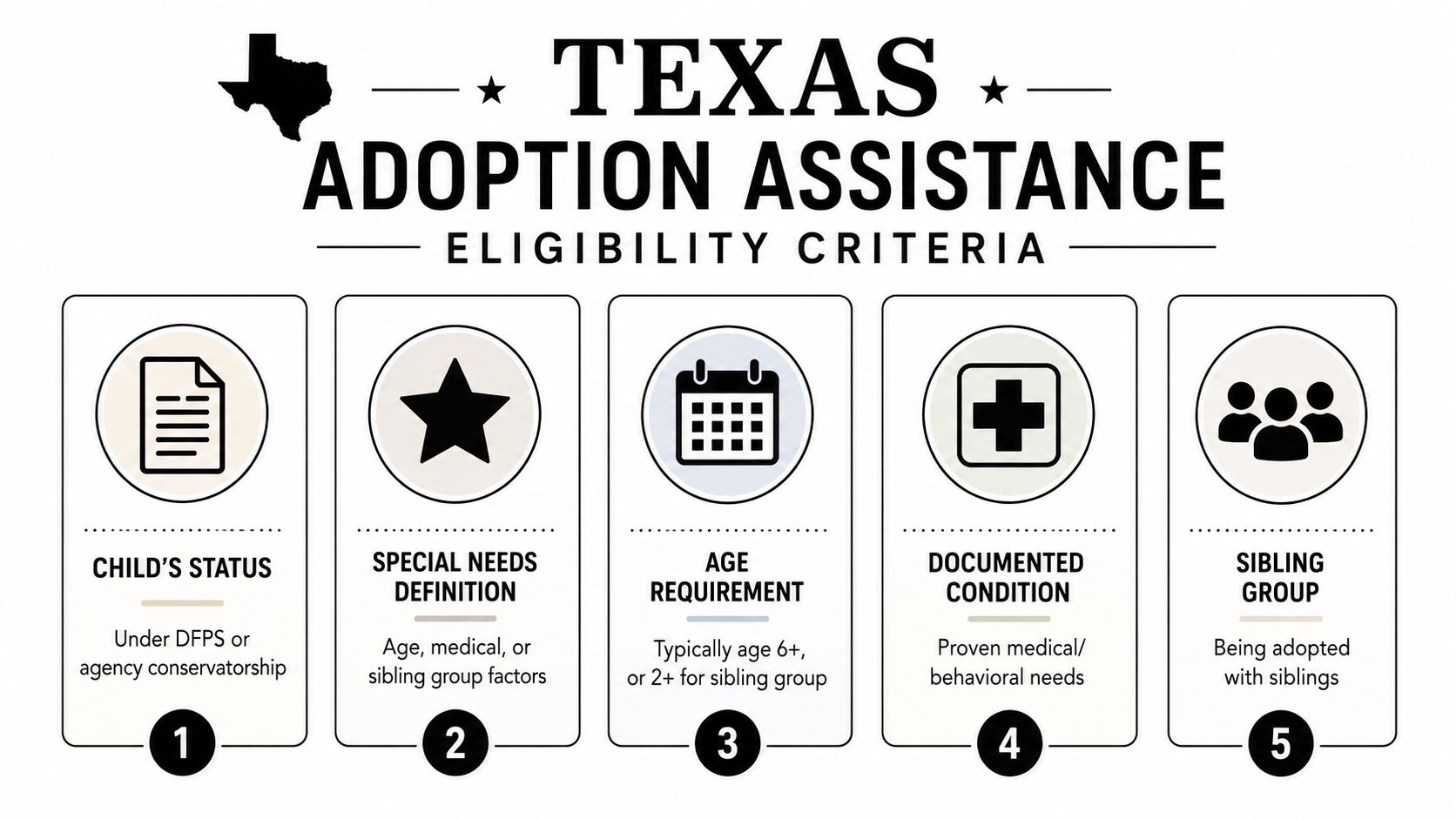
Texas adoption assistance eligibility is legally anchored in the child's special needs status under the Texas Family Code. That requires a judicial determination that the child cannot return to their birth home, plus at least one qualifying characteristic such as age 6 or older, membership in a sibling group of 2 or more adopted together, race or ethnicity barriers to placement, or a verifiable disabling condition, as described in this Texas adoption assistance explanation.
What special needs means in everyday terms
The phrase special needs can sound harsher or narrower than Texas uses it here. It does not only mean a severe medical diagnosis.
A child may qualify because of age, because brothers and sisters are being adopted together, because a documented condition requires treatment, or because placement barriers have made adoption harder. If you're learning more about adopting from foster care in Texas, this eligibility framework often becomes one of the most important parts of your planning.
Here's how families usually see these categories in real life:
- Older child: A child who is already in school may qualify based on age alone.
- Sibling group: Two or more siblings being adopted together may qualify because keeping them united serves family stability.
- Medical, mental, or emotional condition: A child with a verifiable condition that requires ongoing professional support may qualify.
- Placement barriers tied to race or ethnicity: Texas recognizes that some children face harder placement circumstances and treats that as part of the special needs analysis.
What does not control eligibility
Many parents are relieved to hear this. Their income is not the deciding factor in the Texas State Adoption Assistance Program. The child's needs and legal history drive the analysis.
That means a teacher, a mechanic, a nurse, a grandparent, or a single parent may all stand in the same legal position if the child qualifies. This can make adoption possible for families who have the emotional capacity to parent, even if they don't have unlimited financial flexibility.
For families considering Foster Care and CPS Adoption in Texas, this child-focused eligibility rule is one reason subsidy matters so much. It helps keep the adoption decision centered on permanency and best interests rather than on a family's fear of future expenses.
A child's eligibility doesn't turn on whether adoptive parents earn “too much” or “too little.” The legal focus stays on the child.
Benefit Types and Typical Payment Amounts
A lot of families reach this point and ask a very human question: what will this look like in our monthly budget?
That question makes sense. Adoption assistance is meant to reduce pressure, not create more mystery. In Texas, support usually comes in two different forms. One helps with ongoing care after the adoption is final. The other helps with certain one-time expenses tied to the adoption process.
The monthly payment is generally based on the child's service level at the time of adoptive placement. Texas provides $400 per month for a child at the Basic service level and $545 per month for a child at Moderate or higher service levels, according to Texas State adoption assistance program guidance.
Texas Adoption Assistance Monthly Payment Levels (2026)
| Service Level | Maximum Monthly Payment |
|---|---|
| Basic | $400 |
| Moderate or higher | $545 |
What these payments are meant to help cover
A monthly subsidy is part of the child's support plan. It is not a paycheck to the parents, and it is not meant to cover every possible cost. It works more like a financial cushion that helps a family absorb the regular expenses of raising a child who qualifies for adoption assistance.
That can include everyday needs such as housing, food, transportation, supervision, school-related costs, and other care expenses that come with the child's circumstances. For many families, the value of the subsidy is not that it pays for everything. The value is that it makes room in the budget for therapy appointments, missed work time, extra travel, or the ordinary surprises that come with parenting.
Texas places a cap on the monthly amount tied to the child's service level. In practice, families often focus on whether the negotiated amount will realistically support the child's day-to-day care over time. There may be limited situations involving a higher rate, but standard cases usually fall within the levels listed above.
Reimbursement for one-time adoption costs
Texas may also reimburse up to $1,200 per child for reasonable and necessary adoption-related expenses. These are the costs connected to getting the adoption completed, not the costs of parenting after finalization.
Examples often include court filing fees, home study expenses, legal paperwork, and other adoption-related charges a family had to pay as part of the process.
This part of the program can relieve stress at a key moment. Families are often preparing for finalization, adjusting routines, and trying to keep the focus where it belongs, on the child's transition into a permanent home.
A simple way to sort it out is this:
- Monthly assistance: Ongoing help with the child's care after finalization.
- Expense reimbursement: Repayment for certain necessary adoption costs.
- Medical and service support: Part of the larger assistance picture many families review when planning for the future.
If you are feeling unsure about the numbers, that is normal. A good way to approach subsidy benefits is the same way many attorneys explain family budgets in adoption cases. Separate the support into buckets, monthly help, one-time reimbursement, and longer-term care planning. Once you do that, the program usually feels much easier to understand.
How to Apply for the Subsidy Step by Step
You are preparing for adoption finalization, the paperwork is stacking up, and one question keeps coming back. Has the subsidy agreement been handled yet? That question matters because adoption assistance usually needs to be discussed, documented, and signed before the court signs the final adoption order.

A good way to approach this process is to treat it like closing on a house. You can love the home and be ready to move in, but you still want every important document reviewed before you sign. Adoption works the same way. Finalization is the happy ending, but it is also the point where unfinished subsidy paperwork can create lasting problems.
Start the conversation early
If you are matched with a child through foster care, ask the caseworker early whether the child may qualify for adoption assistance. Do not wait for the issue to come up on its own. Parents are often juggling visits, training, court dates, and day-to-day family life. It is easy for subsidy questions to get pushed aside until the case feels urgent.
Early conversations give everyone time to gather the right records. That may include placement information, court orders, medical or educational records, and documents showing why the child meets the legal standard for special needs. If the child qualifies because of age, sibling group status, or a documented physical, emotional, or developmental condition, the file should clearly show that.
Review the legal pieces before finalization
Under the Texas Family Code, the adoption becomes legally permanent when the court signs the adoption order. Before that point, families usually work through several connected steps:
- Home study approval
- Placement and supervision
- Termination or other legal clearance for adoption
- Subsidy paperwork and negotiation
- Final adoption hearing
Step four deserves careful attention. Families sometimes focus so hard on reaching the final hearing that they assume the subsidy issue will sort itself out later. In many cases, later is too late.
Key reminder: Sign and confirm the adoption assistance agreement before the judge signs the adoption order.
Texas may also reimburse certain reasonable adoption-related expenses, as noted earlier in this guide. Keep your receipts and organize them early so reimbursement requests do not become a scavenger hunt after finalization.
A short overview of eligibility and the legal standard can also help as you prepare paperwork:
Know who does what
The caseworker and the adoption attorney usually handle different parts of the process.
The caseworker often helps gather the application, supporting records, and agency forms. The attorney looks at the legal side of the case. That includes checking whether the adoption is procedurally ready for finalization, whether the paperwork matches the child's circumstances, and whether anything needs to be corrected before court. This division of roles can ease a lot of anxiety for families. One person helps build the file. The other helps make sure the legal train stays on the tracks.
That is one reason some families work with Law Office of Bryan Fagan, PLLC during foster care or kinship adoption matters. The firm handles adoption and guardianship matters in Texas, including preparing families for court procedures and finalization requirements. Families who want a broader picture of what comes after court can also review these Texas post-adoption requirements for parents.
A practical document checklist
Keep one folder, digital or paper, for subsidy-related documents. A single organized file can save hours of stress later.
Include:
- Court documents: Orders showing the child cannot safely return home and that adoption may proceed.
- Eligibility records: Materials showing age, sibling group status, or documented conditions tied to the child's qualification.
- Placement information: Records showing the child's service level and placement history.
- Adoption assistance forms: The agreement and any supporting paperwork requested by the agency.
- Expense receipts: Proof of approved adoption-related costs you may request for reimbursement.
If any document is missing, ask for it early. Parents often feel hesitant about asking too many questions, but this is one area where careful follow-up helps protect the child's long-term support.
Managing and Modifying Your Subsidy Agreement
The adoption is final. Your child is home. Then a letter arrives asking for updated information about the subsidy, and you are left wondering whether anything is wrong.
Usually, nothing is wrong. A subsidy agreement works a lot like a long-term care plan on paper. It does not end just because the court case ended. Texas families often need to keep contact information current, respond to review requests, and report changes that affect the child's needs or eligibility.

What usually happens after finalization
After the judge signs the adoption order, the legal parent-child relationship is permanent, but the subsidy still has its own rules and paperwork. Families may receive notices for periodic reviews or requests to confirm that the child remains eligible for certain support. That can feel frustrating at first, especially after all the work it took to reach finalization, but it is a normal part of keeping benefits in place.
A helpful way to view it is this. The court order creates the family. The subsidy agreement helps support the child's ongoing needs.
If you want a broader picture of what families may need to handle after court, this guide on Texas post-adoption requirements for parents after finalization gives useful context beyond the subsidy itself.
When benefits may end or continue
Many families want a clear answer here, and the safest answer is to read the agreement closely and ask questions early. In many cases, adoption assistance continues until the child turns 18. Some older youth may qualify for continued support past that point if they meet specific requirements tied to age, disability, or education.
That issue matters most in adoptions involving teens. A 17-year-old who is still in school or has a condition that affects daily functioning may have different support needs than a younger child. The key is not to assume the payments stop or continue automatically. Check the written terms and confirm what the agency requires.
If your child's needs change
Children grow, and their needs can change with them. A child who needed one level of support at age five may need different services at age nine or fifteen. That does not guarantee a change in the agreement, but it does mean parents should keep good records and raise concerns promptly.
Clear documentation helps. Medical records, school evaluations, therapy updates, and other written materials give the agency a concrete picture of what has changed. Without that paper trail, families often end up trying to explain months of concern from memory, which is much harder.
If you believe the agreement no longer matches your child's needs, ask about the review process in writing. A calm, organized request usually works better than waiting until a crisis. Families working with the Law Office of Bryan Fagan, PLLC often want help understanding which changes may matter legally and which documents best support a request before the issue reaches a point of conflict.
Keep this goal in mind. The subsidy is there to support stability for the child, not to create extra stress for the family.
Common Questions About the Texas Adoption Subsidy
A parent often reaches this stage with the same worry. "We think we understand the process, but what if we missed something important?" That feeling is normal. Adoption subsidy rules can sound technical on paper, yet the pertinent questions are usually practical ones about money, timing, and what happens after the adoption is final.
Is the subsidy based on the parents' income
In many cases, no. Texas adoption assistance usually turns on the child's eligibility and needs, not whether the adoptive parents earn above or below a certain amount. A simple way to view it is this: the program is designed to support a child who meets legal requirements for assistance, not to test whether a family "deserves" help based on income alone.
That said, families should always review the specific facts of their case with the agency and, if needed, with an attorney. Eligibility depends on more than one detail.
Can a family receive subsidy in a stepparent or private infant adoption
Usually, families should approach that question carefully. Texas adoption subsidy most often applies in cases involving children from state care or other qualifying circumstances. A stepparent adoption, relative adoption, or private infant adoption may follow the adoption procedures in the Texas Family Code, but that does not mean subsidy assistance will be available in the same way.
This point confuses many families because "adoption" is one legal word covering several very different paths. It works a bit like insurance categories. Two people may both have coverage, but the benefits depend on the type of policy. In the same way, the kind of adoption often affects whether subsidy rules apply.
What if we move to another state
A move does not automatically end the subsidy, but it can change how services are handled. Families should ask questions before the move, not after the boxes are packed. Written guidance from the agency can prevent months of confusion.
Interstate issues often involve paperwork, service coordination, and questions about who administers which benefit. If your family is considering a relocation, treat that step like a contract issue. Get the terms confirmed early and keep copies of everything.

Is the subsidy taxable income
Parents ask this for a good reason. They are trying to build a stable budget for their child.
Tax treatment depends on the family's specific situation, so a qualified tax professional should answer that question after reviewing the facts. Your adoption attorney can explain the legal side of the subsidy agreement and the adoption process, while a tax professional can explain how those benefits may be treated on a return.
What if the child was eligible, but the paperwork was not finished before the adoption
That question can be stressful because timing matters in subsidy cases. Families should raise it as soon as possible with the agency and get clear answers in writing. Delays in paperwork can create problems that are harder to fix after finalization.
This is one reason many families want legal guidance before the final hearing. A missed signature or an unsigned agreement can have long-term effects, even when everyone involved believed the child qualified.
If you're considering adoption subsidy Texas and want guidance that fits your family's exact situation, the Law Office of Bryan Fagan, PLLC offers free consultations to discuss foster care adoption, kinship adoption, stepparent adoption, and the legal steps needed to move from placement to finalization with clarity and confidence.
