 Skip to content
You may be here because your stepchild already calls you for help with homework, wants you at school events, or reaches for your hand when life feels uncertain. On paper, though, you may still feel like you're standing just outside the legal circle of parenthood. That gap can feel small on ordinary days and very large when a school form, medical decision, or family emergency reminds you that love and legal rights aren't always the same thing.
In Texas, stepparent adoption can close that gap. It can turn a lived family bond into a legally protected one. For many families, that step brings peace, stability, and a clearer future for the child.
It also brings questions. What counts as eligibility? What happens with the other biological parent? How long will this take, and what does it cost? Those are normal questions, and the answers matter because stepparent adoption is both a legal process and an emotional one. Families often need help with both.
Texas adoption law, especially Chapters 162 through 166 of the Texas Family Code, gives courts the framework for adoption, consent, evaluations, and final orders. In a stepparent case, the court's focus stays on one central principle: the best interests of the child. That sounds broad, but in practice it means the judge wants to see stability, honesty, and a plan that supports the child's long-term well-being.
Foundational Requirements for Texas Stepparent Adoption
A lot of stepparents reach this point after years of doing the work of parenting. You may be the one handling school pickups, bedtime routines, doctor visits, and hard conversations. Then you learn that Texas still asks a basic question before the case can even move ahead: does this family meet the starting requirements for adoption?
That question can feel frustrating. It also serves a purpose. The court is looking for a family relationship that has already taken root in daily life, not one that is still taking shape.
The two legal basics the court looks for first
For a Texas stepparent adoption, two facts usually need to be true at the outset.
First, the child must have lived with the stepparent and the stepparent's spouse for at least six months before the court can grant the adoption, as explained in Texas Law Help's overview of stepparent adoption. Second, the stepparent must be legally married to the child's parent.
Those rules are easier to understand if you picture the court checking the foundation before building the rest of the case. A judge wants to see an established household, not a brand-new arrangement. The marriage shows a recognized legal bond between the adults. The time living together helps show consistency for the child.
Why the six-month period matters
Families often ask whether six months is just a technical box to check. Usually, it is more than that.
That period gives the court a chance to look at ordinary family life. Has the child been living in a stable home? Has the stepparent been acting in a steady parental role? Has the household settled into routines that support the child's well-being?
For example, a couple may feel emotionally ready soon after a wedding. That makes sense. But if the child only recently moved into the home, the court may want more time to see that the arrangement is stable and lasting. In family law, time often works like evidence. It shows the difference between a hopeful plan and a proven pattern.
The marriage requirement is more than a formality
Texas stepparent adoption is tied to the legal relationship between the stepparent and the child's parent. Living together, even in a committed relationship, does not fill that requirement for this kind of adoption.
That point surprises some families because their home already feels like a family in every practical sense. The law, though, uses legal categories. For this process, the court expects a valid marriage because the adoption is built on the existing parent-spouse relationship.
Other details families should check early
Once those two starting points are in place, it helps to look ahead at a few other issues that can slow a case down if they are overlooked.
- Background screening may be required. Courts commonly require the stepparent to complete a criminal background check.
- Records matter. Marriage certificates, the child's birth certificate, and any prior custody or support orders often become part of the case file.
- The whole family is part of the picture. The court is not only evaluating the stepparent as an individual. It is looking at the child's home life and the stability of the family unit.
- The other parent's legal status must be addressed. Adoption does not layer another legal parent onto the existing structure.
If you are gathering court records or signed forms electronically, privacy deserves some attention too. Hidden metadata can stay attached to a file even after you review the visible text. File Studio's guide on PDF privacy explains how to remove that extra information before sharing documents.
Families who want to compare their situation against the broader requirements for adoption in Texas can use that checklist as a starting point. It helps, but it does not replace a careful look at the family's specific facts. In stepparent adoption cases, the emotional reality and the legal structure have to line up. When they do, the process tends to move with fewer surprises.
The Critical Step of Parental Rights Termination
A lot of stepparents reach this point with a mix of hope and dread. They are ready to make everyday family life match the legal reality, but one hard truth stands in the way. Texas cannot add a new legal parent until the other legal parent's rights are ended.
That rule can feel harsh at first. It helps to picture the child's legal parentage as a document with limited spaces, not an open list that keeps growing. Before the court can place the stepparent into that legal role, it has to resolve the status of the other parent.
When the other parent agrees
Some cases begin with consent, and that usually lowers the temperature in the room.
For example, a stepfather may have raised a child for years while the biological father has stayed on the edges of the child's life. If that father decides the adoption is the right path and signs a voluntary relinquishment or other required consent documents, the case often becomes more straightforward. The paperwork still matters. So does the parent's understanding of what they are signing.
The judge will still look closely at the decision. A signed consent does not end the court's job. The court wants to see that the choice was made knowingly, voluntarily, and with the child's best interest in mind.
That emotional piece matters too. Even in cooperative cases, families often carry grief, relief, guilt, or old resentment into the courtroom. A smoother legal path does not always mean an easy family moment.
Consent can reduce conflict, but the judge still has to approve the result.
When the other parent does not agree
In these situations, families often feel stuck. A parent may object. A parent may be absent. A parent may drift in and out of the child's life just enough to keep everyone uncertain.
In that situation, the court usually needs more than a story about disappointment. It needs legally recognized grounds for involuntary termination, plus proof that termination is in the child's best interest. That is a high bar because the decision is permanent.
A common misunderstanding comes up here. Many stepparents say, "I am the one doing the parenting, so the adoption should be simple." From a human standpoint, that feeling makes complete sense. From a legal standpoint, the court is asking a different question: has the law been satisfied strongly enough to cut off another parent's rights forever?
That is why these cases can slow down. The issue is not whether the stepparent loves the child. The issue is whether the evidence fits Texas law.
What evidence usually matters
Judges usually want a careful record, not broad statements like "he was never around" or "she did not help." Families are often in a better position when they can show patterns with documents and specific dates.
Useful evidence may include:
- Support records: proof of missed child support or long gaps in financial help
- Contact records: calendars, texts, emails, school records, or visitation logs showing little or inconsistent involvement
- Existing court orders: prior custody, child support, or protective orders
- Witness testimony: statements from the custodial parent or other adults with direct knowledge of the parent's conduct
Good evidence works like assembling a timeline instead of offering a conclusion. The court does not want guesses about motive. It wants facts it can trace.
For a closer look at what Texas courts examine, this guide to grounds and procedures for termination of parental rights in Texas can help you separate painful family history from legally sufficient proof.
One final point deserves plain language. Termination is not a way to punish a flawed parent or reward a devoted stepparent. It is a legal decision about the child's long-term welfare. Families who understand that distinction early are often better prepared, both for the paperwork and for the emotions that come with it.
Your Step-by-Step Guide to the Legal Process
You have already handled the hardest emotional question in many stepparent adoptions: whether the legal path is open. Once that piece is settled, families often feel relief, then a new kind of anxiety. What happens next? The answer is more orderly than it first appears. The process works like building a file the judge can trust, one step at a time.
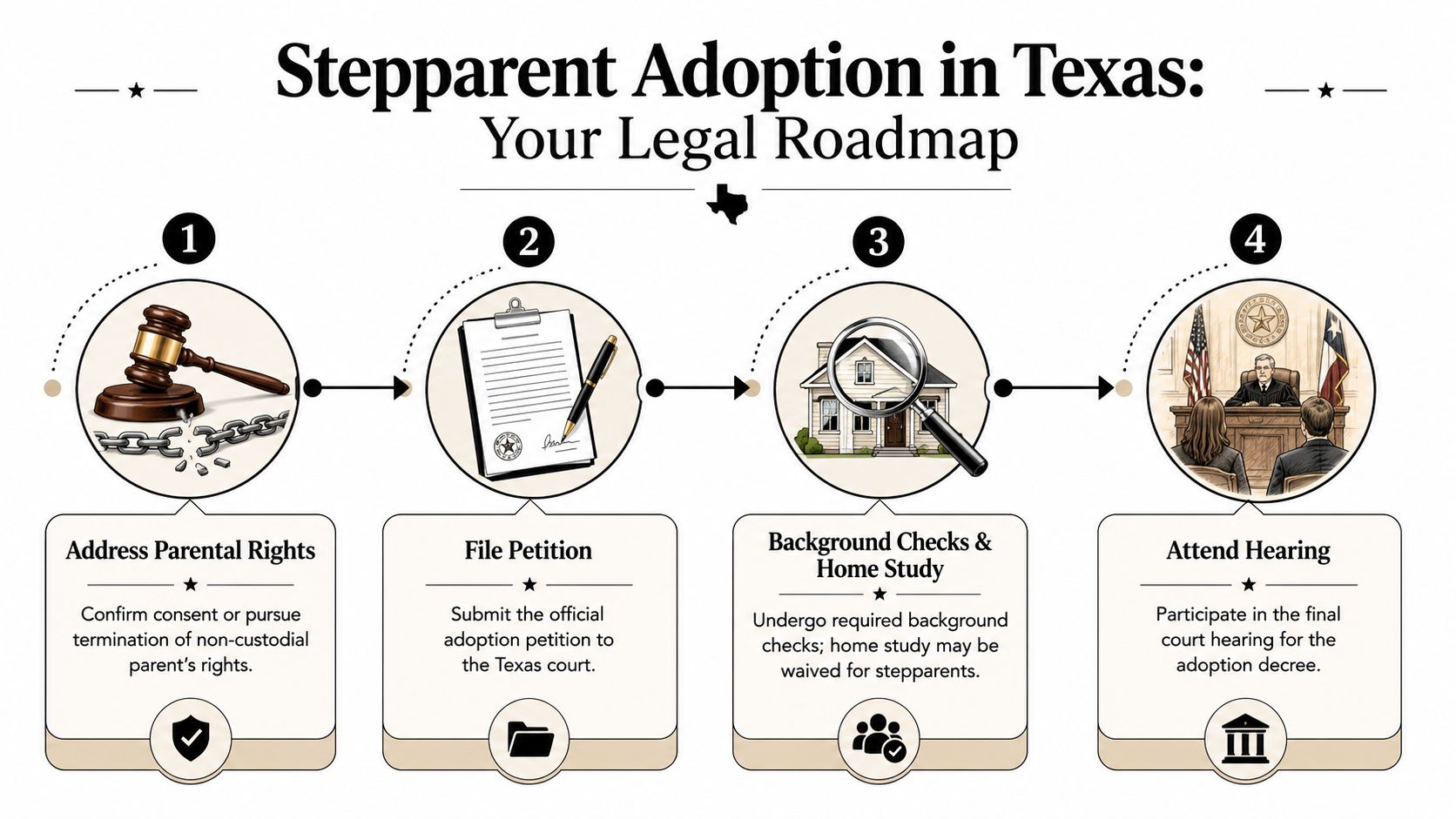
The filing stage
The case usually starts with an adoption petition filed in the proper Texas court. In a stepparent adoption, the child's custodial parent is typically part of that filing as a co-petitioner, because the court is not only reviewing your role. It is also approving the child's legal family structure going forward.
That point can feel technical, but it matters in a very human way. The court wants to see that the household asking for adoption is acting together. A stepparent adoption is not just one adult asking for rights. It is a family asking the court to recognize a relationship that is already being lived at home.
If you are sorting through paperwork and trying to understand what may be required, these Texas stepparent adoption forms can give you a practical starting point.
Court review and child-focused safeguards
After the case is filed, the court may require a few protective steps before setting everything for final review. Some families hear terms like "attorney ad litem" or "child representative" and immediately worry that something has gone wrong. Usually, it means the judge wants an independent person focused on the child's interests.
That role is easier to understand if you picture a careful referee. The adults each have their own hopes, history, and emotions. The child needs someone whose only job is to ask, "Will this adoption serve this child well?" In some cases, the court may also require background checks, and some courts ask for an evaluation or home study while others waive it in a stepparent case.
The exact requirements can differ by county, judge, and the facts of the family.
A clear sequence to follow
Families often feel steadier when they break the case into stages:
- Make sure parental rights issues are resolved so the court can legally consider the adoption.
- File the adoption petition with the custodial parent participating as required.
- Complete any court-required screenings or reviews, such as background checks or an evaluation if the judge orders one.
- Prepare for the final hearing, where the judge reviews the case and decides whether to sign the adoption decree.
This part of the process is paperwork, but it is also preparation for a life event. I often tell families to treat it like two projects happening at once. One is legal. The other is emotional. The child may be excited, nervous, confused, or all three, especially if the adoption formalizes a bond that has existed for years.
In an uncontested case, the timeline is often shorter and more predictable. Even so, delays can happen if forms are incomplete, required parties are not properly included, or the court wants more information before the hearing. Patience helps. So does careful preparation.
Finalizing the Adoption and Understanding Costs
On the day of the final hearing, many stepparents expect a formal legal event and are surprised by how personal it feels. You may be standing in a courtroom, but the moment often feels more like a family milestone. A judge is not only reviewing forms. The judge is confirming a parent-child relationship that may have already been lived out for years at home, at school events, and around the dinner table.
The hearing itself is usually brief in an uncontested case. The judge may ask about your relationship with the child, your role in the child's life, and why the adoption serves the child's best interests. If the child is older, the court may also want to hear directly from them. That can feel intimidating, but the purpose is usually simple. The court wants to make sure the child understands what is happening and feels heard.
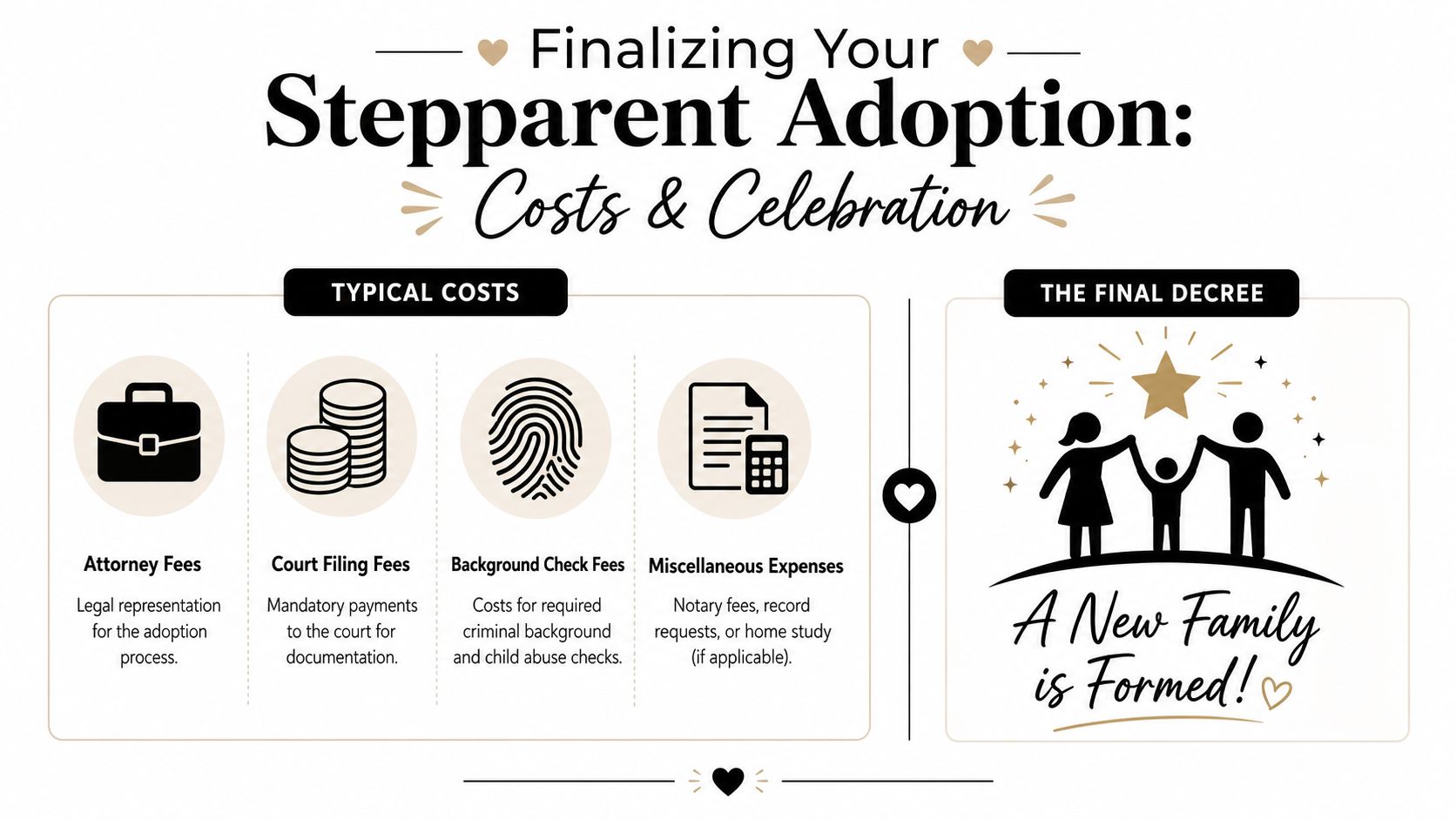
Here is a visual snapshot of that final stage.
What happens at the end
One point often catches families off guard. In Texas, a child who is 12 or older generally must consent to the adoption. As explained in Terry & Roberts' Texas stepparent adoption article, that consent may be given in writing or through the child's appearance before the judge. For many families, this requirement is more than a legal box to check. It is the court's way of recognizing that older children should have a say in a decision that permanently changes their legal family ties.
After the judge signs the adoption decree, one practical step remains. The adoption paperwork must be completed so the state can issue an updated birth certificate listing the stepparent as a legal parent. Families are often so relieved after the hearing that they assume everything is finished that day. Legally, the hard part may be over, but closing out the records matters too.
Planning for the cost
Cost depends less on the title of the case and more on how many problems must be solved before the judge can sign the decree. A straightforward, uncontested adoption with complete paperwork usually costs much less than a case with service problems, extra hearings, or a dispute involving the other parent.
In practical terms, families are usually paying for several layers at once. There are court filing fees. There may be charges for certified copies, service of process, background checks, or other court-required steps. Attorney's fees can stay relatively modest in a smooth case and rise sharply if the case becomes contested or delayed.
That is why I often compare adoption costs to home repair. Replacing a single fixture is one project. Opening the wall and finding wiring, plumbing, and structural issues is another. Two families may both say they are pursuing stepparent adoption, but the legal work underneath can be very different.
A short video can help you picture what the final stage may feel like in practice.
Budgeting insight: If there is a real chance the other parent will object, budget for more than filing fees and prepare for a longer emotional process as well as a more expensive legal one.
Navigating Contested Adoptions and Special Cases
Some stepparent adoptions move with steady, quiet momentum. Others hit sharp turns. The difficult cases usually involve disagreement, missing information, or special family circumstances that make the court proceed more carefully.

When an adoption is contested
A contested adoption usually means the non-custodial parent does not consent, challenges the case, or forces the family to prove legal grounds for termination. That changes the tone of the matter. It stops being mainly a paperwork case and becomes an evidence case.
In those situations, the court may hear testimony, review support records, and examine whether notice was proper and whether statutory grounds are met. The judge still centers the child's best interests, but the path to that decision is more demanding.
Families often feel frustrated because they see the daily reality clearly. The court, however, needs admissible proof and procedural fairness. That gap between lived experience and legal proof is where many contested cases become stressful.
If the other parent cannot be found
A missing parent creates a different problem. The issue isn't direct opposition. The issue is notice.
Texas courts generally expect real effort to locate and notify that parent before moving forward. That can include checking last known contact information, reviewing old records, and documenting attempts to serve notice. If those efforts fail, the court may allow an alternate method of notice. The exact path depends on the facts and the judge's instructions.
The practical point is simple. “We don't know where they are” usually isn't enough by itself. The court wants to see a record of genuine effort.
Military families, CPS history, and other sensitive facts
Military families may face scheduling and notice issues that make timing more complicated. A parent's service status can affect how the case moves and whether additional protections apply. Families should raise that issue early so the court process respects those legal requirements.
A prior history with CPS does not automatically end an adoption effort, but it can draw closer review. The court may want more information about safety, home conditions, or the current stability of the household. What matters most is whether the home now supports the child's welfare.
This is one of the few places in the process where having organized legal help can make a major difference. Families may choose private counsel, use court-provided information where available, or consult a Texas adoption practice such as Law Office of Bryan Fagan, PLLC for guidance on case strategy, filings, and hearings.
Your Texas Stepparent Adoption Questions Answered
By this point, most families aren't asking whether adoption matters. They're asking what daily life looks like after the judge signs. Those are good questions, because adoption is meant to create lasting security, not just a successful hearing.
Frequently Asked Questions
| Question | Answer |
|---|---|
| How long does stepparent adoption in Texas usually take? | In an uncontested case, the process typically takes 3 to 6 months, based on McCarty-Larson's discussion of Texas stepparent adoption timing. Contested matters can take longer. |
| What legal rights do I gain after adoption? | Once the adoption is final, the stepparent becomes the child's legal parent. That generally includes the right to make decisions for the child and the duty to support the child as a parent. |
| Does my stepchild have to agree? | If the child is 12 or older, formal consent is generally required, as described by Terry & Roberts' Texas stepparent adoption overview. |
| Can the case go forward if my spouse doesn't join it? | No. The custodial biological parent must join the adoption petition as a co-petitioner, according to McCarty-Larson's explanation of filing requirements in Texas. |
| Will there be a new birth certificate? | Yes. After the decree is signed, a Report of Adoption is filed so the state can issue a new birth certificate naming the stepparent as a legal parent, as explained by Terry & Roberts on post-decree adoption steps. |
| Can a stepparent adoption be reversed later? | Courts treat adoption as a permanent legal change. Families should approach it as a lifelong commitment, not a temporary arrangement. |
A final point is worth holding onto. The legal process can feel formal, but the heart of it is personal. A stepparent adoption can give a child clearer security, stronger legal protection, and a sense that the family they live in every day is the family the law recognizes too.
If you're weighing this step, slow down enough to prepare well. Gather records carefully. Think about the child's voice. Be honest about any conflict with the other parent. Those choices usually matter as much as the petition itself.
If you're ready to talk through your family's situation, Law Office of Bryan Fagan, PLLC offers free consultations for Texas families exploring adoption and guardianship. A conversation can help you understand your options, spot possible roadblocks early, and move toward the next step with clarity and confidence.

