
Late at night, many San Antonio families start the same way. One person opens a laptop, types “adoption lawyer San Antonio,” and wonders if this dream is finally becoming real. The hope is huge. So is the uncertainty. You may be asking whether you qualify, what the court will expect, how long things might take, or how to tell if a lawyer is the right fit for your family.
That mix of excitement and nerves is normal. Adoption is a legal process, but it's also a personal one. Whether you're a stepparent who's already raising a child every day, a relative trying to create stability, an LGBTQ+ couple building a family, or a hopeful parent exploring private or CPS adoption, the path can feel easier when you have a steady guide beside you.
Families often want more than legal paperwork. They want someone who can explain what happens next in plain English, help them avoid delays, and keep the focus where it belongs, on the child's best interests and the strength of the family unit. That's the role a thoughtful adoption lawyer should play. If you're comparing firms, reviewing options like a San Antonio family law office, or trying to understand the process before making any calls, it helps to view adoption as a journey with clear stages.
Starting Your San Antonio Adoption Journey
Maria had already been helping her husband raise his son for years. School pickups, doctor visits, bedtime routines, parent-teacher conferences. In every way that mattered emotionally, she felt like a parent. But legally, she still had questions. If something happened to her spouse, where would that leave her relationship with the child she loved?
That's where many adoption journeys begin. Not with paperwork, but with a family trying to make love, stability, and responsibility legally secure.

Some readers are hoping to adopt a newborn through a private placement. Others are grandparents caring for grandchildren, foster parents ready for permanence, or adults considering whether guardianship or adoption fits their situation better. Texas Family Code Chapters 162 through 166 define much of this area. In simple terms, those laws govern who may adopt, what court approvals are needed, how parental rights are handled, and what must happen before a judge can finalize a new legal parent-child relationship.
Why the first conversation matters
A good lawyer doesn't just tell you what form to sign. They help you understand which path fits your family.
For example:
- Stepparent adoption often centers on consent and the legal status of the other parent.
- Kinship adoption may involve a child who's already living with relatives and needs long-term stability.
- Private adoption often raises questions about matching, consent, paperwork, and final court approval.
- CPS adoption and reunification issues can involve careful attention to existing court orders and the child's permanency plan.
- Adult adoption works differently from child adoption and usually has a shorter, simpler court path.
Adoption law is technical, but the reason families pursue it is simple. They want a child to feel secure, loved, and fully part of the family.
In San Antonio, that means looking for an advocate who can guide you from the first search through the final hearing with patience, clarity, and steady communication.
Finding Your Family's Advocate in San Antonio
The first lawyer you find online isn't always the right one for your situation. Adoption law includes several very different paths, and the lawyer who handles one well may not focus on another. That's why your search should start with two questions. What kind of adoption are you pursuing, and what kind of guidance do you need most?
Start with eligibility and fit
Texas sets a basic starting point. Under Texas adoption law, which governs all adoption proceedings in San Antonio, any adult aged 21 or older is legally eligible to adopt if they can demonstrate financial stability and responsible behavior, according to this overview of Texas adoption eligibility. That doesn't mean every case is simple, but it does mean many hopeful parents rule themselves out too early.
Texas also doesn't allow agencies or certain child-placement entities to impose a maximum age limit or age gap rule in the way some families fear. Health and best-interest concerns may still matter in an individual case, but the law itself no longer permits a blanket maximum age policy in that setting. For many readers, that's reassuring.
Where to look for the right lawyer
Local families usually benefit from gathering names from more than one source. A thoughtful search often includes:
- Bar referrals: The San Antonio Bar Association referral tools can help you identify family law attorneys in the area.
- Agency input: Licensed adoption agencies often know which lawyers regularly handle private, agency, stepparent, or kinship matters.
- Community recommendations: Foster parent groups, kinship caregivers, and local family support circles may share practical feedback about communication and responsiveness.
- Focused legal reading: A plain-language page like Texas adoption attorney guidance can help you compare legal roles before you schedule a consultation.
If you're researching how law firms present their practice online, a broader resource like this law firm SEO roadmap can help you spot the difference between clear educational content and generic marketing language.
Match the lawyer to the adoption type
A lawyer should be able to explain the difference between adoption categories in practical terms.
A stepparent needs answers about the other biological parent's rights. A relative caregiver may need help deciding between conservatorship and adoption. A hopeful parent in a private adoption may need guidance on agency coordination, home studies, and finalization. LGBTQ+ families often want clear reassurance that the attorney understands both the legal process and the emotional importance of secure parent-child recognition.
Practical rule: The right adoption lawyer in San Antonio isn't the one with the broadest service list. It's the one whose day-to-day experience matches your family's path.
That's also why many families read resources such as When to Hire a Texas Adoption Attorney before moving forward. The key point is simple. Early legal guidance can protect an adoption from delays and challenges.
Key Questions to Ask a Potential Adoption Lawyer
The consultation matters because it shows you how the lawyer thinks, explains, and listens. Families often focus on one question, “Can you handle this?” A better approach is to ask several targeted questions that reveal whether the lawyer can guide your specific case with clarity and care.
Near the start of that meeting, it helps to keep a visual checklist in front of you.
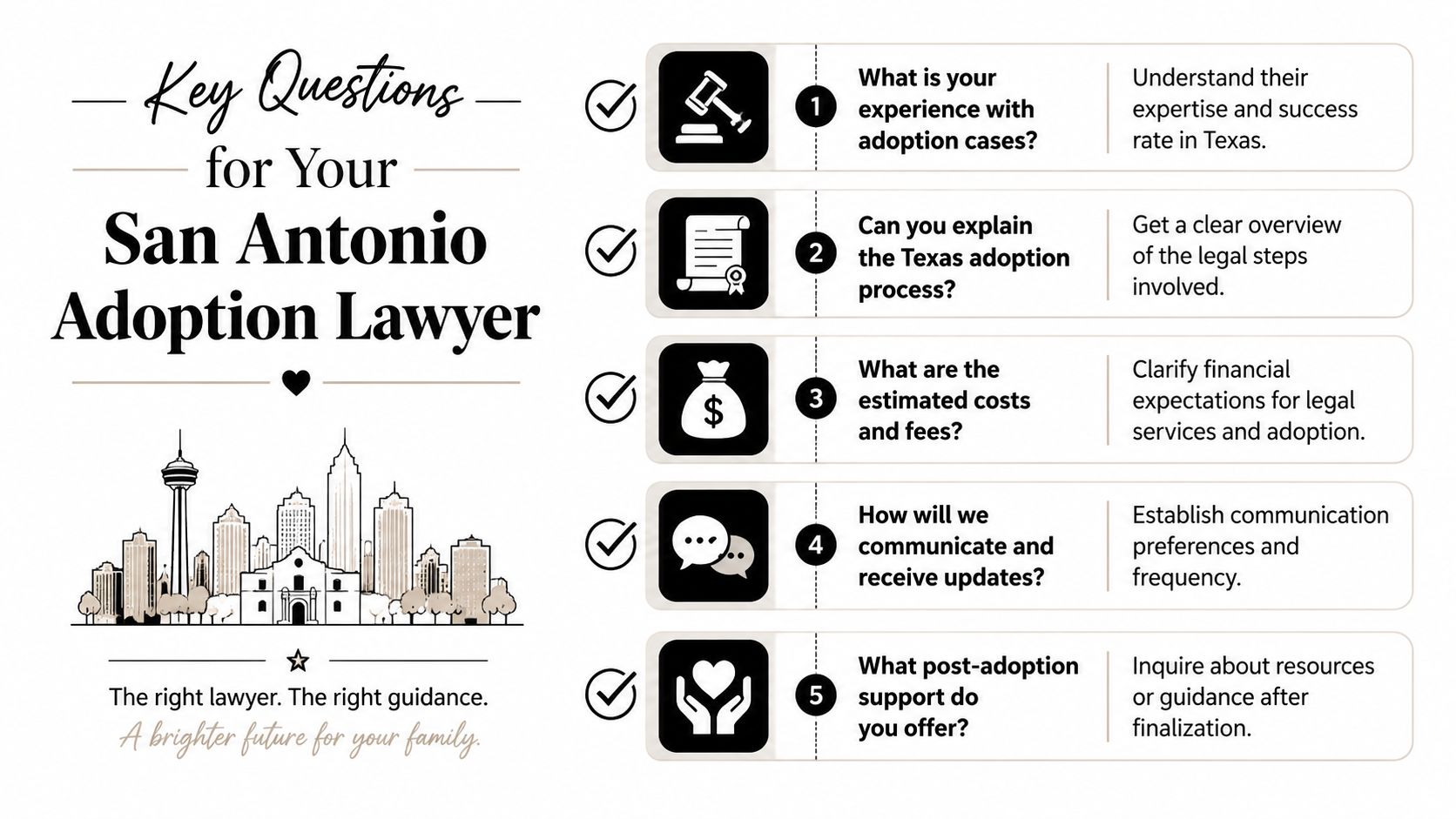
Bring questions about experience and process
A family pursuing a stepparent adoption should not ask the same questions as a family pursuing a private domestic placement. The categories overlap, but the risks are different.
Here's a simple checklist you can bring into the room.
| Category | Question to Ask | Why It Matters |
|---|---|---|
| Experience | What kind of adoption cases like ours do you regularly handle? | You want experience that matches your actual path, not just general family law work. |
| Process | What are the main legal steps in our case? | A clear answer shows the lawyer can translate Texas law into practical action. |
| Timelines | What can affect how quickly or slowly this may move? | Good lawyers explain possible delays without making promises they can't control. |
| Communication | Who will update us, and how often should we expect to hear from the office? | Families feel calmer when they know how communication will work. |
| Costs | Will you give us a written estimate for legal fees and outside costs? | Cost transparency reduces confusion and helps you plan. |
| Court preparation | What will you need from us before filing? | This shows whether the lawyer can organize the case efficiently. |
| Problem areas | What issues commonly stall cases like ours? | This helps you spot risk early, especially in consent-related cases. |
| After finalization | Will you explain what changes legally after the adoption is granted? | Families need to understand what the final decree means in daily life. |
Ask directly about fees
Families are often surprised by how unclear cost conversations can be. Prospective parents rarely receive itemized fee schedules or clear timelines for when outside-service costs are due. This is a critical gap, as adoption industry guidance urges attorneys to provide written estimates for all third-party costs to avoid anxiety about hidden expenses, as noted in this discussion of San Antonio adoption cost transparency.
That matters in every type of adoption. Home studies, document preparation, filing-related steps, and other outside services can affect planning. Even when a lawyer can't predict every detail, they should still explain the categories of costs in writing when possible.
If a lawyer answers cost questions vaguely, that's useful information. It tells you what communication may feel like later in the case.
Listen for teaching, not just selling
A strong consultation should leave you better informed. You should understand what Chapters 162 through 166 generally require, why consent matters, what the home study involves in applicable cases, and what the final hearing is likely to feel like. If the lawyer uses legal terms, they should explain them in plain language.
This short video gives a helpful overview of adoption questions families often ask before hiring counsel.
A calm, organized consultation often tells you as much as the answers themselves. If you feel rushed, confused, or talked around, that's worth noticing. Adoption is too important to move forward without trust.
Navigating the Legal Path to Adoption in Texas
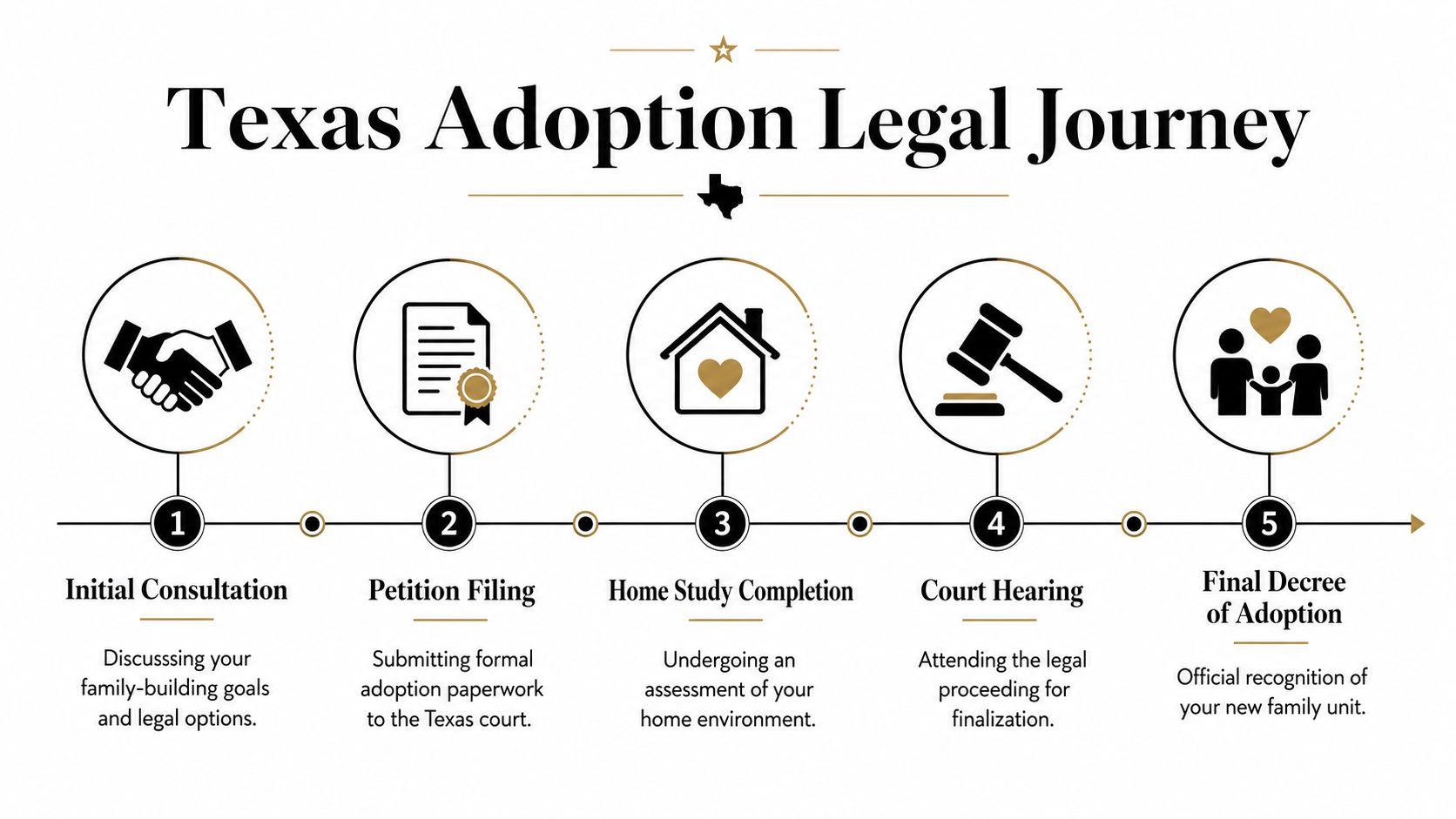
For many San Antonio families, the process becomes easier once they can see the steps in order. A lawyer's job is to move the case from uncertainty to structure. That means identifying the legal path, preparing the right filings, tracking deadlines, and anticipating where problems might arise.
The legal journey looks different depending on whether you're adopting through a stepparent, kinship, private, CPS, or adult adoption path. Still, child adoptions in Texas usually follow the same broad sequence under the Family Code.
A family story that shows how the steps unfold
Consider a San Antonio stepparent who has been parenting a child for years. The child calls her “Mom,” but the child's biological father has had little contact. The family wants the law to align with their daily reality.
The lawyer starts by reviewing whether the other parent will sign a voluntary consent or whether the case may require a contested court process. This point matters because the Texas adoption process requires first terminating parental rights, either voluntarily or involuntarily, followed by a mandatory home study. Failure to secure proper consent from both biological parents is the most common pitfall in step-child adoptions, often requiring contested TPR proceedings that add 6–18 months to the timeline, according to this outline of Texas adoption procedure and stepchild consent issues.
That's why the early legal review is so important. A family may feel ready to “just file,” but a careful lawyer will first ask whether the legal foundation is secure.
What your lawyer handles at each milestone
In plain English, the main stages often look like this:
Legal screening and strategy
The lawyer identifies the adoption type, checks for consent issues, and explains whether adoption or another family law option better fits the child's needs.Termination of parental rights
In child adoption cases, existing legal parental rights must be addressed first. This may happen through signed consent or through litigation if a parent objects or cannot be located.Home study and required review
In cases where a home study applies, the family works through background checks, fingerprinting, health-related requirements, and home visits with an authorized professional.Petition filing
Once the groundwork is ready, the attorney files the adoption petition in the proper county court.Court preparation and final hearing
The lawyer prepares the family for questions from the judge and makes sure the court has the documents needed to consider finalization.
What this means emotionally
A legal process can stir up complicated feelings. Birth parents may be grieving. Stepparents may fear rejection by the court. Kinship caregivers may feel torn between protecting the child and preserving family relationships. Foster parents may be thrilled and anxious at the same time.
A good lawyer makes space for both the legal and human sides of the case. Families often appreciate hearing how others describe legal support in emotionally significant matters, even outside adoption. Broader reflections like these customer experiences in AI law can remind readers how much clear communication and predictability matter during legal decision-making.
The court process is formal, but the reason behind it is personal. Judges want to know that the adoption serves the child's best interests and creates a stable legal family.
Open versus closed adoption questions may also come up in private placements. Some families want ongoing contact with birth parents. Others prefer more privacy. Those decisions should be handled carefully, with attention to expectations, boundaries, and the child's long-term well-being.
Your Partnership with Your San Antonio Adoption Lawyer
Once you've chosen counsel, the relationship should feel steady and practical. You're not hiring someone to “take over your family.” You're working with a professional who keeps the legal process moving while you prepare your home, your records, and your expectations.
Families often relax once they understand what their role is.

What you may need to gather
The exact list depends on the adoption type, but many families are asked for records that help support filings, background review, or the home study process. That may include identity documents, marriage records if applicable, information about the child's living arrangements, and other records your attorney or evaluator requests.
If you want a plain-language overview of the attorney's working role, this guide on what an adoption lawyer actually does step by step can help frame expectations before meetings and filings begin.
What communication should feel like
Good communication is rarely dramatic. It's clear. You know what your lawyer is waiting on, what the next deadline is, and when the court may act. You also know what you need to do and what you don't need to worry about.
That matters because waiting can be one of the hardest parts. Under Texas Family Code Chapter 162, a court cannot grant an adoption until the child has resided with the petitioner for at least six months, though this requirement may be waived if the court determines it serves the child's best interest, as stated in Texas Family Code Chapter 162. Families often need reassurance during that period that the waiting has a legal purpose and doesn't mean the case has stalled.
What the final hearing usually feels like
People often expect the final hearing to feel intimidating. In many adoptions, it feels meaningful and even joyful. The judge may ask simple questions to confirm your intentions and the legal basis for the adoption. Your lawyer handles preparation so you aren't walking in cold.
Some families bring photos. Some children dress up. Some relatives attend. Even though the setting is a courtroom, the moment often feels like recognition of a bond that already exists in daily life.
What many parents remember most: not the legal wording, but the moment they heard the adoption granted and knew the law now matched their family.
Taking the First Step to Grow Your Family
Finding the right adoption lawyer in San Antonio isn't just about locating someone who files documents. It's about choosing a guide for one of the most meaningful transitions your family may ever make. The law has rules, deadlines, and formal steps. But with thoughtful guidance, those steps become manageable.
Families come to adoption from many directions. A stepparent wants lasting legal security. A grandparent wants permanence for a grandchild. A hopeful parent wants to understand private or agency adoption. A foster family wants finality after a long road. In each situation, the central question is the same. What path best protects this child and supports this family?
That's where calm legal help matters. A lawyer should explain your options in plain language, help you avoid avoidable delays, and keep the process centered on the child's best interests. If you're at the point of searching “adoption lawyer San Antonio,” you may be closer than you think to getting real answers.
One practical option for families comparing resources is the Law Office of Bryan Fagan, PLLC, which provides Texas adoption and guardianship guidance for families working through home studies, filings, and court finalization. A free consultation can help you understand what kind of adoption fits your situation and what steps come next.
Common Questions About Adoption in San Antonio
Do both biological parents have to consent?
In many child adoption cases, consent or a court order addressing parental rights is a core issue. If one parent won't consent, the case may become more complex and may require the court to decide whether legal grounds exist to terminate that parent's rights. This is one reason stepparent and relative adoptions can become more involved than families first expect.
Can a single adult adopt in Texas?
Yes, Texas law allows an eligible adult to pursue adoption. The court still focuses on stability, responsibility, and the child's best interests. Single parents, married couples, relatives, and LGBTQ+ families may all explore adoption options under Texas law, depending on the facts of the case.
Is adult adoption different from child adoption?
Yes. For adult adoption in Texas under Texas Family Code §162.501, the adoptee must be at least 18 and provide written consent; no home study or TPR is required, and most cases are finalized within 30 to 60 days, according to this guide to adult adoption in Texas. Adult adoption is often used to formalize an existing parent-child bond, recognize a longtime family relationship, or support inheritance and legal clarity.
What if we're deciding between adoption and guardianship?
That depends on your long-term goals. Adoption creates a permanent legal parent-child relationship. Guardianship or conservatorship may provide authority to care for a child without creating the same permanent legal status. Families caring for relatives often need help comparing both paths.
Do open and closed adoptions affect finalization?
They can affect expectations and planning, but the court's main concern remains the child's best interests and whether all legal requirements are met. If you're considering private adoption, it's important to discuss communication expectations early and handle them carefully.
If you're ready for clear, compassionate guidance, schedule a free consultation with Law Office of Bryan Fagan, PLLC. Whether you're exploring stepparent adoption, kinship adoption, private placement, CPS adoption, or adult adoption, a thoughtful legal conversation can help you understand your options and take the next step with confidence.
