
A child is due soon. The mother wants to make an adoption plan, but she doesn't know where the biological father is, or even with confidence who he is. Or maybe you're a stepparent who has raised a child for years, and now you're ready to make that bond legal, but the child's biological father has never been involved. In both situations, the same question rises to the top very quickly. What happens if the biological father is unknown?
In Texas, that question doesn't stop an adoption or guardianship automatically. It does mean the court will expect careful steps, proper notice, and solid documentation. The process can feel personal and painful, but it is also a legal problem with a legal path forward. When families understand what the court needs, they can move with more confidence and less fear.
Your Questions Are Valid and You Are Not Alone
Sarah is making an adoption plan for her baby. She has limited information about the father, and contact ended months ago. She worries that one missing piece could unravel everything. Across town, Marcus has been raising his wife's child since preschool and wants to complete a stepparent adoption, but the biological father hasn't been identified in any practical way. Both families are carrying the same quiet fear. "Will this stop us from giving this child stability?"
It may help to know that family life is often more complicated than a birth certificate form makes it seem. In the United States, 18.2 million children, or 1 in 4, live without a biological, step, or adoptive father in the home, according to a father absence statistic cited by Fatherhood.org. That number does not mean every case involves an unknown biological father. It does show that father absence is a real part of life for many families, and it helps explain why adoption, guardianship, and paternity procedures matter so much.

What people usually fear most
Most readers aren't just asking a legal question. They're asking several questions at once.
- Will the court think I didn't try hard enough? Many parents worry that imperfect information will look like carelessness.
- Can a father appear later and challenge everything? That fear is common, especially in private infant adoptions and stepparent cases.
- Is this unfair to the child? Families want permanency, but they also want to do things the right way.
Those concerns are valid. Texas courts care strongly about fairness, notice, and the child's best interests. They also understand that some fathers are unknown, absent, or impossible to locate.
The legal system can't force certainty where certainty doesn't exist. What it can require is honesty, diligence, and proof that the adults acted in good faith.
Why this issue feels bigger than it is
When people hear stories about paternity disputes, they often assume every uncertain father situation turns into a courtroom crisis. Usually, the harder part is not drama. It's paperwork, timelines, and evidence. Families often need help organizing facts, identifying possible fathers, checking records, and showing a judge that they made a real effort.
That is manageable. It takes care, not panic.
If you're facing this now, you're not starting from nowhere. You're standing at the beginning of a process Texas courts handle regularly, especially in cases involving adoption, termination, and conservatorship.
Understanding Paternity and the Texas Putative Father Registry
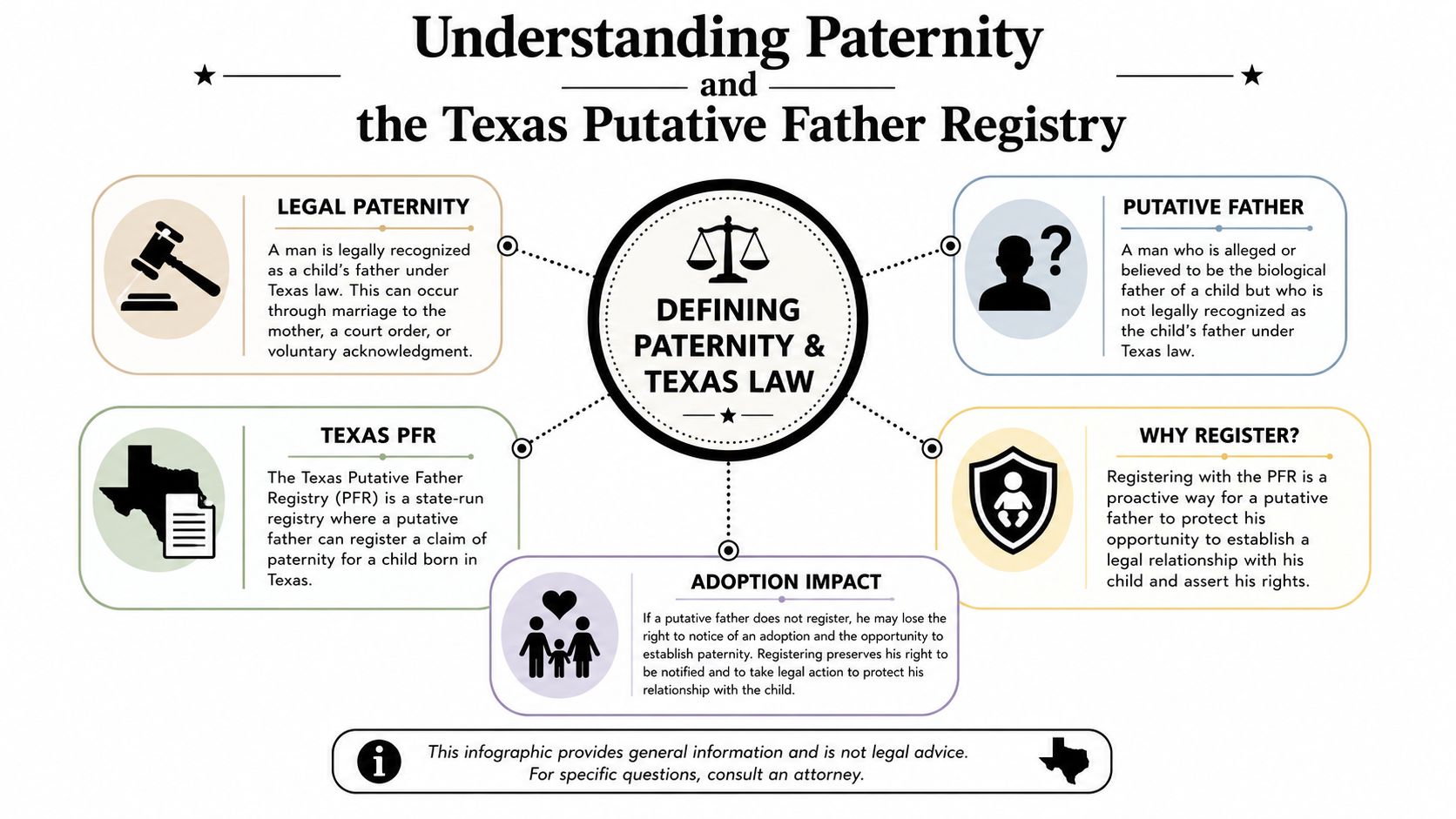
Texas law uses several labels for fathers, and those labels matter because each one can affect notice, consent, and whether an adoption can move forward. Families often get stuck because they use everyday language while the court uses legal categories.
Three labels that matter in real cases
A presumed father is usually a man the law already treats as the child's father based on family circumstances recognized under Texas law, such as marriage-related rules. An alleged father is a man who may be the biological father but whose legal status has not been confirmed. An unknown father is exactly what it sounds like. No specific man has been identified with enough certainty to name him and serve him directly.
These categories sound technical, but they shape practical decisions:
| Category | What it usually means | Why it matters |
|---|---|---|
| Presumed father | The law may already recognize him | His rights often must be addressed directly |
| Alleged father | Someone may be the father, but paternity is unresolved | He may need notice and a chance to respond |
| Unknown father | No definite identity is available | The court looks closely at search efforts and notice steps |
Why the registry matters so much
Texas maintains a Paternity Registry, sometimes called the putative father registry. Texas Law Help explains that a man can use it to assert parentage independently, and if an alleged father does not register before or shortly after birth within a strict timeframe, he may lose the right to receive notice of an adoption. You can read that overview in this Texas guidance on unknown fathers.
For birth mothers and adoptive families, that means an "unknown" father isn't always legally irrelevant. A man may not be involved in the pregnancy and may still try to protect his rights through the registry. For men who believe they may be the father, registration is a proactive step, not something that waits for the mother to contact them.
Practical rule: In unknown-father cases, one of the first legal questions is often whether the Texas Paternity Registry was checked and documented.
Why readers get confused here
Many people assume that if no father is listed on the birth certificate, the legal issue is over. It isn't. The birth certificate is one record. The court looks more broadly at possible legal fathers, alleged fathers, and whether anyone preserved rights through proper legal channels.
That's why families considering adoption should learn early about birth father rights in Texas adoption cases. The point isn't to create fear. The point is to avoid surprises.
Texas Family Code Chapters 162 through 166 govern many core adoption procedures, including how adoptions are filed, reviewed, and finalized. In practice, those chapters work alongside Texas parentage rules and termination procedures. So even when the father is unknown, the adoption case still has to answer one central question before finalization. Have the father's rights, or the possibility of those rights, been handled in a legally sound way?
The Legal Process for Terminating an Unknown Father's Rights
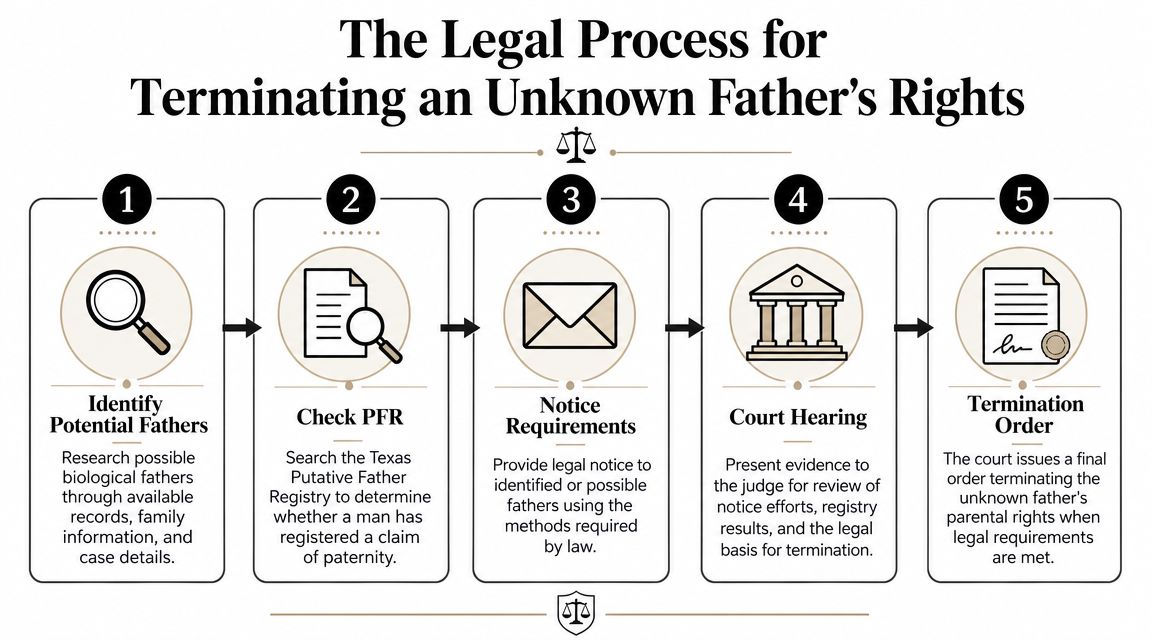
For an adoption to be secure, the rights of both biological parents must be dealt with properly. When the biological father is unknown, the court does not expect magic. It expects proof of effort.
What the judge is really looking for
Courts focus heavily on procedure. California self-help guidance captures the same principle family courts use broadly in these situations: the key issue is often not "who is the father?" but "what evidence will satisfy a court that reasonable search efforts were made?" That explanation appears in this court guidance on identifying and notifying a father.
That idea matters in Texas too. If no one can identify the father with certainty, petitioners usually need to show a diligent search. That means a careful, documented effort to identify possible fathers and provide notice where required.
What a diligent search may include
In plain English, the court wants to see that the adults involved did real work, not guesswork.
A search may involve:
- Gathering names and facts from the mother about relationships, possible conception dates, last known contact, and identifying details.
- Checking the Texas Paternity Registry to see whether anyone asserted possible parentage.
- Reviewing available records that may help identify or locate an alleged father.
- Attempting notice if a possible father is identified.
- Using alternative service, such as publication, when direct service isn't possible and the court allows it.
Some cases are straightforward. Others aren't. A private infant adoption may turn on what the mother knows and can swear to under oath. A stepparent adoption may involve years of silence and little reliable information.
The goal is not always to find the man. The goal is to show the court that you made a serious, honest effort to identify and notify anyone who may have rights.
How this fits into a Texas adoption case
Texas Family Code Chapters 162 through 166 address the adoption process itself, including filing the petition, home study or other pre-placement requirements when applicable, court review, and finalization. But before the judge signs the adoption, the case must be legally clean on the parental-rights side.
That is why unknown-father issues often become the gatekeeper issue in:
- Stepparent adoptions
- Relative and kinship adoptions
- Private infant adoptions
- Some foster care and CPS-related permanency cases
If you're trying to understand whether an adoption may proceed without a father's agreement, this overview on whether an adoption can happen without the father's consent in Texas helps frame the issue.
Families also sometimes benefit from outside reading about paternal-rights disputes more generally, especially where identity, notice, and standing overlap. In that context, this resource on experienced Austin fathers' rights guidance can help readers understand how fathers' rights arguments are approached from the other side of the case.
The paperwork matters as much as the facts
A weak case often isn't weak because the mother lacked information. It's weak because no one organized the information well. Judges want specifics. Dates if known. Names if known. Last contact if known. Search efforts. Registry checks. Copies of notices. Affidavits. Filing records.
That is what turns a difficult family story into a legally provable case.
Next Steps for Your Specific Family Situation
Not every reader is standing in the same place. The right next step depends on your role in the child's life and what kind of case you're trying to build.
If you're a birth mother making an adoption plan
You do not need a perfect memory or a perfect situation. You do need to be truthful and detailed. Courts usually care less about whether your information is neat and more about whether it is complete and honest.
A helpful starting list looks like this:
- Write down what you know: Names, nicknames, phone numbers, social media accounts, workplace, relatives, old addresses, and the timeframe of conception.
- Be candid about uncertainty: If there is more than one possible father, say so early. That may feel uncomfortable, but it protects the adoption from later attack.
- Save communications: Old texts, emails, and messages may help identify a person or show efforts to locate him.
A common example is a mother who only has a first name, an old number, and a city where the father once lived. That may not be enough to find him immediately, but it is still useful information for a legal search strategy.
If you're a hopeful adoptive parent
The uncertainty may feel like you're waiting for the ground to stop shifting. That feeling is normal. In most cases, your role is not to investigate on your own. Your role is to support a careful legal process and keep your paperwork moving.
Focus on the parts of the adoption you can control under Texas Family Code Chapters 162 through 166:
| Stage | What you can do now |
|---|---|
| Pre-placement | Complete required forms, background steps, and any home study requirements that apply |
| Placement period | Keep records organized and respond quickly to attorney and court requests |
| Finalization prep | Confirm that parentage, notice, and termination issues are resolved before asking the court for final adoption relief |
If you're using an attorney, ask one direct question early: "What evidence are we building now to protect finalization later?" That question often clarifies the whole case.
If you're a stepparent
Stepparent cases are emotional because the daily parenting relationship already exists. You may be doing school pickups, doctor's visits, bedtime routines, and financial support, yet still lack legal parent status.
Your checklist is often short but important:
- Confirm who has legal status now: The mother, a presumed father, or an alleged father may already create issues that have to be addressed.
- Gather your family history: How long have you lived with the child? What role have you played? What contact, if any, has the biological father had?
- Prepare for termination first: In many stepparent adoptions, the unknown or absent father's rights must be resolved before the adoption itself can be finalized.
If you're a grandparent, aunt, uncle, or other relative caregiver
Kinship and relative caregivers often carry both practical and emotional burdens. You're trying to keep the child safe, preserve family ties, and avoid another disruption. The unknown father issue can feel like one more barrier, but it is often just one legal track among several.
Think in terms of two parallel needs:
- Immediate stability for the child, which may involve temporary orders, conservatorship, or guardianship-related planning.
- Long-term permanency, which may involve termination and adoption once notice issues are handled.
A child's best interests are not served by guessing. They're served when caregivers create a record the court can trust.
One gentle warning
Don't rely on family assumptions. "He knows about the child." "He was around years ago." "Everyone knows he's the father." None of those statements replaces legal notice, registry review, or court findings.
When families slow down long enough to document the facts, they usually move faster later.
Handling Paternity and the Birth Certificate When a Father Is Found
Sometimes a possible father is identified during the process. Sometimes he comes forward on his own. When that happens, the case shifts from unknown-father procedure to paternity resolution.
Two main paths for establishing paternity
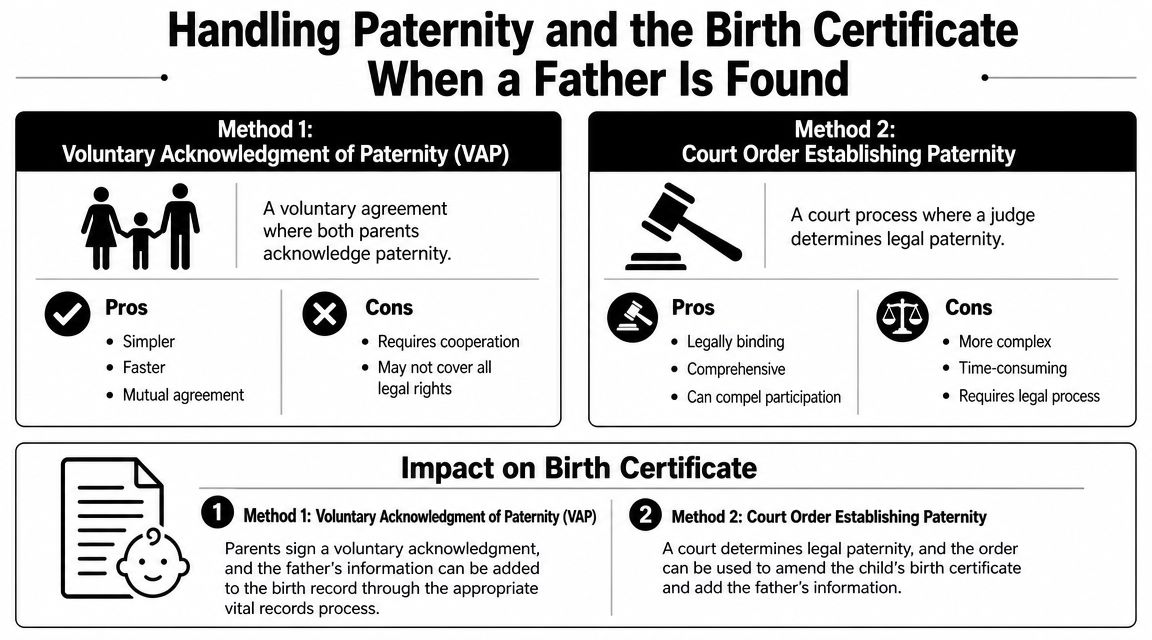
In broad terms, families usually face one of two routes: a voluntary acknowledgment or a court-based process.
| Method | How it works | Best fit |
|---|---|---|
| Voluntary acknowledgment of paternity | Both parents agree to identify the father through signed legal paperwork | Useful when everyone agrees and there is no real dispute |
| Court-ordered paternity process | The court handles the dispute and may require testing or other proof | Better when there is doubt, conflict, or missing cooperation |
The voluntary route is usually simpler. The court route is more formal and often slower, but it creates a clearer path when facts are contested.
Why DNA testing changes the conversation
When a biological father is unknown, DNA-based parentage testing is the most direct way to establish a paternal link. Even when the father himself is unavailable, modern autosomal DNA analysis can identify paternal relatives through shared ancestry, as discussed in this Science article on unexpected paternity and genetic discovery.
That does not mean an at-home DNA result automatically settles a Texas court case. It means genetic evidence can point the case in the right direction, support further testing, and help identify the right people.
If everyone agrees, paperwork may solve the problem. If people disagree, the court usually wants stronger proof.
What happens to the birth certificate
The birth certificate and legal parentage are related, but they are not identical. If the father is unknown at birth, the certificate may be completed without naming him. If paternity is later established, the record can often be updated through the proper legal channel.
And if the child is later adopted, Texas can issue a new birth certificate reflecting the adoptive parent or parents after the adoption is finalized. Families who need to understand that record-change process can review this guide to a Texas birth certificate amendment.
How this affects rights and responsibilities
Once paternity is legally established, the father may have rights and duties connected to the child. Those can include notice rights, potential custody or visitation claims, and support obligations. That is why families should be careful before choosing the easy-sounding route.
If there is doubt, testing first is usually safer than signing first. Legal forms can create lasting consequences.
The Growing Impact of At-Home DNA Tests
Consumer DNA testing has changed family law conversations in a very quiet way. A person buys a test for ancestry, ethnicity, or family-tree research, and suddenly a close match appears who doesn't fit the known story. That can uncover an unknown biological father, a different paternal line, or a long-hidden adoption fact.
Those discoveries are emotionally powerful, but they don't arrive with legal instructions. A surprise match may answer a personal question while creating several legal ones. Who is the legal father now. Does this affect a pending adoption. Should anyone contact the newly discovered relatives. Is more formal testing needed.
What the numbers actually suggest
Popular culture makes misattributed paternity sound common. Population research paints a more restrained picture. A 2005 scientific review found a worldwide range of about 0.8% to 30%, with a median of 3.7%, while more representative population studies in places like the UK and Switzerland were closer to 1% to 2%, as summarized in this overview of paternity-fraud research.
That doesn't make the issue unimportant. It does help keep one frightening thought in perspective. A shocking DNA discovery is serious for the people involved, but it is not proof that hidden paternity problems are everywhere.
The legal difference between discovery and proof
An AncestryDNA or 23andMe result may help a family identify possible paternal relatives. It may also guide an attorney toward the right next step. But consumer DNA results are not the same as a final court order.
A careful response often includes:
- Pause before contacting everyone: New relatives may be unaware of the family history.
- Preserve screenshots and records: Keep the information in case it becomes useful later.
- Ask what legal issue needs solving: Personal identity, adoption notice, child support, or inheritance questions may require different steps.
Sometimes the right move is no move until legal advice is in place. That's especially true if an adoption, termination case, or custody case is already pending.
Building Your Family's Future with Confidence
When the biological father is unknown, families often fear that everything is too uncertain to move forward. In Texas, that usually isn't the case. The situation is delicate, but it is legally manageable when the adults involved approach it with honesty, good records, and a clear plan.
The court's job is not to punish families for uncertainty. Its job is to protect the child's stability while making sure notice and parental-rights issues are handled correctly. That is why the process can feel detailed. The detail is what helps create permanence.
If you're caring for a child and trying to sort through paternity, adoption, or guardianship, it may also help to read practical outside guidance on related family questions. For caregivers thinking about DNA issues more generally, this article offering help for caregivers on genetic testing can be a useful starting point for understanding the broader topic.
The next step is usually not dramatic. It is simple. Gather what you know. Save documents. Write down names, dates, and contact details. Ask what kind of case you are really dealing with, adoption, stepparent adoption, kinship care, paternity, or termination. Then get legal guidance before assumptions harden into mistakes.
For Texas families, one option is the Law Office of Bryan Fagan, PLLC, which handles adoption and family law matters involving termination, notice, home studies, court filings, and finalization. The right fit in any case depends on your facts, your county, and how much is known about the father.
You do not need to have every answer before you ask for help. You just need a starting point.
If you're facing questions about an unknown biological father in an adoption, guardianship, or stepparent case, a conversation can bring a lot of relief. The Law Office of Bryan Fagan, PLLC works with Texas families who need clear next steps, careful documentation, and a child-focused legal plan. Schedule a free consultation to talk through your situation in a confidential, supportive setting.
