
Thinking about adoption is a monumental step, one filled with both excitement and many questions. We understand. The legal side of things, especially Texas adoption laws, can seem like a dense forest of rules and paperwork. But here’s the truth: every single one of those rules is there for one reason—to make sure every child finds a safe, stable, and loving forever home.
Your Guide to Adopting a Child in Texas
The legal process might feel intimidating, but it’s better to think of it as a well-marked trail leading to the family you’ve always dreamed of. At The Law Office of Bryan Fagan, PLLC, we believe you shouldn't have to walk that path alone. We're here to light the way with compassion and clarity, whether you're a hopeful adoptive parent, a birth parent considering your options, or a relative stepping up to care for a child.

The Many Paths to Building Your Family
Adoption in Texas isn't a one-size-fits-all process. It's a collection of different pathways, each tailored to the unique circumstances of children and the families ready to welcome them. This guide will break down the most common routes you can take to grow your family, including:
- Private Infant Adoptions: This is the path where you connect directly with birth parents who are making the incredibly brave and selfless decision to place their newborn with an adoptive family.
- Stepparent Adoptions: You're already a parent in your heart and in your home. This process makes it official, legally cementing the powerful bond you share with your stepchild and strengthening your family unit.
- Kinship Adoptions: When a child needs a stable home, sometimes the best place is with family. This is for grandparents, aunts, uncles, or other relatives stepping up to provide that permanent, loving care.
- Foster Care Adoptions: These are children in the state's care who are waiting for their forever family. Opening your home to them is a life-changing act of love.
No matter which path you explore, the goal is always the same: creating a home built on safety, stability, and love. The legal foundation for this is found mainly in Chapters 162-166 of the Texas Family Code, which provides the framework to ensure every adoption is handled with the utmost care, prioritizing the best interests of the child.
At its core, adoption is about creating permanency. It’s the legal and emotional process that turns a house into a forever home and a group of people into a family, bound by law and by love.
Our mission is to make these laws make sense. We'll cut through the jargon and explain everything in plain English, from the first home study to that final, joyful moment in the courtroom. This is a journey you take with a team, and we're ready to be in your corner, empowering you at every milestone.
The Legal Heart of Texas Adoption Law
Jumping into the legal side of adoption can feel like you’re trying to read a map in a foreign language. But once you get your bearings, you’ll find that Texas adoption laws are all built around one simple, powerful idea: doing what’s best for the child.
Let’s translate the key legal concepts from the Texas Family Code into plain English. That way, you can walk into this process feeling confident and prepared, not overwhelmed. At The Law Office of Bryan Fagan, PLLC, we see the law not as a roadblock, but as the very foundation for building strong, legally secure families.

Who Is Eligible to Adopt in Texas?
You might be asking yourself, "Do I even qualify to adopt?" The great news is that Texas law is wonderfully inclusive. It focuses on your ability to provide a stable, loving home, not on a rigid checklist of life achievements.
Any adult or married couple can petition to adopt. The state’s main concern is simply that you are financially stable, mature, and ready to care for a child.
This is all confirmed through a process called a home study. Instead of a scary inspection, think of it as a get-to-know-you session. A licensed social worker partners with you to understand your home, your life, and your reasons for wanting to adopt. It’s designed to educate and prepare you, making sure your home is ready to welcome a new family member. For a deeper dive into the statutes, check out our guide to the Texas Family Code and adoption.
Understanding Termination of Parental Rights
Before any adoption can move forward, the legal relationship between the child and their biological parents must be officially ended. This critical legal step is called the Termination of Parental Rights (TPR).
A TPR is a court order that permanently severs the legal ties between a child and their birth parents. This is what makes a child legally available for adoption and gives them the chance at a stable, permanent new family.
There are two paths for this to happen:
- Voluntary Relinquishment: Sometimes, a birth parent makes the courageous and selfless decision to sign legal paperwork (an affidavit of relinquishment) to voluntarily give up their parental rights. In Texas, a birth mother cannot sign this document until at least 48 hours after the child is born. This compassionate waiting period gives her time to recover physically and be absolutely sure of her decision.
- Involuntary Termination: In heartbreaking situations involving abuse, neglect, or abandonment, a court may step in to involuntarily terminate a parent's rights. This is a very serious legal action taken only to protect a child’s safety and well-being after a thorough investigation and court hearings.
Imagine a couple, Sarah and Mark, hoping to adopt a newborn. The birth mother, after receiving counseling and support, decides that adoption is the best choice for her child. Forty-eight hours after giving birth, she signs the papers to relinquish her parental rights. This single act of love legally clears the way for Sarah and Mark to become the child's parents and provide a forever home.
The TPR process is the legal bedrock of every adoption in Texas. It creates the finality needed for a child to move forward without legal question marks and for an adoptive family to build their future with confidence.
Exploring Different Paths to Adoption in Texas
The journey to building a family through adoption is deeply personal, and here in Texas, you have several different paths you can take. Each one has its own unique steps and emotional landscape, but they all lead to the same beautiful destination: giving a child a permanent, loving home. Figuring out which type of adoption fits your family’s story and heart is the first step.
At The Law Office of Bryan Fagan, PLLC, we believe every hopeful parent deserves a clear path forward. Whether you’re making a bond that already exists official or opening your heart to a child you haven’t met yet, we’re here to guide you with compassion through the specific Texas adoption laws that apply to your journey.
Stepparent Adoptions: Solidifying Your Blended Family
For so many blended families, the love between a stepparent and stepchild is already as real as any biological bond. A stepparent adoption is the legal process that finally makes that heartfelt reality official on paper. It’s a powerful way to give your stepchild the ultimate sense of security, belonging, and family unity.
The process usually involves the non-custodial biological parent agreeing to terminate their parental rights. This is often a collaborative and emotional decision, but it clears the way for the stepparent to legally step into the role of parent. Once it's finalized, you'll have all the same rights and responsibilities, from making medical decisions to being named on a new birth certificate.
Kinship Adoptions: Keeping Family Together
Texas law operates on a profound belief: whenever possible, children thrive when they stay with family. Kinship adoptions—where a relative like a grandparent, aunt, or older sibling adopts a child—are a perfect example of this principle in action. This path is all about maintaining family bonds, which gives a child a crucial sense of identity and stability during what is often a tough time.
In fact, this commitment to family connection is woven into state policy. Relatives account for a significant portion of all adoptions of Texas foster children. This isn't just a number; it shows how the Texas Family Code prioritizes placing kids with their extended family to reduce trauma and keep them connected to their roots.
Adoptions from Foster Care (CPS)
Right now, children in the state's foster care system are waiting for one thing: a forever family. Deciding to adopt from Child Protective Services (CPS) is a truly life-changing choice, both for you and for the child you welcome home. These children have often faced trauma or instability, and they need a home that offers patience, understanding, and unconditional love.
The state provides significant support for families who choose this path, often covering legal costs and offering ongoing financial and medical assistance. The main goal is to find a permanent, stable home, and the reward of providing that for a child is simply immeasurable.
Private Adoptions and Paths for All Parents
Private infant adoption is another common route, where a hopeful family connects directly with a birth mother who is making a courageous and selfless adoption plan for her newborn. An agency or an attorney often helps facilitate these adoptions, allowing a personal connection to form between the families.
It's so important to know that under Texas law, the door to adoption is open to anyone with a loving heart and a stable home. This absolutely includes:
- Single-Parent Adoptions: You don’t have to be married to adopt in Texas. Single adults are welcomed and are evaluated on their individual ability to provide a safe, nurturing home.
- LGBTQ+ Adoptions: Same-sex couples and LGBTQ+ individuals have the exact same legal rights to adopt as anyone else in Texas. The focus always remains on the best interest of the child.
For a deeper dive into these options, you might find our guide on the different types of adoption in Texas helpful.
To help you see the differences at a glance, here’s a quick comparison of the most common adoption paths.
Comparing Common Adoption Types in Texas
| Adoption Type | Typical Timeline | Home Study Required? | Key Consideration |
|---|---|---|---|
| Stepparent Adoption | 6–9 months | Yes, but can often be expedited or simplified. | Requires consent or termination of the other biological parent's rights. |
| Kinship Adoption | 8–12 months | Yes, but with considerations for the existing family relationship. | Prioritizes keeping the child within their existing family network for stability. |
| Private Infant Adoption | Varies (1–2+ years) | Yes, a comprehensive study is required. | Involves a matching process with birth parents and honoring their adoption plan. |
| Foster Care (CPS) Adoption | 12–18+ months | Yes, with specific training for foster-to-adopt parents. | Adopting a child who has experienced trauma and may have special needs. |
Each journey is different, but the goal is always the same: to build a family founded on love and commitment. Understanding these key distinctions can help you decide which path feels right for you.
Your Step-by-Step Adoption Process Roadmap
Knowing what comes next in a Texas adoption can turn an overwhelming process into a manageable one. Think of it as a roadmap—every step you take brings you closer to the moment you legally become a family. While no two adoption stories are identical, Texas adoption laws lay out a clear, structured path from your first step to your final day in court.
Our job at The Law Office of Bryan Fagan, PLLC, is to handle the legal heavy lifting. We manage the court filings and deadlines so you can pour your energy into what really matters: preparing your home and heart for your child.
Let’s walk through that roadmap together.
The Home Study and Background Checks
For most hopeful adoptive parents, the journey begins with a home study. This isn't some intimidating inspection designed to make you nervous. Instead, think of it as a collaborative process where a licensed social worker gets to know you, your home, and why you want to adopt. The goal is simply to ensure a child will be in a safe, supportive environment.
As part of this, you and any other adults living in your home will complete thorough criminal background checks. This is a non-negotiable step required by Texas law, because the child’s safety and well-being always come first.
Filing the Petition and Legal Proceedings
Once your home study is done and a child has been identified, the official legal process kicks off. We’ll file a Petition for Adoption with the court on your behalf. This is the formal document that tells the court you intend to adopt a specific child.
If the birth parents’ rights are still intact, we often file the adoption petition at the same time as a suit to terminate their rights. This is a critical legal move that makes the child legally available for adoption, giving them the permanence and stability they deserve.
These are a few of the common paths that bring families to the legal stage of adoption.
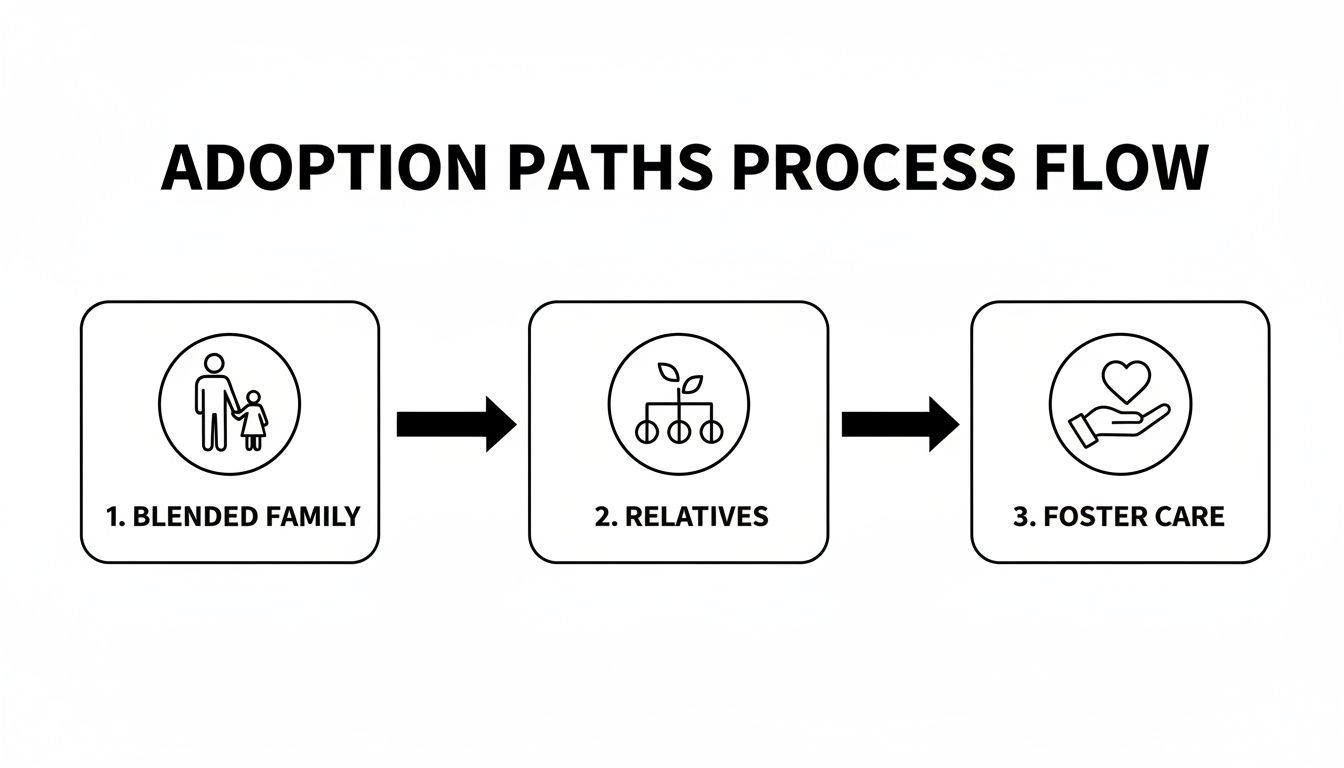
Whether you’re blending a family, adopting a relative, or adopting from foster care, every path leads to this final legal process.
Post-Placement Visits and Observation
After your child is placed with you, Texas law requires a brief observation period before the adoption can be finalized. This stage, which usually lasts at least six months, involves several post-placement visits from a social worker. These aren't tests—they're supportive check-ins to see how everyone is adjusting to the new family dynamic.
The social worker is there to offer resources, answer your questions, and make sure the child is settling in well. This period is all about ensuring the placement is a success for the long haul.
The post-placement period is more than a legal requirement; it's a supportive bridge. It gives your family time to bond and adjust, with a safety net of professional guidance to ensure a smooth transition for both you and your child.
The Finalization Hearing
This is the day you’ve been waiting for: the adoption finalization hearing. You’ll go to court, and a judge will sign the final decree of adoption. It’s an emotional, celebratory moment—the legal beginning of your new family.
During the hearing, the judge reviews the paperwork, confirms all legal steps were followed, and may ask a few simple questions. Then, with the strike of a gavel, it’s official. The child is legally and forever a part of your family, with all the rights and love that come with it.
How to Plan for Adoption Costs and Timelines
For almost every hopeful parent, two questions loom large: "How much is this going to cost?" and "How long will this take?" We get it. The practical side of building your family is just as real as the emotional one, and our goal is to bring some much-needed clarity to your journey.
The costs and timelines for a Texas adoption can vary widely. The good news is that by understanding what drives these factors, you can step forward with confidence instead of uncertainty.
The path you choose will have the biggest impact on your budget. A private infant adoption, for example, typically involves agency fees, legal costs for both you and the birth parents, and the expense of a home study. While these costs add up, they are part of a clear and well-defined process.
Understanding the Financial Landscape
The numbers can feel intimidating at first, but it’s so important to know that you don't have to shoulder these costs alone. Financial resources are out there, and they are what make adoption a reality for countless loving families.
Here’s a quick breakdown of the main financial pieces you’ll encounter:
- Agency Fees: If you partner with a private agency, these fees are for their work in matching you with a birth mother, providing counseling, and managing your case from start to finish.
- Legal Fees: This covers your attorney's expertise in handling all the court filings, navigating the termination of parental rights, and representing you at the finalization hearing.
- Home Study Costs: This is the fee paid to the licensed social worker who conducts your home study and prepares the report required by the court.
It's smart to have an open conversation about these costs with your agency and attorney right from the start. You can also get a more detailed look in our complete guide to Texas adoption costs.
One of the most incredible things about the Texas system is its support for families adopting from foster care. For these adoptions, the state often covers most—if not all—of the legal and administrative fees, making it a virtually no-cost path to building your family.
Financial Assistance and Tax Credits
Beyond the low cost of adopting from foster care, there's even more help available. The federal adoption tax credit is a game-changer for many families. It's a significant, non-refundable credit created to help you offset adoption expenses.
This credit can cover thousands of dollars in qualified expenses for each child you adopt.
On top of that, children adopted from the foster care system who have special needs may qualify for monthly subsidies from the state. This ongoing support helps ensure you have the resources to give them the best care possible.
While a stepparent adoption might wrap up in six months and a private or foster care adoption could take over a year, the financial piece doesn't have to be a roadblock. With some smart planning and a good understanding of the resources available, your dream of adopting a child in Texas is absolutely within reach.
Ready to Take the Next Step and Build Your Family?
You’ve made it through the landscape of Texas adoption laws, and hopefully, this guide has turned a mountain of legal questions into a clear, manageable path. The journey to adoption is always a mix of hopeful excitement and real-world questions, but one thing is certain: you have so much love and stability to offer a child, and that’s what matters most.
Every family’s story is unique, and you don’t have to figure out the next chapter on your own. We believe the most powerful step you can take now is to get personalized answers for your specific situation. This isn’t a sales pitch; it’s a warm invitation to find clarity and compassionate support.
You've already taken the biggest step by opening your heart to adoption. Now, let us help you with the legal steps that make your dream a reality.
Taking that brave step forward starts with a simple conversation. We’re here to listen to your story, answer your questions, and provide the expert legal guidance you need to confidently build your forever family. Schedule a free, no-obligation consultation with our team at The Law Office of Bryan Fagan, PLLC today.
Frequently Asked Questions About Texas Adoption
The decision to adopt is a huge, exciting one. But alongside all that hope and excitement, a flood of practical questions usually follows. We get it. We’ve heard just about every question there is, and our goal is to give you the clear, straightforward answers you need to feel empowered.
Here are a few of the most common questions we hear from families starting their adoption journey in Texas.
How Long Does the Adoption Process Take in Texas?
There's no single answer here—the timeline really depends on the type of adoption you're pursuing. For a stepparent or kinship adoption, where you're formalizing a relationship that already exists, things can move relatively quickly. You're often looking at a timeline of about 6 to 9 months.
Adoptions from the foster care system (through CPS) tend to take longer, usually somewhere between 12 to 18 months. There are more steps to ensure the child’s long-term needs are front and center.
Private infant adoptions have the most unpredictable timeline. It can be less than a year or stretch out over several years, simply because it all depends on being chosen by and matched with a birth mother.
No matter the path, remember that every Texas adoption requires a post-placement observation period. A judge can’t finalize the adoption until the child has lived in your home for at least six months. This is the state’s way of making sure the placement is a stable, successful fit for everyone involved.
Can a Single Person Adopt a Child in Texas?
Absolutely, yes. Texas law makes it very clear: single adults are fully eligible to adopt. The home study process and all the legal requirements are exactly the same for a single person as they are for a married couple.
The court’s focus is never on your marital status. It’s all about your ability to provide a child with a safe, stable, and loving home. What really matters is your maturity, your financial and emotional stability, and your readiness to be a parent.
At its heart, Texas adoption law is about finding the best possible home for a child to thrive. A loving home can be built just as beautifully by a single parent as it can by a couple.
What Is the Difference Between an Open and Closed Adoption?
These terms describe how much contact, if any, the adoptive family and the birth parents will have after the adoption is finalized. Understanding the options is the first step to figuring out what feels right for your family.
- Open Adoption: This means there's some form of ongoing communication. It can be anything from sharing photos and letters through an agency to having occasional in-person visits. The goal is to build a respectful relationship that benefits the child.
- Closed Adoption: In a closed adoption, all identifying information is sealed, and there is no contact between the birth family and the adoptive family. This used to be the standard, but it's much less common today.
- Semi-Open Adoption: This is a popular middle ground. Communication is handled by a neutral third party, like an adoption agency, so letters and updates can be shared without revealing identifying details.
The right choice is always the one that puts the child's well-being first while respecting the comfort levels of both the birth parents and the adoptive family.
The path to building your family is unique, and you deserve a legal partner who understands that. At The Law Office of Bryan Fagan, PLLC, we provide compassionate, expert guidance tailored to your story. If you're ready to take the next step, schedule a free consultation with us today and let us help you move forward with confidence.
