
If you’re reading this, you are likely already a parent in every way that truly matters. You are there for the homework, the scraped knees, and the late-night talks. Taking the step toward a stepparent adoption in Texas isn’t about becoming a parent—it's about legally cementing the profound bond you already share with your stepchild.
At The Law Office of Bryan Fagan, PLLC, we understand this process is so much more than paperwork. It’s about giving your child a deep-seated sense of security and making your family whole in the eyes of the law, always with the child's best interests at heart.
Making It Official: The Power of Stepparent Adoption in Texas
You’re here because you're ready to make that connection permanent. A stepparent adoption transforms your role from a supportive figure into a full legal parent, giving you the same rights and responsibilities as a biological parent. Our goal is to explain the Texas Family Code in plain English and show you the clear path forward, turning any uncertainty you feel into confidence.

We've helped countless Texas families just like yours finalize their 'forever family.' Let's break down exactly what that journey looks like, step by step.
Why Formalize the Relationship?
For most families, a stepparent adoption is simply making the law catch up to a reality that has existed for years. It's about giving the child an unshakable sense of belonging and security. The benefits are deeply emotional, but they are also incredibly practical.
Here’s what you gain by making it official:
- Providing Legal Security: The adoption ensures you can legally make critical decisions about your child’s education, healthcare, and well-being without hitting any roadblocks.
- Strengthening Family Bonds: It solidifies the child’s place in the family, erasing any doubt about your role and lifelong commitment, which is central to family unity.
- Securing Inheritance and Benefits: An adopted child gains the right to inherit from you just like a biological child and can be covered under benefits like your health insurance or Social Security.
This legal step formalizes a relationship that has long existed in practice, giving everyone—especially the child—lasting security and peace of mind.
It’s also smart to keep an eye on the state’s ever-evolving legal framework. For instance, resources discussing legislative changes like Texas House Bill 4224 can offer important context on family law.
While the legal steps are vital, this journey is ultimately about love, commitment, and family. At The Law Office of Bryan Fagan, PLLC, we get that, and we're here to support you at every turn with compassionate, knowledgeable guidance.
Checking Your Eligibility for Texas Stepparent Adoption
Before you dive into the legal process of adopting your stepchild, it’s important to make sure you meet the legal requirements. This isn't just about paperwork; Texas law sets these requirements to ensure every adoption serves the child's best interest and creates a stable, legally sound family.
Let's break down exactly what the state requires in simple terms.
The Foundational Requirements
First things first, the most basic rule is that you must be legally married to the child's custodial parent. This is non-negotiable and establishes the stable family unit the court wants to see. If you aren't married yet, you'll need to tie the knot before you can file the adoption petition.
Texas law also has a residency rule to show that the child is settled and bonded with you. The child must have lived with you (the stepparent) for at least six months right before you file.
This rule gives the court confidence that your home is a stable environment and that you and your stepchild have an established, positive relationship. Of course, life happens. A judge can waive the six-month rule if they believe it's in the child's best interest. For instance, if you've been a major part of the child's life for years but only just moved in due to a job change, a court might agree to make an exception.
Busting the Income Myth
Many stepparents worry they don't earn enough to qualify. Let’s clear this up: there is no specific income requirement for a stepparent adoption in Texas.
A judge is far more interested in your ability to provide a safe, stable, and loving home than what your W-2 says. Your commitment to the child and your established relationship are what truly matter.
Imagine a stepparent who has coached every Little League season, never missed a parent-teacher conference, and been a consistent source of support for years. That demonstrated history of care is what a Texas court values most.
Who Needs to Be Involved
Understanding who needs to participate can clear up a lot of confusion. In a Texas stepparent adoption:
- Both you and your spouse will file the adoption petition together as "co-petitioners." This shows the court you're a united front.
- You, your spouse, and the child being adopted must all attend the final hearing.
- If the child is 12 or older, they will also need to give their own written consent to the adoption.
This joint effort is a powerful symbol of your family's unity as you take this incredible step together. For a deeper look into the legal side of things, you can discover more insights about navigating these legal challenges on youngblood-law.com.
Handling Parental Rights with Care and Respect
Now we've arrived at what is often the most delicate part of the stepparent adoption journey: addressing the parental rights of the other biological parent. This is a sensitive step that demands both legal precision and a great deal of emotional care.
The law in Texas, specifically the Family Code, is crystal clear on this point. Before a stepparent can adopt, the child can only have one other legal parent. This means the non-custodial parent's rights must be legally and permanently ended.
Depending on your family’s unique situation and the cooperation of the other parent, this can happen in one of two ways.
The Smoothest Path: Voluntary Relinquishment
The best-case scenario is when the other biological parent supports the adoption and agrees to voluntarily give up their parental rights. This is a huge decision, and it’s one the court does not take lightly.
The parent formalizes this choice by signing a legal document known as an Affidavit of Relinquishment of Parental Rights. This affidavit confirms they are knowingly and willingly giving up all their legal rights and duties as a parent.
To be legally binding, the parent must sign this document after the child is born, fully understanding that it permanently severs their legal tie to the child. This creates a much smoother, less confrontational path for the adoption and allows everyone to focus on the child's well-being.
When Cooperation Isn’t an Option: Involuntary Termination
Unfortunately, not every case is so straightforward. If the other biological parent refuses to consent, has disappeared, or simply can’t be located, you may have to pursue an involuntary termination of their parental rights. This is a serious court action.
The court's number one priority is always the best interests of the child. To move forward, you must prove that ending the parent's rights is better for the child’s physical and emotional health than leaving them in place.
The Texas Family Code provides specific grounds for involuntary termination. You’ll need to prove one or more of them exist. In stepparent adoptions, the most common grounds include:
- Abandonment: The parent knowingly left the child with another person without providing adequate support and stayed away for a specific length of time.
- Failure to Support: The parent failed to support the child financially according to their ability for one year, ending within six months of when you file the court case.
- Endangerment: The parent engaged in conduct—or knowingly placed the child with people who did—that endangers the child's physical or emotional well-being.
- No Contact: The parent has had no meaningful contact with the child for a long time, showing a clear lack of interest in being a parent.
Let’s look at a common scenario. A stepfather wants to adopt his 10-year-old stepson. The biological father hasn't called, visited, or sent a single child support check in over two years, even though he knows where they live. Here, the family could ask the court for an involuntary termination based on both abandonment and failure to support.
Proving these grounds requires solid, undeniable evidence. We're talking about financial records, text messages, emails, and testimony from witnesses who can back up your claims about the parent's absence or lack of support. This is where an experienced family law attorney becomes essential. The burden of proof is incredibly high.
If you're asking yourself what to do if the other parent will not consent, a compassionate attorney can lay out your legal options clearly.
Whether the process is a cooperative one or a contested court case, handling the termination of parental rights with integrity is vital. It clears the way for the joyful final steps of the adoption and ensures your new family is built on a strong legal foundation.
Your Roadmap Through the Texas Stepparent Adoption Process
Alright, let's break down the actual journey of a stepparent adoption in Texas. Think of this less like a rigid legal checklist and more like a step-by-step guide. It has specific turns and milestones, all designed to ensure the adoption is truly in your child's best interest and leads to one beautiful destination: a legally-united family.
The first official move is preparing and filing the Original Petition for Adoption. This legal document is your formal introduction to the court. It explains who you are, who your spouse and the child are, and why you are seeking to adopt. It’s the opening chapter of your family’s story in the eyes of the law.
Step 1: Preparing and Filing Your Petition
This initial paperwork is the foundation of your entire case. Getting your documents in order from the very beginning can save you from frustrating and unnecessary delays down the road.
You'll typically need to gather a few key documents to file with your petition:
- Your official marriage license to the child's parent.
- The child’s certified birth certificate.
- The results of your criminal background check.
- If the other parent has consented, their signed affidavit of relinquishment.
Navigating the courts means knowing the right way of filing court documents is absolutely critical. Doing it correctly ensures your case moves forward without procedural snags. For a complete list and explanation of the paperwork you'll encounter, our guide on stepparent adoption forms in Texas is an invaluable resource.
Step 2: The Social Study and Protecting the Child’s Interests
Once your petition is filed, the court may order a social study. We know many parents hear "home study" and immediately feel a wave of anxiety, but it’s important to know that in a stepparent adoption, this is often a much more relaxed process. Its goal isn't to judge your home or lifestyle but simply to confirm that you provide a safe, stable environment and that the adoption is a positive step for the child.
A court-approved evaluator, usually a social worker, will prepare this report for the judge. They’ll look at your family’s history, the strength of your relationship with the child, and the general stability of your home. It’s really just a way for the court to get an objective view of the positive life you’ve already built.
In some situations, particularly if the other parent’s rights were contested, a judge might appoint an amicus attorney. This attorney doesn't work for you or your spouse—their only client is the child. Their role is to investigate the circumstances and advise the court on what they believe is in the child’s best interests, giving the child a powerful voice in the process.
This visual breaks down the two main paths for handling the non-custodial parent's rights, a crucial step that must be completed before any adoption can be finalized.
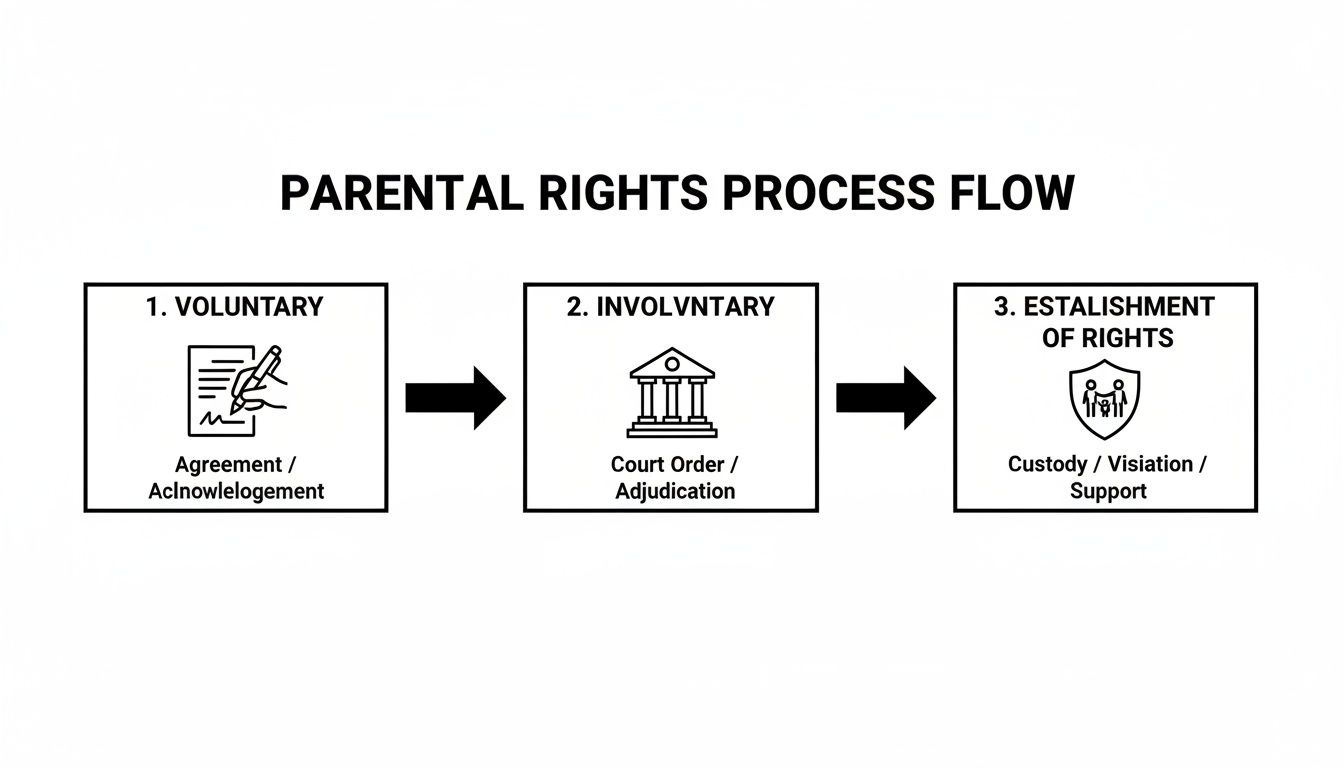
As you can see, resolving the other parent's rights—either through their voluntary consent or a court order—is a mandatory prerequisite. The adoption cannot move forward until this is settled.
Step 3: The Final Hearing: A Moment of Celebration
The final court hearing is the moment your family has been working toward. It's almost always a happy and surprisingly brief ceremony, not a tense trial. You, your spouse, and your child will stand before the judge. Our advice? Dress up a little and bring a camera—it’s a memory you’ll want to capture.
The judge will quickly review the paperwork, ask a few simple questions to confirm everyone is on board, and verify that all legal requirements have been met.
A judge will often look directly at the stepparent and ask something like, "Do you promise to love, support, and care for this child as your own for the rest of your life?" Then, they might turn to the child (if they're old enough) and ask, "Are you happy to have this person as your legal parent?" It’s an incredibly powerful and affirming moment for everyone in the room.
Once the judge is satisfied, they will sign the Decree of Adoption. That's it. In that instant, you are officially and legally the child’s parent.
The final step is to apply for a new birth certificate. This new document will list you as a parent, permanently and legally sealing your new family unit. It's the last piece of paper that makes your loving bond official in every way.
Demystifying the Costs of Stepparent Adoption
Let's talk about one of the biggest questions on every family’s mind: what does a stepparent adoption actually cost in Texas? We have good news for you: this path is one of the most affordable ways to legally unite your family. Knowing the numbers upfront helps you plan and move forward with confidence.
The journey to make your family legally whole shouldn't be a source of financial stress. It’s a process built on love and commitment, and thankfully, the costs usually reflect that.
A Realistic Look at Adoption Expenses
Unlike other adoptions that can quickly run into tens of thousands of dollars, a stepparent adoption is far more accessible. The main reason is simple: the child is already a cherished part of your household, which cuts out many of the most complicated and expensive legal hurdles.
Stepparent adoption in Texas is one of the most affordable adoption pathways, with costs typically landing somewhere between $2,500 and $5,000. This affordability is a direct result of a more streamlined legal process, especially when the other biological parent agrees to the adoption.
You can learn more about the affordability of stepparent adoption on texasfamilyadoption.com. This range almost always covers the professional services and court requirements needed to get to the finish line.
What Do These Costs Typically Cover?
When you invest in a stepparent adoption, you’re paying for legal expertise and the formal court process that solidifies your child's future. The total cost is really a combination of a few key components that ensure every "i" is dotted and "t" is crossed.
Here’s a breakdown of what those fees usually include:
- Attorney's Fees: This is the largest part of the cost. It pays for your lawyer's time drafting and filing the legal documents, managing the termination of the other parent's rights, and standing beside you at the final court hearing.
- Court Filing Fees: Every lawsuit requires fees to file the initial petition and other documents with the court clerk. These fees vary from county to county but are a standard part of any legal case.
- Social Study or Ad Litem Fees: In some cases, a judge might order a social study or appoint an independent attorney (an "ad litem") to represent the child’s best interests. If that happens, their professional fees become part of the total cost.
- Service of Process: If the other biological parent has to be formally served with the lawsuit, there are small fees for having a sheriff's deputy or a private process server deliver the legal papers.
Think of these costs not as just another bill, but as a direct investment in your child's security and your family's legal unity. The peace of mind that comes from making that bond official is truly priceless.
Why Stepparent Adoption Is More Affordable
The number one reason stepparent adoption costs less is efficiency. Because the child already lives with you, Texas law often lets you skip the full, formal home study. That step alone can save you thousands of dollars and months of waiting.
Even better, if the other parent voluntarily consents to the adoption by signing the paperwork, it completely avoids a contested court battle over their parental rights. A cooperative approach is always less complex, less time-consuming, and—you guessed it—less expensive. To get a more detailed financial picture, you might want to read our in-depth article on the cost of stepparent adoption. Knowing these details empowers you to plan ahead and truly appreciate the value of securing your child’s legal place in your family.
Taking the Next Step Toward Your United Family

You’ve read the guides, pictured the final court hearing, and you know in your heart that this is the right move for your family. The love and commitment are already there; a stepparent adoption in Texas is just the legal step that makes your family whole on paper.
It’s completely normal to feel a mix of excitement and apprehension. The path ahead involves specific legal requirements set by the Texas Family Code, from filing the right petition to making sure every detail is perfect for the judge. But it's a path you don’t have to walk alone.
Turning Your Plan into a Reality
At The Law Office of Bryan Fagan, PLLC, we’ve been honored to stand beside countless families as they took this final, powerful step. We believe our job isn't just to handle the legal filings—it’s to give you the clarity and confidence you need to focus on what truly matters: your family.
Your next step isn’t some giant, intimidating leap. It’s a simple conversation to get your questions answered and feel peace of mind about your family’s future.
We invite you to schedule a free, no-obligation consultation with our compassionate adoption attorneys. This is your time to talk about your unique situation, get straight answers, and see exactly how we can help make your family’s bond legally permanent. Let us help you take that next step toward building your family with confidence.
Common Questions About Stepparent Adoption in Texas
As you prepare to make your family legally whole, it's natural to have questions. This journey is deeply personal, and no two families have the exact same story. Here are some of the most common questions we hear, with clear, plain-English answers to help you see the path forward for your stepparent adoption in Texas.
What If We Cannot Find the Other Biological Parent?
This is a common and completely valid worry. What happens when the other biological parent seems to have vanished? You can't just proceed without them; the law requires you to show the court you've made a diligent effort to find them.
This isn't just a quick Google search. You'll need to document every attempt to locate them, which often includes:
- Searching public records and online databases.
- Reaching out to their last known employer, friends, or relatives.
- Keeping a detailed log of every call, email, and search you conduct.
If you’ve truly exhausted every reasonable avenue, the court can allow you to provide legal notice another way, such as by publishing a notice in a newspaper. This process is legally known as "service by publication." If the parent doesn’t respond within a set time, the judge can terminate their parental rights, clearing the way for your adoption.
Does My Child Have a Say in the Adoption?
Absolutely. Texas law firmly believes a child’s voice matters in a decision this big. If your stepchild is 12 years of age or older, the law requires their written consent before the adoption can be finalized.
The court handles this with incredible care. A judge will usually invite the child into their chambers for a private, informal chat. This isn't an interrogation; it's a conversation to make sure the child understands what adoption means and genuinely wants it to happen, without any outside pressure.
This step highlights the single most important rule in any adoption: every decision must be in the best interest of the child. Respecting their wishes is a huge part of that.
How Long Does the Stepparent Adoption Process Take?
Every case has its own rhythm, but a straightforward stepparent adoption in Texas generally takes about six to nine months to complete. This timeline assumes the other biological parent consents to the adoption and all the paperwork is filed without a hitch.
However, the process can stretch out if complications pop up. The biggest potential delay is a contested termination of parental rights, where the other parent fights the adoption, which could lead to a court battle. Other things like court backlogs or waiting on a court-ordered social study can also add time.
Can We Start Before We Get Married?
That’s a great question—it shows you’re thinking ahead and trying to get everything in order. In Texas, the law is crystal clear on this point: you must be legally married to the child's custodial parent before filing the adoption petition.
The marriage itself is a legal foundation. It establishes the stable, two-parent home that the court wants to see for the child's well-being. You can't start the formal legal process while you're engaged or living together. Getting this sequence right is critical to starting your adoption journey on solid legal footing.
Navigating the details of stepparent adoption can feel overwhelming, but you don't have to piece it all together on your own. At The Law Office of Bryan Fagan, PLLC, our compassionate attorneys are here to offer personalized guidance for your family. We are here to empower you to take the next step. Schedule a free, no-obligation consultation today by visiting us at https://texasfamilyadoption.com for compassionate legal guidance.
