
When you are exploring the path of building or protecting your family in Texas, you may come across the legal term "sole managing conservator." In simple, everyday language, this is what Texas law calls the person—often a parent, stepparent, or grandparent—who has the exclusive right to make most of the major decisions for a child. This role is similar to what many people know as sole custody.
This arrangement is designed with one goal in mind: to give a child a stable, safe, and consistent home, especially when shared decision-making isn't possible or in the child's best interest.
Understanding the Role of a Sole Managing Conservator in Texas
Here at The Law Office of Bryan Fagan, PLLC, we understand that any conversation about a child's future is deeply personal and often filled with emotion. Our mission is to bring clarity and a steady, compassionate hand to the process, helping you understand how Texas law is designed to protect your child’s best interests, whether you are a hopeful adoptive parent, a birth parent considering your options, or a relative stepping in to provide care.
While it's true that Texas courts prefer to name parents as joint managing conservators—believing that having both parents involved is best for a child—they will not hesitate to appoint a sole managing conservator in certain situations. The ultimate goal is always to protect a child's physical and emotional well-being.
This isn't about one person "winning" and another "losing." It’s about creating a legal foundation that gives a child the security and stability they need to grow and thrive.

Sole vs. Joint Managing Conservatorship At a Glance
The most significant difference between a sole and joint arrangement is who has the final say on important life decisions for a child. A sole managing conservator has the exclusive power to make these critical choices without needing to get the other parent’s approval.
This situation is more common than you might think. Across the United States, around 13 million custodial parents are primarily responsible for their children's care. This number sheds light on just how many families are navigating these exact legal challenges with love and resilience.
To give you a clearer picture, let's compare the two arrangements side-by-side.
| Area of Responsibility | Sole Managing Conservator | Joint Managing Conservators |
|---|---|---|
| Primary Residence | Has the exclusive right to decide where the child lives, often without geographic restriction. | One parent is typically designated to establish the child's residence, usually within a specific geographic area. |
| Medical Decisions | Can make all medical, dental, and psychological decisions independently. | Both parents must typically consult one another on non-emergency medical decisions. |
| Educational Decisions | Has the sole authority to make all decisions regarding the child's education and school enrollment. | Both parents usually share the right to make educational choices together. |
| Legal Rights | Can represent the child in legal actions and make other significant legal decisions on their behalf. | These rights are generally shared, requiring mutual agreement for most legal actions. |
Understanding these differences is a crucial first step. Legal terms like conservatorship and guardianship can sometimes feel confusing, but each has a distinct purpose in protecting a child. If you want to explore this further, you can learn more about the difference between custody and guardianship in our detailed guide.
Next, we’ll explore the specific rights this important role carries and the circumstances that lead a court to grant it.
The Exclusive Rights and Duties of a Sole Managing Conservator
When a Texas court names you a sole managing conservator, it is entrusting you with the profound responsibility of guiding your child’s life toward a stable and nurturing future. This legal role isn’t about winning or losing; it’s about giving one dedicated caregiver a specific set of exclusive rights to make critical decisions, providing unwavering consistency when a child needs it most.
Think of yourself as the loving guardian of your child’s well-being. You get to make the final call on the big decisions, ensuring your child has a clear and secure path forward, especially when family circumstances are challenging.

Core Decision-Making Authority
Under the Texas Family Code, a sole managing conservator holds the exclusive right to make several key decisions that shape a child’s daily life and future. These rights are granted to one person to act decisively in the child's best interest, cutting through potential conflict or delays.
Your primary responsibilities will include:
- Determining the Child's Residence: You have the exclusive right to decide where your child lives. This is the bedrock of stability, allowing you to choose a safe home and community, often without geographic restrictions.
- Making Medical Decisions: You are empowered to consent to all medical, dental, and psychological care on your own. That means you can authorize routine check-ups, approve emergency procedures, or get your child into therapy without needing a co-parent’s permission.
- Overseeing Educational Choices: From enrolling your child in a specific school to approving tutoring or special programs, you have the sole authority over their education.
These duties allow you to create a seamless and supportive environment. For instance, if you are a grandparent who has adopted your grandchild and they need to switch schools for a better special needs program, you can handle all the enrollment paperwork without waiting for an agreement that might never come. This ability to act quickly is absolutely crucial for a child's uninterrupted development.
Legal and Financial Responsibilities
Beyond daily decisions, being a sole managing conservator also means you are in charge of your child's legal and financial affairs. This is a vital part of protecting their future and ensuring their needs are always met.
The core duty of a sole managing conservator is to provide a stable foundation. The law centralizes decision-making to shield the child from conflict and uncertainty, ensuring their physical and emotional needs are always the top priority.
This responsibility translates into several specific legal duties:
- Representing the Child in Legal Actions: You have the right to act on your child's behalf in any legal matters that might arise.
- Managing Child Support: You are the parent or guardian who receives child support payments from the other parent (the possessory conservator). These funds are meant to help you cover the child's living expenses.
- Consenting to Marriage or Military Enlistment: If these major life events come up before your child turns 18, you hold the exclusive right to give legal consent.
Imagine you're a stepparent who has adopted your spouse's child, and the other biological parent is unreliable. As the sole managing conservator, you and your spouse can enroll your child in school, sign them up for the soccer team, and take them to the doctor without the process being derailed by arguments or the other parent’s absence. It creates a shield of certainty around the child.
This framework doesn't erase the other parent. They typically become the "possessory conservator," holding rights to visitation but without the power to make these key life decisions.
The next section will explore the specific, often difficult circumstances that lead a Texas court to decide that appointing a sole managing conservator is the only way to protect a child.
When Texas Courts Appoint a Sole Managing Conservator
In Texas, family law starts with a simple, powerful belief: children thrive when both parents are actively involved in their lives. This is why courts always lean toward naming parents as joint managing conservators. But life is not always simple, and sometimes, the only way to guarantee a child’s safety and stability is to give one parent the final say.
A judge will only move away from a joint arrangement if there is clear evidence that it would harm a child's physical or emotional health. This is a very high bar to clear. Appointing a sole managing conservator is a serious step, taken with great care. It isn't about punishing a parent—it's about protecting a child from a harmful situation.
Proving Harm to a Child's Well-Being
To show a judge that one parent needs sole decision-making power, you must demonstrate that the other parent's behavior creates a dangerous or unstable environment for the child. It’s not about minor disagreements; the court is looking for a pattern of serious issues that make co-parenting impossible or unsafe.
Here are some of the challenging situations that often lead a court to this decision:
- Family Violence or Abuse: If a parent has a documented history of physical, emotional, or sexual abuse toward the child or another family member, a court will act swiftly.
- Substance Abuse: A parent struggling with a drug or alcohol addiction may not be able to make sound decisions, which can directly put a child's safety at risk.
- Chronic Neglect or Abandonment: When a parent is consistently absent, fails to provide basic care, or shows no interest in their responsibilities, a judge may decide they have effectively given up their parental role.
- Involvement in Criminal Activity: A parent's ongoing criminal lifestyle can create an environment that's both physically dangerous and emotionally damaging for a child.
It’s important to understand that these aren't just claims made in court; they require solid evidence. In the most severe cases, these issues can lead to the complete termination of parental rights, a necessary step in many adoptions. You can learn more about that process in our guide on terminating parental rights in Texas.
Scenarios Where Sole Conservatorship Becomes Necessary
To see how this works in real life, let's look at a couple of scenarios. These stories illustrate why a judge might feel a sole conservatorship is the only responsible choice.
Scenario 1: A Kinship Adoption
Maria and her husband have been caring for their 8-year-old nephew, Leo, for two years. His birth parents struggle with addiction and have been unable to provide a stable home. Maria wants to enroll Leo in a new school that has better resources for his learning disability, but she can't without legal authority. The birth parents are unreachable.
Maria and her husband can petition the court to become Leo's sole managing conservators. By providing evidence of the parents' inability to care for Leo, they can gain the legal right to make all educational and medical decisions, giving Leo the stability and support he needs to flourish.
Scenario 2: A Stepparent Adoption
David has been a loving and dedicated stepfather to 10-year-old Chloe for six years. Her biological father moved out of state years ago and has had no contact with her. David wants to adopt Chloe to make their family legally whole, but he needs the authority to do so.
David's wife, Chloe's mother, is already the sole managing conservator. The stepparent adoption process will formalize David's role, giving him the same legal rights and responsibilities. This provides Chloe with the emotional and legal security of having two devoted parents.
In high-stakes cases, Texas family courts reserve sole managing conservatorship for situations demanding unwavering stability. Judges invoke this under Texas Family Code §153.132 when evidence shows joint decision-making would impair the child's health, such as in cases involving family violence, drug abuse, or parental absence. You can learn more about how courts handle these situations and discover more insights about sole vs. joint conservatorship on scrogginslawgroup.com.
At the end of the day, the court’s decision will always come down to one thing: what is truly in the child's best interest. Proving that requires more than just a story; it takes carefully gathered evidence and a compassionate legal strategy. The next section will walk you through the practical steps of this journey.
Navigating the Legal Process for Sole Conservatorship
The thought of going to court can feel overwhelming, but you don't have to walk that path alone. This section is your roadmap, breaking down each step—from filing your initial request to receiving a final court order. When you understand the process, you can move forward with confidence, knowing you have the right support behind you.
The entire legal journey to becoming a sole managing conservator is built on one simple, powerful principle: protecting the child. Every document filed and every piece of evidence presented must all point to that one goal. This isn't about winning a fight; it's about building a case so strong that the court sees this arrangement as the only way to truly guarantee your child’s well-being.
The First Steps: Filing and Temporary Orders
It all starts by filing a formal request with the court, known as a petition. This document clearly explains why you are seeking to become the sole managing conservator and why this step is necessary for your child’s safety and stability. For adoptions, this is often part of the initial adoption petition.
If your child is in immediate danger, you don't have to wait. You can ask for Temporary Orders right away. These are short-term court orders designed to protect your child while the case moves forward. A judge can issue them quickly, granting you exclusive decision-making rights and limiting the other parent's contact until a full hearing can take place.
Building Your Case with Strong Evidence
To convince a judge that sole conservatorship is truly in your child's best interest, you have to show them, not just tell them. You need concrete proof that paints a clear picture of why shared decision-making is not a safe option.
Powerful evidence often includes things like:
- Police Reports or Court Records: Official documents showing family violence, criminal charges, or protective orders.
- Medical and School Records: These can reveal patterns of neglect, like a history of missed doctor's appointments or chronic absenteeism.
- Communications: Text messages, emails, or voicemails that show a parent's instability, substance abuse, or abusive language.
- Witness Testimony: Statements from teachers, counselors, or family members who have seen the harmful behavior firsthand.
Gathering this information is the most critical part of your case. It transforms your valid concerns from personal feelings into hard facts a judge can act on. This simple chart shows how it all connects—you prove harm, which leads to a protective order.
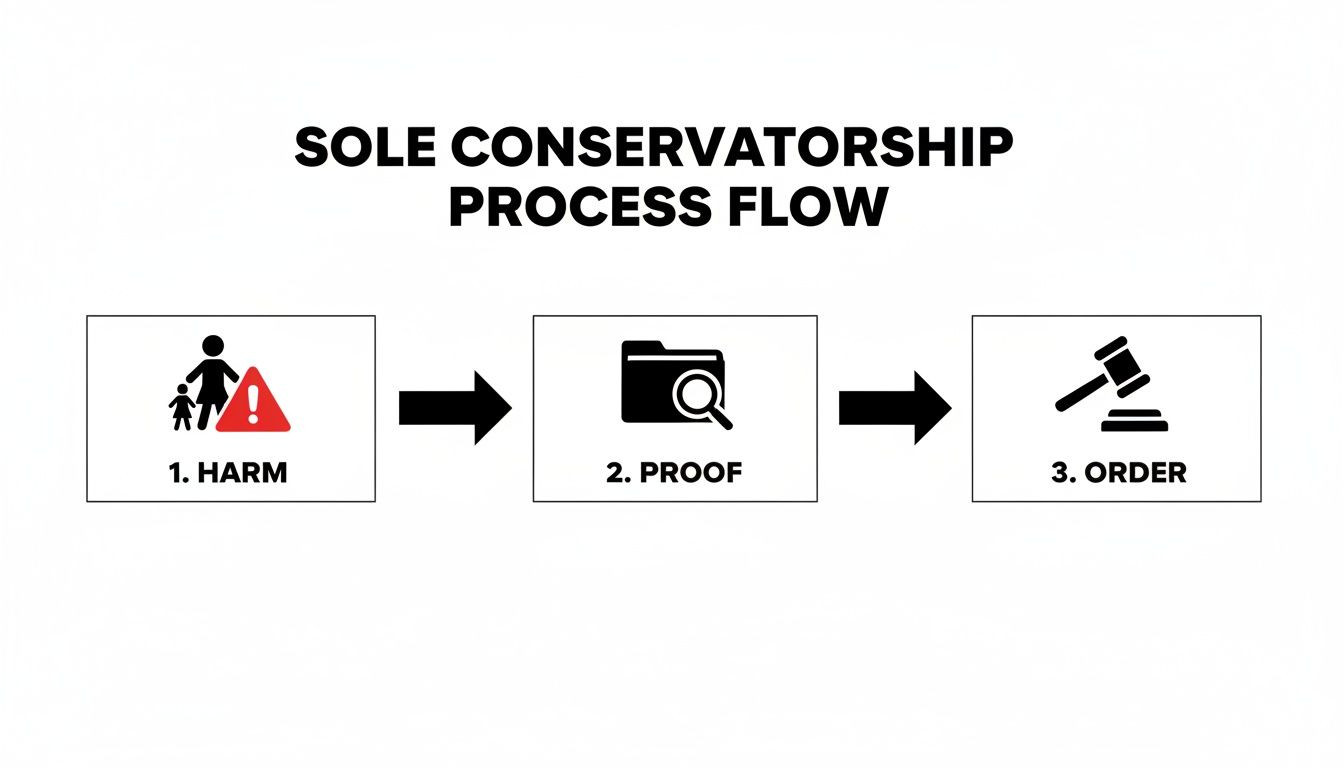
As the infographic illustrates, the journey hinges on connecting the risk of harm to concrete proof. That is what empowers a court to step in and issue an order that protects your child.
Mediation and the Final Hearing
Before a final trial, Texas courts almost always require mediation. It's a confidential meeting where a neutral third-party mediator helps both sides try to reach an agreement. If common ground can be found, it can save the tremendous emotional and financial cost of a trial.
However, if mediation doesn't work—or isn't appropriate because of issues like family violence—your case will move to a final hearing. This is your day in court. You and your attorney will present all your evidence, and the judge will listen to both sides before making a final decision based strictly on what's best for the child. When navigating the legal process for sole conservatorship, finding qualified legal counsel is paramount; understanding the importance of an effective web presence for family lawyers can be an initial step in identifying potential support.
The road ahead may seem complex, but every step is designed with a clear purpose. With the right preparation and support, you can successfully show the court why your child needs the stability that only a sole managing conservator can provide.
How Sole Conservatorship Works in Adoption and Guardianship
When people hear sole managing conservator, their minds often jump to a difficult divorce. But this legal role is so much more—it’s a powerful tool for building and protecting families through adoption and guardianship. It’s about creating unwavering stability for a child who needs it most.
In these situations, the focus shifts from parental conflict to providing a child with legal permanence and a clear, undisputed authority figure who can protect them, advocate for them, and make all the critical life decisions a parent should. It’s where the legal process becomes a true act of love.

Providing Stability in Kinship and Relative Adoptions
One of the most heartwarming places we see this role is in kinship adoptions. Picture a grandparent stepping up to raise their grandchild because the parents are unable to provide a safe home. Their love is essential, but it isn't enough on its own; they also need legal authority.
By being named the sole managing conservator, that grandparent gains the power to act. They can:
- Enroll their grandchild in school without legal hurdles.
- Consent to medical care, from routine check-ups to emergency room visits.
- Make decisions about therapy and mental health support.
- Apply for benefits on the child’s behalf.
Without this legal standing, a grandparent’s hands can be tied. Sole conservatorship gives them the undisputed legal power to provide the stable, loving home their grandchild deserves. This is a common path to creating long-term security, and our guide on guardianship laws in Texas explores these options in more detail.
A Foundation for Stepparent and CPS Adoptions
The same principle acts as a cornerstone in other types of adoptions. In a stepparent adoption, the biological parent is often already the sole managing conservator. The adoption process simply formalizes the stepparent’s role, legally creating a new, complete family unit.
It's a similar story when a child is adopted from the foster care system (CPS). The adoptive parents are granted this authority to give a child who has faced immense trauma the incredible gift of permanence. It’s a clear signal to that child: you have a forever family who will make every single decision with your best interest at heart.
The authority a sole managing conservator holds is profound. Nationally, guardianship and conservatorship cases impact about 1.3 million Americans and control at least $50 billion in assets. This highlights the immense responsibility one person can have over another's life. In Texas, this mirrors the power a sole managing conservator has to exclusively manage a child's education, healthcare, and where they live to ensure their well-being.
Whether you are a grandparent, a stepparent, or a hopeful adoptive parent, understanding this legal role is key. It is the framework that turns your commitment into the legal authority needed to build a safe, loving, and permanent home for a child. This is how families are built and futures are protected.
A Few Common Questions About Sole Conservatorship
Once a judge issues a final order for sole managing conservatorship, life shifts into a new chapter. You might be wondering what your day-to-day reality will look like now that the legal process is complete. Understanding each person's ongoing role is the key to moving forward with confidence.
Here are some of the most common questions our clients ask. Our goal is to give you straightforward, real-world answers that help you feel secure about your family’s future.
What Rights Does the Other Parent Have?
Even when you're named the sole managing conservator, the other parent doesn't just disappear from your child's life, unless their rights have been terminated for an adoption. In most other cases, the court will name them the possessory conservator.
This is a legal role with specific rights and duties. While they no longer have the authority to make major decisions, they are not erased from the picture.
The possessory conservator almost always keeps the right to:
- Visitation: They have a right to spend time with the child according to a court-ordered schedule, as long as it is safe and in the child's best interest.
- Information: They have the right to be kept informed about the child’s health, education, and general well-being.
- Access to Records: They can go directly to the doctor's office or school and get copies of medical, dental, and educational records.
The law aims to protect the parent-child relationship whenever it's safe and possible. The court wants the child to benefit from having both parents involved, even if one holds all the decision-making power.
How Does Child Support Work in This Situation?
Child support is a separate but closely related issue. The possessory conservator has a legal obligation to financially support their child.
The court will order the possessory conservator to pay monthly child support to you, the sole managing conservator. In Texas, the amount is calculated using a formula based on the paying parent's income and the number of children they support.
The purpose of child support isn't to punish anyone; it's to ensure the child's needs are met. These payments help you cover essentials like housing, food, clothing, and all the other daily costs that go into providing a stable home.
Additionally, the court order will clearly state which parent is responsible for providing the child's health and dental insurance. This financial duty is a core part of being a parent, regardless of their conservatorship status.
Can a Sole Managing Conservator Order Be Changed Later?
Yes. Court orders involving children are never permanently set in stone. Texas law recognizes that families change, circumstances evolve, and what was in a child's best interest years ago might not be what's best today.
An order can be legally modified, but it requires a new court process. To change the order, a parent must prove two key things:
- There has been a material and substantial change in the lives of the child or parents.
- Changing the order would be in the child’s best interest.
For example, if a possessory conservator who struggled with substance abuse has completed a long-term recovery program and shown years of stability, that could be a material and substantial change. A court might then be willing to consider modifying the order to a joint conservatorship. Any change must be officially signed by a judge; informal agreements won't hold up in court.
Every family’s story is unique, and these answers are just a starting point. For guidance that’s tailored to your family's journey, the compassionate team at The Law Office of Bryan Fagan, PLLC is here to help. Schedule a free consultation with us to discuss your situation and learn how we can help you build and protect your family's future. Start your journey with us today.
