
There's nothing quite like the bond between a grandparent and a grandchild. It’s a special connection built on unconditional love and support. While Texas law rightfully gives parents the primary authority to raise their children, it also recognizes that a grandparent’s role is often vital. When that relationship is at risk, the law provides specific legal grandparents rights to step in and protect that bond.
This guide is designed for loving grandparents who are navigating difficult family situations. Whether you are seeking visitation or exploring more permanent options like guardianship or adoption, we are here to provide the clarity and reassurance you need. Your journey to secure your relationship with your grandchild hinges on two key legal concepts: proving you have standing to file a case, and then showing that your involvement is in the best interest of the child.
Understanding Your Rights as a Grandparent Under Texas Law

Trying to understand your rights as a grandparent can feel overwhelming. The law places a high value on a parent's constitutional right to make decisions for their child. Because of this, courts start with the presumption that a fit parent is acting in their child’s best interest.
This means if a parent decides to limit or stop your contact with your grandchild, you face a significant legal challenge. The court won’t easily overrule a parent’s decision. But the law also acknowledges that your role is often essential for a child's stability and emotional health. When that bond is threatened by divorce, family conflict, or tragedy, it can leave you feeling powerless. This guide is here to offer clarity and hope by explaining the specific pathways the Texas Family Code provides for you to protect that precious relationship.
The Two Pillars of a Grandparent's Case
Every legal action involving a child in Texas rests on two foundational concepts. Understanding these is the first step toward protecting your relationship with your grandchild.
- Standing: This is a legal term for your right to file a lawsuit. You can't just walk into court because you want to see your grandkids more; you have to meet very specific criteria laid out in the Texas Family Code.
- Best Interest of the Child: This is the single most important factor a judge will ever consider. Every decision, from visitation schedules to custody orders, must put the child's physical and emotional well-being above everything else.
Your Essential Role in the Family
The reality is that millions of grandparents have stepped up to become primary caregivers. In the United States, about 2.5 million children are being raised in "grandfamilies." These families provide incredible stability and keep countless children out of the foster care system. You can explore more data on the critical role of kinship care from Generations United.
The core of any legal action is proving that your continued presence is not just beneficial but essential to your grandchild's well-being. The court's primary goal is to ensure the child has a safe, stable, and loving environment.
Try to think of this process not as a battle against your own family, but as a necessary journey to secure your grandchild's future. Our goal at The Law Office of Bryan Fagan, PLLC, is to empower you with the knowledge to navigate this complex legal world with confidence, always focusing on what truly matters: the child you love.
Securing Visitation with Your Grandchild

When the door to your grandchild's life is suddenly closed, it can be heartbreaking. You may be asking, "How can I legally make sure I can see my grandchild?" Getting a court to order visitation—which Texas law calls “possession or access”—is a challenging journey, but it’s not impossible in the right circumstances.
The first thing to understand is that you can’t simply ask for visitation because you miss your grandchild. Before a judge will even hear your case, you have to prove you have “standing.” This isn’t just a legal technicality; it's a critical requirement that shows the court you have a legitimate reason to bring a case.
Meeting the Standard for Standing
To have standing to request visitation, the Texas Family Code has a specific rule: the child’s parents can’t both be living together in the same home. This usually means you are the parent of a parent who:
- Has passed away.
- Has been in jail for at least three months.
- Has been declared legally incompetent by a court.
- Doesn't have physical or court-ordered access to the child.
- Has had their parental rights legally terminated.
If one of these situations applies to your child (the grandchild's parent), a legal door may have opened for you to step in and ask the court to protect your relationship.
The Highest Hurdle: Proving Significant Harm
Even if you meet the standing requirement, you now face the toughest part of the entire case. You must prove to the judge that denying you access to your grandchild would significantly impair the child's physical health or emotional well-being.
This is an incredibly high standard. It’s not enough to show that you are a loving grandparent who would make the child’s life better. The court needs to be convinced that the child will actually suffer harm without you in their life.
Why is the standard so high? It goes back to a major U.S. Supreme Court case, Troxel v. Granville. This decision established that fit parents are presumed to act in their child's best interests, putting a heavy burden on anyone, including grandparents, to prove that a court needs to step in. While every state has laws for grandparent visitation, the rules vary wildly. You can see how different states handle grandparents' rights on World Population Review.
A Real-Life Scenario
Imagine a grandmother who picked up her granddaughter from school every single day for five years while her son was at work. After a bitter divorce, the child's mother remarried and cut off all contact. In this situation, the grandmother wasn’t just a visitor—she was a primary caregiver and a source of daily stability. A judge might agree that suddenly losing that core attachment figure would cause the child significant emotional harm.
Gathering Compelling Evidence
To meet this tough standard, you must build a powerful case backed by solid, compelling evidence. This is where an experienced family law attorney becomes invaluable, helping you gather and present a story that shows just how essential you are to your grandchild’s life.
Your evidence might include:
- Testimony: Powerful stories from teachers, counselors, neighbors, or family friends who have seen your bond firsthand.
- Photos and Videos: Visual proof of your consistent presence at birthdays, holidays, and everyday moments.
- School and Medical Records: Documents listing you as an emergency contact or showing you attended parent-teacher meetings.
- Communication Records: A timeline of emails, text messages, or letters that show both your close relationship and the abrupt cutoff.
It’s important to remember that securing visitation is a very different legal goal than seeking full responsibility for a child’s care. To get a clearer picture of these differences, you can read our guide on the distinction between custody and guardianship. Protecting that precious bond with your grandchild is worth fighting for, and understanding your options with compassion and clarity is the first step.
Seeking Custody When a Child Is at Risk
Sometimes, a grandparent’s role must shift from providing comfort and joy to becoming a child’s last line of defense. There are heartbreaking moments when you realize the only way to protect your grandchild is to step in and provide the safe, stable home their parents cannot. This isn't just about spending more time with them; it's about taking on full legal responsibility for their life and well-being.
In Texas, this legal step is called seeking conservatorship, which is the court's term for custody. It’s a world away from asking for visitation. When you seek conservatorship, you are asking a judge to give you the authority to make critical life decisions—where your grandchild lives, where they go to school, and who provides their medical care.
The Extremely High Bar for Grandparent Custody
Let’s be clear: courts do not take the removal of a child from their parent lightly. The legal standard a grandparent must meet to gain custody is incredibly high. You have to prove that the child's current situation with a parent would “significantly impair the child's physical health or emotional development.”
This is a much steeper climb than the standard for visitation. It requires you to present undeniable, convincing evidence that the child is in an environment that is actively harming them or putting them in danger. This is a protective measure of last resort, reserved for only the most serious and urgent situations where a child's safety is at stake.
What Constitutes Significant Impairment?
So, what kind of real-world scenarios meet this tough legal standard? Every family’s story is different, but judges often see certain patterns of parental behavior that put a child at obvious risk.
These situations can include things like:
- Parental Substance Abuse: Clear evidence of a parent's drug or alcohol addiction that makes it impossible for them to provide a safe home.
- Severe Neglect: A parent’s failure to provide the basics, like food, shelter, medical care, or proper supervision.
- Family Violence: Exposing the child to physical, verbal, or emotional abuse in the home.
- Abandonment: A parent has voluntarily left the child with you for a long time with no intention of returning or providing support.
- Extreme Instability: A pattern of dangerous behavior, such as ongoing criminal activity or untreated, severe mental health issues that make the home unsafe.
To be successful, you must show more than just being a "better" or more stable caregiver. The entire focus must be on the real harm or risk of harm the child is facing right now.
A grandparent’s love is often a child’s last, best hope for safety and stability. The law recognizes this, but it requires powerful proof that your intervention is not just helpful, but absolutely necessary for the child's protection.
Understanding Types of Conservatorship in Texas
If a court agrees that a change is needed to protect the child, it will issue orders that define your new role. In Texas, conservatorship can be structured in a few different ways, and it helps to know what they mean for your rights and responsibilities.
- Sole Managing Conservator (SMC): This gives you the exclusive right to make most major decisions for your grandchild. It’s typically awarded when a parent is completely out of the picture or has engaged in behavior that puts the child in danger.
- Joint Managing Conservator (JMC): It's more common for a court to name a grandparent and a fit parent as JMCs. In this setup, you would share parental rights and duties, though one of you would likely be designated to decide where the child lives.
Stepping up to provide this level of care is a profound act of love, but it often means navigating a complex legal system. For those on this path, it’s useful to understand the full scope of what it means to take on this responsibility. You can learn more by exploring our detailed guide on how to become a legal guardian in Texas.
Pursuing custody is a massive undertaking, both emotionally and legally. It is a journey born from the fierce desire to protect your grandchild from harm and give them the future they deserve. The road can be incredibly difficult, but for the child you love, it can make all the difference in the world.
Navigating the Texas Court Process
Facing the legal system can feel overwhelming, but knowing what to expect can make the journey less intimidating. This section serves as a step-by-step guide through the court process, helping you feel more prepared and in control as you build the strongest possible case for your grandchild's future.
The process begins when you file a lawsuit. This critical first document is called an Original Petition in a Suit Affecting the Parent-Child Relationship (SAPCR). Think of it as the official start of your case, where you formally ask the court to step in and establish your legal grandparents rights.
The First Steps in a Grandparent's Lawsuit
Once your petition is filed with the court, the legal process begins. The next essential step is to ensure the child's parents receive official notice of the lawsuit. This is a fundamental requirement known as "service," and it ensures that everyone involved has a fair opportunity to respond.
A sheriff, constable, or private process server will personally deliver a copy of the lawsuit to each parent. From that moment, a series of legal deadlines kicks in, and the case will move through several predictable stages.
This infographic breaks down the core of a custody case—from identifying the initial risk to proving your case and getting a final order.
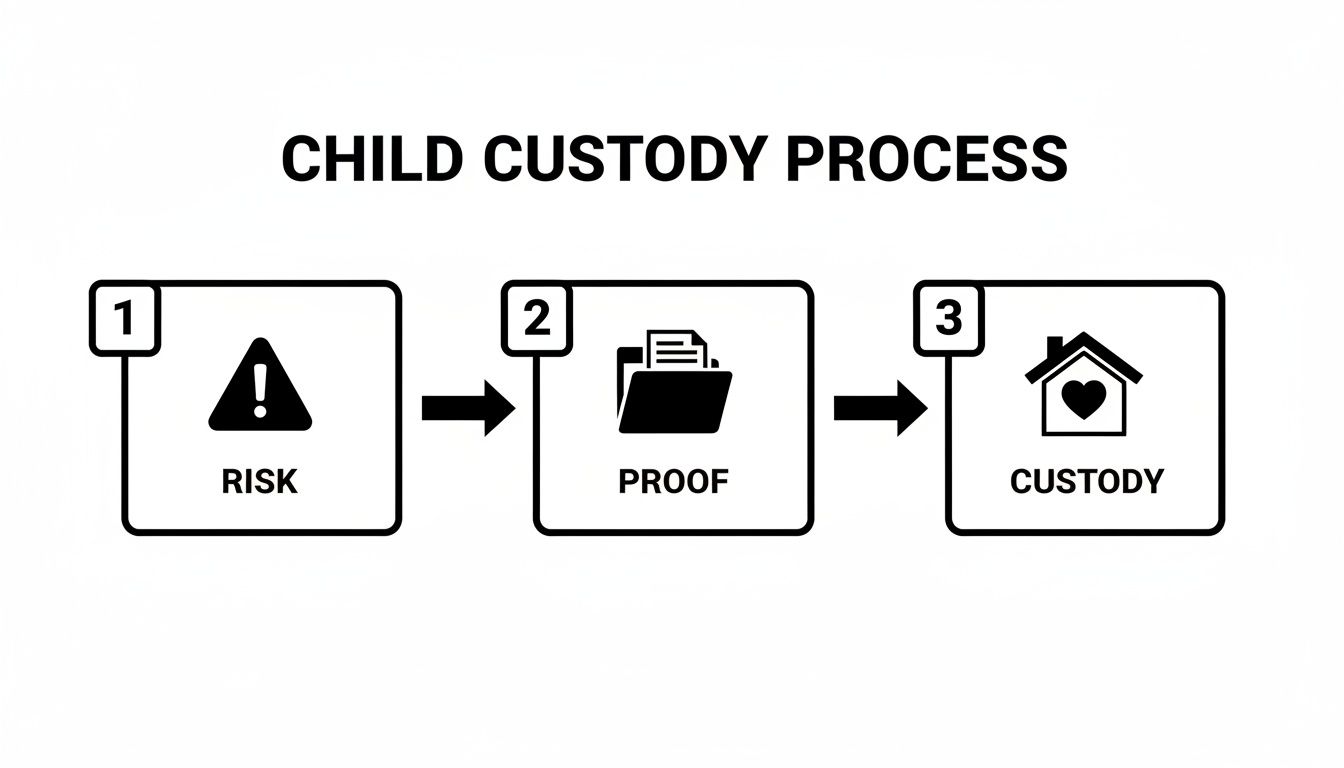
As you can see, a successful outcome is built on a foundation of solid proof that your involvement is necessary for the child's well-being.
Key Stages of a Court Case
After the initial paperwork is filed and served, your case will move through several distinct phases. While every family’s situation is different, most cases follow these key steps:
- Temporary Orders Hearing: This is often your first time in front of a judge. The court can make temporary rules about visitation or even custody that will stay in place while the case moves forward. This hearing is critical for creating immediate stability for your grandchild.
- Discovery: This is the formal, evidence-gathering phase where both sides share information. It can involve written questions (Interrogatories), requests for documents (Requests for Production), and sworn testimony taken outside of court (Depositions).
- Mediation: Before going to a final trial, Texas courts almost always require you to try and resolve the issues through mediation. A neutral, third-party mediator helps you and the parents find common ground and reach an agreement.
- Final Trial: If an agreement cannot be reached in mediation, your case will be set for a final trial. This is where you will present all your evidence and testimony to a judge (or sometimes a jury), who will then make a final, binding decision about your rights.
Building Your Case with Compelling Evidence
The heart of your legal effort is the evidence you bring to the table. Your word alone, no matter how heartfelt, isn't enough. You have to be able to prove your claims. Your goal is to paint a clear, compelling picture for the judge that shows exactly why your involvement is essential for your grandchild’s well-being.
Strong evidence can come in many forms:
- Communication Records: Text messages, emails, and voicemails that show your relationship with your grandchild or any concerning behavior from the parents.
- School and Medical Documents: Things like report cards, attendance records, and notes from doctors or teachers can be powerful proof of your role as a caregiver.
- Witness Testimony: Statements from teachers, counselors, neighbors, or other family members who have seen your bond with their own eyes and can speak to the child's needs.
- Photos and Videos: Visual proof of your consistent, loving presence in your grandchild's life can be incredibly persuasive.
If your case involves documents from other states or countries, or if anything needs to be translated, using professional legal document translation services can be indispensable to ensure everything is court-admissible.
Protecting your relationship with your grandchild through the court system is a major undertaking. At The Law Office of Bryan Fagan, PLLC, we understand the weight of this journey. We are here to help you understand your options and take the next step with confidence.
Kinship Adoption for Ultimate Stability

Sometimes, temporary solutions like visitation or even custody are not enough. For a child who has experienced instability, what they truly need is a sense of permanence—a forever family.
When a child's parents cannot provide a safe and stable home, kinship adoption offers that permanent, loving solution. It is the legal process that transforms your role from a dedicated caregiver into a legal parent, providing the ultimate security for your grandchild. Unlike custody orders, which can be modified by a court, an adoption is final. It creates a new, legally recognized parent-child relationship, giving your grandchild the unwavering foundation they deserve.
From Grandparent to Parent in the Eyes of the Law
Adoption is the most powerful legal tool you have to secure your grandchild's future. It permanently terminates the legal rights of the biological parents and makes you the child's parent in every sense of the word.
This means you have the final authority on all major life decisions—from where they go to school and which doctor they see to where they will grow up. This step is especially critical when a child’s biological parents have a history of instability, neglect, or substance abuse. Adoption prevents future custody disputes and gives your grandchild the chance to build a happy, secure life.
The Essential Steps in a Texas Kinship Adoption
The path to adoption is a formal legal journey, with every step designed to confirm that this move is truly in the child’s best interest.
- Termination of Parental Rights: Before an adoption can occur, the biological parents' legal rights must be ended. This can be done voluntarily if the parents agree, or a court can terminate them involuntarily if there's clear and convincing evidence of abuse, neglect, or abandonment under the Texas Family Code.
- Home Study (Adoption Evaluation): Texas requires an evaluation of the home you plan to provide. For relatives like grandparents, this process is often simplified. The main focus is ensuring your home is a safe, suitable, and loving place for the child.
- Finalization Hearing: This is the joyful conclusion to the process. You, your grandchild, and your attorney go before a judge who reviews the case and signs the final decree of adoption. It’s a celebratory moment when your family is officially recognized forever.
Kinship adoption is more than a legal procedure; it is the ultimate act of love and commitment. It officially recognizes the parent-child bond that has already formed in your hearts and provides the legal shield your grandchild needs to thrive.
The need for this kind of stability is growing. Across the U.S., over 2.5 million children live in "grandfamilies," and nearly 60% of these arrangements last for five years or more. Making these relationships official through adoption is key to getting resources and ensuring long-term security. You can learn more about the modern grandparenting landscape at Grandkids Matter.
Navigating the rules for kinship adoption can feel overwhelming, but you don’t have to do it alone. For a deeper understanding of the specific steps and legal requirements, we encourage you to read our complete guide to kinship adoption in Texas. It’s filled with the detailed information you need to move forward with confidence.
Common Questions About Grandparents Rights in Texas
When you're fighting for your grandchild, it’s natural to have many questions. Here, we provide clear, plain-English answers to some of the most common concerns we hear from Texas grandparents, giving you the clarity you need to plan your next steps with confidence.
Navigating the world of legal grandparents rights can be an isolating experience, but please know you are not alone in asking these questions. Every concern is valid, and getting straight answers is the first step toward protecting that precious bond you share with your grandchild.
Can My Grandchild's Parent Legally Stop Me From Seeing Them?
Yes, in most situations, a parent has the final say on who their child interacts with. Texas law is built on a very strong presumption that a fit parent is always acting in their child's best interest. For a grandparent, this is a major legal hurdle to overcome.
To get a court to intervene, you have to prove that being cut out of your grandchild's life would cause them significant emotional or physical harm. Unfortunately, simply being a wonderful, loving grandparent who enriches the child's life isn't enough to meet this high legal bar if a parent is objecting. The court’s focus will be squarely on the harm the child would suffer without you in their life.
What Kind of Evidence Do I Need for My Case?
Evidence is the bedrock of any grandparent's rights case. The specific proof you'll need depends on what you are asking the court to grant, and an experienced attorney's job is to help you weave a compelling story backed by concrete proof.
- For Visitation: You’ll need to demonstrate the depth of your bond and how the child would be harmed by your absence. Think photos, videos, school records listing you as an emergency contact, and powerful testimony from teachers or counselors who have seen your relationship firsthand.
- For Custody: The evidence must be much stronger. You must prove the child is in an environment that is physically or emotionally dangerous. This could mean CPS reports, police records, or documented proof of a parent's severe neglect, substance abuse, or family violence.
A judge once told me that a picture is worth a thousand words, but in family court, a documented timeline is worth a thousand pictures. Keeping detailed, organized records of your involvement and any concerning incidents can be one of the most powerful tools in your arsenal.
What Is the Difference Between Custody and Adoption?
It's easy to confuse these two terms, but they create very different legal realities for your grandchild. Understanding the distinction is key to figuring out which path is right for your family.
Think of custody (or "conservatorship" in Texas) as having temporary legal authority. You have the right to care for your grandchild, but the biological parents' rights still exist. They might have court-ordered visits or other legal ties to the child, and a judge can always change custody orders later if circumstances change.
Adoption, on the other hand, is permanent. It's an irreversible legal act that completely and forever terminates the biological parents' rights. It creates a brand-new, legal parent-child relationship between you and your grandchild. You become their parent in every legal sense of the word, giving them the ultimate stability and security.
Does a Divorce Give Me Automatic Visitation Rights?
No, a divorce between your grandchild's parents does not automatically give you any visitation rights in Texas. What it does do is create a critical and strategic window of opportunity to have them formally established.
While the parents are going through their divorce, you can file a special legal action called an "intervention." This allows you to join their existing divorce case and ask the judge to include a specific, court-ordered visitation schedule for you in the final divorce decree.
This approach is often more effective and streamlined than trying to file a new lawsuit later on. It lets the court look at everyone's roles at once and create a comprehensive plan that serves the child's best interest from the very start of their new family dynamic.
The journey to secure your rights as a grandparent is deeply personal and often challenging. You don't have to walk this path alone. The compassionate attorneys at The Law Office of Bryan Fagan, PLLC are here to provide the clarity and guidance your family deserves. We invite you to schedule a free, confidential consultation to discuss your unique situation and explore your legal options. Let us empower you to take the next step toward building and protecting your family.
