
Some relatives don't start out planning to adopt. They start by helping for a weekend, then another week, then a whole school semester. Before long, they're the one packing lunches, signing report cards, and sitting up at night when a child can't sleep.
If that's where you are, you're not alone. Many Texas grandparents, aunts, uncles, adult siblings, and other relatives step in, out of love and necessity. Relative adoption texas is the legal process that can turn that caregiving role into permanent parenthood.
That matters for everyday life. Adoption can give you the legal authority to make school, medical, and other parental decisions without constant uncertainty. It can also give a child something they may be craving more than anything else: permanence.
Texas law treats adoption as a serious decision centered on the best interests of the child. In plain terms, the court wants to know whether this child will be safe, stable, and cared for in your home for the long term. Relative adoption often fits that goal because the child already knows you, trusts you, and has family ties with you.
Some families come to this process through CPS. Others never enter the foster care system at all. Some have agreement from the parents. Others face hard conversations and contested hearings. Every path is different, but the legal building blocks are often similar.
A little later, we'll talk about court forms, home studies, termination of parental rights, and finalization under Texas Family Code Chapters 162 through 166, with some related issues from Chapter 161 when parental rights must be terminated first. For now, hold onto one simple truth. If you've already become the steady adult in a child's life, the law may offer a path to make that bond permanent.
From Loving Relative to Legal Parent Your Introduction to Kinship Adoption
Maria thought she was helping temporarily when her granddaughter stayed with her after a family crisis. She bought a backpack, found the right bus stop, and learned which bedtime story worked best on difficult nights. Months later, she realized she wasn't acting like a backup plan. She was parenting.
That moment is common in relative adoption texas cases. The legal system uses terms like kinship adoption or relative adoption, but most families experience it more directly. A child needs safety, and a relative steps forward.

What kinship adoption means in real life
When a Texas court approves a relative adoption, the adoptive relative becomes the child's legal parent. That usually means full parental rights and duties, not a temporary caregiving arrangement. The relationship becomes legally secure.
For many children, that security changes daily life in quiet ways:
- School decisions: You can handle enrollment and educational planning with clearer authority.
- Medical care: You can consent to treatment as a parent, not just as a caretaker trying to explain your role.
- Long-term stability: The child no longer has to wonder whether another move is around the corner.
If you're still sorting out whether your situation fits kinship adoption, this overview of what kinship adoption is in Texas can help you place your family story into the legal framework.
Why relatives often feel torn
Relative adoption can bring relief and grief at the same time. You may feel proud to protect a child and heartbroken that the family reached this point. Both feelings can exist together.
Practical rule: Needing legal permanence doesn't mean you're trying to erase the child's history. It means you're trying to protect the child's future.
That emotional tension shows up often with grandparents adopting grandchildren, aunts adopting nieces, or adult siblings taking on a parenting role. The law focuses on the child's best interests, but families also carry history, loyalty, guilt, and hope into court with them.
The legal framework in plain English
Texas adoption cases usually involve statutes in Chapters 162 through 166 of the Texas Family Code. Those chapters address the adoption process, required evaluations, and legal effects of adoption. In many relative adoptions, another major issue comes first. The rights of the biological parents usually must be addressed before the adoption can be finalized.
That sounds intimidating, but it becomes easier when you treat it as a sequence instead of one giant problem. First, figure out whether you qualify. Then address parental rights. Then complete the court process step by step.
Who Qualifies for a Relative Adoption in Texas
Not every loving adult falls neatly into the same legal category. Texas courts care about the child's safety and best interests, but they also care about whether the person asking to adopt has the right legal footing.
Relatives the court usually recognizes
In everyday practice, grandparents, great-grandparents, aunts, uncles, siblings, nieces, and nephews are the family relationships people most often think about in a relative adoption. These are the kinds of placements many readers mean when they search for relative adoption texas.
If you're married, your spouse's role matters too. In many adoptions, married spouses file together because the court is creating a legal parent-child relationship within a family unit.
What about close family friends or fictive kin
Some children are raised around adults who aren't blood relatives but are still family in every meaningful sense. A longtime godparent, a parent's close friend, or a trusted neighbor may have deep emotional ties to the child.
Those cases can still matter, but they may not move through the exact same lane as a traditional relative adoption. Courts often look closely at the nature of the relationship, existing orders, and whether CPS is involved. The child may know that person as family, while the legal system may classify the case differently.
A child can feel rooted with someone long before the law catches up. The court's job is to decide whether legal adoption should make that relationship permanent.
How this differs from other adoption types
Relative adoption is not the same as every other Texas adoption.
| Adoption type | Main feature | Common legal difference |
|---|---|---|
| Relative adoption | Child is adopted by family or kin | Existing family ties often shape placement and consent issues |
| Stepparent adoption | A spouse adopts their partner's child | One parent remains a legal parent |
| Private adoption | Child is placed outside the family | Matching and placement issues often look very different |
| CPS adoption | Child welfare system is involved | Court oversight and agency involvement may be more extensive |
That difference matters because families often compare the wrong process. A grandmother raising a grandchild may not need to think like someone pursuing a private infant adoption. The questions are different. The evidence is different. The family history is different.
A simple way to self-check your situation
Ask yourself these questions:
- What is my legal relationship to the child?
- Am I already providing daily care?
- Do the parents agree, or will parental rights be contested?
- Is CPS involved, or is this a private family matter?
- Do I need adoption, conservatorship, or another form of legal authority first?
The role of relatives in Texas child welfare has grown. In 2021, a significant number of children in state care were living with relatives, and nationally relatives adopted about one-third of the 57,200 children adopted from foster care in 2016, reflecting a broad move toward preserving family connections, according to the Annie E. Casey Foundation's adoption statistics summary.
That trend doesn't decide your case, but it does reflect something courts and families already know. When a safe relative can provide permanence, keeping family connections intact often matters.
The Step-by-Step Guide to the Texas Relative Adoption Process
Court procedure feels heavy when you're living it. It helps to break the process into separate pieces. Relative adoption texas cases usually move through a series of legal milestones, each with its own purpose.
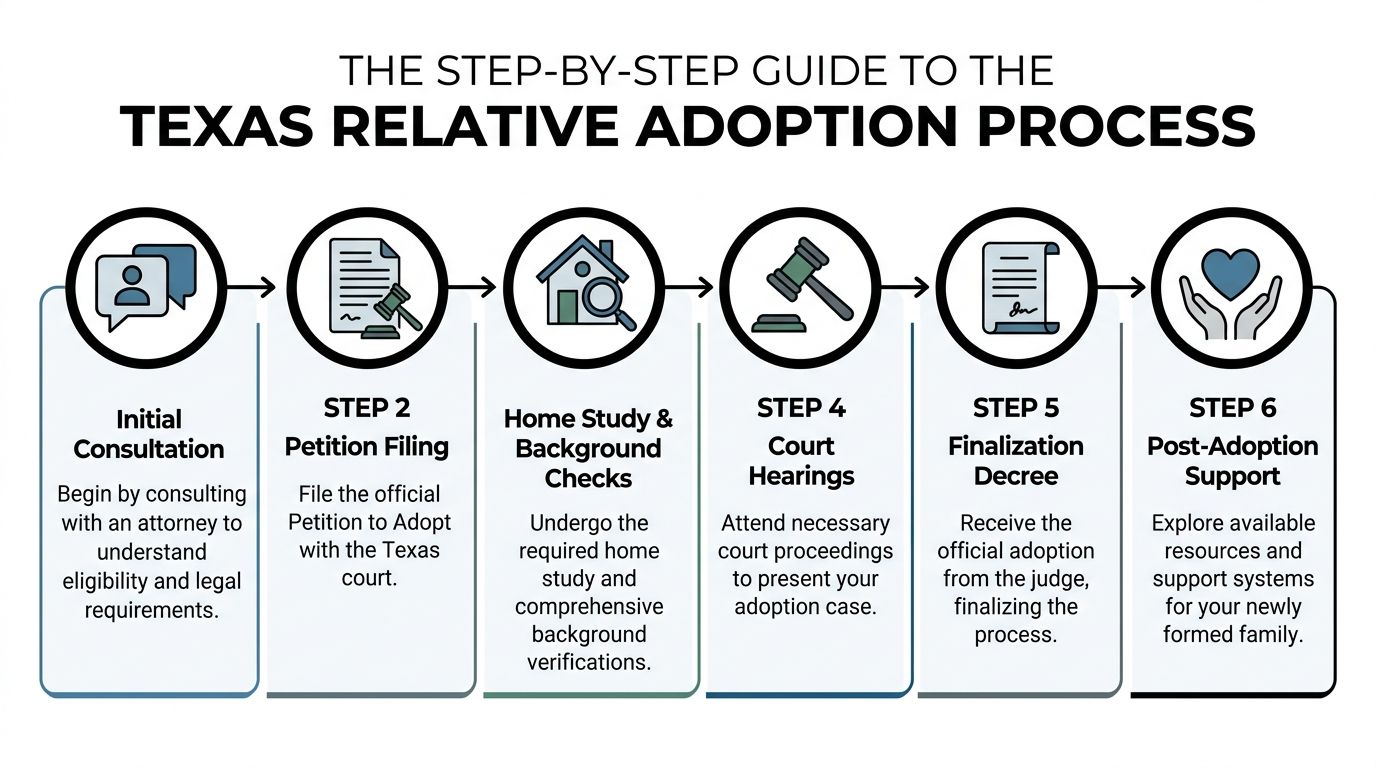
Step one starts before filing
The first real task is understanding your posture in the case. Are you already caring for the child under a court order? Is CPS involved? Are the parents willing to sign paperwork? Has someone else been named managing conservator?
Those facts shape almost everything that follows.
A careful lawyer will usually review:
- Current orders: Any custody, conservatorship, or CPS orders already in place
- Parent status: Whether parental rights are intact, restricted, or already terminated
- Child status: Where the child lives now and who makes daily decisions
- Venue questions: Which Texas court should hear the adoption
This is also the stage where organized records help. Many families keep calendars, school notes, medical records, and communications with parents. Even simple organization can reduce stress. Some firms and legal teams also use digital tools to manage timelines, tasks, and secure notes. If you're curious how law offices structure this kind of work behind the scenes, this overview of family law software gives a useful look at the systems professionals use to keep complex family cases moving.
Step two addresses parental rights
This is often the hardest part emotionally and legally. Before an adoption can be finalized, the rights of the biological parents usually must be terminated or otherwise resolved under Texas law.
That may happen in one of two broad ways:
- Voluntary termination or relinquishment. A parent agrees to sign documents surrendering parental rights.
- Involuntary termination. A court terminates rights after legal proceedings and evidence.
This issue is closely tied to Chapter 161 of the Texas Family Code, even though the adoption itself is largely governed by Chapters 162 through 166. Families often get confused here because they think filing for adoption alone is enough. It usually isn't. Adoption and termination are connected, but they are not the same legal step.
Step three is filing the adoption petition
Once the case is legally ready, the adoptive relative files the petition for adoption in the proper court. The petition tells the court who the child is, who seeks to adopt, and why the adoption should be granted.
Expect supporting paperwork. Depending on the case, that can include prior orders, consents, affidavits, and documents tied to the child's legal status. If the child is old enough, the child's wishes may also matter, though the judge still focuses on best interests.
Step four involves evaluations and checks
Texas courts usually require a home study or social study in adoption matters. Relatives sometimes worry this means strangers are coming to grade their housekeeping. That isn't the right way to think about it.
What the evaluator is looking for
A social worker or evaluator is usually trying to answer practical questions.
- Is the home safe? Think working utilities, sleeping arrangements, and general safety.
- Is the environment stable? The court wants signs that daily life is manageable and consistent.
- Does this relative understand the child's needs? School, health, behavior, routine, and emotional care all matter.
In other words, the home study is less about perfection and more about capacity.
A grandparent's home may look different from a private adoptive placement. An aunt may already have three children in the home. An uncle may work long hours and rely on trusted after-school help. Those facts don't automatically hurt the case. The evaluator usually wants to know whether the plan is realistic and safe.
What relatives can do before the visit
Preparation helps because it lowers your stress and shows seriousness.
| What to prepare | Why it matters |
|---|---|
| Basic documents | Helps verify identity, residence, and household details |
| A simple routine for the child | Shows how school, meals, and care are handled |
| Medication and safety storage | Demonstrates attention to child safety |
| Honest explanations of challenges | Builds trust more than trying to hide problems |
Many families find it useful to review a practical Texas adoption home study checklist before the process starts.
Background checks are serious, but honesty matters
Adults in the household should expect background checks. If something from the past may appear, talk to your lawyer early rather than hoping it won't matter. Old issues don't all carry the same legal weight, and context matters.
Keep this in mind: A clean explanation is better than a surprise. Courts and evaluators dislike concealment more than they dislike human imperfection.
If your case involves CPS, the standards may be applied with added scrutiny because the system is trying to protect a vulnerable child. If your case is private, the court still needs reassurance that adoption serves the child's interests.
The best way to think about the process
Treat the home study as a collaborative review, not a trap. The evaluator isn't deciding whether you're flawless. The evaluator is helping the court understand whether this child can thrive in your care.
That's especially important in kinship cases, where the child often already has a bond with the adoptive relative. The legal system still needs formal proof of safety, but it doesn't ignore the value of existing family connection.
Understanding the Costs and Timelines for a Texas Kinship Adoption
Families usually ask two practical questions early. How long will this take? And how expensive will it be? Honest answers require a little patience because no two cases move exactly the same way.
Why timelines vary so much
The largest factor is usually not the adoption paperwork itself. It's whether parental rights are agreed, contested, already terminated, or tied to a separate court case.
A smoother case may move more directly through filing, evaluation, and final hearing. A harder case can slow down because of service issues, contested termination, scheduling delays, or missing documents. If CPS is involved, the court's broader case calendar may also affect timing.
You can get a fuller sense of process pacing from this guide on how long adoption takes in Texas.
What costs families usually plan for
Most relative adoption budgets include some combination of:
- Court filing fees
- Home study or social study costs
- Attorney's fees
- Document and record expenses
- Possible hearing-related costs
The exact total depends on complexity. A straightforward agreed adoption and a contested CPS-related kinship case are not priced the same because the legal work is different.
If you're trying to understand how lawyers structure billing, this plain-english breakdown of the true cost of lawyers per hour can help you ask sharper questions during a consultation.
Why kinship adoptions may feel more manageable than other routes
Relative adoptions often avoid some of the costs and delays associated with unrelated private placements. There may already be a connection with the child, an existing caregiving pattern, or a court history that clarifies the path. That doesn't make the process effortless, but it can make it more direct.
Texas has also shown a long-term commitment to permanency through adoption. Between fiscal years 2010 and 2019, 53,412 children were adopted from the child welfare system in Texas, and the annual number of adoptions increased 27.2% over that decade, according to the Texas Council on Adoptable Children and Families post-adoption services report.
That doesn't tell you your personal timeline, but it does show that Texas courts and agencies have substantial experience moving children from temporary care toward permanency.
Questions worth asking before you hire anyone
A short consultation can save confusion later. Consider asking:
- What parts of my case are predictable, and what parts could create delay?
- Will parental rights be contested?
- What fees are fixed, and what fees depend on how the case unfolds?
- Do I need a home study in my exact situation?
- What post-adoption benefits or support programs should I ask about?
The right expectation isn't speed at all costs. It's clarity. Families do better when they know what can be controlled and what can't.
Life After Finalization Navigating Post-Adoption Support and Challenges
The final hearing can feel like the finish line. For many families, it's really the start of a different kind of work. Once the papers are signed, you still have a child who may be grieving, adjusting, testing boundaries, or trying to understand where they belong in a complicated family story.

Why kinship adoption can feel emotionally layered
Children adopted by relatives often gain permanence without losing awareness of their original family relationships. That can be comforting, but it can also be confusing.
A child may wonder:
- What do I call you now?
- Will I still see my parent?
- Why did this happen to our family?
- Do I have to choose sides?
Adults feel that tension too. A grandmother may now be the legal mother. An aunt may need firmer boundaries with the child's biological parent, who is also her sibling. Adoption solves legal uncertainty, but it doesn't erase family history.
Support matters more than many families expect
Texas has a significant gap in post-adoption support. An estimated 56.5% of adoptive families in Texas are considered underserved because they do not access needed post-adoption services, and that risk is especially high for kinship placements, according to the Texas Medical Center library article on post-adoption service access disparities.
That number matters because many families assume needing help means something is wrong. It doesn't. Counseling, support groups, school advocacy, and adoption-informed therapy can be part of a healthy family plan.
Families often prepare carefully for court and barely prepare for the emotional aftershocks. The second part deserves just as much attention.
Practical ways to build support after adoption
Some families do well when they put supports in place early instead of waiting for a crisis.
| Area | Helpful next step |
|---|---|
| School | Meet with teachers or counselors and explain the new legal family structure |
| Medical care | Update records and ask for referrals if the child shows signs of trauma or anxiety |
| Family boundaries | Decide in advance how contact with extended family will work |
| Emotional support | Look for adoption-competent counseling and kinship support groups |
What to watch for in the first stretch after finalization
Relief doesn't always arrive neatly. Sometimes a child acts out more after adoption because permanence finally feels real enough to test. Sometimes the adoptive relative feels unexpectedly tired because the legal fight is over and the emotions catch up.
That doesn't mean the adoption was a mistake. It usually means your family is adjusting.
Children do best when the adults around them stay calm, honest, and consistent. Simple routines, direct answers, and age-appropriate truth help more than grand speeches. So does giving yourself permission to ask for help.
Your Kinship Adoption Questions Answered
Some questions come up in almost every consultation. They usually sound practical on the surface, but underneath them is fear. Fear of doing this wrong. Fear of hurting family relationships. Fear that love alone won't be enough in court.
Common answers in plain language
| Question | Answer |
|---|---|
| Can a grandparent adopt a grandchild in Texas? | Yes, in many situations a grandparent can adopt, but the court still requires the legal steps for adoption, including addressing parental rights and proving the adoption is in the child's best interests. |
| Does the child's parent have to agree? | Not always. Agreement can simplify part of the process, but when a parent does not agree, the court may need to decide whether legal grounds exist to terminate parental rights. |
| Is adoption the same as conservatorship? | No. Conservatorship can give important decision-making power, but adoption creates a permanent legal parent-child relationship. |
| Will I need a home study even if the child already lives with me? | Often, yes. Courts usually still want formal information showing that your home is safe and stable for adoption. |
| Can an older sibling adopt a younger sibling? | Sometimes, depending on age, legal posture, and the facts of the case. The court will look closely at stability, readiness, and the child's best interests. |
| Does CPS have to be involved? | No. Some relative adoptions arise from CPS cases, but others are private family matters handled through the courts. |
| Can the child keep family connections after adoption? | Family relationships often continue in real life, but the legal structure changes. Each family should think carefully about boundaries, safety, and what contact serves the child. |
| What if my home isn't perfect? | The court is not asking whether your life is polished. The court is asking whether you can give the child a safe, stable, and permanent home. |
A few hard questions deserve direct answers
If you're worried that seeking adoption makes you disloyal to the child's parent, remember this: courts don't grant adoptions to punish adults. They grant adoptions to protect children.
If you're worried the child is too old to adjust, don't assume that. Older children often understand more than adults realize. They may not need a perfect explanation. They need truthful, steady care.
If you're worried that asking for legal help will inflame the family, that can happen. But uncertainty also has a cost. Children feel instability even when adults try to hide it.
When a consultation makes the most sense
You should strongly consider getting legal advice if:
- Parental rights are contested
- CPS is involved
- You're unsure whether adoption or conservatorship fits better
- The child has lived with you for a long time without formal legal authority
- Another relative may also seek placement or adoption
A thoughtful consultation can help you understand where your case sits under Texas Family Code Chapters 162 through 166, and whether a related parental-rights issue under Chapter 161 needs to be resolved first.
If you'sve read this far, you've probably already done the hardest human part. You showed up for a child. The legal part can still be challenging, but it doesn't have to stay confusing forever.
If you're considering relative adoption texas and need guidance specific to your family, Law Office of Bryan Fagan, PLLC offers free consultations for Texas families navigating adoption and guardianship questions. A conversation can help you sort out eligibility, parental rights issues, home study concerns, and the next legal step toward a stable, permanent home for the child you love.
