
Deciding to grow your family through adoption is a huge, heart-filled decision. But that first step can feel like trying to find a single address in a city you've never visited—you know where you want to go, but the map looks incredibly complex.
This is exactly where a private adoption agency in Texas comes in. They act as your personal guide, providing the support, resources, and expert navigation you need for this deeply personal journey.
Your First Step in Texas Private Adoption
Think of a private adoption agency as a specialized partner, one hundred percent focused on your goal of building a family. They handle the complex logistics so you can focus on what really matters: preparing your heart and home for a child.
This path is different from the public foster care system. While foster care's primary goal is often to reunite children with their biological families, private adoption is all about creating a new, permanent family when a birth mother voluntarily chooses an adoption plan.
Building Your Adoption Dream Team
No one should walk the adoption path alone. A successful, secure adoption is a team effort, and you’ll want two key players in your corner:
- A Licensed Private Adoption Agency: This is your frontline support. They're the experts who connect you with expectant mothers, conduct the required home study, and provide the crucial emotional support and education you'll need along the way.
- An Experienced Adoption Attorney: Your lawyer is your legal shield. They are the ones who navigate the Texas Family Code, handle the critical court process of terminating parental rights (TPR), and stand beside you at the finalization hearing to ensure your adoption is legally sound and permanent.
Here at The Law Office of Bryan Fagan, PLLC, we work hand-in-glove with your chosen agency. We manage the legal framework while your agency focuses on the personal side of the match, creating a strong, seamless support system for your growing family.
Building a family through adoption is an act of profound love. Having a team that offers both compassionate guidance and strong legal protection ensures that love is built on a secure and lasting foundation, always prioritizing the best interests of the child.
Adoption Paths in Texas at a Glance
Before you go any further, it’s helpful to understand the main roads you can take. Each one leads to the same destination—creating a family—but the journey looks a little different.
Here’s a quick look at the three main adoption avenues in Texas to help you see where you might fit.
| Adoption Path | Primary Focus | Typical Timeline | Who It's For |
|---|---|---|---|
| Private Adoption | Creating a family through a voluntary plan between birth parents and adoptive parents, facilitated by an agency. | Varies, often 1-2+ years | Hopeful parents seeking to adopt an infant and have a more direct connection with the birth mother. |
| Foster Care Adoption | Providing a permanent home for a child in state custody whose biological parents' rights have been terminated. | Varies significantly, can be shorter or longer. | Families open to adopting older children, sibling groups, or children with special needs. Often less expensive. |
| Relative/Stepparent Adoption | Formalizing the legal relationship with a child you are already raising (e.g., a grandchild, niece, or stepchild). | Generally faster, a few months to a year. | Kinship caregivers or stepparents wanting to secure legal parental rights for the child in their care. |
Understanding these distinctions is the first step in making an empowered choice. It helps you align your hopes and expectations with the path that's truly designed to meet them.
The Private Adoption Journey Step by Step
Starting a private adoption can feel like you’re standing at the trailhead of a massive, unmarked wilderness. You know where you want to go—welcoming a child into your family—but the path ahead looks winding and full of unknowns. Let’s clear that path together, turning a complex map into a step-by-step guide you can follow with confidence.
Think of this process less like a test and more like a partnership. A good private adoption agency in Texas won’t just hand you a checklist; they’ll walk alongside you from the first application form to the moment a judge declares you a legal family.
Here’s what that journey looks like, one step at a time.
The Application and Home Study
Your journey kicks off when you select a licensed Texas agency and fill out their application. This is the starting point where the agency gets to know your family, your story, and your hopes for adoption. Once your application is green-lit, you’ll head toward one of the biggest milestones in the process: the home study.
That term, "home study," can sound pretty intimidating. Let's be clear: it's not a white-glove inspection. It's a collaborative process where an expert helps you prepare your home and your hearts for a child. A licensed social worker will:
- Visit your home: They’re there to ensure it’s a safe, stable, and nurturing place for a child to thrive.
- Conduct interviews: The social worker will chat with everyone living in your home. This is to get a feel for your family’s dynamics, your approach to parenting, and the support system you have in place.
- Review documents: This is a standard part of the process and includes things like background checks (required by Texas Family Code Chapter 162), a review of your financial stability, and personal references.
The whole point is to educate and prepare you. It’s a foundational step that confirms your readiness and is legally required for every adoption in Texas.
Creating Your Family Profile
While the home study is in motion, you get to work on a project that comes straight from the heart: your family profile book. This is your chance to introduce yourselves to expectant parents who are considering an adoption plan for their child. It’s your story, told through pictures and words—your values, your traditions, your home, and all the love you’re waiting to share.
Your profile is much more than a biography; it's a personal letter. It’s your very first chance to make a real connection with a birth mother, showing her the kind of loving home and bright future you can offer her child.
An authentic, warm profile is everything. It helps a birth mother picture her child’s life with you, giving her the peace and confidence she needs to make one of the hardest decisions of her life.
This image shows the core team that will support you throughout the private adoption process.
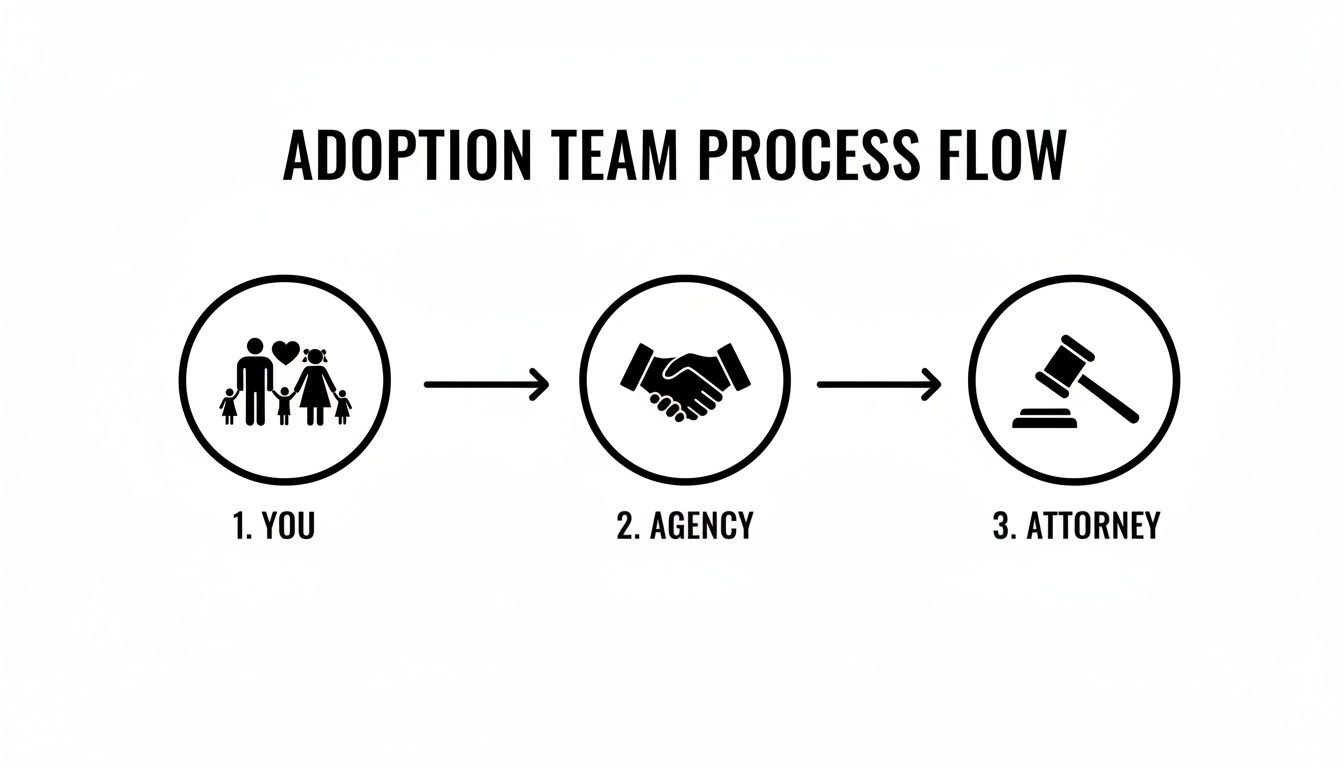
As you can see, you, your agency, and your attorney all work together. It’s a team effort designed to make the entire experience secure and supportive.
The Match, Placement, and Post-Placement Support
Once your home study is approved and your profile is ready, you officially enter the waiting period. This part of the journey calls for a lot of patience and hope. Your agency will begin showing your profile to birth mothers whose hopes for their child align with what your family can offer. When a birth mother chooses you, that incredible moment is called a match.
Placement—the day the baby is finally placed in your arms—is a milestone you’ll never forget. But the journey isn’t over yet. After you bring your child home, a period of post-placement supervision begins. Your social worker will visit your home a few times over the next six months to see how your new family is adjusting.
These aren't inspections; they’re supportive check-ins. The social worker is there to offer resources, answer your questions, and document the child's well-being for the final report that goes to the court. This phase ensures your family gets off to a strong, healthy start before the adoption is legally finalized—the final, critical step we’ll cover next.
Navigating the Legal Side of Texas Adoption
While your adoption journey is an emotional one, it’s all built on a solid legal foundation. It’s easy to get lost in the legal jargon, but understanding these steps is really about seeing how the law protects everyone involved—you, the birth parents, and most importantly, the child.
Think of the legal process as the steel frame of a new home. It’s what ensures the entire structure is safe, secure, and built to last a lifetime. Everything is laid out in the Texas Family Code, and these aren’t just arbitrary rules. They are safeguards that make sure every adoption is handled ethically and with the child’s best interests at heart.

Why Termination of Parental Rights Is Critical
One of the most significant legal moments in a private adoption is the Termination of Parental Rights (TPR). This is a court process that legally and permanently ends the rights and responsibilities of the biological parents. It’s the step that makes the child legally available for you to adopt.
This part of the journey is handled with incredible care. In Texas, a birth mother cannot sign the documents to relinquish her parental rights until at least 48 hours after the child is born, a waiting period outlined in Texas Family Code Chapter 162. This waiting period is a crucial protection, ensuring her decision is made voluntarily and without any undue pressure.
Ultimately, the TPR process is what creates the legal space for your own parental rights to be established. It’s a pivotal moment for your new family.
The Finalization Hearing: The Last Step Home
After you’ve completed your home study, post-placement visits, and the TPR process, you’ll arrive at the last legal milestone: the finalization hearing. This court appearance is often a day filled with joy and emotion. It's the moment a judge reviews all the paperwork and officially signs the adoption decree.
The adoption decree is so much more than a piece of paper. It is the legal document that declares your child is, in every way that matters, a permanent member of your family. From this day forward, you hold all the rights and responsibilities of a parent, and your child gains all the rights of inheritance—just as if they were born to you.
This hearing is the beautiful culmination of your legal journey. It's where "hopeful adoptive parents" officially become, simply, "parents."
The Role of Your Adoption Attorney
Navigating the Texas Family Code requires precision and experience. While a private adoption agency in Texas provides crucial social and emotional support, an adoption attorney is your dedicated legal advocate. They are the ones who make sure every document is filed correctly, every deadline is met, and every court appearance goes smoothly.
An attorney’s job is to manage the legal complexities so you can focus on what’s most important: bonding with your new child. To see exactly how they do this, you can learn more about what an adoption attorney does for you. They work to protect your family’s future, giving you the peace of mind that your adoption is legally secure for a lifetime.
How to Choose the Right Adoption Agency
Choosing an adoption agency is one of the most critical decisions you'll make on this journey. This isn't just a service provider; this is the partner who will be your guide, your sounding board, and your support system through one of life's biggest transitions.
Think of it like picking a co-captain for a long voyage. You need someone who not only knows the charts but also communicates clearly and shares your vision for the destination. This choice is deeply personal, and the agency that’s perfect for one family might not be the right fit for yours. Taking the time to research and talk to a few different agencies will empower you to find a partner that truly aligns with your family’s heart and goals.

Key Questions to Ask a Private Adoption Agency
When you first start talking to agencies, it's easy to get overwhelmed by all the information. It’s a good idea to go into those conversations with a list of questions to help you compare them thoughtfully and make an informed choice.
Here are some essential questions to get you started:
- Financial Transparency: Can you give me a detailed, line-by-line breakdown of all fees? What is your policy if a match doesn't work out?
- Birth Mother Support: How do you support expectant mothers who are considering adoption? What specific services—like counseling, financial aid, or medical care—do you offer them before and after placement?
- Wait Times and Matching: What is your current average wait time for a match? Can you walk me through your process for matching birth parents with adoptive families?
- Communication: What is your communication policy? How often should we expect to hear from you, and who will be our main point of contact through this process?
- Licensing and Credentials: Are you a fully licensed child-placing agency in the state of Texas? (You can and absolutely should verify this yourself with Texas Health and Human Services.)
These questions are about more than just gathering facts; they’re about getting a feel for the agency’s philosophy. A quality private adoption agency in Texas will welcome your questions and answer them with patience and total transparency.
A Tale of Two Agencies: A Real-Life Scenario
Let’s imagine a hopeful Houston couple, Maria and Sam, as they interview two different agencies.
Agency A has a flashy website and makes big promises about a fast timeline. But when Maria asks about their support for birth mothers, the representative gets vague. He brushes off her questions about the fee structure, saying, "Don't worry, we take care of all that." The whole conversation feels rushed, and Sam gets a knot in his stomach. It feels more like a business deal than a life-changing partnership.
Then, they have a video call with Agency B. The director spends a full hour with them, patiently walking them through every step of the process. She explains their comprehensive counseling and support programs for birth mothers, emphasizing that a healthy, supported birth mother is essential for a healthy adoption. She gives them a clear fee schedule and speaks with genuine compassion about the families they’ve helped build. Maria and Sam hang up feeling seen, respected, and full of hope.
For them, Agency B was the obvious choice because it aligned with their values of empathy and ethical practice. Trust your gut—it's often your most reliable guide.
An ethical agency always puts the well-being of everyone in the adoption triad first: the child, the birth parents, and you. Vague answers, high-pressure tactics, or a focus only on the money are major red flags that you shouldn't ignore.
Finding the Right Fit for Your Family
As you begin your search, remember that you are in the driver's seat. You have the power to choose the partner that feels right. To find local options, you can explore resources for an adoption agency in Houston, Texas, or whichever major city is closest to you. The right agency will feel like a true partner—one dedicated to helping you build your forever family with integrity and heart.
Understanding Adoption Costs and Financial Aid
Let's be honest—for most hopeful parents, the cost of adoption is the biggest question mark. It can feel like a massive mountain to climb. But we want to assure you that while it's a significant investment, it’s one that countless families successfully make every year.
Think of it less as a "cost" and more as an investment in the professionals, resources, and legal protections needed to build your family ethically and securely. When you work with a private adoption agency in Texas, your fees go directly toward ensuring every part of the process is handled with expertise and compassion.
Breaking Down the Costs
Adoption fees aren't just a single, arbitrary number. They represent a bundle of essential services designed to create a smooth, legal, and supportive journey for everyone involved—you, the birth mother, and your future child. In Texas, most private adoptions typically fall in the range of $35,000 to $50,000.
So, where does that money actually go?
- Agency and Application Fees: This covers the administrative backbone of your adoption—the staff who guide you, the educational materials you receive, and the initial paperwork processing.
- Home Study Expenses: You'll pay for the licensed social worker who conducts your home study. This includes their time for interviews, home visits, and writing the final, court-required report.
- Birth Mother Support: This is one of the most important parts of an ethical adoption. These funds legally assist a birth mother with reasonable living expenses—like housing, groceries, and medical co-pays—during her pregnancy and recovery. This ensures her decision is made from a place of love, not financial pressure.
- Legal Fees: These costs cover the crucial legal work, from filing the initial petition and managing the termination of parental rights (TPR) to representing you at the finalization hearing.
- Post-Placement Services: After your child comes home, a social worker will conduct follow-up visits. These are required by law before the adoption can be finalized, and the fees cover the social worker's time and travel.
Knowing exactly what you're paying for brings a lot of peace of mind. Every dollar is working to build a safe, legal, and loving foundation for your family's future.
The goal of these fees is to facilitate a healthy, ethical, and legally sound adoption for everyone involved. Full transparency from your agency about these costs is not just good practice—it's a sign you've chosen a trustworthy partner.
Financial Aid and Resources to Build Your Family
Here's the good news: you don't have to fund this journey on your own. There is a whole ecosystem of financial resources designed specifically to help families like yours make adoption more affordable. Your dream is within reach.
- The Federal Adoption Tax Credit: This is a game-changer for many families. For 2024, the federal government offers a tax credit of up to $16,810 per child to help offset your adoption expenses. It's a nonrefundable credit, which means it can reduce your federal income tax liability.
- Employer Benefits: More and more companies are offering adoption assistance. Check with your HR department—you might be surprised to find your employer offers reimbursement for adoption expenses or even paid leave.
- Adoption Grants: Dozens of non-profit organizations provide grants to hopeful adoptive parents. These are gifts that don't need to be repaid and are often awarded based on financial need or other specific circumstances.
- Community Fundraising and Loans: Don't underestimate the power of your community. Many families successfully raise a portion of their funds through personal fundraising platforms. You can also find financial institutions that offer low-interest loans specifically for adoption.
These financial tools exist because our government and communities believe in helping build families through adoption. For a much deeper dive into these costs and how to budget for them, we encourage you to learn more about how much private adoption costs in Texas in our detailed guide.
Your Next Steps on the Path to Adoption
We’ve covered a lot of ground in this guide, and our hope is that you’re ending with a clear head and a confident heart. The road to building your family through adoption can feel complex, but it’s a journey rooted in love—and you never have to walk it by yourself.
With the right people in your corner, this beautiful, life-changing goal is entirely within reach.
As you get ready to step into the incredible role of parenthood, a little practical wisdom goes a long way. These essential tips for new dads can help you prepare for the amazing chapter ahead.
Your family's story is waiting to be written. The next chapter starts not with a leap, but with a single, simple conversation. Taking that first step is the most powerful thing you can do today.
If you’re ready to learn more about the adoption process or have questions about your unique situation, we’re here to listen with empathy and professional insight.
We invite you to schedule a free consultation with us today. Let our experienced adoption team at The Law Office of Bryan Fagan, PLLC, provide the clear legal guidance and compassionate support you deserve as you take the next step toward building your family.
Frequently Asked Questions About Private Adoption
As you start exploring private adoption, it's natural to have a million questions running through your mind. This is a huge, heart-driven decision, and feeling prepared is the best way to move forward with confidence. We’ve put together answers to some of the most common questions we hear from families just like yours.
What Are the Basic Requirements to Adopt in Texas?
At its core, Texas wants to ensure every child has a safe, stable, and loving home. While every case is unique, the state generally looks for a few key things.
You’ll need to be at least 21 years old, be financially stable enough to support a child, and be a responsible, mature adult. A major part of this is the home study, where a social worker will get to know you through interviews and background checks to confirm you’re ready to welcome a child into your life.
How Long Does a Private Adoption Take?
This is the big question every hopeful parent asks, and the honest answer is: it varies. No two adoption journeys are the same.
Typically, you can expect the process to take anywhere from one to two years, though sometimes it can be longer. The timeline depends on how quickly your home study is completed, how long it takes to create a compelling family profile, and of course, the matching process with a birth mother. Patience is tough, but it's an essential part of the process.
Can Single People or LGBTQ+ Couples Adopt?
Absolutely. In Texas, the law allows for adoption by single adults as well as married couples. What truly matters is your ability to provide a loving and stable home for a child.
At The Law Office of Bryan Fagan, PLLC, we are proud to help all families grow. Whether you're a single parent-to-be or an LGBTQ+ couple, we’ll stand by your side to ensure your rights are protected every step of the way.
The most important qualification for adoption is the ability to provide a secure, nurturing, and permanent home. The law focuses on the best interests of the child, and loving parents come from all walks of life.
What Happens If a Birth Mother Changes Her Mind?
This is one of the deepest fears for many adoptive families, and it's completely understandable. The good news is that Texas law has specific safeguards in place to provide legal finality for everyone involved.
A birth mother cannot legally sign the papers to relinquish her parental rights until at least 48 hours after the baby is born. This waiting period is critical—it ensures she is making a conscious, uncoerced decision. Once those rights are terminated by a judge in court, the decision is permanent and cannot be reversed. This gives your new family the legal security you need to move forward.
The journey to adoption is full of questions, and you deserve to have a team that answers them with clarity and compassion. The Law Office of Bryan Fagan, PLLC is here to provide the legal guidance and support you need to navigate every step with confidence. If you're ready to take the next step or simply want to learn more, schedule a free consultation with us today.
