
A child may already be sleeping in your guest room. Their backpack may be by the door. You may be the one signing school papers, scheduling doctor visits, and answering hard bedtime questions you never expected to hear.
For many Texas relatives, that’s how this begins. Not with a plan, but with a need.
A grandparent steps in after a parent’s crisis. An aunt takes her nephew for what was supposed to be a short stay. An older sibling helps hold life together while the adults sort things out. After a while, one question starts to matter more than all the others. How do we make this stable for the child?
Keeping Family Together A Compassionate Introduction
Kinship adoption means a relative, and sometimes another adult with a close family-like bond, becomes the child’s legal parent through adoption. In plain terms, it turns the care you’re already giving into permanent legal security.
That matters because informal care can leave families exposed. You may love the child and handle every daily need, but without a court order, simple things can become difficult. School enrollment, medical care, travel, and long-term planning can all feel uncertain.

Kinship adoption texas cases often start from love, loyalty, and urgency. The law comes later. If that’s your situation, you’re not behind. You’re doing what many families do first. You protect the child, then you figure out the paperwork.
Texas relies heavily on relatives to care for children. As of 2023, an estimated 263,013 children in Texas lived in kinship households, according to Every Texan’s kinship care analysis. That number reflects grandparents, aunts, uncles, and other loved ones stepping in when parents can’t.
What kinship adoption changes
Adoption does more than confirm what your heart already knows. It gives the child permanence.
With adoption, you can usually make the same legal decisions any parent would make. The child also gains the stability of a legally recognized parent-child relationship. For many children, that legal certainty supports the emotional work of strengthening family relationships after a difficult transition.
Practical rule: If a child is already depending on you every day, it’s worth asking whether your current arrangement protects them in the long run.
What tends to confuse families
Most relatives don’t struggle with the emotional answer. They know they want to keep the child safe. The confusion usually comes from the legal choices.
Families often ask:
- Should we pursue adoption or guardianship
- Do the parents have to agree
- What if CPS is involved
- How long do we have to wait
- What happens if we recently moved to Texas
Those are the right questions. The process can feel heavy, but it becomes much easier when you break it into pieces and look at one decision at a time.
Kinship Adoption or Guardianship Choosing the Right Path
Some families need permanent legal parenthood. Others need authority to care for a child while keeping the door open for a different long-term outcome. That’s why the first legal question usually isn’t “How do we adopt?” It’s “What are we trying to build?”
Kinship adoption and legal guardianship, often handled in Texas through managing conservatorship, can look similar in daily life at first. In both situations, a relative may be caring for the child, taking them to appointments, and making practical decisions.
The difference is what the law says about the future.
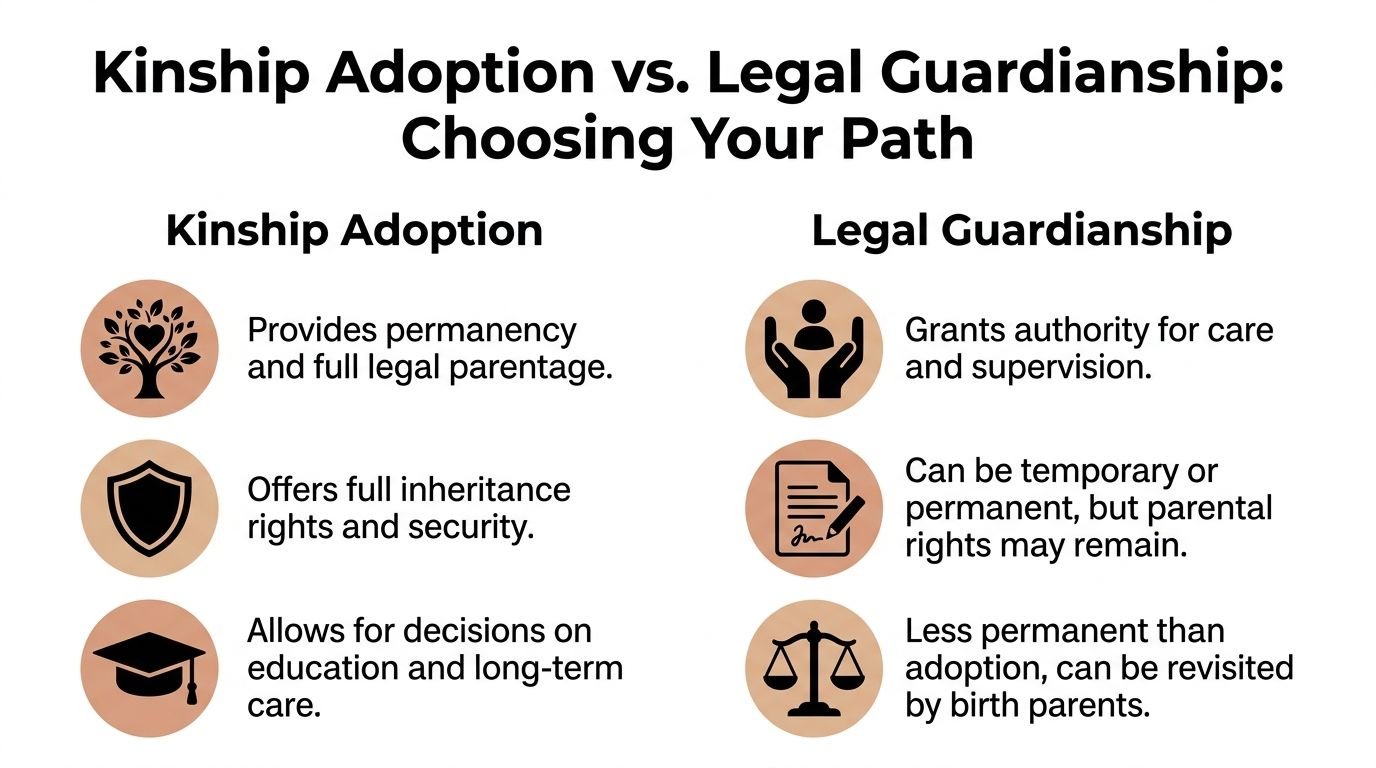
The core difference
Adoption creates a new legal parent-child relationship. It is designed to be permanent.
Guardianship or managing conservatorship gives a caregiver authority to raise the child, but it does not make the caregiver the child’s legal parent in the same way adoption does. The birth parents’ rights may remain in place, depending on the court orders.
That distinction affects almost every long-term issue.
Kinship Adoption vs. Legal Guardianship in Texas
| Feature | Kinship Adoption | Legal Guardianship (Managing Conservatorship) |
|---|---|---|
| Legal status | Relative becomes the child’s legal parent | Caregiver receives authority to care for the child |
| Birth parents’ rights | Usually must be terminated before adoption is finalized | May remain intact, though limited by court order |
| Permanence | Intended as a permanent family relationship | Can be more vulnerable to future legal changes |
| Decision-making | Adoptive parent usually makes full parental decisions | Authority depends on the court’s order |
| Inheritance | Child generally gains the legal rights of a child in the adoptive family | May require separate planning, such as a will |
| Name and records | Adoption may allow changes to legal records | Guardianship usually does not create the same change in legal parentage |
| Future court involvement | Often less ongoing court oversight after finalization | More likely to require continued legal attention if disputes arise |
When adoption may fit better
Adoption often makes sense when the child has been living with you for a meaningful period, reunification is no longer realistic, and everyone involved wants lasting stability.
A grandmother raising her grandson after years of inconsistency from both parents may decide that the child needs more than temporary court orders. He may need the reassurance that the person tucking him in at night is also, in the eyes of the law, his permanent parent.
When guardianship may fit better
Sometimes adoption is too final for the family’s situation.
An aunt may be caring for her niece while the child’s mother receives treatment and works toward stability. The aunt may need legal authority right now, but the family may not be ready to permanently end the mother’s parental rights. In that situation, guardianship or conservatorship can provide a legal bridge.
Guardianship can solve an urgent care problem. Adoption solves the long-term permanence question.
Questions to ask before choosing
Rather than rushing into one path, slow down and look at what the child will need a year from now, not just this week.
Ask yourself:
Is reunification still a real possibility
If yes, guardianship may deserve serious consideration.Does the child need lifelong legal security now
If yes, adoption may be the better fit.Are the birth parents willing to consent
Their position can shape timing and legal strategy.Will the child benefit from a clearer legal identity in your home
School, health care, and emotional stability often matter here.Are there CPS orders already in place
Existing court involvement may affect which option is practical first.
For a closer look at how conservatorship and related kinship arrangements work, this guide on kinship guardianship in Texas can help clarify the differences.
A gentle way to think about it
If guardianship says, “I’m responsible for this child right now,” adoption says, “This child is my child in every permanent legal sense.”
Neither choice is selfish. Neither choice is cold. Families make these decisions under pressure, often while trying to protect a child from more change.
The right path is the one that best protects the child’s safety, stability, and sense of belonging.
Confirming Your Eligibility for Kinship Adoption in Texas
Before filing anything, it helps to answer a basic but important question. Can you legally pursue kinship adoption in Texas right now?
Many relatives assume the answer is yes because the child already lives with them. Sometimes that’s true. Sometimes one missing requirement creates a delay that catches families off guard.
Who counts as kin
In everyday conversation, kin usually means family. In child welfare cases, the term can include a wider circle.
Texas kinship placements often involve grandparents, aunts, uncles, adult siblings, and other relatives. Texas policy also recognizes fictive kin in some CPS matters, meaning adults who are not related by blood, marriage, or adoption but have a close emotional bond with the child.
Many children are safest with the people they already trust, not only with people who fit a narrow family tree.
The residency issue families often miss
One of the biggest points of confusion in kinship adoption texas cases is the waiting period tied to Texas residency and the child’s residence in the home.
Texas kinship adoption law requires adoptive relatives to be Texas residents for at least six months and also requires that the child must have lived with them for at least six months before adoption can begin, as explained in this Texas kinship adoption guide.
That dual timeline causes problems for families who relocate to Texas to help a child.
A common example looks like this. An aunt in another state learns her nephew can’t safely stay with his parents. She moves to Texas, brings him into her home, and wants to file right away. Emotionally, that makes perfect sense. Legally, she may need to wait until both six-month requirements are satisfied.
Important note: Caring for the child now does not always mean you can file for adoption now.
Why this catches families by surprise
Relatives often focus on the child’s immediate needs first. They get the child enrolled in school, arrange counseling, and create a bedroom. By the time they contact a lawyer, they assume the legal filing is the simple part.
But the court will want to know whether the threshold requirements have been met. If they haven’t, your family may need an interim plan.
Documents that help show the timeline
If you’re in the waiting period, keep clear records. Families often underestimate how helpful this can be.
Consider gathering:
- School records that show the child’s address
- Medical records listing your home as the child’s residence
- Lease papers or utility bills confirming your Texas residence
- CPS or court paperwork showing when placement began
- Calendar notes and correspondence tied to the child’s move into your home
These records can help reduce disputes about when the child started living with you and when you established residency.
If you’re moving to Texas for kinship care
Strategic timing matters here. Some relatives need to decide whether to seek temporary legal authority in another state first or wait and proceed in Texas after the move.
That choice can affect school access, medical decision-making, and how smoothly the eventual adoption proceeds. Interstate family situations are often less about one perfect answer and more about avoiding a preventable restart.
A grandmother who already has guardianship in another state may need specific advice before moving to Texas with the child. Another caregiver may need to stay put until a short-term legal order is entered where the child currently lives. The details matter.
A practical checklist
Use this simple gut-check before assuming you’re ready to file:
- You have a qualifying family or kin-like connection
- You’ve established Texas residency
- The child has lived with you long enough under Texas requirements
- You can document the living arrangement clearly
- You have a plan if a parent contests the case
If one of those pieces is missing, that doesn’t mean the path is closed. It usually means the timing or legal route needs adjusting.
Navigating the Home Study and Background Checks
For many relatives, the home study is the part they dread most. They worry someone will walk in, notice laundry on a chair, and decide they aren’t good enough.
That's not its purpose.
In kinship cases, the home study is less about presenting a perfect home and more about showing that the child is safe, cared for, and living in a stable environment. The state already knows these situations often happen quickly. The question is whether your home can support the child’s needs.
What a home study usually involves
A home study is an assessment. It usually includes interviews, document review, safety observations, and background checks for adults in the household.
Relatives are often asked about:
Daily life in the home
Who wakes the child up, helps with homework, cooks meals, and handles discipline.Health and finances
Not to demand wealth, but to see whether the household is reasonably stable.Parenting plans
How you’ll handle school, medical care, routines, emotional support, and contact with other family members.Household safety
Basic issues like sleeping arrangements, hazards, and the general condition of the home.
Texas does allow faster movement in some kinship cases
Texas DFPS uses a tiered assessment system that can move quickly for kinship caregivers. If early assessments show no concerns with DFPS history or criminal backgrounds, the case can be referred to the Kinship Program within two days of placement, according to the DFPS Kinship Caregiver Home Assessment protocol.
That’s an important reassurance for relatives. Texas policy recognizes that keeping children with family often needs speed, not red tape for its own sake.
If there are concerns that need attention, placement may still proceed while those issues are addressed through a Kinship Developmental Plan.
A home study is not a contest for the nicest house. It is a review of whether this child can safely live and grow there.
How long the broader adoption review can take
The home study itself is often one of several moving parts. Texas adoption guidance explains that the home study process commonly takes 3 to 6 months, with preliminary approval often arriving about one month after screening is completed if no major concerns appear, according to this Texas adoption home study timeline overview.
For many relatives, that timeline feels frustrating because they’ve already been parenting the child in real life. But the court still needs formal confirmation that the home is suitable for adoption.
How to prepare without panic
A calm, organized approach usually helps more than trying to make everything look flawless the night before.
Start with the basics:
Gather your paperwork early
Financial records, medical information, identification, and any prior court orders.Think through your routine
Be ready to explain school mornings, bedtime, transportation, and discipline.Talk about challenges
If the child has anxiety, grief, or behavioral struggles, say so. Caseworkers don’t expect a child in transition to be problem-free.Check household safety
Working smoke alarms, secure medications, and practical sleeping arrangements matter.
For a practical starting point, this adoption home study checklist can help families organize documents and reduce last-minute stress.
What caseworkers listen for
They’re listening for stability. They want to hear that you understand the child’s history, that you’re realistic about the child’s needs, and that you’re committed.
A grandfather might say, “She still cries after calls with her mom, so we keep evenings quiet on those days.” That kind of answer tells a caseworker much more than a polished speech ever could.
If your history isn’t spotless
Some families assume any past problem means the process is over. That isn’t always true.
A prior hardship, an old mistake, or a less-than-perfect season in your life does not automatically define your current ability to parent. What matters is the nature of the issue, whether the child is safe now, and whether concerns have been addressed.
Honesty matters here. Surprises hurt more than imperfections.
The Court Process From Filing to Finalization
Aunt Rosa has had her nephew sleeping in the next room for months. She knows his teacher, keeps his asthma medicine filled, and has learned that he needs quiet after calls with his mother. In every way that matters at home, she is already parenting him. Court is the part where Texas decides whether the law will catch up to the life this family is already living.
That perspective helps. Kinship adoption is not only about forms and hearings. It is about preserving family ties in the safest, most lasting way the court can approve.
Texas adoption cases are shaped by Texas Family Code Chapters 162 through 166, along with other rules about parental rights, conservatorship, and child protection. A judge is usually asking two basic questions. Does the law allow this adoption, and does this particular child benefit from it?

Filing the petition starts the legal case
The process usually begins when the relative files an Original Petition for Adoption in the correct Texas court. That petition introduces the child, the person seeking to adopt, the family relationship, and the reason adoption is being requested.
It helps to picture the petition as the court’s front door. Until it is filed, the judge has no formal case to act on.
The filing often works alongside other legal pieces already in place. Some relatives are caring for a child through a prior conservatorship order. Others are part of an active CPS case. Some are dealing with an interstate issue because the child, parent, or caregiver lives across state lines. Those details matter because they affect which court has authority, what notices are required, and whether another state's approval process has to be completed before finalization.
Notice to family can shape the case early
Relatives are often surprised to learn how much the court and child welfare system care about family notice. Texas policy calls for broad notice to grandparents and adult relatives in many CPS-related cases, so the system can identify safe family options before a child drifts further away from familiar people.
Sometimes that happens through Family Group Decision Making conferences. Those meetings can feel emotional and messy because they bring legal questions into the middle of family history. They can also be one of the few moments when preservation and permanency are discussed in the same room. A judge may later review a case file that started with one of those family conversations.
Parental rights are often the turning point
Before an adoption can be finalized, the birth parents’ legal rights usually must be terminated. That can happen in two general ways:
Voluntary relinquishment
A parent signs legal papers giving up parental rights.Involuntary termination
A court ends parental rights without consent after hearing evidence and finding legal grounds.
For relatives, this is often the hardest part of the case. Love and grief can sit side by side. A grandfather may believe adoption is the safest plan for his grandson and still feel deep sadness about his own daughter's losses.
Judges treat termination with great care because it permanently changes the parent-child legal relationship. If guardianship leaves the original legal door partly open, adoption closes one chapter and creates a new legal parent-child bond. That permanence can bring stability for school enrollment, medical decisions, inheritance rights, and everyday authority, but it comes at a real emotional cost for many families.
The court reviews whether the placement is stable and lawful
After filing, the case enters a period where the court gathers enough information to decide whether finalization should happen. The judge may review the home study, background results, social history, medical information, prior orders, and any reports required in the case.
This stage can feel slow. There is a reason for that.
A court is doing more than checking boxes. It is testing whether the child’s day-to-day reality matches the legal request on paper. Is this home stable? Does the caregiver understand the child’s needs? Have all legal prerequisites been met? If the family has crossed state lines, has the interstate process been cleared so Texas can finalize without creating problems later?
That interstate point gets missed often. A relative may think, "The child is already with me, so the hard part is over." Legally, that is not always true. Crossing from one state to another can add approval requirements that affect timing and, in some cases, where finalization should happen.
Some relatives also benefit from hearing how other families got through this stage. Local adoption support groups for kinship and adoptive families can make the court process feel less isolating.
A short explainer can also help if you want to hear this process discussed in a more conversational format.
Finalization day makes the legal relationship permanent
At the final hearing, the judge decides whether to sign the Final Decree of Adoption. If the decree is signed, the adopting relative becomes the child’s legal parent.
For many families, that hearing feels like both a courtroom event and a family milestone. Children may wear new clothes. A few relatives may sit on the bench behind them. Some judges pause long enough to recognize that this case is about more than paperwork. It is about a child staying connected to family with the protection of a permanent legal bond.
After finalization, daily life often becomes simpler. Consent forms make sense. Medical providers know who can decide. Schools know who has authority. Long-term planning becomes clearer because the law now reflects the family structure already taking shape at home.
Mixed emotions are normal
Finalization can bring relief, sadness, pride, guilt, and peace, sometimes all in the same afternoon.
A child may feel safe with an aunt and still miss a parent. A grandmother may leave court grateful and heartbroken. None of that means the adoption was the wrong choice. It means kinship adoption is built from real family history, not from a blank slate.
The law can create permanence. Families still need time to heal.
Navigating Common Hurdles and Finding Support
A common kinship adoption texas story looks like this. A grandmother has the child enrolled in school by Monday, buys extra toothbrushes that night, and spends the rest of the week answering calls from CPS, worried parents, and confused relatives. The child is finally with family, but the hard part is not over. It has only changed shape.

Kinship care often protects family bonds and reduces disruption for a child. It also places real pressure on the relative who steps in. You may be trying to preserve a child’s connection to parents, siblings, school, culture, and routine while also dealing with court rules, household costs, and grief that nobody had time to process.
If CPS is involved
Cases involving CPS can feel like joining a train that is already moving. Hearings may already be scheduled. Service plans may already exist. Decisions about placement, visitation, and permanency may be happening on a timeline you did not choose.
For relatives, that creates two jobs at once. You are caring for the child in your home, and you are learning a system with its own vocabulary and deadlines.
Some families may qualify for kinship care assistance through state programs, as noted earlier in this guide. Eligibility often depends on the child’s placement status, approval of the home, required paperwork, training, and income rules. If you are dealing with an interstate placement, ask early whether residency or ICPC-related issues could slow approval. That question gets overlooked often, and it can affect both timing and planning.
Financial pressure can change family decisions
Relatives rarely step forward because the numbers make sense. They step forward because the child needs family.
Still, money affects nearly every practical choice. Child care, counseling, transportation, school supplies, larger grocery bills, and missed work can turn a temporary arrangement into a long-term financial strain. As noted in the Every Texan report mentioned earlier, many Texas kinship households are carrying that burden with limited public assistance.
This matters for legal planning. Some relatives want adoption right away because they want stability. Others need to pause and ask whether guardianship, temporary orders, or kinship benefits would give the household enough breathing room first. Family preservation is not only emotional. It is also about choosing a legal path your home can realistically support.
Family conflict often follows the child into the new home
Bringing a child to safety does not end family tension. It often concentrates it.
An aunt may be caring for her nephew while getting late-night texts from his father. A grandparent may hear from siblings who disagree with house rules but are not providing daily care. Relatives can feel pulled between compassion for the parent and the child’s need for predictability.
In that situation, boundaries work like the frame around a house. They are not there to make the family cold. They hold things up.
A few habits usually help:
Keep the focus on the child
Ask which option gives the child more stability, less confusion, and fewer loyalty conflicts.Put key communication in writing
Texts and emails can reduce misunderstandings and preserve a clear record of what was said.Be careful with promises about visits or reunification
Adults may want reassurance. Children need honesty more than optimism.Use outside support before burnout sets in
Therapists, caseworkers, school counselors, clergy, and peer groups can give relatives room to breathe.
If you want practical connection with families carrying similar responsibilities, these adoption support groups can be a good starting point.
Strong caregivers ask for help. Support is not a sign that you are falling short. It is part of carrying a heavy role well.
Children often hold two truths at the same time
Children in kinship placements may feel safer and sadder at once. That can confuse adults who are working hard to create calm.
A child may sleep better in your home and still cry for a parent. A teenager may say he wants to stay with you and still resist your rules because loyalty feels complicated. Those reactions do not mean the placement is failing. They often mean the child is trying to keep love for more than one person in the same heart.
That is one reason kinship adoption is different from a simple legal transfer. The goal is not just to complete paperwork. The goal is to preserve what can be preserved, protect the child where protection is needed, and build a stable future without pretending the family’s history disappeared.
Your Next Step Toward Building Your Family's Future
Kinship adoption is one of the clearest expressions of family preservation. A relative steps in, not because the moment is easy, but because the child needs someone steady.
If you’re considering kinship adoption texas, you don’t need to know every answer today. You do need a clear view of your options, the timing rules that may affect your case, and the legal steps required to give the child lasting stability.
For some families, adoption is the right destination. For others, guardianship or another temporary arrangement may be the wiser first move. What matters most is choosing a path that protects the child and fits the reality your family is living.
You’ve already done something meaningful by asking these questions. That shows care, foresight, and commitment. With the right guidance, this process becomes far more manageable, even when emotions are high and the facts are complicated.
If your family is caring for a relative’s child and you need clear answers about adoption, guardianship, CPS involvement, residency rules, or court procedure, schedule a free consultation with Law Office of Bryan Fagan, PLLC. A confidential conversation can help you understand your next step and move toward a more secure future for the child in your care.
