 Skip to content
Starting adoption often begins the same way for Texas families. You're at the kitchen table with a notebook, a browser full of tabs, and a mix of hope and nerves. One page talks about foster care. Another talks about private infant adoption. A third mentions court petitions, home studies, and consent forms. It's easy to feel ready and confused at the same time.
That confusion is normal. Many families searching for how to start the adoption process in Texas don't realize that the first step depends on the kind of adoption they want. A couple hoping to adopt a newborn through a private match won't start in the same place as a grandparent caring for a grandchild, or a stepparent who has raised a child for years.
Texas adoption law gives families several paths, but each path has its own starting point, paperwork, and court requirements. What matters most is choosing the right route early so you don't waste time on the wrong process. If you want a broader overview of the legal situation, the Texas adoption overview is a helpful place to continue reading after this guide.
Introduction to Starting Adoption in Texas
A hopeful family may say, “We're ready to adopt. What do we do first?” The honest answer is, “First, figure out which adoption you're pursuing.”
That sounds simple, but many people often get stuck. Texas families often read general adoption advice that blends private adoption and foster care adoption together. Those are not the same process. If you follow the wrong starting instructions, you can lose time, energy, and confidence before your case even gets moving.
The right first step isn't “start adoption.” The right first step is “identify the adoption path that fits your family and the child's situation.”
For example, a married couple hoping to adopt an infant through a private arrangement usually begins by contacting a licensed child-placing agency or an adoption attorney. A relative caring for a niece may need to focus first on the child's legal status and whether parental rights must be terminated. A stepparent may already have daily parenting responsibilities but still need a court order to create full legal parentage.
Texas Family Code Chapters 162 through 166 shape the legal process for adoptions, consent, and related procedures. In plain English, that means the court wants to know who is adopting, whether the necessary consents and terminations are in place, whether the required studies were completed, and whether the adoption serves the child's best interest.
Choosing the Right Adoption Path for Your Family
The best adoption path depends on your relationship to the child, the child's age, and how the placement begins. Some families want to welcome a newborn. Others want to make an existing parent-child bond legally secure.
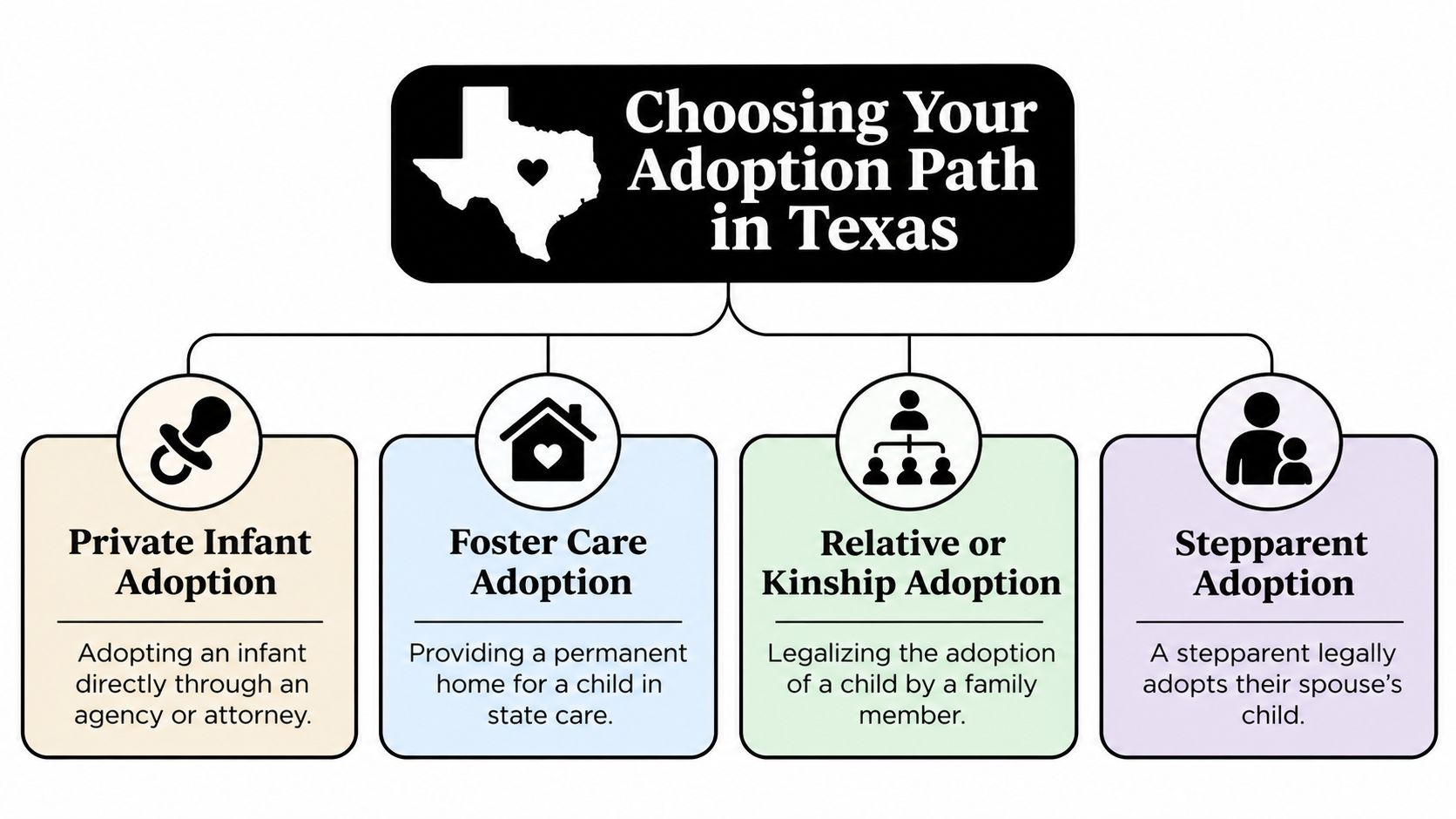
Families comparing options often benefit from reviewing the different types of adoption in Texas before taking action.
Private infant adoption
This path is often a fit for families hoping to adopt a newborn or infant through a licensed agency or attorney-guided private process. It usually involves matching, consent from the birth parents, termination of parental rights, placement, and later finalization in court.
Emotional questions often matter just as much as legal ones. Are you open to ongoing contact with birth parents? Do you want a process where the expectant mother may choose the adoptive family? Those are personal decisions, and they shape the experience.
Foster care adoption
This route is often chosen by families open to adopting a child from state care, including older children or sibling groups. The emotional journey can be different. Some children have experienced trauma, disruption, or uncertainty before adoption becomes possible.
A key point many families miss is this: foster care adoption usually begins through DFPS information and training channels, while private adoption does not. That distinction matters right away.
Relative or kinship adoption
Kinship adoption often grows out of a family crisis or a long period of informal caregiving. Grandparents, aunts, uncles, or other relatives may already be handling school pickups, doctor visits, and day-to-day parenting before they begin the legal process.
In these cases, the legal question is often less about “Should we parent this child?” and more about “How do we secure this child's future?”
Stepparent adoption
For many blended families, adoption is about making family life match legal reality. Stepparent Adoption in Texas addresses the most common Texas adoption and how it works.
A stepparent may be the person attending school events, helping with homework, and providing daily care. Adoption can formalize that bond, but the rights of the other biological parent usually still have to be addressed.
A good path feels right both legally and emotionally. The fastest-looking option isn't always the best fit for the child or the adults involved.
Fulfilling Eligibility and Legal Requirements
After families choose a path, the process becomes more concrete. Texas asks a simple question before anything else: can this home meet a child's day-to-day needs, and can the court verify that safely?
The answer looks a little different depending on the path. Private adoption and foster care adoption can share some screening steps, but families often get tripped up by assuming the legal requirements are identical from the start. They are not always handled through the same channel, and that is why choosing the right path first saves time here.
Texas sets baseline expectations for prospective adoptive parents. As explained in Depelchin's Texas adoption requirements summary, adoptive parents must generally be at least 21, show financial stability, complete a home study, pass criminal and child abuse background checks, and participate in required training. That same source also explains an important home limit for some agency processes: no more than six children may live in the home, including biological children and children receiving daycare services.
A home study often sounds more intimidating than it is. It works like a careful safety review, combined with a conversation about family life. The reviewer is not looking for a perfect house or perfect parents. The goal is to see whether the home is safe, stable, and ready for a child.
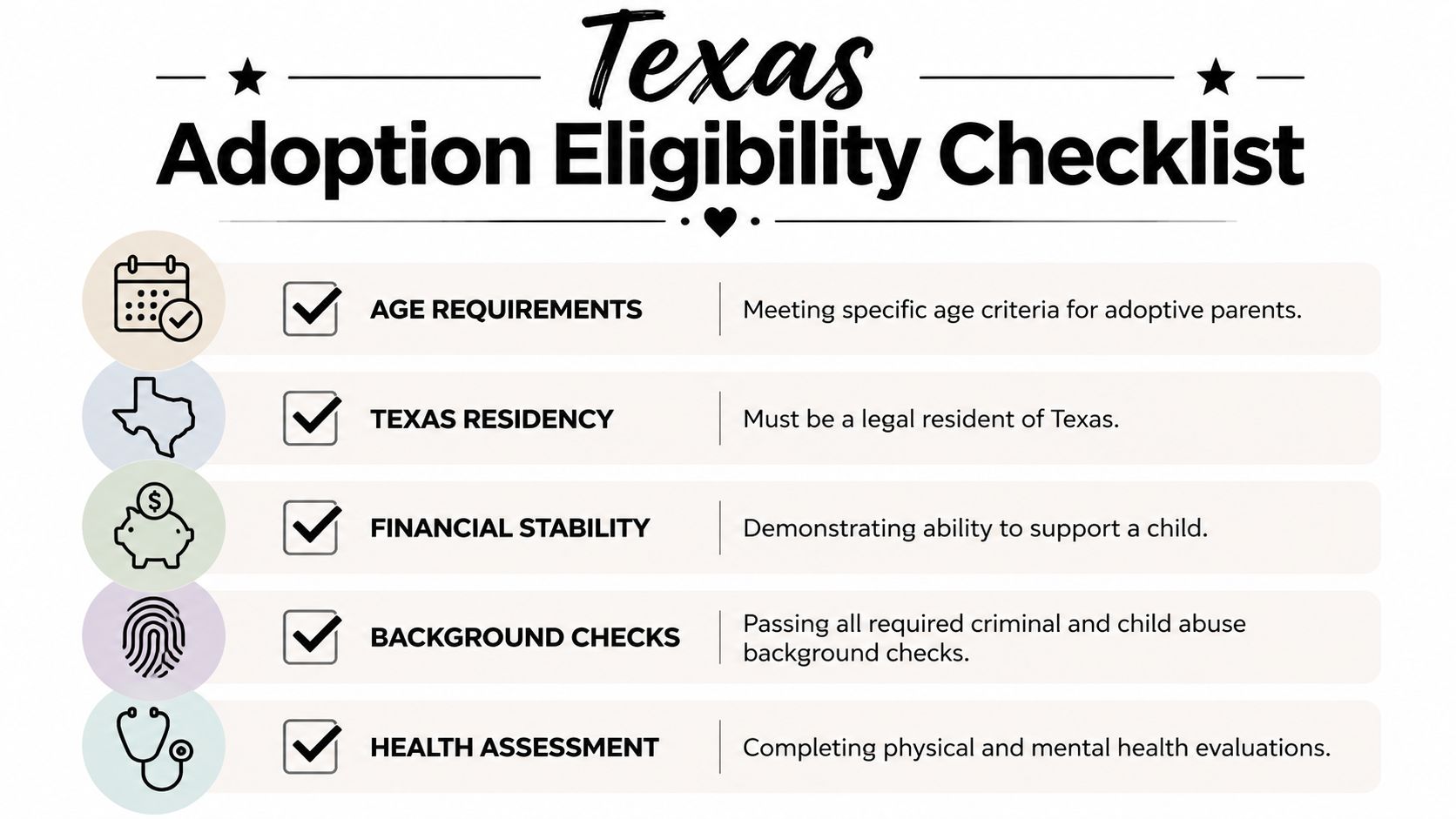
What families usually need to show
Families are usually asked to show several kinds of readiness at once.
- Adult eligibility. Texas generally expects adoptive parents to be mature adults who can provide safe, consistent care.
- Financial stability. The standard is stability, not wealth. Courts and agencies want to see that ordinary living expenses can be met.
- A suitable home. The home study examines living conditions, sleeping arrangements, and overall safety.
- Background clearance. Adults in the household should expect criminal history and abuse registry screening.
- Willingness to complete training. This matters in many cases, especially when a child may have experienced trauma, loss, or disruption.
What Texas law requires in plain English
Texas Family Code Chapter 162 lays out much of the legal framework for adoption. In plain English, the law addresses who may adopt, what consents are required, when the court may grant the adoption, and what supporting reports must be filed.
One rule that often surprises hopeful parents applies to newborn adoptions. A birth mother cannot sign an affidavit of relinquishment until at least 48 hours after the child is born under Texas law. That waiting period gives space for a decision made during an emotional and physically demanding time.
Special rules families sometimes overlook
Some requirements depend on the child's age or the family relationship.
- Children age 12 or older. A child who is 12 or older must usually consent to the adoption in writing unless the court waives that requirement in the child's best interest, under Texas Family Code Chapter 162.
- Health history paperwork. Unless the adoptive parent is a grandparent, aunt, uncle, or stepparent, the court generally requires a Health, Social, Educational, and Genetic History report under that same statute.
- Relative and stepparent cases. Some study requirements or filings may be reduced or handled differently because the child is already living within an established family relationship.
One practical tip helps almost every family. Start gathering records early. Identification, marriage or divorce records if applicable, proof of income, medical information, and any prior court orders are much easier to collect before a deadline is attached to them.
Partnering with Agencies or Attorneys and Preparing Documents
Many Texas families lose time at the very beginning because they contact the wrong place. If you are pursuing private adoption, the first step is usually not a state foster care information meeting. Verified guidance from the Texas DFPS adoption FAQ makes that distinction important. Foster-to-adopt applicants are directed into DFPS information channels, while private adoption families generally need to contact a licensed child-placing agency or an attorney instead.

If you're trying to decide whether legal counsel would help in your situation, it can be useful to review what a Texas adoption attorney typically handles in private, relative, and contested adoption matters.
Who to contact first
Private adoptions often begin with one of these professionals:
- A licensed child-placing agency that handles screening, education, matching, and placement support.
- An adoption attorney who manages legal filings, consent issues, termination of rights, and court proceedings.
- Both, in cases where one professional helps with placement and another handles the legal side.
The Law Office of Bryan Fagan, PLLC is one example of a Texas family law practice that handles adoption and guardianship matters across multiple adoption types.
Questions worth asking before you hire anyone
Not every family needs the same kind of help. Ask direct questions.
- What adoption types do you handle most often? A stepparent adoption and a private infant adoption don't involve the same workflow.
- Who prepares the court filings? Families should know whether the agency, the attorney, or both handle key documents.
- How do you coordinate the home study and post-placement process? Delays often happen when no one is clearly managing deadlines.
- What happens if a consent or termination issue becomes contested? This matters more than many people realize.
The documents that often matter most
Texas courts care about complete filings. The paperwork depends on the adoption type, but families often gather personal identification records, financial records, background check forms, and case-specific affidavits.
Under the Texas Children's Commission bench book summary of Family Code §162.003, a pre-adoptive social study and a post-placement social study must be completed by a licensed provider before an adoption is granted, unless the adoptive parent is a stepparent, grandparent, aunt, or uncle.
For many families, organizing forms into one digital packet makes communication easier. If you're combining scans from different sources into one file for review, a simple tool like Merge PDF can help you keep documents together before sending them to a professional.
A short explainer may also help if you want to hear common document issues discussed in a more conversational format.
A common paperwork mistake
Consider a couple like Sarah and Miguel. They know they want private adoption, so they contact a professional and start quickly. They complete many of the obvious tasks, but one affidavit is left out when the petition is prepared. Suddenly, what felt like forward momentum turns into waiting, corrections, and another round of review.
That kind of problem is avoidable. Verified legal guidance from this Texas adoption procedure discussion notes that adoption requires a two-step legal approach. Prior parental rights must be terminated first, and then the Petition for Adoption is filed. The same source explains that skipping the termination step, or filing an incomplete petition without required affidavits such as the Affidavit of Relinquishment or UCCJA affidavit, can lead to dismissal. It also states that in stepparent cases, failure to document a waiver of the six-month requirement when one is sought is a major cause of filing delays.
Missing paperwork doesn't just slow the case. It can force a family to start over on documents the court needed from day one.
Navigating Timeline Costs and Avoiding Pitfalls
Timelines matter because adoption is emotional work. Waiting is easier when you know what the court is looking for and which delays are preventable.
One rule applies to most Texas adoption cases after placement. Under Texas adoption finalization guidance, a child must live with the adoptive parents for a minimum of six months before finalization, and five post-placement visits are required before the final hearing. That same source explains that in cross-state adoptions, families may need to remain in the state for 7 to 10 business days while ICPC paperwork is cleared. It also notes that a child over 12 years old must consent before the adoption proceeds.
Timeline and cost comparison by adoption type
Because verified cost figures were not provided here, the cost column stays qualitative.
| Adoption Type | Timeline | Cost Range |
|---|---|---|
| Private infant adoption | Varies by match, consent, termination, placement, and court scheduling. Finalization cannot occur until the child has been in the adoptive home for at least six months in cases where that rule applies. | Varies widely depending on agency, legal, and case-specific needs |
| Foster care adoption | Varies based on the child's legal status, training, placement history, and court process | Often differs from private adoption and depends on case circumstances |
| Relative or kinship adoption | May move more directly when the child is already living with the caregiver, but legal status and parental rights issues can still affect timing | Varies based on court filings, legal help, and required studies |
| Stepparent adoption | May be more streamlined than other adoption types, but the other biological parent's rights still usually must be addressed | Usually case-specific and dependent on legal complexity |
Pitfalls that cause trouble
Some mistakes are legal. Others are practical.
- Starting in the wrong system. Families pursuing private adoption sometimes follow foster care instructions and lose momentum before they speak to the right professional.
- Ignoring termination issues. An adoption can't create a new legal parent-child relationship if old parental rights haven't been properly handled.
- Underestimating post-placement requirements. Families often focus on placement and forget that the court still expects documented follow-up before finalization.
- Treating every adoption like every other adoption. Relative, stepparent, and private infant cases may look similar emotionally, but the legal steps can be very different.
How to stay on track
A steady approach usually works best.
Keep one checklist for legal tasks and a separate checklist for family readiness. The court reviews documents, but your child will live the daily reality.
Try these habits:
- Choose the right starting point based on your adoption path.
- Ask for a document list in writing so nothing gets overlooked.
- Track deadlines and appointments for studies, visits, and court filings.
- Prepare for waiting periods emotionally as well as legally.
Conclusion and Next Steps
Starting adoption in Texas gets much easier once you separate the paths instead of treating adoption like one checklist. Private adoption and foster care adoption may lead to the same goal, but they begin in different places, follow different procedures, and usually call for different early decisions. That distinction helps families avoid a frustrating detour and take the right first step sooner.
A good closing question is simple: what does your family need to do first, not eventually? For one family, that may mean confirming whether their case is private, foster-related, relative, or stepparent adoption. For another, it may mean organizing documents and writing down legal questions before speaking with a professional. Adoption works a lot like building a road map before a long trip. The destination matters, but the route you choose at the beginning affects everything that follows.
Practical preparation still has a place in that process. As families get ready for the day-to-day realities of welcoming a child, some enjoy browsing a thoughtful guide for new parents' gifts for ideas that support life after placement.
While practical preparations are important, legal questions often need answers suited to your family's facts. If you want legal guidance specific to your situation, a confidential consultation with Law Office of Bryan Fagan, PLLC can help you sort out your adoption path, understand the filings your case may require, and take your next step with more confidence.

