 Skip to content
Adopting an adult in Texas is a beautiful and often simple legal process designed to formalize a lifelong parent-child bond. It’s for families where the relationship already exists in every way that matters—emotionally, practically, and spiritually. All that’s missing is the legal paperwork to make it official.
The process is built on mutual agreement: the adopting adult and the adult being adopted both consent, sign a petition, and file it with the court. With these steps, the law finally catches up to what your hearts have known for years, securing your family’s future and providing profound peace of mind.
Formalizing a Lifelong Bond Through Adult Adoption
The decision to adopt an adult is a public acknowledgment of a bond that has been growing for years, sometimes decades. It’s for families who already see each other as parent and child and simply want the law to recognize that simple truth. You aren't creating a new family; you're giving legal weight and a proper name to the one that love and time have already built.
This is a common path for stepparents who’ve been a constant source of guidance and love since childhood. It’s also for former foster parents or other caregivers whose connection with a young person grew into a permanent, parental relationship that outlasted any official oversight.
In Texas, the process is streamlined to honor these established relationships. Unlike child adoptions, which focus on creating a safe and stable home for a minor, adult adoption recognizes the stability that’s already there. The legal hurdles are minimal because the emotional foundation has been solid for years, and the primary goal is to uphold the best interests of the family unit.
Why Families Choose This Path
The reasons for pursuing an adult adoption are as personal as the families themselves, but they almost always come down to a need for emotional security and legal clarity. Making the relationship official provides a profound sense of peace for everyone involved.
Here are a few of the most common motivations we see:
- Emotional Affirmation: It’s a powerful, public declaration of your family bond. For an adult who was raised by a stepparent, it offers a deep sense of belonging and validates a relationship that was parental in every way but name.
- Legal Security: An adoption decree cuts through a lot of legal red tape. It automatically establishes inheritance rights, ensuring the adopted adult is treated the same as a biological child in an estate plan, even without a will.
- Practical Benefits: This legal status is also crucial for things like having medical decision-making authority, securing hospital visitation rights, and sometimes even adding the adopted adult to a family health insurance plan.
A Real-Life Scenario: We often work with families where a stepfather, for example, raised his stepdaughter from a very young age. Even though her biological father was never in the picture, the legal ties were still there. As an adult, the stepdaughter and her stepfather chose to pursue adoption to finally make their true parent-child relationship official, giving them both the legal protection and emotional closure they deserved.
At its core, adult adoption is a celebration of family. It’s a way to make sure the love and commitment you’ve shared for a lifetime are formally recognized and respected. To learn more about the specifics, you can dig deeper into adopting adults in Texas and the why, when, and how. This final legal step ensures your family's story is complete, secure, and officially recognized.
Breaking Down the Texas Adult Adoption Process
The idea of navigating a legal process can sound intimidating, but adult adoption in Texas is surprisingly straightforward. Since it’s all based on mutual agreement, it’s much simpler than a child adoption. You're not trying to prove a bond exists; you're just asking the law to formally recognize one that's already there.
We'll walk through everything from the first piece of paperwork to the final court hearing that makes it all official. Think of it less as a legal hurdle and more as the final step in cementing a lifelong family connection.
This graphic really captures the heart of the process—it’s about moving from an emotional bond to a legally secure family.
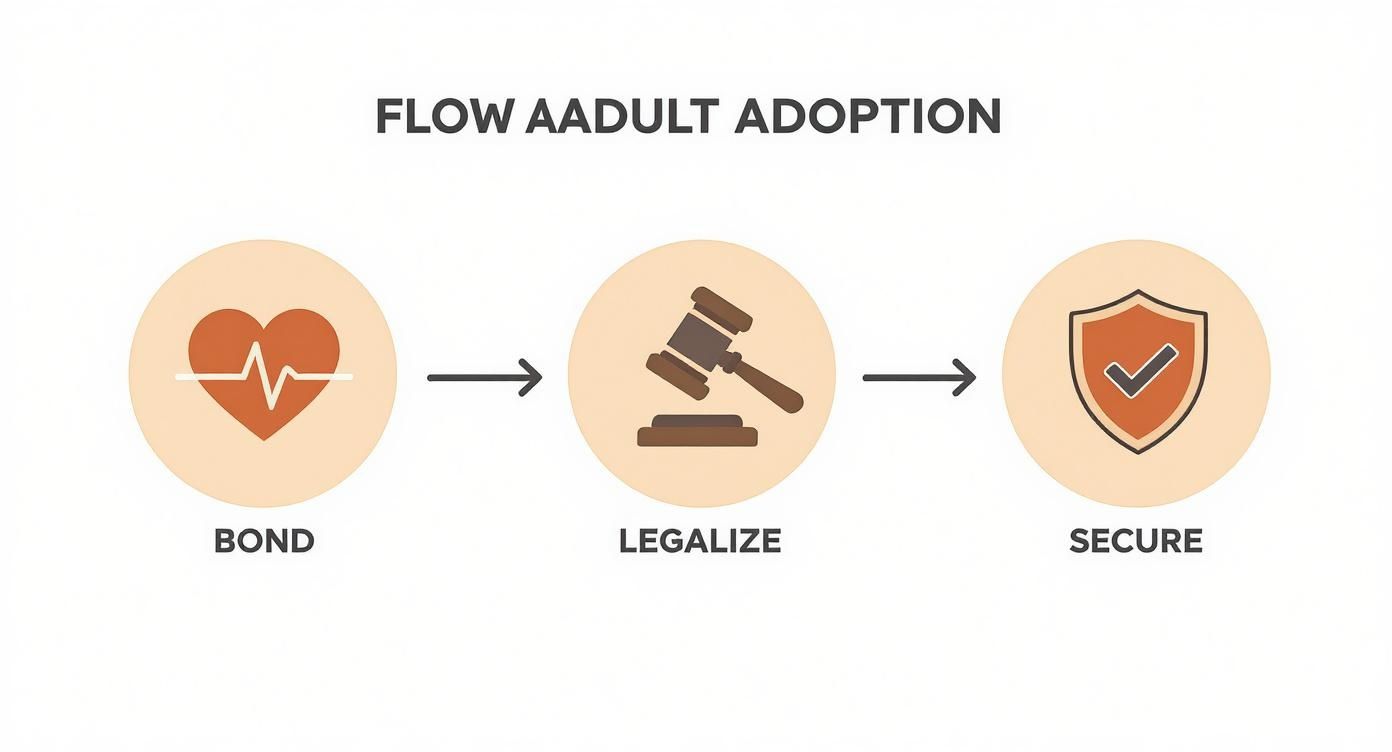
As you can see, the journey is all about formalizing the personal relationship you already have, giving your family lasting security for the future.
Step 1: Preparing the Initial Paperwork
Your first move is to draft a legal document called the Original Petition to Adopt an Adult. This is your formal request to the court, and it tells the judge who you are, who you want to adopt, and the story of your relationship in a legal format.
The petition needs to include key details like:
- The full names and addresses for both the person adopting and the adult being adopted.
- A clear statement confirming the person being adopted is an adult.
- A short explanation of your relationship and the reasons behind the adoption.
This document is the foundation of your entire case, so getting every detail right from the start is crucial for a smooth process.
Step 2: The Importance of Written Consent
Here’s the single most important piece of the puzzle: the written consent of the adult being adopted. This isn't just a casual agreement; it must be a signed, notarized statement showing they are entering into this adoption voluntarily and enthusiastically.
In the eyes of the Texas Family Code, this consent is everything. It proves to the court that this isn't a one-sided decision but a mutual choice by two adults to create a legal parent-child relationship.
Without this formal consent document filed alongside your petition, the adoption simply cannot move forward. It highlights just how much the process centers on personal choice.
Step 3: Filing the Petition and What Happens Next
With the completed petition and signed consent form in hand, you’ll file them with the district court. You can file in the county where either you or the adult adoptee lives. Once filed, a court clerk will review everything to make sure it meets all the legal requirements.
Here’s a major difference from child adoption: there is no home study and no lengthy, invasive investigation. The court’s primary job is to verify that the consent is legitimate and the paperwork is correct. This is a huge reason the timeline is so much shorter. For a deeper dive into what to expect, check out our guide on how long adult adoption takes in Texas.
It's also interesting to realize just how unique this process is. Adult adoptions are so uncommon that they often represent less than 1% of all adoption cases in the U.S. and aren't even tracked separately in many national statistics. While tens of thousands of children are adopted annually, the rarity of adult adoption shows how personal and specific the need for it is. You can discover more insights about national adoption statistics to see just how different the legal frameworks are.
Step 4: The Final Adoption Hearing
The last step is the court hearing, which is usually a simple and often emotional occasion. You and the adult you're adopting will appear before the judge, who will ask a few straightforward questions to confirm everyone is on the same page.
For instance, the judge might ask the adoptee something like, "Do you understand that this will legally make you the child of this person for all purposes, including inheritance rights?"
Once the judge is satisfied that the consent was given freely and both parties understand the outcome, they will sign the Final Decree of Adoption. That's it. The order makes the adoption official, creating a brand-new legal parent-child relationship. At that moment, you’ve officially created your legally recognized family. It's time to celebrate.
Who Is Eligible for Adult Adoption in Texas
When families start exploring adult adoption, one of the first questions is always about who qualifies. The great news is that Texas law keeps the requirements refreshingly simple and clear. Unlike the often complex rules for adopting a child, the entire process for adult adoption hinges on mutual consent between two capable adults.
The legal foundation for this is found in the Texas Family Code, specifically Chapter 162. The law is straightforward: any adult can petition a court in Texas to adopt another adult. There are no tricky requirements based on age differences, marital status, or income levels. It all comes down to one thing: the adult being adopted must give their full, willing, and written consent.
The Two Core Requirements
At its heart, eligibility for adult adoption in Texas boils down to just two people: the petitioner (the person doing the adopting) and the adoptee (the person being adopted). Both just need to meet some very direct criteria.
The Adopting Adult (Petitioner) simply needs to be a legal adult. We've seen this process used by all kinds of people who have become family over time, such as:
- A stepparent who has been a parental figure for decades.
- A former foster parent who maintained a lifelong bond.
- An aunt, uncle, or even an older sibling who stepped into a parental role.
- A long-term mentor or caregiver who is family in every way that matters.
The Adult Being Adopted (Adoptee) must also be a legal adult. The only thing required of them is to provide clear, unequivocal consent to the adoption. This signed consent is the legal backbone of the whole process, showing the court that this is a desired and mutual decision.
Understanding Consent and Its Legal Effects
When we talk about consent in this context, it’s more than just a verbal "yes." The adoptee must sign a formal legal document, which is typically notarized, stating they fully understand what the adoption means and that they willingly agree to it. Because clear identity is so crucial for everyone involved, sometimes an Identity Affidavit might be needed to formally verify who everyone is.
Once the judge finalizes the adoption, a brand-new, legally binding parent-child relationship is created. This has some profound and immediate effects:
- Inheritance Rights: The adopted adult now has the same inheritance rights as a biological child. This means they can inherit from their new adoptive parent(s), even if there isn't a will.
- Termination of Prior Ties: The adoption legally severs the relationship with the adoptee's former legal parents. A major consequence of this is that inheritance rights from the biological family are cut off.
- Name Change: The adoptee gets the option to change their last name to match their new adoptive parent's name.
It's important to remember that while legal ties are severed, personal relationships are not. An adopted adult can absolutely still maintain a personal connection with their biological family if they want to. The law only changes the legal and financial relationships.
For a deeper dive into the nuts and bolts, you can learn more about the specific legal requirements and documentation for adult adoption in Texas in our detailed guide.
Adult Adoption vs. Guardianship: A Key Distinction
It's common for families to confuse adult adoption with establishing a guardianship. While both are legal tools, they serve completely different purposes. Understanding this distinction is key to choosing the correct path for your family.
| Feature | Adult Adoption | Guardianship |
|---|---|---|
| Purpose | To create a legal parent-child relationship and formalize an emotional bond. | To grant legal authority to make decisions for an incapacitated adult. |
| Consent | Requires the full and written consent of the adult being adopted. | Established by a court when an adult is found to be legally incapacitated and unable to consent. |
| Permanence | Permanent and creates a lifelong legal family relationship. | Can be temporary or permanent, but can be modified or terminated by the court. |
| Key Outcome | Inheritance rights are created; a new birth certificate can be issued. | The guardian manages personal, financial, or medical affairs; does not alter family relationships. |
Ultimately, eligibility in Texas is designed to be inclusive, focusing on the loving, established relationships that already exist. If you and the adult you wish to adopt are on the same page, the path is wide open to making your family bond official.
The Real-World Benefits of Adopting an Adult
The legal paperwork and court filings are just the mechanics. The real heart of adult adoption is the profound sense of peace and security it brings to a family. This isn't just about changing a name on a document; it's about the law finally catching up to a bond that has been nurtured for years.
Imagine the relief of a young adult who aged out of foster care, finally gaining a legal, permanent family. Think of the quiet joy a stepparent feels when they are officially recognized as the parent they have always been. These are the moments that truly matter—the real "why" behind this unique legal journey.

Securing Your Family's Future
While the emotional validation is priceless, the practical advantages of an adult adoption are just as crucial. Taking this one legal step can prevent countless future complications, giving your family a clear and secure foundation to stand on.
This legal recognition acts as a shield, ensuring your relationship is respected in situations where it matters most. For many families we've worked with, this practical security is just as important as the emotional affirmation.
Here are some of the most powerful benefits:
- Simplified Estate Planning: An adult adoption creates automatic inheritance rights. Legally, the adopted adult is treated the same as a biological child, meaning they can inherit property and assets directly, even without a will. This simple fact can prevent devastating legal challenges from other relatives down the road.
- Critical Healthcare Rights: In a medical crisis, an adoption decree gives you the clear legal authority to make critical healthcare decisions and guarantees hospital visitation rights. It cuts through any red tape or ambiguity, allowing you to be there for your loved one without question.
- Access to Family Benefits: In certain situations, a legal adoption may qualify the adoptee to be added to family health insurance plans or receive other employment-related benefits extended to an employee's children.
Adopting an adult is a powerful act of love that provides a legal framework for a relationship that has already been built. It’s the final piece of the puzzle, ensuring that the law sees your family exactly as you see it yourselves.
A Path to Permanence for Former Foster Youth
The impact of adult adoption is especially powerful for young adults who aged out of the foster care system. While many find permanent homes, thousands enter adulthood without a legal family to call their own. Adult adoption can provide the legal and emotional anchor they've always needed. It formalizes a bond with a caregiver that often lasted long after the system's involvement ended, offering a true sense of belonging and family unity.
The Emotional Cornerstone of Adoption
At the end of the day, the most significant benefit is the emotional one. It's the peace of mind that comes from knowing your family is legally whole and protected. For a stepparent, it’s the official validation of decades of love and support. For a former foster child, it’s the certainty of finally having a forever family.
This process is a celebration. It solidifies the love, commitment, and history you already share, making an official declaration that says, "We are family, now and always."
How a Family Lawyer Can Guide Your Adoption
As you prepare to take this incredible step, having the right legal support can make all the difference. While adult adoption in Texas is more straightforward than child adoption, an experienced family law attorney ensures every detail is handled correctly. Their guidance helps you sidestep potential delays, reduces stress, and lets you focus on what really matters—celebrating your family's new chapter.
Think of an attorney as your compassionate guide, transforming your heartfelt intention into a legally solid reality. They are your advocate, making sure the path to finalization is as smooth and joyful as possible.

Ensuring Accuracy and Preventing Delays
The foundation of any successful adult adoption is getting the paperwork right. A skilled attorney will meticulously prepare your Petition to Adopt an Adult and the all-important Consent to Adoption, ensuring they meet every requirement of the Texas Family Code. This isn't just about filling in blanks; it's about precision.
Even a small error or a missing piece of information can cause a judge to reject the filing, sending you back to square one. A lawyer's expertise is your best defense against these frustrating setbacks. They know exactly what the court is looking for and how to frame your family's story in a legally compelling way.
Confident Representation in Court
Even though the final hearing for an adult adoption is usually a short and happy event, standing before a judge can feel intimidating. Your attorney will prepare you for what to expect and will be right there beside you in the courtroom, speaking on your behalf.
Here's what they handle:
- All communication with the court clerk and the judge's office.
- Presenting your case clearly and professionally to the judge.
- Answering any legal questions the judge might have about your petition.
This support brings an immense sense of peace of mind. It allows you to be fully present and simply soak in the moment, knowing the legal details are in expert hands.
An experienced family lawyer does more than file papers; they provide reassurance. They anticipate the court's expectations and handle the procedural formalities so you can focus entirely on the personal significance of the day.
Navigating the Final Steps with Ease
Once the judge signs the Final Decree of Adoption, a few crucial administrative tasks remain. Your attorney will ensure these final details are handled correctly, cementing the legal transition.
This includes obtaining certified copies of the adoption decree, which you'll need for various official purposes. If a name change was part of the adoption, your lawyer will guide you through updating the adoptee's birth certificate and other vital records, like their Social Security card and driver's license.
Having a legal professional manage these final steps ensures that every part of the adoption is properly recorded, securing the legal rights and benefits you set out to achieve from the very beginning.
Common Questions About Adopting an Adult in Texas
The idea of adopting an adult is still unique, so it’s natural to have questions about how it all works. We hear from families all the time who are curious about the specifics. Here are some clear, plain-English answers to the questions that come up most often.
Our goal is to demystify the process and give you the confidence you need to take the next step in formalizing your family bond.
Is a Home Study Required for an Adult Adoption in Texas?
No, a home study is not required for adult adoptions in Texas. This is one of the biggest and most welcome differences between adopting an adult versus a child.
The law operates on a simple principle: an adult is fully capable of making their own life choices and consenting to the adoption. The court's focus is entirely on the mutual agreement between the two of you, not on investigating your living environment. This is a major reason why the process is so much faster and less invasive.
Can We Change the Adopted Adult's Last Name?
Yes, absolutely. The adult being adopted can choose to legally change their last name to match the adoptive parent’s. This is a very common part of the process and serves as a powerful symbol of the new, official family unit.
The request for a name change is included in the initial adoption petition filed with the court. When the judge signs the Final Decree of Adoption, the name change becomes official at the same moment.
A name change is a deeply personal choice, but for many, it's the final, affirming step that makes the family connection feel complete. It's a public declaration of a bond that has been private for years.
What Happens to the Adoptee's Legal Ties to Their Biological Parents?
This is a critical point: a final adoption order legally severs the relationship between the adopted adult and their biological or prior legal parents. This has significant consequences, especially when it comes to inheritance.
Once the adoption is finalized, the adoptee will no longer have a legal right to inherit from their biological parents' estates if they were to pass away without a will. The new adoptive parent becomes the legal parent for all purposes, including inheritance rights.
It’s important to remember that this legal change doesn't stop anyone from maintaining a personal or social relationship with biological relatives. The court order only impacts the legal ties, not the emotional ones you choose to keep.
How Long Does the Adult Adoption Process Take?
The timeline is usually much faster than a child adoption. Because there's no need for a home study, termination of parental rights proceedings, or extensive background checks, an adult adoption can often be completed in just a few months.
The exact timing can vary based on two main things:
- The local court's docket: How busy the court is will directly affect how quickly you can get a hearing scheduled.
- The efficiency of paperwork: How quickly and accurately the petition and consent forms are prepared and filed makes a big difference.
Working with an experienced attorney can help speed things up, as they ensure all documents are filed correctly the first time, allowing you to move from petition to finalization in a relatively short period.
Does the Adoptee's Spouse Need to Consent?
Yes. If the adult being adopted is married, their spouse must provide written consent for the adoption to proceed.
The law recognizes that creating a new parent-child relationship can impact a marriage, so it requires the spouse’s full agreement. This ensures all relevant parties are on board with the decision and promotes family unity.
Similarly, if the person adopting is married, their spouse must also consent. In many cases, both spouses choose to adopt together, becoming co-parents to the adult adoptee and making the family unit even stronger.
At The Law Office of Bryan Fagan, PLLC, we believe that formalizing your family should be a moment of pure celebration. Our compassionate team is here to provide the knowledgeable legal guidance you need to navigate the adult adoption process with confidence and ease. If you're ready to empower your family by making your lifelong bond official, we gently invite you to schedule a free consultation with us today.

