
Deciding to adopt a child is one of the most profound and exciting moments in a family's journey. But it often comes with a wave of questions and a bit of anxiety about the legal side of things. Our goal with this guide is to give you a clear, compassionate roadmap for how to adopt a child in Texas, turning that uncertainty into confidence.
We'll walk you through everything from the home study to the final day in court, so you know exactly what to expect.
Your Texas Adoption Journey Starts Here
Whether you're a stepparent hoping to make your bond official, a relative stepping up to provide a stable home, or a hopeful parent ready to welcome a child into your life, you're on a meaningful path. You already have the love and commitment. We're here to provide the clarity on the legal steps needed to make it a reality.
The entire Texas adoption process is built around one guiding principle: protecting the best interests of the child. This idea, found throughout the Texas Family Code, shapes every requirement and every hearing. But you don't need a law degree to understand it. Think of this as a conversation, where we break down complex legal language into plain English, empowering you to move forward.
Understanding the Key Milestones
Every adoption is unique, but most follow a similar framework. Knowing these key stages ahead of time can make the whole process feel much more manageable and less intimidating.
- Choosing Your Path: First, you'll decide which type of adoption is the right fit for your family. This could be a private infant adoption, adopting from foster care, a stepparent adoption, or a relative adoption. Each has its own specific process.
- The Home Study: This isn't as intimidating as it sounds. It's a collaborative process where a social worker gets to know you, ensures your home is safe, and helps prepare you for a new child through interviews and background checks.
- Termination of Parental Rights: This is a critical legal step that must be handled with care and precision. It can be a voluntary choice by a birth parent or an involuntary court action needed to protect a child's welfare, as outlined in the Texas Family Code.
- Finalization: This is the day you've been waiting for. It's the final court hearing where a judge signs the Decree of Adoption, legally and officially creating your new family and celebrating this new chapter.
The journey to adopt a child in Texas is not just a legal process; it's a profound commitment to providing a child with a permanent, loving family. Each step is designed to build a secure foundation for that future.
We'll break down each of these stages in more detail, sharing real-world examples to show you what they look like in practice. From a couple navigating a match with a birth mother to grandparents formalizing their role as primary caregivers, we'll cover the scenarios you're likely to encounter.
Let’s start this journey together. If you need personalized advice for your unique situation, we invite you to schedule a free consultation with our compassionate legal team.
Choosing the Right Adoption Path for Your Family
Adoption in Texas isn't a single road—it's a network of different paths, each leading to the same destination: building a family. Your journey is deeply personal, and the route you choose should feel right for your unique circumstances, whether you are a hopeful adoptive parent, a birth parent, or a relative.
Figuring out your options is the first real step. The legal and emotional dynamics vary quite a bit between, say, adopting from foster care versus legally formalizing a bond with a stepchild you've parented for years. Let's walk through the main pathways so you can see which one resonates with you.
Private Infant Adoption
When many people think of adoption, this is the path that comes to mind. Private infant adoption is the process of working with a licensed adoption agency or an attorney to connect with an expectant mother who is making a loving plan for her baby.
At its core, this journey is about relationships. You’ll create a profile that shares your story, and an expectant mother will choose you based on the life she pictures for her child. A huge part of this process is deciding on future contact, often called an open adoption. This can look like anything from exchanging letters and photos to having in-person visits, giving the child a stronger sense of identity as they grow.
Adopting from Foster Care (CPS)
Adopting a child from the Texas Department of Family and Protective Services (DFPS), also known as CPS, is an incredible way to give a permanent, loving home to a child who desperately needs one. These children, from infants to teenagers, entered state care because of abuse or neglect, and they are now legally free for adoption.
While the primary goal of foster care is always reunification with the birth family, that isn't always possible. The result is thousands of children waiting for a forever family. In a recent year, 7,168 children were adopted across Texas, and a huge number of those came from the public foster care system. And it's not just young children; 35.9% of children aged 12 and older who left foster care were adopted, proving there's a real need for families willing to open their hearts to teens.
Adopting from foster care is more than just building a family; it's a profound act of community support that gives a deserving child the stability and love they need to thrive.
Stepparent and Kinship Adoptions
Sometimes, the child you hope to adopt is already a huge part of your life. Stepparent and kinship adoptions are about legally cementing a bond that has long existed in your heart, strengthening family unity.
- Stepparent Adoption: If you're a stepparent, you may have already been raising your stepchild for years. An adoption gives you full legal rights and responsibilities, letting you make medical decisions, enroll them in school, and secure their inheritance rights. It offers powerful security and emotional validation for both the child and your blended family.
- Kinship Adoption: This is when a relative—like a grandparent, aunt, or uncle—steps in to adopt a child in their family. It often happens when the birth parents can no longer provide care. This route allows the child to stay with people they already know and trust, preserving critical family ties while providing legal permanence.
This flowchart breaks down the key stages in a Texas adoption, helping you visualize the journey from your initial decision to the finish line.
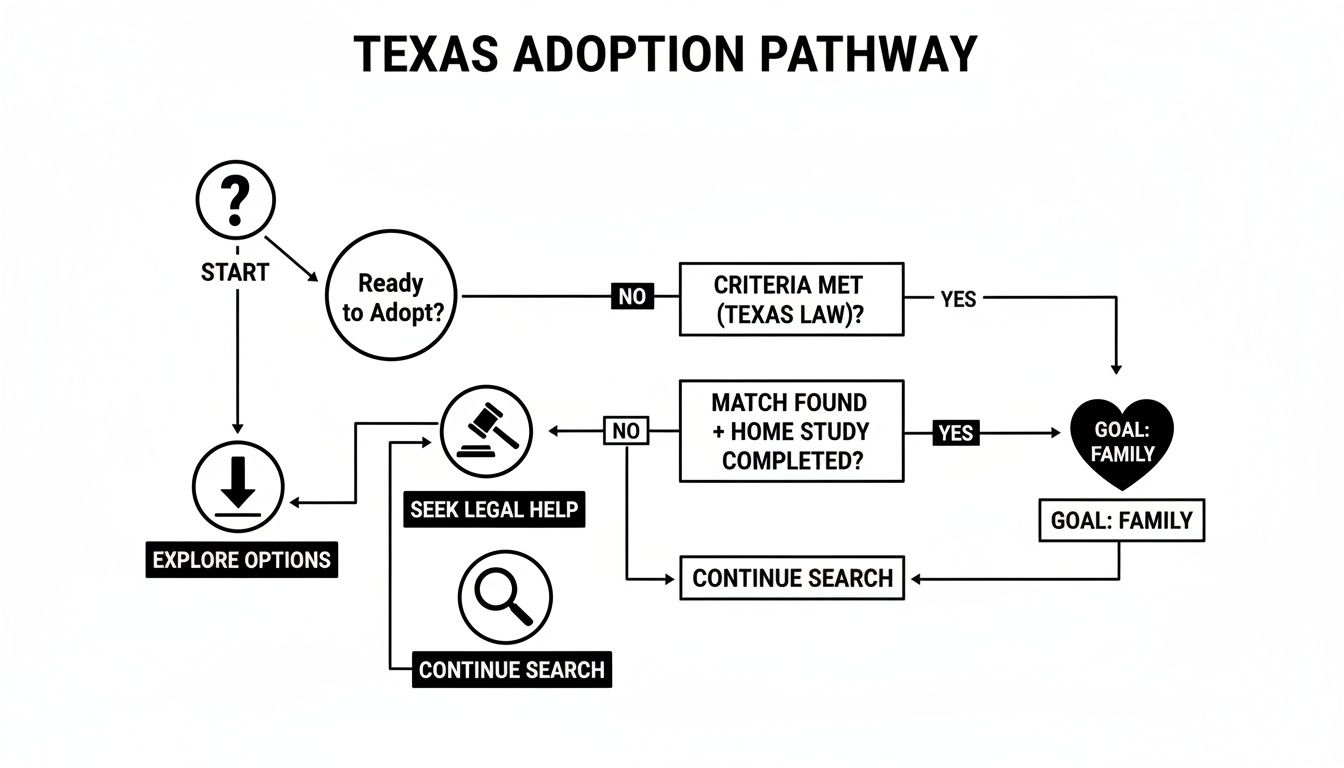
As you can see, while the specific steps might differ, every path involves getting the right legal help to build your family. For a closer look at the nuances of each route, check out our detailed breakdown of adoption types in Texas.
No matter which path you’re drawn to, the guiding principle is always the same: ensuring the "best interest of the child." Each journey requires careful legal navigation, a lot of heart, and a steadfast focus on creating a secure and loving future.
Preparing Your Home and Heart: The Texas Home Study
Let’s be honest—for many hopeful parents, the home study is the part of the adoption process that causes the most anxiety. It’s easy to picture someone judging your home and questioning your every move.
But we want to help you see it differently. The home study isn’t an inspection; it’s a partnership. Think of it as a collaborative process designed to get you and your home ready for this incredible new chapter. The Texas Family Code (specifically Chapter 162) defines its purpose not as a judgment, but as a way to ensure a child will join a safe, stable, and loving environment.

What the Texas Home Study Really Involves
So what actually happens? The home study is a series of conversations and a collection of important documents. Together, they paint a full picture of your life and your readiness to parent. Your social worker isn’t there to catch you slipping up; they’re there to support you and, ultimately, advocate for you.
One thing to know right away: every adult (age 14 and older) living in the home must pass background checks. This is a non-negotiable step designed to protect the child and is a standard part of every Texas adoption.
Here’s a step-by-step breakdown of what you can expect:
- Personal Interviews: These are straightforward, get-to-know-you conversations with your social worker, both individually and as a couple (if applicable). You’ll chat about your own childhood, your relationship, your ideas on parenting, and what led you to adoption.
- Financial Review: You’ll need to show that you can responsibly provide for a child. This usually means sharing pay stubs and tax returns. The goal isn’t to see if you’re wealthy—it’s to confirm you have stable finances to support a family.
- Health Statements: You’ll get a statement from your doctor confirming you’re physically and mentally healthy enough to take on the demands of parenting.
- Reference Letters: You'll ask friends, coworkers, or neighbors to write letters that speak to your character and suitability as a parent.
- Home Visits: Your social worker will visit your home at least once. They are not looking for perfection. They’re simply checking for basic safety measures like smoke detectors, secure storage for chemicals, and a generally safe space for a child to live and play.
The home study is fundamentally about preparation and education. It’s a chance to reflect on your strengths, receive guidance, and figure out where you might need a little extra support.
Navigating the Paperwork and Interviews with Confidence
Gathering all the paperwork can feel like a part-time job. Our best advice? Get organized from day one. Create a dedicated binder or a digital folder to keep everything in one place. For a detailed list of what you'll need, our Adoption Home Study Checklist is an invaluable resource that breaks it all down for you.
For example, one couple we worked with, Maria and David, were incredibly nervous about their small apartment. During the home visit, the social worker wasn't bothered by the size at all. Instead, she offered them practical tips on child-proofing and creating a cozy, dedicated space for the baby. That’s the true spirit of the home study—support and guidance, not judgment.
As you prepare, it can also be incredibly helpful to learn more about a child's emotional needs. Taking some time for understanding attachment theory can give you a head start, especially if you're adopting a child who has faced instability.
Special Training for Foster to Adopt Journeys
If you're planning to adopt from the foster care system, Texas requires you to complete specialized training. This isn't just another box to check; it's an essential toolkit for your journey ahead.
This training, often called Parent-Resource Information Development Education (PRIDE), gives you the tools to parent children who may have experienced trauma. You'll learn about trauma-informed care, managing difficult behaviors, and how to help a child heal and process their past. This education is invaluable, building a foundation of trust and connection with a child who needs it more than anything.
The Legal Heart of Adoption: Terminating Parental Rights
Before any adoption can become legally final in Texas, the parental rights of the birth parents must be addressed. This is the most profound and sensitive part of the entire journey.
This legal step, governed by Chapter 161 of the Texas Family Code, is what allows a child to legally and permanently become part of a new family. It gives the child a clean slate and a secure future, free from any future legal challenges to the adoption.
This critical step happens in one of two ways: either voluntarily or, in more difficult situations, involuntarily.
Voluntary Relinquishment: A Courageous Choice
In many private adoptions, a birth parent makes the incredibly courageous and selfless decision to choose an adoption plan for their child. In Texas, we call this voluntary relinquishment.
Texas law has very specific rules to make sure this decision is made freely and without any pressure. A birth mother cannot sign the final legal document—an affidavit of relinquishment—until at least 48 hours after the child's birth. This mandatory waiting period is a crucial safeguard, giving her time to recover physically and emotionally and be absolutely certain of her decision.
A birth father can sign before the birth, but his affidavit only becomes irrevocable once the baby is born. Once these documents are properly signed, they are powerful legal statements that pave the way for a child to be welcomed into their new adoptive family.
Involuntary Termination: Protecting a Child's Well-being
Sometimes, a court must step in to protect a child's safety when their well-being is at risk. This is known as involuntary termination, and it is a path the courts never take lightly. Severing a parent-child bond against a parent's will has an incredibly high legal bar.
For a judge to terminate a parent’s rights, there must be "clear and convincing evidence" of two things:
- The parent committed an act listed in the Texas Family Code, like abandonment, neglect, endangerment, or failing to support the child.
- Terminating their rights is truly in the best interest of the child.
Imagine a scenario where grandparents have been raising their grandchild for over a year because the parents are struggling with substance abuse and have dropped out of the child’s life. In a case like this, a court might find grounds for involuntary termination based on abandonment and rule that a stable, permanent home with the grandparents is in the child's best interest.
The standard of "clear and convincing evidence" is the highest burden of proof in Texas civil law. It means the evidence must be so strong that it leaves no serious doubt in the judge's mind. This is exactly why having an experienced adoption attorney is so vital.
Navigating the termination process—whether voluntary or involuntary—is the legal core of your adoption. It requires precision, compassion, and a deep understanding of Texas law. You can explore this topic in greater detail by reading our guide on the process for terminating parental rights in Texas. Having an attorney ensures every legal requirement is met, protecting the integrity of your adoption and securing your family’s future.
Finalizing Your Adoption and Celebrating Your New Family
After all the interviews, paperwork, and patient waiting, the moment you’ve been working toward is finally here. The finalization hearing is so much more than a court date—it’s a celebration. This is the day a judge officially and legally recognizes you as a family, marking the start of your new life together.
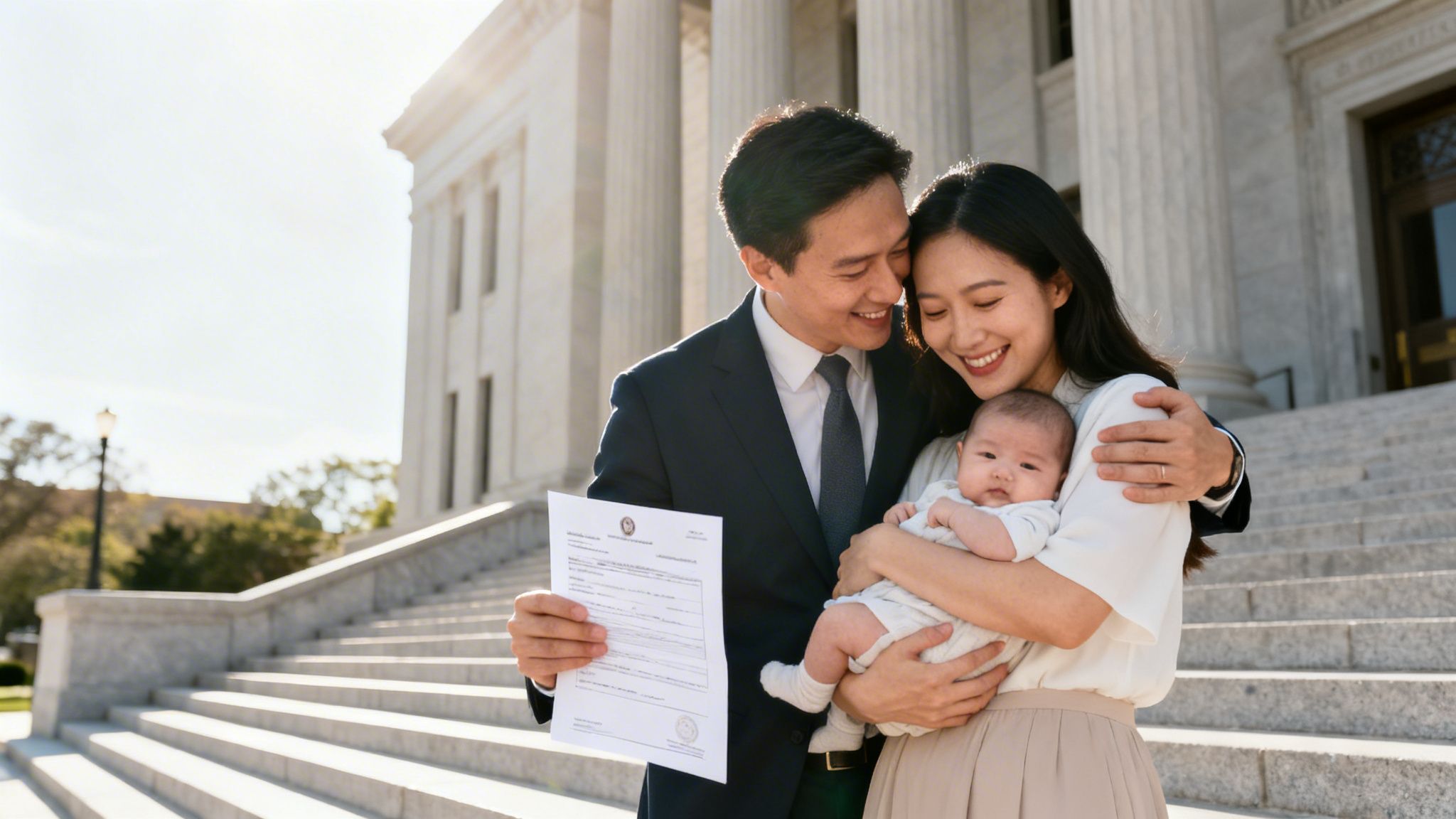
Before this joyful day, there's one last waiting period. In Texas, it’s called the post-placement supervision period, which usually lasts about six months. During this time, the child lives in your home, and a social worker will visit every so often. These are just supportive check-ins to make sure everyone is adjusting well and to offer any resources you might need as you bond.
What Happens on Adoption Day
The finalization hearing is the beautiful finish line of your journey. While it is a legal proceeding, it’s almost always a warm and happy event. We always encourage families to treat it like a special occasion—bring grandparents, close friends, and a camera to capture the memories.
Imagine walking into the courtroom with your child. Your attorney will present the final paperwork to the judge, who reviews your case file one last time. The judge might ask you a few simple questions, confirming your commitment to providing a loving, permanent home. If the child is old enough, the judge may even ask them how they feel about the adoption in a gentle, friendly way.
This hearing is the moment when the law catches up to what your heart has known all along. A judge’s signature transforms your hope into a legal reality, creating a permanent, secure bond for your child.
Once the judge is satisfied that everything is in order and the adoption is in the best interest of the child, they will sign the Final Decree of Adoption. That document is the key—it officially makes the child a member of your family with all the rights and privileges as if they were born to you.
The New Birth Certificate and Beyond
With the signed decree in hand, your attorney will help you with the final piece of the puzzle: getting a new birth certificate. The court sends an order to the Texas Bureau of Vital Statistics, which will create an amended birth certificate listing you as the child's parent(s). It’s a powerful symbol of your new family unit and a critical document for school, medical care, and everything that comes next.
As you start your life as a new family, remember you aren’t alone. This is especially true for families who adopt from foster care, where the need for permanent homes is immense. At the end of a recent fiscal year, 70,418 children were waiting for adoption nationwide. Texas accounted for 14,740 of those children in out-of-home care, with kids of all ages waiting for a family. You can learn more by exploring the latest foster care and adoption statistics.
Navigating how to adopt a child in Texas officially ends on this wonderful day, but it’s just the beginning of your family’s story. There are countless post-adoption resources, from parent support groups to therapy services, ready to help you navigate any challenges and celebrate every milestone.
Your First Step Toward Building Your Family
You’ve learned about the different paths, the legal maze, and the milestones of a Texas adoption. The big question is, what now? Reading and learning is one thing; taking that first real step is another. It's a journey that, while full of details, is really just a series of moves that get you closer to building your family.
Every adoption story is different. Your questions, your worries, and your hopes deserve to be heard by someone who gets it. Whether you're thinking about adopting from foster care, as a stepparent, or through a private agency, having the right guide in your corner makes all the difference.
It's Time to Turn Your Hope into a Plan
The process can feel overwhelming, but it's more than possible. Just look at the numbers—in one recent year, Texas found forever homes for 4,361 children in foster care. While a typical adoption can take 6-12 months or even longer, every day on that timeline is a day closer to your goal. You can see more on Texas adoption trends and outcomes for yourself.
Your desire to provide a loving, permanent home is what truly matters. All the legal steps? That’s just the scaffolding we use to build it.
Getting clear on your specific path is what you need to focus on now. Answering questions like, "What does my timeline actually look like?" or "What are the first three documents I need to find?" is where an experienced guide becomes essential.
The best way to get answers is to talk to someone who understands both the law and the heart behind adoption. A no-obligation, free consultation can give you the specific advice you need to move forward with confidence. Let's talk about your hopes for adoption and how our team at The Law Office of Bryan Fagan, PLLC, can help make them happen.
Ready to talk about your family's future? Schedule a free consultation with our compassionate legal team today. We’re here to help you get started.
Frequently Asked Questions About Texas Adoptions
The adoption journey is an exciting one, but it’s completely normal to have a lot of questions. To give you some clarity, we’ve put together straightforward answers to the questions we hear most from families starting the Texas adoption process.
How Much Does It Cost to Adopt a Child in Texas?
This is one of the first questions on every prospective parent’s mind, and the answer really depends on the path you take. Each type of adoption comes with a different set of costs.
- Adopting from Foster Care (DFPS): This is by far the most affordable route. It’s often free or very low-cost because the state provides financial assistance to help these incredible kids find their forever homes.
- Private Adoptions: These can range from $25,000 to over $50,000. The costs typically cover agency fees, critical legal work, and support for the birth mother.
- Stepparent and Relative Adoptions: These are usually the least expensive, as the costs are mostly for legal fees to handle the necessary paperwork and court filings.
For a much clearer estimate, a personal consultation is the best way to review the specifics of your situation.
How Long Does the Texas Adoption Process Take?
The timeline is another huge unknown for many families, and it really hinges on the type of adoption you’re pursuing. A straightforward stepparent adoption, for example, can often be finalized in about six months if everyone is in agreement.
Private infant adoptions can take anywhere from a few months to a couple of years, largely because the timeline depends on the matching process with a birth mother. For families adopting from the foster care system, the process generally takes between 9 and 18 months from the home study to the final court hearing. Our firm makes it a priority to manage the legal steps efficiently to avoid any unnecessary hold-ups.
Can Single People or LGBTQ+ Couples Adopt in Texas?
Yes, absolutely. Texas law is very clear on this: any single adult and any married couple can petition to adopt a child. There are no state laws that prohibit adoption based on a person's sexual orientation.
The single most important factor in every Texas adoption is what is in the “best interest of the child.” Your ability to provide a safe, stable, and loving home is what matters most.
Our firm is proud to represent all qualified individuals and couples on their journey to build a family, including single parents and members of the LGBTQ+ community.
What if the Birth Father Is Unknown or Uncooperative?
This is a common and understandable concern, and Texas law has a clear process for handling it. The situation may require conducting a diligent search for the father, publishing a legal notice, or using the state's paternity registry to formally notify him of his rights.
If he can't be found or doesn't respond within the legally required timeframe, the court can move forward with terminating his parental rights. This is a crucial step to ensure the adoption is legally secure and can’t be challenged down the road. It’s also one of the key moments where having an experienced adoption attorney is vital to protect your family’s future.
While the adoption process has its share of legal hurdles, at its core, it’s a journey of the heart. Having a compassionate guide to manage the details allows you to focus on what truly matters—preparing to welcome your child home. The experienced team at The Law Office of Bryan Fagan, PLLC is here to provide the clear, supportive legal counsel you need.
Ready to take the next step? Schedule a free, no-obligation consultation with us today.
