
Some families arrive at this question after years of ordinary, beautiful routines. You are the one packing lunches, driving to school, checking homework, calming tears, and showing up for the small moments that make a child feel safe. In every way that matters day to day, you already feel like a parent.
What you want now is for the law to catch up with your life.
That is why so many people ask how long does stepparent adoption take in texas. They are not looking for a cold timeline. They are trying to understand when their family can finally have the legal security that matches the bond they already share.
The answer depends on a few important facts, especially whether the other biological parent agrees to the adoption or whether the court must decide whether to terminate that parent’s rights. Some cases move smoothly. Others take patience, careful preparation, and strong legal guidance.
Your Heart Already Knows You're a Parent
Melissa had been in her stepson’s life long enough that the family stopped using the word “step” at home. She knew which cereal he would eat, which stuffed animal had to be on the bed at night, and how to get a reluctant smile before school on a hard morning.
Her husband never had to explain her role. She was already doing the work of a parent.
What kept lingering in the background was the legal gap. If there were a medical emergency, a school form, or some future question about rights and responsibilities, Melissa wanted certainty. Not for herself alone, but for the child she loved.
That feeling is common in blended families. A stepparent adoption is often not about changing a relationship. It is about protecting one that already exists.

A hopeful stepparent often wonders whether the process will be quick, painful, expensive, or overwhelming. Those worries make sense. Family law can feel intimidating when your heart is fully involved.
Key takeaway: Wanting legal recognition for a relationship that is already real is not selfish. It is one more way of caring for your child’s stability.
Texas law gives families a path forward. It has rules, timelines, and court procedures, but it also has room for the court to focus on what matters most: the best interests of the child.
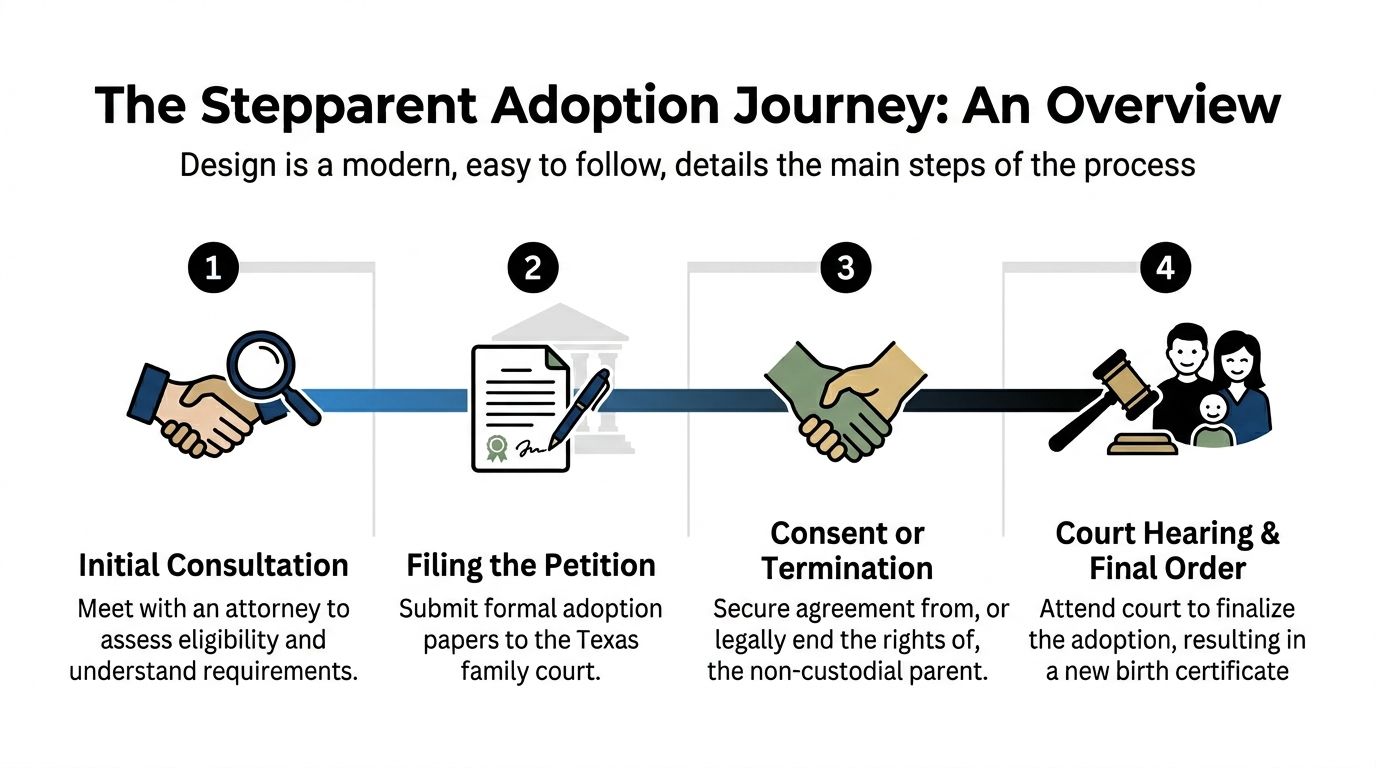
The Stepparent Adoption Journey An Overview
A stepparent adoption is the legal step that turns an existing family bond into a fully recognized parent-child relationship. It is comparable to finishing the last span of a bridge that is already built in every practical way.
Most readers want the short answer first. In Texas, uncontested adoptions typically take 3 to 6 months, while complex cases involving contested termination of parental rights can take one year or longer, according to this discussion of the Texas adoption process for stepparents. That same source explains that the child generally must have lived with the stepparent for at least six months before the adoption can be granted, although a court may waive that requirement if it is in the child’s best interest.
The part that usually controls the timeline
The biggest issue is usually not the petition itself. It is the legal status of the other biological parent.
If that parent agrees and signs the proper paperwork, the path is often more direct. If that parent does not agree, cannot be found, or disputes the case, the court has much more work to do before an adoption can be finalized.
That is why two loving families can start the same month and finish very differently.
The broad stages most families go through
Most stepparent adoption cases include these core steps:
- Initial legal review to confirm eligibility and spot issues early
- Filing the petition with the proper Texas court
- Addressing the other parent’s rights through consent or termination
- Background checks and possible evaluation if the court requires them
- Final hearing where the judge decides whether the adoption is in the child’s best interest
Some families expect a single court date and a quick signature. In reality, adoption is a series of legal checkpoints. Each one helps the court make sure the child’s long-term welfare is protected.
Why county practice matters
Even in a strong case, timing may depend on local scheduling. Some courts hear adoption matters on limited days or have crowded dockets. That does not mean anything is wrong with your case. It often means your family is waiting for the court calendar to catch up.
A family in one county may move quickly to a hearing date. Another family with similar facts may wait longer because that judge handles adoption hearings differently.
Your Step-by-Step Guide Through the Adoption Process
Texas stepparent adoption falls under the adoption rules in Texas Family Code Chapter 162, and the court still expects careful compliance even when the child already lives with you. A broad national comparison places stepparent adoptions in a 3 to 12 month range, and Texas cases often land on the shorter end when consent is available and delays are limited, as explained in this Texas stepparent adoption timeline overview.
Filing the case
The legal process starts when the adopting stepparent files a petition with the court. This filing tells the judge who the parties are, what family relationship already exists, and what order the family is asking the court to sign.
A lot of confusion starts here. People often assume filing the petition means the adoption is almost done. It does not. Filing opens the case. It does not finish it.
For many families, it helps to review practical document requirements before filing. A page like Texas stepparent adoption forms can help you understand the paperwork involved, but court filings still need to match your specific facts.
Consent or termination of the other parent’s rights
This is often the emotional center of the case.
If the noncustodial biological parent agrees, the process may involve a formal written consent or voluntary relinquishment. If that parent does not agree, the court may need to decide whether legal grounds exist to terminate parental rights.
Those are very different paths.
- Voluntary consent: Usually smoother because the court does not need to resolve a fight between adults.
- Contested termination: Often slower because the court must review evidence, ensure notice was proper, and decide whether termination is legally justified and in the child’s best interest.
This is also why people who ask for a simple answer on timing usually get a careful one instead.
Background checks and possible evaluation
Texas courts often require background information, and some courts also require an adoption evaluation or social study. In plain language, that means the court may want a closer look at the home environment, family relationships, and the child’s adjustment.
For a longtime stepparent, that can feel strange. You may think, “We have already been a family for years.” That feeling is understandable. But the court is not questioning your love. It is carrying out its legal duty to verify that adoption is appropriate.
Practical point: A request for an evaluation does not mean the judge is suspicious. It often means the court follows a standard process.
The child’s role in the process
Children are not just bystanders in a stepparent adoption. According to the Texas-specific overview linked above, a child who is 12 or older must consent to the adoption in court.
That requirement surprises many parents. It is not meant to place pressure on the child. It is meant to make sure the child’s own voice is heard in a life-changing decision.
The final hearing
The hearing is often the most joyful part of the case, but families should still prepare for it carefully. The judge reviews the paperwork, confirms legal requirements have been met, and decides whether the adoption serves the child’s best interest.
The adopting stepparent, the child’s parent, and the child if old enough may need to appear. Many families remember this day for years because it turns a lived reality into a legal one.
What Chapters 162 to 166 mean in plain English
Readers sometimes see references to Texas Family Code Chapters 162 through 166 and worry that the process is too technical to understand.
You do not need to memorize chapter numbers. What matters is the substance:
- Chapter 162: Covers adoption procedures and requirements
- Related adoption provisions: Help the court evaluate consent, best interest, and finalization issues
- Court rules and local procedures: Shape how your county handles scheduling and documents
The law provides the framework. Your case facts determine how long the journey feels.
Key Factors That Influence Your Adoption Timeline
Two families can file in the same season and finish months apart. The reason is usually not luck. It is the combination of legal facts, county procedure, and how quickly the required steps come together.
Under Texas Family Code §162.009, the child must live with the stepparent for at least six months before the adoption can be finalized, though a court can waive that requirement. The same source explains that an adoption evaluation can add several weeks and around $1,000 in cost, and that uncontested cases in a county like Harris may average 4 months, while counties requiring evaluations may take 5 to 6 months. That information appears in this discussion of Texas stepchild adoption timing and costs.
Consent changes almost everything
If the other biological parent signs the needed paperwork, the court can focus on completing the remaining legal steps. If that parent refuses, cannot be located, or contests the case, the court must deal with a much more serious legal question before adoption can happen.
That second path often involves more filings, more notice requirements, and sometimes more hearings.
A common misunderstanding is that a parent who has not been involved for a long time automatically “loses rights.” That is not how it works. A court still has to handle parental rights through proper legal procedure.
County practice can speed things up or slow things down
Families often assume Texas adoption timing is the same statewide. It is not.
Some counties move adoption dockets more quickly. Others routinely require evaluations or schedule hearings less often. Court staff, judicial preferences, evaluator availability, and the local calendar all matter.
If a judge hears adoption matters only on certain settings, your case may wait even when your paperwork is ready.
Evaluations and background checks can add real time
A social study or adoption evaluation usually means another layer of scheduling. Someone has to gather records, speak with the family, complete a report, and return it to the court.
Background checks are important for the same reason. The court wants to confirm that the child is entering a stable, safe legal situation.
For a family that is eager to finalize, these steps can feel like delay for the sake of delay. In practice, they are often the court’s way of documenting that the adoption serves the child’s best interest.
Paperwork errors create preventable delays
Missing signatures, outdated orders, incomplete dates, or filing the wrong supporting documents can slow down even a strong case.
That is especially frustrating because those delays are often avoidable. Families may spend emotional energy worrying about big issues when the immediate problem is a technical filing defect.
Tip: The fastest case is not always the one with the simplest emotions. It is often the one with the cleanest paperwork.
Comparison table
| Adoption Stage | Uncontested (with Consent) | Contested (without Consent) |
|---|---|---|
| Starting the case | Usually begins with filing and gathering required documents | Begins the same way, but often with added concern about notice and proof |
| Other parent’s role | Signs consent or relinquishment documents | Refuses, cannot be found, or challenges the case |
| Evaluation issue | May be waived or handled more easily in some counties | More likely to involve added court scrutiny |
| Court involvement | Focused on best interest and final approval | Focused first on whether termination is legally justified |
| Emotional tone | Often cooperative, though still sensitive | Often stressful and uncertain |
| Likely pace | Shorter if records are complete and the court calendar allows | Longer because multiple legal issues must be resolved |
Professional guidance often improves efficiency
A lawyer familiar with local practice can often spot timing problems before they become major setbacks. That may include knowing whether a county commonly requires an evaluation, how to prepare for a waiver request, or how to avoid defects in the filing.
Families who want a clearer sense of evaluation timing often find it helpful to review resources like how long does a home study take before they file.
That kind of preparation does not guarantee speed, but it can reduce unnecessary delay.
Sample Timelines A Tale of Two Adoptions
The easiest way to understand how long does stepparent adoption take in texas is to follow two families through it. Both love their children. Both want permanence. Their timelines look very different.
The Jacksons and the smooth path
The Jackson family has already been living as a stable household. The child’s other biological parent agrees that adoption is appropriate and signs the needed paperwork without a fight.
In a case like this, the process can feel steady instead of chaotic.
Early stage
The family gathers records, meets with counsel, and files the case. Because the paperwork is complete and consent is available, the court does not have to spend months sorting out a dispute about parental rights.
Middle stage
Background information is handled, the family responds promptly to court requirements, and no one has to chase missing documents. The legal process is still formal, but the emotional tone is calmer.
Final stage
Once the required steps are complete and the hearing is scheduled, the family appears in court together. The judge asks a few questions, confirms the adoption is in the child’s best interest, and signs the order.
This kind of uncontested case is often what people imagine when they first begin. It is not effortless, but it is more direct.

The child may experience the hearing as a celebration. For the adults, it often feels like relief mixed with gratitude. The law has finally caught up to the family they already knew they were.
The Garcias and the winding road
The Garcia family starts with the same hope. The difference is that the child’s other biological parent does not consent. At first, no one is even sure where that parent is living.
That changes the whole shape of the case.
Early stage
The family can still file, but now attention turns to proper notice, search efforts, and the legal requirements involved in addressing that parent’s rights. There is more uncertainty from the start.
Middle stage
Instead of moving directly toward finalization, the case may involve efforts to locate the parent, additional filings, and possible hearings about whether termination is legally justified. Even a strong case can slow down here because the court must protect due process.
Later stage
If the court requires more evidence, or if the other parent appears and contests the case, the timeline stretches. The family may feel stuck, even though real progress is happening in the background.
Important reminder: A slower case does not mean your family is doing something wrong. It often means the court is handling a harder legal question.
What these stories show
The Jacksons move through a cooperative legal process. The Garcias move through a disputed one. The love inside both homes may be equally strong, but the court’s job is very different in each situation.
That is why online answers can feel frustrating. “Three to six months” may be true for one family and completely unrealistic for another.
A month-by-month feel without false precision
For the Jacksons, the months feel like document gathering, filing, routine court requirements, and then a hearing date.
For the Garcias, the months feel more like waiting, proving, responding, and returning to court as the case develops.
One family counts down to a celebration. The other learns patience while the court works through a legal conflict that must be resolved carefully.
Why narrative examples matter
Readers often feel calmer when they see that timeline differences are not random. They come from identifiable legal issues.
If your situation resembles the Jacksons, you may be able to plan with more confidence. If it resembles the Garcias, you may need to prepare emotionally for a longer road while staying focused on the same goal: legal security for your child.
Practical Tips for a Smoother and Faster Adoption
Good preparation cannot control every part of the court process, but it can remove many of the delays families create by accident.

Gather your core records early
Do not wait until after filing to hunt for basic paperwork.
Try to collect items such as:
- Marriage records: Proof that you are legally married to the child’s parent
- Birth information: The child’s birth certificate and any prior orders involving custody or support
- Residency records: Documents showing the child lives in the home
- Identity documents: Records the court or evaluator may request later
When families scramble for documents at the last minute, the case often slows down for avoidable reasons.
Handle the consent issue carefully
If it is safe and appropriate, respectful communication with the other biological parent can sometimes reduce conflict before the case escalates.
That does not mean informal promises are enough. The court needs proper legal paperwork. But a calm, well-handled conversation can shape whether the process starts cooperatively or defensively.
Budget for the process, not just the filing fee
Families often focus on the first cost they can see, then feel blindsided by everything else.
If you are trying to plan ahead, reviewing a resource on the cost of stepparent adoption can help you think through court expenses, evaluations, and legal work in a more realistic way.
Learn what your county commonly requires
A family in one county may not need the same evaluation or follow the same hearing rhythm as a family elsewhere in Texas.
That is one reason many people choose to work with counsel familiar with local procedure. The Law Office of Bryan Fagan, PLLC handles Texas adoption matters and helps families prepare filings, evaluations, and hearings based on their circumstances.
Prepare the child emotionally, not just legally
Adults can become so focused on forms and signatures that they forget the child may have mixed feelings. Even in a happy adoption, a child may feel excited, nervous, loyal to different adults, or unsure what will happen next.
Simple, honest conversations help. So does avoiding pressure.
Helpful approach: Tell the child what the court day is for, who will be there, and that it is okay to ask questions.
A short overview can also help families visualize the process before diving into the details:
Keep your expectations hopeful and flexible
The healthiest mindset is often this: prepare thoroughly, move promptly, and stay flexible when the court calendar or case facts require patience.
Stepparent adoption is both legal work and family work. When you treat both parts with care, the process usually feels more manageable.
Frequently Asked Questions About Stepparent Adoption Timelines
What if the other biological parent is deceased or we cannot find them
Those situations do not automatically stop an adoption, but they do change the legal steps involved. The court still needs a proper legal basis to move forward.
If a parent cannot be found, the family may need to show the court what efforts were made to locate that person. If a parent is deceased, different documentation may be required. The exact path depends on the facts.
Does my stepchild have to agree to the adoption
Sometimes, yes. In Texas, a child who is old enough under the law may need to give consent in court.
For younger children, the judge still looks at the child’s well-being even if formal consent is not required. The child’s comfort and understanding matter.
Do we still need a home study if we have been a family for years
Maybe. Some courts may waive or simplify that step in a stepparent case, while others may still require an evaluation or social study.
This is one of the places where local county practice matters a lot. A longtime family bond helps, but it does not always remove every procedural requirement.
Can the six-month residency requirement be waived
Yes, in some cases. Texas law allows a court to waive that requirement when doing so is
