
We understand the deep, unbreakable bond between a grandparent and a grandchild. It's a relationship built on love, wisdom, and unconditional support. When that connection is threatened by a family crisis, the worry and helplessness can be overwhelming. You want to step in, provide stability, and ensure your grandchild is safe and loved, but you may not know where to begin.
At The Law Office of Bryan Fagan, PLLC, we believe in the power of family. We know that sometimes, a grandparent's love is the steady hand a child needs most. This guide is written with compassion to help you understand your options under Texas law. While the legal path can seem complex, our goal is to provide clear, step-by-step guidance so you can make informed decisions that are in the best interest of your grandchild.
Understanding Your Role as a Grandparent Under Texas Law
When a family goes through a seismic shift—like a divorce, a death, or another major crisis—the bond between a grandparent and a grandchild can feel like the only stable thing left. You might feel a powerful pull to stay involved, to be that source of love and consistency, only to find a parent blocking you. It's a confusing and frankly heartbreaking place to be.
The Texas Family Code recognizes that grandparents can be incredibly important. But it also has to protect a parent’s fundamental right to raise their child as they see fit. This creates a delicate balancing act in court.

The Core Principle: Best Interest of the Child
Every single decision a Texas family court makes boils down to one question: What is in the best interest of the child? This isn't just a legal catchphrase; it's the gold standard that guides every single ruling.
For you as a grandparent, this means you have to prove that your involvement is more than just nice or beneficial. You have to show the court that it is essential to the child's physical health or emotional well-being. Think of it this way: the court starts with the assumption that a fit parent is already acting in their child's best interest. The burden is entirely on you to prove otherwise.
In any case involving grandparent rights, the court’s primary focus will always be the child's welfare. You have to build your case by demonstrating that your presence provides critical stability and support that the child would otherwise lose.
The Growing Importance of Grandparents
While Texas law puts parents first, the reality of modern family life tells a different story. Grandparents are stepping up like never before. National statistics from the Pew Research Center show that over 7 million children under 18 now live with at least one grandparent. That’s a huge jump from the 5.8 million reported back in 2000, and it proves just how many families depend on grandparents for support.
This trend makes it more important than ever to understand your legal options. Whether you're thinking about asking for visitation, fighting for custody, or considering guardianship, you need to know what you're asking for and what it will take to get it. A great first step is learning about the difference between guardianship and custody to see which legal path truly fits your family's situation.
Before diving into the process, it's helpful to get a quick handle on the key legal terms you'll hear. This table breaks down the essentials in plain English.
Key Legal Concepts for Texas Grandparents
| Legal Term | Simple Explanation | Why It Matters to You |
|---|---|---|
| Standing | Your legal right to file a lawsuit in the first place. Without it, the court won't even hear your case. | You must meet specific criteria (like having actual control of the child for 6+ months) just to get your foot in the courthouse door. |
| Best Interest of the Child | The guiding principle for all court decisions. It's what the judge believes is best for the child’s well-being. | Your entire case must prove that what you're asking for directly serves the child's emotional and physical health. |
| Parental Presumption | The legal assumption that a fit parent acts in their child's best interest and should make decisions for them. | You have the tough job of overcoming this presumption with strong, compelling evidence that the parent's decision is harmful to the child. |
| Possession or Access | The legal term for visitation rights. It outlines when and how you can see your grandchild. | This is what most grandparents are seeking. It's about securing legally enforceable time with your grandchild. |
| Managing Conservatorship | The legal term for custody. This gives you the right to make major decisions for the child. | This is a much higher legal standard to meet and is only granted in extreme situations where the child's parents are unfit. |
Understanding these terms is the first step. It helps you grasp what the court is looking for and what you need to prove to protect that precious bond with your grandchild.
Securing Visitation Rights with Your Grandchild
The drive to see your grandchild—to be a steady source of love and support in their life—is a powerful and completely natural feeling. When a parent suddenly cuts off that connection, the sense of loss can be overwhelming.
In the eyes of Texas law, what you’re seeking is called "possession or access." And while the path to getting a court to grant it is a narrow one, the rules are clearly laid out in the Texas Family Code for grandparents who meet very specific conditions.

This journey starts with understanding the strict standards set by the Texas Family Code. The law gives a lot of weight to a parent's right to make decisions for their own child. That means a court won't step in just because you disagree with the parent's choices.
Instead, you first have to prove that you have a biological or adoptive relationship with the child and that at least one of the child's biological parents still has their parental rights intact.
Proving Your Case for Visitation
From there, you also have to show that the parent whose rights have not been terminated is the one denying you access. For instance, if your son passed away and his surviving spouse is now preventing you from seeing your grandchild, you may have the grounds to file a lawsuit.
But meeting these initial requirements is only the first step. The biggest hurdle—and the one that every case hinges on—is proving one final, crucial element to the court.
You must show the court, with convincing evidence, that denying you possession of or access to the child would significantly impair the child’s physical health or emotional well-being.
This is the absolute heart of every grandparent visitation case in Texas. It's not enough to argue that your presence is fun, helpful, or even beneficial. You have to prove that your absence would cause actual, measurable harm.
Imagine your relationship with your grandchild as a foundational pillar holding up a part of their emotional world. Your job is to show the court that if that pillar is removed, the whole structure will start to weaken or crumble.
What Does Significant Impairment Look Like?
Proving "significant impairment" is a high legal bar, but it’s not impossible. A judge needs to see a clear and compelling picture of why your bond is absolutely essential to the child's stability and happiness.
Evidence that can help you build that picture might include:
- A History of Caregiving: You can show that you've been a consistent, primary caregiver in the child's life, providing daily stability, comfort, and support.
- A Deep Emotional Bond: You can bring in testimony from teachers, counselors, or family friends who can speak to the child’s deep attachment to you and the distress they show when you're apart.
- The Child’s Unique Needs: You can demonstrate that the child has specific emotional or physical needs that you are uniquely equipped to meet.
- Parental Instability: You might need to prove that the parent's home is unstable due to issues like substance abuse or neglect, and your presence provides a necessary buffer of security for the child.
Let’s look at a real-life scenario. A grandmother cared for her grandson every single day while her daughter worked. After the daughter’s sudden death, her son-in-law, overwhelmed with grief, cuts off all contact. That grandmother could build a strong case by showing she wasn't just a visitor—she was a central figure in that child's daily routine and emotional life. Her sudden absence would create a massive void, likely causing serious emotional harm.
Texas law on this issue is heavily shaped by a landmark U.S. Supreme Court decision. Under Texas Family Code §153.432, grandparents must prove that a denial of access would significantly impair the child's physical or emotional well-being—a tough standard influenced by the U.S. Supreme Court's 2000 ruling in Troxel v. Granville, which emphasized that parents have a fundamental right to make decisions for their children. You can get more details about the legal standards for grandparent visitation at wthompsonlaw.com.
Ultimately, securing visitation is about proving your role is indispensable to the child's health and happiness. It takes careful preparation and a smart legal strategy focused entirely on what's truly in the child’s best interest.
The Path to Grandparent Custody in Texas
While securing visitation rights is a huge win, asking for full custody—what Texas law calls becoming a managing conservator—is like climbing a much steeper mountain. This isn't just about weekend visits; it's about asking a court to give you the legal authority to raise your grandchild. It’s a path reserved for the most serious situations where a child’s safety is on the line.
The very first hurdle you have to clear is called standing. Think of it as your legal ticket to get into the courthouse. Without it, a judge can't even hear your case, no matter how good your reasons are.
Proving You Have the Right to Sue for Custody
To get that ticket, you can't just be a concerned grandparent. The Texas Family Code lays out a very specific, non-negotiable rule.
Under Texas Family Code §102.004, a grandparent must prove they have had “actual care, control, and possession of the child for at least six months” ending no more than 90 days before filing the lawsuit.
This means you were the one acting as the parent. You were responsible for the child’s day-to-day life—getting them up for school, making sure they were fed, and tucking them in at night. You have to show you were the primary caregiver for a solid six months, proving you have a deeply established role in the child's life.
A Real-World Scenario Proving Care and Control
Imagine a grandmother named Maria. Her daughter, Sarah, is battling a severe illness and simply can’t care for her 5-year-old son, Leo. Maria steps up and moves Leo into her home. For the next eight months, she is his entire world. She handles school enrollment, takes him to doctor's appointments, and provides all his meals and emotional support.
If Sarah’s health gets worse and Leo's father isn't in the picture, Maria now has standing to file for custody. She can use school records, medical bills, and even testimony from neighbors to prove she had "actual care, control, and possession" for more than six months. This gives her the right to ask the court to step in and protect Leo.
Showing That the Child Is in Danger
Once you’ve established standing, you face the next giant task: proving that leaving the child with their parents would seriously harm their physical health or emotional well-being. This is a much, much higher bar to clear than the one for visitation.
You have to bring clear and convincing evidence that the child's current home is genuinely dangerous. The court needs to see that a parent's actions—or inaction—are actively harming the child or putting them at risk.
Here’s the kind of evidence a court will look at:
- Documented Neglect or Abuse: Think reports from Child Protective Services (CPS), medical records detailing injuries, or police reports from domestic violence calls.
- Evidence of Substance Abuse: You need to show that a parent's drug or alcohol problem directly endangers the child, like leaving them unsupervised or exposing them to illegal activity.
- Unstable Living Conditions: This could be proof that a parent can't provide basic necessities like food, a safe place to live, or a clean home.
- School and Medical Records: Documentation showing a child is chronically absent from school, has developmental delays from neglect, or isn't getting necessary medical care.
Winning custody means convincing a judge that you aren't just a better choice—you are the necessary choice to protect your grandchild from immediate harm. While this is a tough legal battle, other options might be a better fit. For some families, looking into how to become a legal guardian offers another way to provide the stability a child needs without permanently ending parental rights. This path can give you the authority to make critical decisions for the child's welfare.
Navigating Recent Changes in Grandparent Laws
If you’re a grandparent in Texas, the ground beneath you has shifted. Recent changes in the law have significantly beefed up what’s known as the “parental presumption”—the long-standing legal principle that fit parents know what’s best for their children and have the right to make decisions for them.
What does this mean for you? In short, the bar for winning court-ordered visitation or custody of your grandchild is now much higher. While these laws are meant to protect families from unnecessary court battles, they also create a tougher road for grandparents who are genuinely worried about a grandchild’s well-being.
The Higher Bar for Proving Your Case
One of the biggest hurdles is the new standard of proof. It’s no longer enough to show you have a loving bond or that you’ve been a consistent presence in your grandchild’s life.
Think of it this way: before, showing you helped lay the foundation of the child’s emotional home might have been enough. Now, you have to prove you’re a critical support beam—that if you were removed, the child's emotional and physical well-being would be at risk of collapse. You must present clear evidence that the parent's decision to cut off access will cause actual, demonstrable harm to the child.
This means your evidence has to be stronger, more direct, and far more persuasive than ever before.
The new Texas laws make one thing crystal clear: your case can't just be about showing you're a positive influence. You must prove your involvement is absolutely vital to your grandchild's health and stability.
What Has Changed for Grandparents
These legal shifts come at a time when grandparents are more involved than ever. According to Pew Research, over 7 million U.S. children live with a grandparent, and a staggering 37% of those kids are primarily cared for by them. If you want to dig deeper into this, you can learn more about how new Texas custody laws affect grandparents on thepalmerlawfirm.com.
To get a clearer picture of what these changes mean in practice, let’s compare the old standard with the new one.
Old Law vs New Law: What Grandparents Need to Know
This table breaks down the key differences in what the court expects from you.
| Legal Requirement | Before the Change | After the Change |
|---|---|---|
| Parental Presumption | A strong legal standard assuming fit parents act in the child's best interest. | An even stronger standard that is now significantly harder for any non-parent, including a grandparent, to overcome. |
| Evidence of Harm | Required showing that denying access would be detrimental to the child's well-being. | Demands clear and convincing proof that the parent's decision will cause significant physical or emotional harm to the child. |
| Grandparent's Role | Evidence of being a consistent caregiver was often enough to show a strong, necessary bond. | Requires proof that your role is so essential that removing you would actively endanger the child's well-being. |
Facing these tougher standards can feel overwhelming, but it’s not an impossible fight. It just means your strategy needs to be rock-solid, built on undeniable proof of why your grandchild needs you. With the right legal game plan, you can still make a powerful case for the child you love.
Exploring Alternatives to a Lawsuit
The idea of a courtroom battle is enough to make anyone’s stomach turn, especially when all you want is to protect your grandchild and keep the family from fracturing. While filing a suit is sometimes the only way forward, it’s not always the best path.
Thankfully, Texas law offers several collaborative and peaceful routes to ensure your grandchild gets the stability and love they deserve—without the emotional and financial toll of a contested court case. These options all center on one guiding principle: doing what’s in the child’s best interest.
Legal Guardianship: A Powerful Tool for Caregivers
One of the most effective alternatives is seeking a legal guardianship. Think of it as a legal shield that gives you the authority to protect and care for your grandchild when their parents simply can't. It empowers you to make the critical day-to-day decisions on their behalf.
This authority is comprehensive and absolutely vital for providing consistent care. As a legal guardian, you can:
- Make medical decisions: This means you can consent to everything from routine check-ups and vaccinations to emergency procedures and ongoing treatments.
- Handle educational matters: You’ll be the one enrolling the child in school, attending parent-teacher conferences, and accessing their academic records.
- Provide a stable home: Guardianship gives you the clear legal standing to provide a safe and consistent roof over your grandchild’s head.
The key difference here is that guardianship doesn't necessarily terminate the parents' rights. It’s a solution built for situations where parents are temporarily unable to provide care—due to illness, incarceration, or other serious challenges—but might be able to step back into their role down the road.
This infographic helps visualize the decision-making process grandparents often face, comparing key aspects of older and newer legal frameworks.
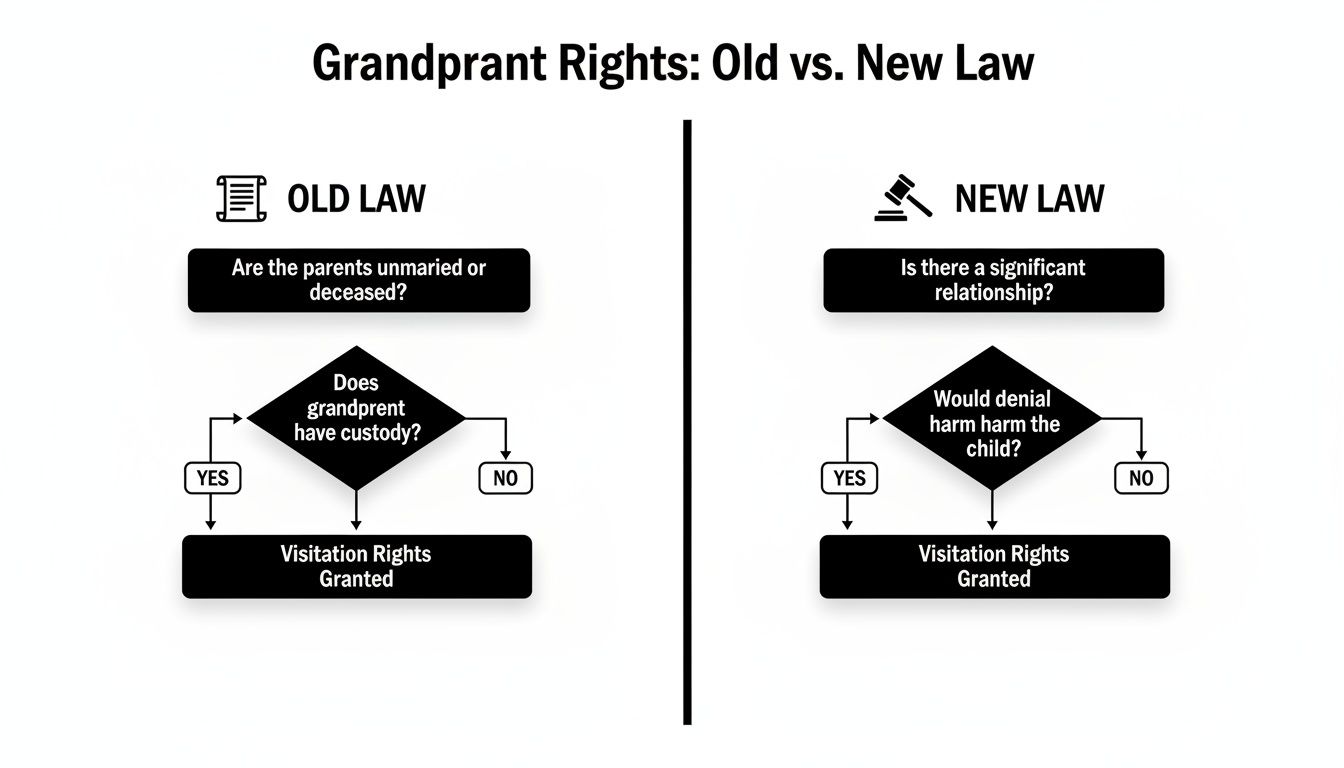
Seeing the different paths laid out can clarify your options and underscore just how important it is to understand every tool available before you act.
Kinship Adoption: Creating a Forever Family
Sometimes, it becomes painfully clear that a child can't safely return to their parents. In these heartbreaking situations, kinship adoption offers a permanent, loving, and legally secure solution. This is so much more than a legal arrangement; it’s about creating a brand-new, legally recognized parent-child relationship.
When you adopt your grandchild, you become their legal parent in every sense of the word. This path, outlined in Chapter 162 of the Texas Family Code, is often taken after a parent’s rights have been terminated by a court because of severe neglect, abuse, or abandonment.
Kinship adoption gives a child who has faced deep uncertainty the incredible gift of permanence. It officially transforms your role from caregiver to parent, guaranteeing your grandchild has a stable, loving foundation for the rest of their life.
This process solidifies your family bond and gives your grandchild an unshakable sense of belonging. It brings emotional peace and legal finality, allowing everyone to move forward with security. If you're considering this deeply rewarding path, you can find a wealth of information in our comprehensive guide on how to adopt your grandchild in Texas.
Mediation: A Collaborative Approach
Let’s be honest—sometimes, the conflict with a parent is rooted in misunderstandings, hurt feelings, or just plain poor communication. When that’s the case, mediation can be an incredibly powerful tool. It’s a structured process where you and the parent sit down with a neutral third party—the mediator—to talk through the issues and try to find a solution you can both live with.
The goal here isn't to "win." It’s to find common ground. Mediation creates a safe space for open conversation that can begin to repair strained relationships. A successful session often results in a written visitation agreement that can be filed with the court, making it legally enforceable without the pain and expense of a lawsuit. It puts the power back where it belongs: in your family’s hands.
Your Next Step in Protecting Your Grandchild
We know this whole journey is fueled by love and a deep-seated worry for your grandchild. Trying to make sense of **grandparent rights in Texas** can feel like you’re walking a tightrope alone. But as this guide has shown, while the law puts up some real hurdles, it also carves out clear paths for protecting the children who need it most.
The most important thing you can do is let the child's best interests be your compass for every decision. The second is to get an experienced legal guide who can help you make sense of the specific legal standards you’ll have to meet.
Taking Action with Confidence
You are not alone in this fight. Every single step—from gathering text messages and school records to deciding between guardianship and adoption—is a move toward building a stable, safe future for the child you love. As you think about all the ways to protect your grandchild’s future, it can also be helpful to look at long-term financial planning, and understanding trust funds can be a valuable part of that bigger picture.
The path forward requires courage, solid preparation, and a legal strategy that puts the child's well-being front and center. Your love is the foundation; let our experience be your guide.
We invite you to take that next step, not with fear, but with confidence. Schedule a free, confidential consultation with our compassionate legal team at The Law Office of Bryan Fagan, PLLC. Let’s sit down and talk about your family’s unique situation and figure out the best way to secure your grandchild's happiness. They are worth it.
Common Questions About Grandparent Rights
When you’re worried about seeing your grandchild, the legal system can feel overwhelming and confusing. The emotional weight of it all is heavy enough without trying to decipher complicated legal terms. Let’s clear up some of the most common questions we hear from grandparents like you.
Do I Automatically Get Visitation If My Child Gets Divorced?
No, unfortunately, it’s not that simple. In Texas, grandparent visitation is never automatic, even after a divorce. A judge won’t grant you visitation rights just because your child and their spouse have split up.
You still have to file a formal lawsuit and meet a very high legal bar: proving that denying you access would cause significant harm to your grandchild's emotional or physical well-being. Texas courts always start with the assumption that a fit parent knows what’s best for their child.
What Kind of Evidence Proves a Child Would Be Harmed Without Me?
This is the toughest hurdle for most grandparents. Proving "significant impairment" means showing a judge that you are more than just a loving, fun grandparent—you are a fundamentally stabilizing force in the child's life. You need to build a powerful case.
Strong evidence might include:
- Testimony from teachers, counselors, or therapists who can speak to the child’s deep, unique bond with you.
- Proof that you’ve acted as a primary caregiver, providing daily essentials like meals, homework help, and a safe place to stay.
- Documentation (like journals, emails, or witness statements) showing the child's noticeable distress or negative changes in behavior after you were cut off.
Your goal is to paint a clear, undeniable picture for the judge: that your relationship isn’t just a "nice-to-have," it's essential to the child's stability and happiness.
Can I Get Custody If the Parent Struggles with Addiction?
It's possible, but prepare for an uphill battle. To get custody, you must file a suit and prove that the parent's addiction has created an environment that actively endangers the child's physical health or emotional well-being.
This requires concrete evidence of direct harm. It’s not enough to show the parent has an addiction; you must show how that addiction leads to neglect, abuse, or exposure to dangerous situations. The court's number one priority is protecting the child from immediate and ongoing harm.
Your love for your grandchild is the most powerful motivation you have. If you're facing a difficult family situation and need to protect that precious bond, you don't have to figure it out alone. The compassionate team at The Law Office of Bryan Fagan, PLLC is here to listen. Schedule a free, confidential consultation with us today to discuss your family’s unique needs and explore your legal options. Visit us at https://texasfamilyadoption.com to take the first step.
