
Some grandparents never expected to be back at the school pickup line, helping with homework again, or keeping a spare change of clothes by the front door. But life changes fast. A short-term arrangement can slowly become the child’s everyday reality.
If that is where you are, you may already be doing the work of a parent without having the legal protection of one. You may be making doctor visits, school decisions, bedtime routines, and hard emotional calls while also trying to protect your grandchild from more instability. In many families, grandparent adoption texas is the legal step that turns that love and responsibility into lasting security.
The Heart of Grandparent Adoption in Texas
A grandmother may start by saying, “She’s just staying with me until things calm down.” A grandfather may tell himself, “I’m only helping for a little while.” Then months pass. The child begins calling that bedroom “my room.” Teachers call the grandparent first. The pediatrician asks who has authority to consent to treatment.
That is often the moment when a family realizes care is no longer temporary. It has become the child’s home.

Texas families are not alone in this. In Texas, 263,013 children were living in kinship households in 2023, and about 40 percent, or over 105,000 children, were living with grandparents, according to Every Texan’s discussion of kinship care in Texas. That means grandparents are not on the edge of the child welfare system. They are a central part of it.
Why adoption matters
Loving a child and raising a child are powerful. But legal adoption adds something important. It gives clarity.
With adoption, a grandparent can usually make the decisions a parent makes. That can include education, medical care, and long-term planning. It also gives the child a stronger sense of permanency. Instead of living in uncertainty, the child knows where home is.
For some families, another option like custody or guardianship may fit better for a time. If you are comparing those choices, this guide on legal rights for grandparents in Texas can help frame the differences.
The emotional layer families rarely talk about
Grandparent adoption is not just paperwork. It often means facing painful truths about your own child. You may feel grief, guilt, anger, protectiveness, and love all at once. That emotional mix is normal.
Key takeaway: Texas courts focus on the best interests of the child. If you have stepped in to provide safety, routine, and care, you are already acting from the place the court cares about most.
A grandparent adoption case is a legal process, but it begins with something very human. A child needs steadiness. A grandparent provides it. The law can help protect that bond.
Understanding Your Path to Legal Parenthood
Before any petition is filed, grandparents usually want to know one basic question. “Can I even qualify?” The answer depends less on having a perfect life and more on whether you can offer a safe, stable, and lasting home.
Texas courts are already familiar with grandparent caregivers. In Texas, 266,337 grandparents are financially responsible for their grandchildren, and over 70 percent of U.S. grandparents report caring for their grandchildren, according to this overview of grandparent adoption in Texas. The legal system does not treat your situation as unusual. Relative placement is often favored because family continuity matters to children.
What the court looks for
A judge and evaluator will usually focus on the same core questions.
- Safe home: The home does not need to be fancy. It needs to be stable, clean, and appropriate for a child.
- Financial stability: You do not need to be wealthy. The court usually wants to see that you can reliably meet the child’s basic needs.
- Physical and emotional readiness: Judges want to know whether you can handle the daily demands of parenting.
- Background check results: Some criminal history can create serious obstacles, especially if it involves violence, abuse, or crimes against children.
- Commitment to permanency: Adoption is not temporary care. It creates a lasting parent-child relationship.
What “financial stability” really means
This phrase confuses many grandparents. It does not mean you need a high income, a large house, or a perfect credit report.
It usually means you can show regular resources and practical planning. A pension, wages, retirement income, disability income, or support from a spouse may all matter. The key question is whether the child’s daily life will be stable.
For example, a retired grandmother living on fixed income may still be a strong adoptive parent if her housing is secure, her bills are manageable, and she has a realistic plan for school, food, transportation, and health care.
What screeners notice in a home setting
A home study or adoption evaluation is not a white-glove inspection. Evaluators are usually trying to understand how the child will live in your home day to day.
They may notice:
- Sleeping arrangements: Is there a reasonable plan for the child’s own space?
- Safety basics: Are medications, firearms, and hazards secured?
- Family relationships: Does the child seem comfortable with you?
- Routine: Can you describe school mornings, meals, bedtime, and discipline in a calm, consistent way?
If you have been caring for the child already, your ordinary routine may be one of your strongest points.
Adoption is not the same as guardianship
Some grandparents first consider a less permanent option. That can make sense, especially if parents may later become able to resume care. If you are trying to understand how a non-adoption arrangement differs from permanent parenthood, this overview of legal guardianship can help you think through how court-authorized caregiving works in a broader family context.
Still, adoption changes the legal relationship in a more permanent way. That is why courts examine readiness carefully.
A simple self-check
Ask yourself these questions:
- Can I provide day-to-day consistency for this child?
- Is my home safe and stable?
- Can I explain why adoption, not just temporary care, serves this child’s best interests?
- Am I prepared for background checks and a close look at my home life?
- If a parent objects, am I emotionally ready for that process?
Practical tip: Gather documents early. Grandparents often feel more confident once they have housing records, income records, medical information, and school documents in one folder.
If your answers are mostly yes, you may be closer than you think. A fuller look at kinship adoption in Texas can help you compare your situation to the broader relative adoption path.
Navigating the Texas Court System Step by Step
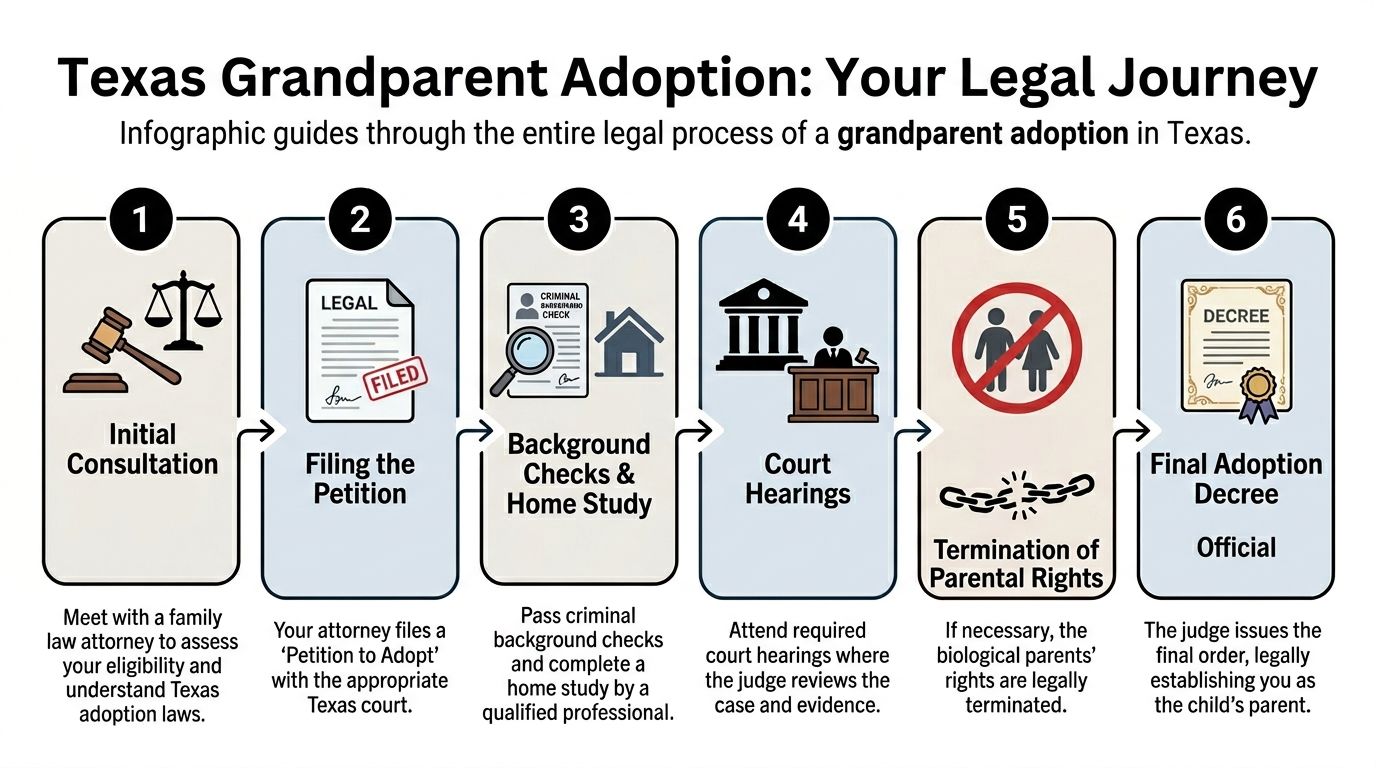
Most grandparents feel calmer once they can see the path in order. The legal process may still feel emotional, but it becomes less mysterious when you break it into stages.
A helpful visual can make that path easier to follow.
The first legal question is parental rights
In Texas, adoption usually begins with the issue no family wants to face. The child’s legal parents must either consent or have their rights terminated by court order.
According to this explanation of the steps to adopt a grandchild in Texas, the process begins with termination of parental rights, either voluntarily through an Affidavit of Relinquishment or by court order. That same source notes that after that come the adoption evaluation and the filing process, that children age 12 and older must consent, and that an uncontested grandparent adoption can often be finalized in 6 to 12 months.
A voluntary relinquishment is usually the smoother route. A parent signs legal documents giving up parental rights. Even when everyone agrees, the court still reviews the case carefully.
An involuntary termination is harder. The court must find legal grounds and also decide that termination serves the child’s best interests. Evidence matters here. The court will look closely at safety, stability, and the child’s needs.
Filing the case
Once the parental-rights issue is properly addressed, the legal paperwork moves forward. Grandparents often file an Original Petition in a Suit Affecting the Parent-Child Relationship, often shortened to SAPCR.
That term sounds intimidating, but in plain English it means you are asking the court to make legally binding decisions about the child. In an adoption matter, the petition tells the court who the child is, who the legal parents are, what orders are requested, and why adoption is in the child’s best interests.
Common supporting documents may include:
- Identity records: A birth certificate and information about the child’s legal parents.
- Residence proof: Records showing where the child has been living, such as school documents.
- Existing orders: Any prior custody, CPS, or family court orders.
- Consent forms: If a parent is agreeing, those documents must be prepared correctly.
The adoption evaluation
This stage is often called the home study, though some Texas cases use the term adoption evaluation. A qualified evaluator reviews whether the grandparent can provide a suitable home.
The evaluator may consider:
| What is reviewed | What it means in plain language |
|---|---|
| Age and health | Can you safely care for the child on a long-term basis? |
| Finances | Do you have a workable plan to meet the child’s needs? |
| Emotional readiness | Are you prepared for parenting and the emotional demands of adoption? |
| Home environment | Is the home safe, stable, and appropriate for a child? |
| Parenting skills | Can you describe discipline, routines, and daily care in a healthy way? |
Grandparents sometimes worry that the evaluator is looking for perfection. Usually, that is not the standard. The question is whether your home and your care meet the child’s needs.
Helpful reminder: If your grandchild already feels safe with you, that existing bond often matters. An evaluator is looking at lived reality, not a staged performance.
Some uncontested cases may allow limited waivers or a simpler path, but families should never assume that applies without legal advice.
A short video can also help families understand how adoption matters move through Texas courts.
The child’s voice
If the child is 12 or older, Texas generally requires the child’s consent to the adoption unless the court waives that requirement in the child’s best interests.
This can be an emotional moment. Some children feel relieved. Others feel conflicted because loving a grandparent does not erase complicated feelings about a parent. Courts understand that children can hold both emotions at once.
A grandparent usually helps most by avoiding pressure. A child does better when given room to speak openly.
The final hearing
At the final hearing, the judge reviews the full picture. That includes parental-rights issues, the evaluation, required paperwork, and the child’s needs.
In an uncontested case, the hearing is often straightforward. In a contested case, it may be much longer and require witness testimony, documents, and careful legal presentation.
The judge’s focus stays the same throughout. Does this adoption serve the child’s best interests?
A practical road map for grandparents
Many families feel steadier when they think of the process in this order:
- Talk with a family law attorney about the facts, especially parental rights and any CPS history.
- Address consent or termination before assuming adoption can proceed.
- Prepare the petition and documents carefully so the court has a complete record.
- Complete background checks and evaluation requirements openly and thoroughly.
- Support the child emotionally through interviews, waiting periods, and hearings.
- Attend the final hearing ready to show why adoption creates long-term stability.
The legal process can feel formal, but at its heart it asks a simple question. Who is providing this child with a safe, steady, permanent home? For many Texas families, the answer is the grandparent who has already been there all along.
When Families Agree and When They Don't
The biggest turning point in many grandparent adoption cases is not paperwork. It is whether the child’s parents agree.
When they do, the case often feels like a family trying to build order out of a painful situation. When they do not, the case can become one of the hardest experiences a grandparent will ever face, especially if the objecting parent is your own son or daughter.
When parents agree
An uncontested adoption usually means the parents cooperate with the legal process. They may sign the necessary documents, appear when required, and avoid fighting the case.
This does not make the situation easy emotionally. A mother may feel ashamed. A father may feel grief. A grandparent may feel torn between protecting the child and mourning what the parent could not do.
Still, cooperation usually helps the child most. It lowers conflict. It reduces uncertainty. It gives the court a clearer record.
A common example is a grandparent who has cared for a child for years while a parent struggles with long-term instability and decides adoption is the most responsible path. In those cases, the legal process still matters, but the emotional tone is often more about acceptance than battle.
When parents object
A contested adoption is different. A parent may refuse to sign. A parent may deny there is a problem. A parent may reappear after a long absence and challenge the case.
This path is heavier for everyone involved. The court will require evidence, not just family frustration. Grandparents usually need to show why adoption, and often termination of parental rights, is necessary for the child’s welfare.
That can mean presenting records, witness testimony, and a careful timeline of what the child has experienced. It may also mean reliving difficult family history in open court.
Important point: A contested case is not about proving you are the “better” grandparent. It is about proving that the legal standard for adoption and any needed termination has been met.
Side-by-side differences
| Factor | Uncontested Adoption (Parents Agree) | Contested Adoption (Parents Object) |
|---|---|---|
| Parental consent | Usually signed voluntarily | Usually disputed or refused |
| Court process | Simpler | More complex and evidence-heavy |
| Emotional tone | Cooperative, though still sad | Often tense and very personal |
| Evidence needs | Basic proof and required evaluations | Detailed proof, witness preparation, and stronger court presentation |
| Timeline | Often faster | Often longer because hearings and disputes can arise |
| Child stress | Usually lower when adults stay calm | Often higher if family conflict becomes visible |
| Legal risk | Lower if paperwork is complete | Higher because the judge must resolve disputed facts |
How grandparents can prepare for either path
In an agreed case, the main goal is care and precision. Documents should be accurate. Consent should be handled correctly. Everyone should understand what adoption changes permanently.
In a contested case, preparation usually needs to go deeper.
- Keep records: School notices, medical records, calendars, texts, and prior court orders may matter.
- Stay child-focused: Judges respond better to facts about the child’s needs than to anger at a parent.
- Avoid side battles: Family arguments about money, blame, or old resentments can distract from the legal issue.
- Protect the child from adult conflict: The child should not be your messenger or your witness coach.
The emotional truth many grandparents carry
Some of the most painful cases involve a grandparent who still loves the parent profoundly. You may be trying to protect your grandchild while also grieving your own child’s choices. That conflict does not make you weak. It makes you human.
Courts do not expect you to be free of emotion. They do expect a stable plan for the child.
If your family is split, it helps to remember that agreement is not always possible. Some cases move forward because adults work together. Others move forward because the child cannot wait any longer for adults to sort out old patterns.
Navigating CPS, Costs, and Unique Family Dynamics
Some grandparent adoptions follow a private family path. Others involve Child Protective Services, prior removals, or concerns about a grandparent’s age and health. Those cases often raise the hardest practical questions.
If CPS is involved
A CPS-related case usually feels different from a private family arrangement. There may already be court orders, caseworkers, service plans, and placement rules. Grandparents often become the most natural placement because the child already knows them and feels safer with family.
If your grandchild entered state care, your legal strategy needs to match that setting. Existing deadlines, court reviews, and agency requirements can affect what happens next. Families dealing with that process often benefit from targeted guidance on CPS adoption in Texas.
The Law Office of Bryan Fagan, PLLC handles adoption and guardianship matters in Texas, including relative and CPS-related cases, which can help families coordinate paperwork, hearings, and permanency planning in one place.
Costs and timing in real life
Grandparents often ask for a price and a date. Family law rarely works that neatly.
Costs depend on whether the case is agreed, whether parental rights are contested, whether CPS is involved, and how much court time the case requires. You may need to budget for filing fees, evaluation costs, background checks, document preparation, and attorney time.
Timing also varies. A smooth case moves very differently from a case with missing parents, emergency orders, or contested testimony.
That uncertainty can feel frustrating, especially when the child has already waited so long. But careful preparation often saves time later by avoiding delays from incomplete notice, missing records, or preventable mistakes.
Practical tip: Ask early for a written checklist of likely documents, deadlines, and decision points. Families cope better when they can see the next task, even if they cannot predict the exact finish date.
Older grandparents and age concerns

Age is one of the most sensitive topics in grandparent adoption texas. Many older grandparents worry that a judge or evaluator will assume they are too old.
According to this overview of grandparent adoption in Texas, grandparents over 60 represent a significant portion of kinship caregivers and may face extra scrutiny regarding health and longevity. That same source states that Texas courts rarely deny adoption based on age alone if stability is proven, and it notes a 2024 Texas Supreme Court case affirming that “advanced age” must not override the child’s best interests if a stable plan is in place.
How older grandparents can address concern directly
If age may become an issue, answer it with evidence and planning.
- Health records matter: If you are managing medical conditions well, clear documentation can help.
- Support systems help: Judges often want to know who could step in during an emergency.
- Long-term planning counts: A will, backup caregiver plan, and stable housing can show foresight.
- Daily function is important: Courts care about whether you can meet the child’s actual needs, not just your birth year.
A healthy, organized grandparent in later life may offer far more stability than a younger adult in chaos. The court’s job is to look at reality.
Family dynamics that complicate cases
Grandparent adoption sometimes brings hidden tensions to the surface. A sibling may accuse you of taking sides. Another relative may want placement too. A parent may swing between gratitude and anger.
In those moments, it helps to keep returning to the same question. What arrangement gives this child the safest and most stable future?
That question does not erase the family’s pain. But it gives the court, and often the grandparent, a clear place to stand.
Your Questions Answered and How to Get Help
Grandparents often carry a few urgent questions long after they understand the main process. These are some of the ones that come up most often.
Can I adopt if one parent is missing
Possibly, yes. But the court will expect proper notice and proof that legal requirements were followed. A missing parent does not automatically make adoption simple. It usually means the court must be satisfied that the parent was properly identified, located if possible, and legally addressed before finalization.
Does the child get a say
Yes. In Texas, a child who is age 12 or older generally must consent to the adoption unless the court waives that requirement in the child’s best interests. Even younger children may still have their feelings considered in practical ways through the evaluation and the court’s best-interest review.
What if I have been caring for my grandchild for a long time without legal papers
That history may matter a great deal. It can help show stability, bonding, and the child’s day-to-day reality. But it does not replace formal legal steps. Grandparents often assume long caregiving automatically gives them parental rights. It usually does not.
Is adoption always better than guardianship or custody
Not always. Adoption is permanent and changes the legal parent-child relationship. Some families need a temporary arrangement instead, especially when a parent may recover stability. The right choice depends on the child’s needs, the parent’s situation, and the long-term goal.
Will the court hold my age against me
Age alone is not usually the deciding factor. Courts look at health, planning, stability, and your ability to care for the child over time. If age may be raised, it should be addressed openly and with documentation rather than avoided.
What helps most before meeting a lawyer
Bring the story in order. That usually includes:
- Basic timeline: When the child came to live with you and why.
- Parent information: What each parent’s current role is.
- Court paperwork: Any prior family court or CPS orders.
- Child records: School, medical, or counseling records if available.
- Your questions: Write them down. Families remember more when they do.
Takeaway: You do not need to solve the case before asking for help. You only need enough information to start the right conversation.
Grandparent adoption is about more than legal status. It is about giving a child a dependable home and giving you the authority to protect that home. For many grandparents, the process also brings something quieter but just as important. Relief. The relief of knowing the child’s future is not hanging by a thread.
If you are considering adoption, custody, or another permanency option for your grandchild, Law Office of Bryan Fagan, PLLC offers free consultations for Texas families. A confidential conversation can help you understand your options, the likely next steps, and how to protect your grandchild’s stability with a plan suited to your family.
